The Indian Navy is preparing Sea Vigil-26, the Navy-coordinated coastal-defence exercise that checks how the Navy, the Coast Guard, marine police, fishermen and other agencies guard India's coastline together. The exercise was first held in 2019, about ten years after the 26/11 attacks. Behind every such watch sit machines that find things they cannot see: radar that tracks aircraft and ships over the horizon, and sonar that hunts submarines below it. Both are one idea, the echo. Our page on sound waves and echo covers the basic formula 2d = vt. This article goes one step further: why each device uses the wave it does, the numericals that follow, and where UPSC sets traps.
Same Idea, Different Waves: Why Sonar Uses Sound and Radar Uses Radio
By Abhishek Thakur · Science faculty, The Cavalier · 15 years teaching NDA and CDS Science
Every echo system does the same three things. It sends a short pulse, waits for the pulse to bounce off a target, and turns the waiting time into a distance: distance = (speed × time) ÷ 2. What changes is the wave, and the choice is forced by the medium.
| Sonar | Radar | |
|---|---|---|
| Full form | SOund Navigation And Ranging | RAdio Detection And Ranging |
| Wave | Ultrasonic sound (a mechanical, longitudinal wave) | Radio waves and microwaves (an electromagnetic, transverse wave) |
| Speed | About 1,500 m/s in sea water | 3 × 10⁸ m/s, the speed of light |
| Works in | Water (and air, poorly) | Air and vacuum; fails underwater |
| Typical job | Depth, submarines, mines, wrecks, fish shoals | Aircraft, ships, missiles, rain clouds, speed guns |
Water is the reason. Light and radio waves are absorbed within a short distance of sea water, so a microwave radar cannot see a submarine just under the surface. Sound does the reverse. It travels far in water and loses little energy, because water is far harder to compress than air. In air, however, sound is slow and fades quickly, and radio is the only wave fast enough for the sky.
An aircraft is 150 km away. Compare the echo time using radar and using sound in air (340 m/s).
A radar sends 1,000 pulses a second (pulse repetition frequency, PRF). What is the greatest range it can read without confusion?
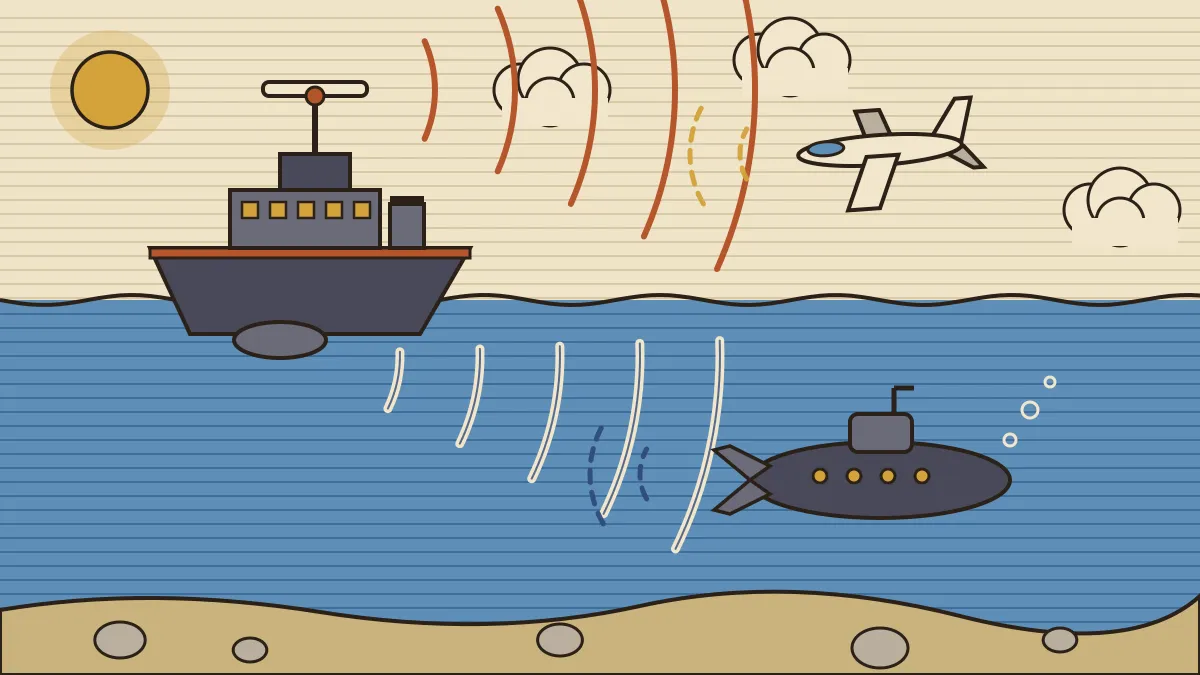
Sonar: How the Sea Is Searched
The first practical echo-ranging device was built by the French physicist Paul Langevin and his colleagues during the First World War to hunt submarines. A modern sonar uses a transducer that converts electrical pulses into ultrasonic pulses, and converts the returning echo back into an electrical signal. There are two ways to use it.
| Active sonar | Passive sonar | |
|---|---|---|
| How it works | Sends a ping and times the echo | Only listens for noise made by the target |
| Gives | Range and bearing | Bearing and the target's sound signature, not range directly |
| Risk | The ping tells the enemy that you are there | Silent, so it gives nothing away |
| Used for | Echo sounders, seabed mapping, hunting a located submarine | Quiet tracking of submarines |
Frequency is a trade-off. A high-frequency ping has a short wavelength, so it shows fine detail, as in mapping a seabed or finding a mine. But water absorbs high frequencies faster, so the range is short. A low-frequency ping travels much farther but sees less detail. Search sonars therefore choose the frequency to suit the job.
A pulse lasts 10 ms. Two objects close together return one merged echo if they are nearer than half the pulse length. Find that distance (v = 1,500 m/s).
The speed of sound in sea water is not constant. It rises with temperature, salinity and depth (pressure), so sound bends as it passes through layers. A submarine can hide below a sharp temperature layer where the sound bends away. At about a kilometre down there is a layer where the speed is least, and sound can be trapped there and carried for thousands of kilometres. That is the deep sound channel, which lets low-frequency sounds, including whale calls, travel very far.
India's navy builds this capability at home. On 12 October 2026 it commissioned INS Mangrol, the third of eight Mahe-class anti-submarine shallow-water craft, built by Cochin Shipyard with over 80 per cent indigenous content. These ships carry sonar for coastal waters, where sound reflects off the shallow seabed and confuses echoes. Our article on INS Malvan and anti-submarine warfare explains the roles in more detail.
1. Sonar uses ultrasonic waves. Infrasonic and audible sound are wrong options (NDA 2022-II). 2. The time given is the round trip, so halve it. 3. Sonar needs a medium, so it is useless in space. 4. Sound is faster in sea water than in fresh water, because of the salt, and much faster than in air.
Radar: Echo With Microwaves, and Speed From the Doppler Shift
Radar was developed in the 1930s, notably in Britain, to spot aircraft before they arrived. A transmitter sends microwave pulses through a rotating or steered antenna, and the same antenna listens for the echo. Metal, rain drops and the ground all reflect microwaves. Weather radars use the S, C and X bands (roughly 2-4, 4-8 and 8-12 GHz).
The wave tells you more than distance. The Doppler effect is the change in the observed frequency when the source and the observer move relative to each other. A train whistle sounds higher as the train approaches and lower as it leaves. A radar echo from an approaching target comes back at a slightly higher frequency, and the shift measures the target's speed.
A 10 GHz radar sees an echo shifted by 10 kHz. How fast is the target approaching? (Radar shift: Δf = 2vf ÷ c)
The shift depends only on the part of the motion along the beam. An aircraft flying across the beam at constant range gives almost no shift. Pilots exploit this by flying across a radar's line of sight, and radar designers answer by combining several radars.
India's Doppler weather radars use the same principle on raindrops. The Ministry of Earth Sciences inaugurated the 51st Doppler Weather Radar at Sambalpur, Odisha, on 17 September 2026, up from 14 in 2014, with about 40 more planned under Mission Mausam. They watch the movement of rain and wind inside storms, and give early warning of cyclones and thunderstorms. See our NDA article on the radars that watch India's weather. For radio waves and the rest of the spectrum, see our page on electromagnetic waves.
Stealth is the art of returning a weak echo. A target's radar cross-section is how big it looks to radar. Designers reduce it in two ways: angled flat surfaces that bounce the beam away from the radar instead of back, and radar-absorbent coatings that soak up the energy. Stealth does not make an aircraft invisible. It only shrinks the range at which radar sees it, and it does nothing against sound or heat. A stealth frigate is still heard by sonar and seen in infrared, and a submarine hides by being quiet in sound.
Living Sonar: Bats and Dolphins
Nature built the echo machine long before humans did. Most bats find their way and their insect prey in the dark by emitting short bursts of ultrasound, often between about 20 kHz and over 100 kHz, from the mouth or nose, and listening for the echoes. Bats are not blind. Their sound is above the human range, so we hear almost nothing. At 50 kHz the wavelength in air is 340 ÷ 50,000 ≈ 7 mm, small enough to be reflected by a moth. As the bat closes in, its pulses come faster and faster, and the timing of each echo gives it the distance. Toothed whales and dolphins do the same in water with clicks, which are focused by a fatty organ in the forehead (the melon) and received through the lower jaw. Some cave-dwelling birds, such as swiftlets, also use audible clicks to navigate caves.
| SONAR | Ultrasound scan | Echolocation | |
|---|---|---|---|
| Medium | Sea water | Body tissue | Air (bats) or water (dolphins) |
| Frequency | A few kHz to hundreds of kHz | Millions of Hz (MHz) | 20 kHz to over 100 kHz |
| Purpose | Depth, submarines | Imaging organs, a foetus | Navigation and hunting |
| Principle | Echo of an ultrasonic pulse, timed to give distance | ||
Sonar = ultrasound echo in water. Radar = microwave echo in air. Echolocation = a living sonar. Doppler = shift in frequency gives speed along the line of sight. Stealth = small radar echo, not invisibility.
How UPSC Has Asked It: Past Papers Solved
Questions on this topic are short: a numerical that needs the factor of 2, or a statement about which wave a device uses.
An echo is heard after 5 seconds of the production of sound which moves with a speed of 340 m/s. What is the distance of the mountain from the source of sound which produced the echo?
(a) 0.085 km (b) 0.85 km (c) 0.17 km (d) 1.7 km
Answer: (b). Round trip: 340 × 5 = 1,700 m, so the mountain is 1,700 ÷ 2 = 850 m = 0.85 km away. The tempting wrong option is (d), 1.7 km, which forgets to halve.
SONAR is a device that is used to measure the distance of underwater objects by a ship. Which of the following types of waves does it use for this purpose?
(a) Infrasonic waves (b) Sound waves in audible range for human beings (c) Ultrasonic waves (d) All of the above
Answer: (c). Ultrasound has a short wavelength, so it travels in a narrow beam and resolves small targets. Infrasound has very long wavelengths and cannot be focused.
Which one of the following statements about X-rays is not true?
(a) They have wavelengths of about 1 Å. (b) These can be generated by bombarding a metal target by high energy electrons. (c) Due to their wavelengths being shorter, these can be used for radar systems. (d) These are also used for the treatment of certain forms of cancer.
Answer: (c). Radar uses microwaves and radio waves. X-rays are not used for radar. The other three statements are true.
At 20°C, the speed of sound in water is approximately
(a) 330 m/s (b) 800 m/s (c) 1500 m/s (d) 5000 m/s
Answer: (c). It is about 1,480 m/s in fresh water. 330 m/s is air, and 5,000 m/s is closer to steel or glass.
In which one among the following mediums would the speed of sound be maximum?
(a) Distilled water (b) Sea water (c) Drinking water (d) Methanol
Answer: (b). Dissolved salt makes the water slightly stiffer, so sound goes a little faster in sea water than in fresh water. Methanol is slower, at about 1,100 m/s.
Compared to audible sound waves, ultrasound waves have
(a) higher speed. (b) higher frequency. (c) longer wavelength. (d) both higher speed and frequency.
Answer: (b). In a given medium all sound travels at the same speed, so higher frequency means shorter wavelength, not higher speed. That is why (a) and (d) fail.
Numericals always hide the round trip: the data is the to-and-fro time, and the answer is half of v × t. Concept questions test which wave goes with which device, and whether the speed depends on frequency (it does not).
Practice MCQs (with answers)
- A radar echo returns from a ship after 0.0002 s. How far is the ship?
- 3 km
- 6 km
- 30 km
- 60 km
- A sonar pulse takes 8 s to return from the seabed (speed of sound in water 1,500 m/s). The depth is
- 3 km
- 6 km
- 12 km
- 24 km
- Radar cannot be used to find a submerged submarine mainly because
- radio waves are absorbed quickly by sea water
- radio waves are too slow
- submarines are too small
- radio waves are longitudinal
- A radar with a pulse repetition frequency of 500 per second can read a maximum range of
- 150 km
- 200 km
- 300 km
- 600 km
- A passive sonar
- sends ultrasonic pulses
- sends microwaves
- measures range with a radio echo
- only listens to sounds from the target
- Bats find their way in the dark by emitting
- infrasound
- audible sound
- infrared waves
- ultrasound
- A target moving at right angles to the radar beam at a constant distance gives
- almost no Doppler shift
- the maximum Doppler shift
- a negative range
- a shorter pulse
- Stealth technology reduces the
- weight of an aircraft
- radar cross-section of the target
- speed of sound in air
- frequency of the sonar
1-c, 2-b, 3-a, 4-c, 5-d, 6-d, 7-a, 8-b. Q1: d = (3 × 10⁸ × 0.0002) ÷ 2 = 30,000 m. Q2: d = 1500 × 8 ÷ 2 = 6,000 m. Q4: range = 3 × 10⁸ ÷ (2 × 500) = 300,000 m. Q7: Doppler measures only the speed along the line of sight, so a crossing target gives almost none.
Quick Revision
- All echo systems: d = v × t ÷ 2. Sonar: ultrasound, about 1,500 m/s in sea water. Radar: microwaves, 3 × 10⁸ m/s. Radio is absorbed by sea water; sound goes far in water.
- Active sonar pings and gives range; passive sonar listens and stays silent. High frequency gives detail but short range.
- Maximum radar range = c ÷ (2 × PRF). Resolution = (pulse length) ÷ 2.
- Doppler: Δf = 2vf ÷ c for radar; only the motion along the beam counts. Weather radar tracks rain and wind.
- Bats (20 kHz to over 100 kHz) and dolphins (clicks) are living sonar. Bats are not blind.
- Stealth lowers radar cross-section by shape and absorbent coatings. It does not hide against sound or heat.
- India: INS Mangrol (12 Oct 2026), third of eight Mahe-class ASW shallow-water craft; 51st Doppler Weather Radar at Sambalpur (17 Sep 2026).
Frequently asked questions
What is the difference between radar and sonar?
Radar sends radio waves or microwaves and works in air and space, while sonar sends ultrasonic sound and works in water. Both time an echo to find distance. Radar waves travel at the speed of light, and sound in sea water travels at about 1,500 metres per second.
Why can radar not detect submarines underwater?
Sea water absorbs radio waves and microwaves within a short distance, so the radar pulse never reaches a submerged submarine. Sound travels far through water, which is why navies use sonar instead.
How do bats find their way in the dark?
Bats emit short bursts of ultrasound and listen for the echoes that bounce back from obstacles and insects. The delay of each echo tells them the distance. Bats are not blind, but their echolocation lets them hunt in complete darkness.
What is the Doppler effect and how does radar use it?
The Doppler effect is the change in the observed frequency when the source and the observer move relative to each other. Radar measures the shift in the frequency of the returning echo to find how fast the target is moving towards or away from it. Weather radars use the same method on raindrops.
Does stealth technology make an aircraft invisible to radar?
No. Stealth lowers the radar cross-section by using angled surfaces and radar-absorbing coatings, so radar detects the target only at a shorter range. It does not hide the target from sonar, infrared sensors or the human eye.
Related CDS / OTA Science topics
Science is a third of the CDS GS paper
Cavalier's CDS/OTA batches teach physics, chemistry and biology from first principles, with numericals and weekly PYQ tests.