On 19 November 2026 the Department of Telecommunications handed Letters of Intent to 25 companies that will set up units in the Telecom Manufacturing Zone at Gwalior, and announced Phase-II of the project. The zone covers about 170 acres and is meant to make telecom equipment, components, software and optical fibre inside India. Behind that factory floor sits a single school-level idea: when light tries to leave glass at a steep enough angle, it cannot, and bounces back inside. That is total internal reflection. UPSC asks about it almost every year, from the diamond to the mirage to the fibre.
The Two Conditions and the Critical Angle
By Abhishek Thakur · Science faculty, The Cavalier · 15 years teaching NDA and CDS Science
Start with ordinary refraction (see our refraction page). When a ray goes from a denser medium (higher refractive index) into a rarer one, it bends away from the normal. Increase the angle of incidence and the refracted ray bends further, until it just skims the boundary at 90°. That angle of incidence is the critical angle ic. Beyond it no refracted ray can exist, and all the light returns into the denser medium.
1. Light must travel from a denser to a rarer medium (glass to air, water to air, diamond to air). 2. The angle of incidence must be greater than the critical angle. Either one alone is not enough. Light going from air into glass can never be totally reflected, at any angle.
At the critical angle, Snell's law gives a neat result. For a medium of refractive index n against air:
A bigger n means a smaller critical angle, so a highly refracting material traps light more easily. The values worth remembering:
| Medium | Refractive index (n) | Critical angle (with air) |
|---|---|---|
| Water | 1.33 | about 48.8° |
| Crown glass | 1.52 | about 41.1° |
| Dense flint glass | 1.62 | about 38.1° |
| Diamond | 2.42 | about 24.4° |
A silvered mirror absorbs part of the light. Total internal reflection returns all of it, with no coating to tarnish, which is why engineers use it wherever light must be guided with little loss.
An option saying total reflection occurs at "any angle" from denser to rarer is wrong: the angle must exceed the critical angle. NDA 2026-II tested exactly this.
Diamond, Prisms and the Mirage
Diamond. Its refractive index of 2.42 gives a critical angle of only 24.4°. Light entering a cut diamond meets the inner faces at larger angles, so it is reflected again and again and leaves mostly through the top. Glass, with a critical angle near 41°, loses far more light through its back faces and looks duller.
Prisms that replace mirrors. A right-angled isosceles glass prism has two angles of 45°. A ray entering one short face along the normal travels straight on and strikes the long face (the hypotenuse) at 45°. Since the critical angle of glass (about 41.8° for n = 1.5) is less than 45°, the ray is totally reflected and turns through 90°. Let the ray enter the hypotenuse instead and it can be turned through 180° by two such reflections, or inverted without changing its size. Binoculars and submarine periscopes use these prisms, and so does the reflector on a bicycle, which sends light straight back to its source.
The mirage. On a hot summer day the layer of air just above a tar road is much hotter, and therefore rarer, than the air above it. Light from the sky travelling downward passes from denser air into ever-rarer layers and bends away from the normal at each step. At some layer its angle of incidence exceeds the critical angle and it is turned back upward. To the eye the sky seems to lie on the road, shimmering like a pool of water. This is why the correct answer to "mirage is an illustration of" is both refraction and total internal reflection, not reflection alone.
The Sun is visible for about two minutes before it actually rises and after it sets. That is atmospheric refraction: air gets denser towards the ground and bends sunlight over the horizon. No total internal reflection is involved. For the colours of a rainbow or a prism see our page on dispersion; for why the sky is blue and the Sun red at sunset see scattering of light.
Seeing out of water. A fish near the bottom of a calm lake sees the whole sky squeezed into a circular patch overhead. The edge of that patch is set by the critical angle of water, about 48.8°; outside it the fish sees only a mirror image of the lake bottom.
Inside an Optical Fibre
An optical fibre is a hair-thin strand of very pure silica glass (or sometimes plastic) built in two layers. The inner core has a slightly higher refractive index than the outer cladding. A pulse of light sent into one end strikes the core–cladding boundary at a shallow angle, so it is denser-to-rarer and above the critical angle. It is totally reflected, strikes the opposite wall, is reflected again, and zigzags down the strand. Because nothing leaks out at each bounce, the signal loses very little strength, and the fibre can be bent into curves without losing the light.
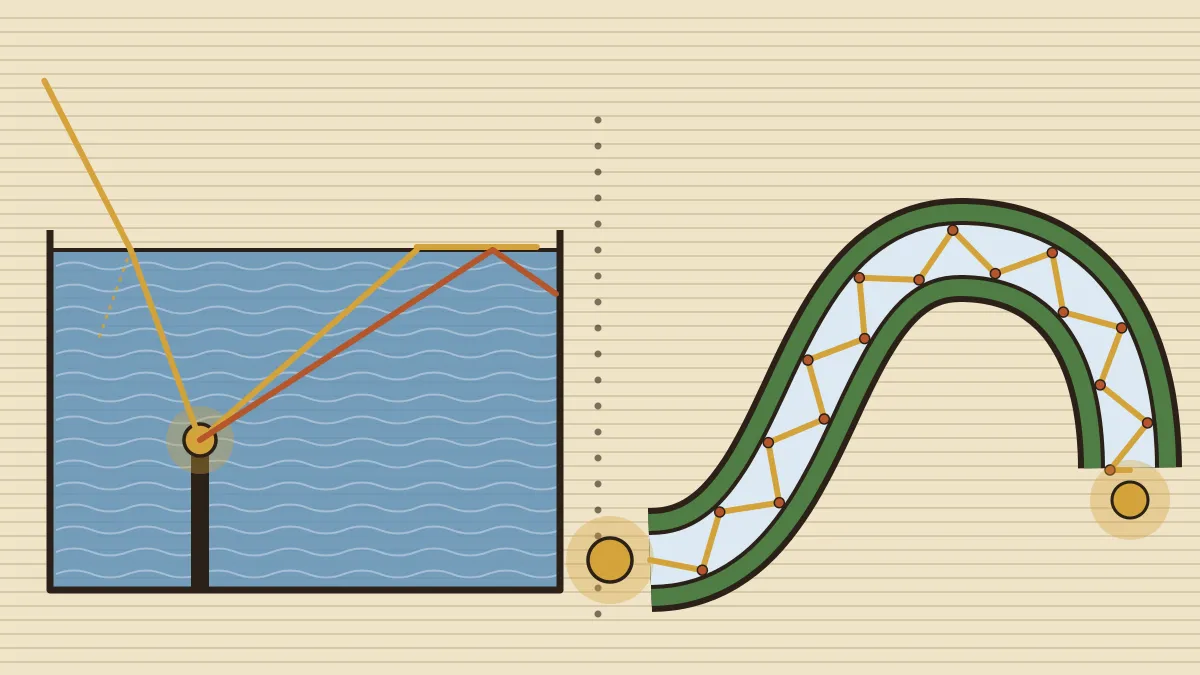
| Part | What it is | Why it matters |
|---|---|---|
| Core | The glass thread that carries the light; only about 9 micrometres across in long-distance single-mode fibre, and 50 to 62.5 micrometres in multi-mode fibre | Higher refractive index than the cladding, so rays inside are trapped |
| Cladding | Glass layer around the core, typically 125 micrometres across in total | Lower refractive index; makes the boundary where total reflection happens |
Why not just use copper? A fibre carries far more information because light has a vastly higher frequency than the electrical signals in a wire. The silica glass is so clear that modern fibre loses only a fraction of a decibel per kilometre at wavelengths in the infrared, around 1,550 nanometres (see our page on the electromagnetic spectrum). Light signals are also unaffected by electrical interference or lightning, produce no sparks, and the cable is light and cheap per unit of data. Its drawbacks are fragility and the skill needed to join two ends cleanly.
The people. The Indian-born physicist Narinder Singh Kapany guided light through glass-fibre bundles in the 1950s and coined the term fibre optics. In 1966 Charles Kao showed that glass lost light mainly through impurities, so purer glass could carry signals over long distances. Kao received half of the 2009 Nobel Prize in Physics. Kapany never won a Nobel Prize, a common quiz mix-up.
Where fibres are used.
- Communication. Telephone, broadband and TV networks, including the submarine cables that carry most of the world's intercontinental internet traffic. The Chennai-Andaman and Nicobar Islands undersea optical fibre cable was inaugurated on 10 August 2020. On land, BharatNet is taking fibre to gram panchayats; see our article on Digital Bharat Nidhi and BharatNet.
- Medicine. The endoscope is a fibre bundle used as a "light pipe": one set carries light into the stomach or intestine, another carries the image out.
- Defence and industry. Fibre-optic cables link radar and command posts with no electromagnetic signature, and fibre sensors measure strain in bridges and aircraft wings.
Light in glass of index 1.5 travels at 2 × 10⁸ m/s, two-thirds of its vacuum speed. A signal in fibre takes about 5 milliseconds to cover 1,000 km.
Three Numericals, Worked Out
Find the critical angle for glass of refractive index 1.5 with air outside.
A small lamp sits at the bottom of a pool 2 m deep, filled with water of refractive index 4/3. What is the radius of the lit circle on the surface?
A fibre has a core of n = 1.50 and a cladding of n = 1.45. (a) What is the critical angle at the boundary? (b) What is the largest angle, measured from the axis, at which a ray from air can enter and still be guided?
How UPSC Has Asked It: Past Papers Solved
Questions are either a one-line "which phenomenon", a statement on the conditions, or a numerical on refractive index or apparent depth.
Light rays move in straight lines. But through an optical fibre, they can move in any type of zigzag path because
(a) the holes through the fibre are extremely fine. (b) light rays are absorbed at the entry end and relieved at the exit end of the fibre. (c) scattering of light occurs inside the fibre. (d) successive total internal reflections occur as a ray moves through the fibre.
Answer: (d). The ray is reflected each time it reaches the core–cladding boundary. Option (c) is tempting but backwards: scattering is what engineers work to reduce, since it makes the signal weaker.
Mirage is an illustration of
(a) only dispersion of light. (b) only reflection of light. (c) only total internal reflection of light. (d) both refraction and total internal reflection of light.
Answer: (d). The rays first bend through the layers of air of changing density (refraction) and are then turned back at the critical angle (total internal reflection). The word "only" removes (a), (b) and (c).
Which of the following is correct regarding the total internal reflection at the interface between two different optical media?
(a) It can occur only if light is passing at any angle from a medium of low refractive index to a medium of high refractive index. (b) It can occur only if light is passing from a medium of high refractive index to a medium of low refractive index and at an angle greater than the critical angle. (c) It can occur only if light is passing at any angle from a medium of high refractive index to a medium of low refractive index. (d) It can occur only if light is passing from a medium of low refractive index to a medium of high refractive index and at an angle greater than the critical angle.
Answer: (b). Both conditions are stated. Option (c) has the right direction but drops the critical-angle condition ("any angle"), and (a) and (d) reverse the direction.
A fish is at a depth d in water of refractive index 4/3. If a transparent slab of refractive index 3/2 and thickness d/2 is placed on the surface of water, then which one of the following is the apparent depth of the fish observed by an observer in air?
(a) d/2 (b) 5d/8 (c) 13d/12 (d) 17d/24
Answer: (c). Add the apparent thickness of each layer: (d/2) ÷ (3/2) + d ÷ (4/3) = d/3 + 3d/4 = 13d/12. The tempting wrong choice (b) multiplies by the indices instead of dividing.
Which one of the following is the natural phenomenon based on which a simple periscope works?
(a) Reflection of light (b) Refraction of light (c) Dispersion of light (d) Total internal reflection of light
Answer: (a). The word "simple" matters: a simple periscope is two plane mirrors set at 45°. Periscopes in submarines and binoculars that use right-angled prisms do depend on total internal reflection, which is the tempting wrong answer here.
Match phenomenon to cause: optical fibre, diamond, mirage and prism go with total internal reflection; early sunrise and the bent straw go with plain refraction; the rainbow goes with dispersion. When an option contains "only" or "any angle", test it against the two conditions.
Practice MCQs (with answers)
- Total internal reflection can take place when light travels from
- air into water
- water into glass of index 1.5
- glass into air at an angle larger than the critical angle
- vacuum into diamond
- A cut diamond sparkles mainly because
- its high refractive index gives a small critical angle, so light is totally reflected repeatedly inside it
- it absorbs light and re-emits it as heat
- its refractive index is lower than that of glass
- it polarises the light that falls on it
- In an optical fibre the core, compared with the cladding, has
- a lower refractive index
- a higher refractive index
- the same refractive index
- a refractive index equal to that of air
- The refractive index of a medium with respect to air is √2. Its critical angle is
- 30°
- 60°
- 90°
- 45°
- A road looks wet on a hot summer afternoon because
- air next to the road is hot and rare, so light from the sky is turned back upward by total internal reflection
- water vapour collects on the road
- sunlight is dispersed into colours by the road
- the road polarises the light
- A fish at the bottom of a lake looks up at the surface. It can see the outside world through a circle whose edge corresponds to
- an angle of 0°
- an angle of 90°
- an angle of 24°
- the critical angle of water, about 49°
- A ray enters one short face of a right-angled isosceles glass prism (n = 1.5) along the normal and meets the long face. It will
- pass out through the long face without a change in direction
- be split into a spectrum
- be totally reflected and turned through 90°
- be absorbed by the glass
- Half of the 2009 Nobel Prize in Physics, for the development of low-loss optical fibre, went to
- Narinder Singh Kapany
- Charles Kao
- C. V. Raman
- S. Chandrasekhar
1-c, 2-a, 3-b, 4-d, 5-a, 6-d, 7-c, 8-b. Q1: only denser to rarer qualifies, and the angle must also exceed ic. Q4: sin ic = 1/√2, so ic = 45°. Q6: the edge of the fish's "window" is the critical angle. Q7: the ray meets the long face at 45°, which is more than glass's critical angle of 41.8°. Q8: Kapany coined "fibre optics" but did not win a Nobel Prize.
Quick Revision
- Total internal reflection needs (1) denser to rarer and (2) angle of incidence > critical angle.
- sin ic = 1/n (with air). Higher n gives a smaller critical angle. Water 48.8°, crown glass 41.1°, diamond 24.4°. Critical angle for n = √2 is 45°.
- Diamond sparkles by multiple total reflections. A right-angled glass prism turns light by 90° or 180° because glass's critical angle (41.8°) is under 45°.
- Mirage = refraction + total internal reflection (hot, rare air near the ground). Early sunrise, twinkling = atmospheric refraction only; the Sun is seen about two minutes early.
- Optical fibre: core (higher n) + cladding (lower n); signal zigzags by total internal reflection; low loss near 1,550 nm; no electrical interference. Uses: telecom, submarine cables, endoscope.
- v = c/n (glass: 2 × 10⁸ m/s). Apparent depth = real depth ÷ n; for layers, add thickness ÷ n.
- Kapany coined "fibre optics"; Charles Kao got half of the 2009 Physics Nobel. Telecom Manufacturing Zone, Gwalior: 170 acres, 25 LoIs on 19 Nov 2026.
Frequently asked questions
What is total internal reflection?
Total internal reflection is the complete return of light into a denser medium when it meets a rarer medium at an angle larger than the critical angle. No light is refracted out.
How do you find the critical angle?
For light going from a medium of refractive index n into air, the sine of the critical angle is 1 divided by n. For glass of index 1.5 this gives about 41.8 degrees, and for water of index 1.33 about 48.8 degrees. A higher refractive index means a smaller critical angle.
How does an optical fibre carry light?
An optical fibre has a glass core surrounded by cladding of lower refractive index. Light entering the core meets the boundary above the critical angle and is totally reflected again and again, so it zigzags along the fibre with very little loss, even when the fibre is bent.
Why is a mirage an example of both refraction and total internal reflection?
Hot, rare air near the ground bends light from the sky by refraction, and at some layer the light meets the next one beyond the critical angle and is reflected upward. The eye sees an image of the sky on the road, which looks like water.
Why do diamonds sparkle more than glass?
Diamond has a refractive index of 2.42 and a critical angle of only about 24.4 degrees, so light inside is totally reflected many times before it escapes through the top. Glass, at about 41 degrees, loses more light through its back faces.
Related CDS / OTA Science topics
Science is a third of the CDS GS paper
Cavalier's CDS/OTA batches teach physics, chemistry and biology from first principles, with numericals and weekly PYQ tests.