C.V. Raman was born on 7 November 1888 in Tiruchirappalli, and 7 November 2026 is his 138th birth anniversary. India also honours him on National Science Day, observed on 28 February since 1987. It marks the day in 1928 when Raman and his student K.S. Krishnan first saw the spectral lines of a new kind of scattered light, the discovery that won Raman the 1930 Nobel Prize in Physics. It began with a question about why the sea is blue. Scattering also explains the blue sky, red sunsets, white clouds and the Tyndall effect, and UPSC asks about them every year or two.
What Scattering Is, and the 1/λ⁴ Law
When light falls on a molecule or a tiny particle, its electric field makes the particle's electrons vibrate, and they send out light of their own in all directions. This is scattering. Refraction bends a beam but keeps it a beam; scattering sprays part of it sideways, which is why a sunbeam in a dusty room is visible from the side.
The colour scattered depends on particle size compared with wavelength (visible light: about 400 nm violet to 700 nm red).
- Far smaller than the wavelength, like nitrogen and oxygen molecules (under 1 nm): Rayleigh scattering, which strongly favours short wavelengths.
- About the wavelength or larger, like cloud droplets, dust and smoke: Mie scattering, which treats all colours almost alike.
- Rayleigh, Mie and Tyndall scattering are elastic: the frequency does not change. Raman scattering is inelastic: it does.
Lord Rayleigh showed in 1871 that for very small scatterers, the scattered intensity varies as the inverse fourth power of the wavelength.
How much more strongly does air scatter blue light (450 nm) than red light (700 nm)? What about violet (400 nm)?
Sunlight contains less violet than blue, and our eyes are far less sensitive to violet, so the mix looks sky blue.
Blue Sky, Red Sunset, Black Space
Each of these is Rayleigh scattering plus one extra idea, usually how much air the light has crossed.
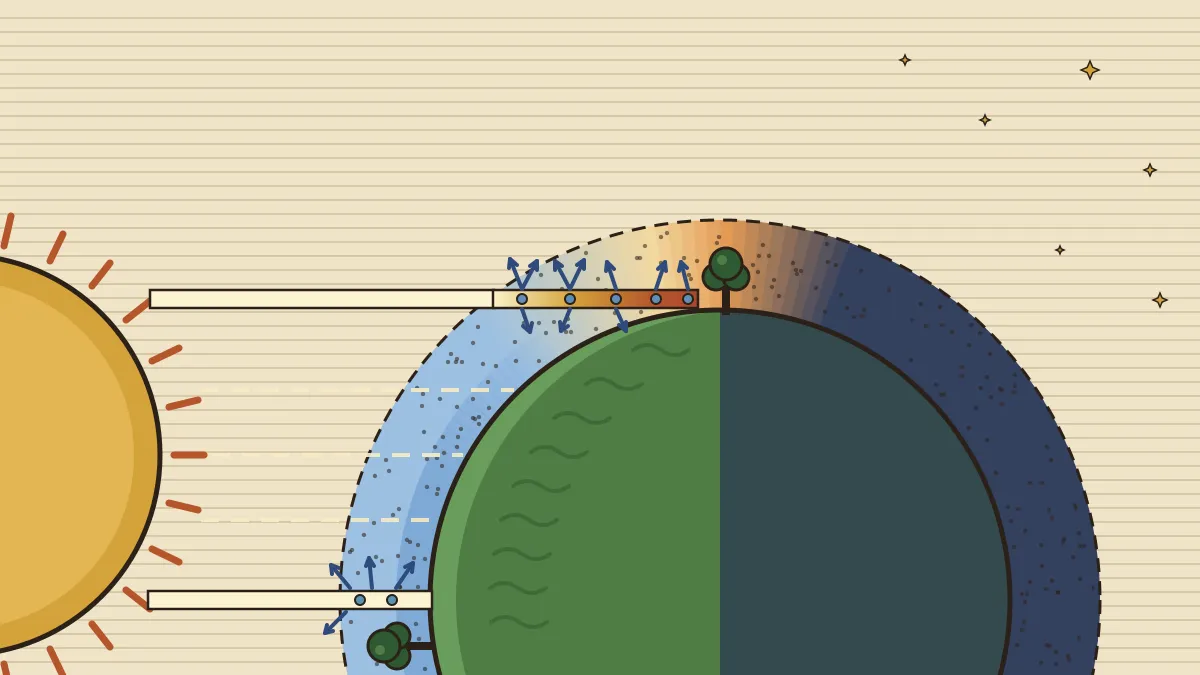
- Blue sky. Air molecules scatter blue out of the sunbeam in every direction, so blue reaches the eye from all over the sky.
- Nearly white Sun at noon. Overhead sunlight crosses the least air, so little blue is lost.
- Red Sun at sunrise and sunset. Near the horizon, sunlight crosses about 38 times as much air as from overhead. Most of the blue and much of the green is scattered out on the way, and the light that comes straight through is orange-red.
- Red danger signals. Red is scattered least by air, fog and smoke, so a red lamp is seen from the greatest distance.
- Black sky in space. With no atmosphere, nothing scatters sunlight towards the eye, so the sky is black even in full sunshine, for astronauts and on the Moon. At very high altitudes the sky looks darker for the same reason.
Add a little sulphuric acid to sodium thiosulphate solution in a tank lit by a white beam. As fine sulphur particles form, the tank glows blue from the sides and the beam leaving the far end turns orange-red.
Clouds, Haze and the Tyndall Effect
For particles about as large as the wavelength or larger, Rayleigh's law no longer applies. This is Mie scattering, after Gustav Mie (1908). It scatters all colours by nearly the same amount, so the scattered light looks white.
- Clouds are white because their droplets, many times larger than the wavelength, scatter all colours almost equally. A thick rain cloud looks grey from below because little light gets through.
- Haze, fog and smog make a city sky milky white or grey.
The Tyndall effect, named after John Tyndall, is the scattering of light by the particles of a colloid, making a beam's path visible: sunlight through a forest canopy, headlights in fog. A true solution such as salt water does not show it; its particles are too small.
| Mixture | Particle size | Beam path visible? | Settles? | Examples |
|---|---|---|---|---|
| True solution | Below about 1 nm | No | No | Salt or sugar in water, tincture of iodine |
| Colloid | About 1 to 1000 nm | Yes (Tyndall effect) | No | Milk, fog, smoke, ink, soap solution |
| Suspension | Above about 1000 nm | Yes | Yes | Chalk powder or sand in water |
Some books put the upper limit for colloids at 100 nm. A colloid looks uniform but is heterogeneous. Soap solution is cloudy because soap molecules cluster into micelles big enough to scatter light. A torch beam through diluted milk looks faintly bluish from the side and orange straight through. Richard Zsigmondy's ultramicroscope used this sideways light to detect colloidal particles, work rewarded with the 1925 Nobel Prize in Chemistry.
The Raman Effect: Light That Comes Back Changed
Sailing home from Europe on the SS Narkunda in 1921, Raman was struck by the deep blue of the Mediterranean. Lord Rayleigh had called it reflected skylight. Raman viewed the water through a polarising prism that cut out the reflected skylight, and the blue remained: it came from water molecules scattering sunlight. (Water's faint absorption of red deepens it.) At the Indian Association for the Cultivation of Science (IACS), Calcutta, he then studied how liquids scatter light.
By 1928 his test was simple. Sunlight passed through a blue-violet filter into a liquid, and the scattered light was viewed through a yellow-green filter that blocked the original colour. Light still got through: the scattered light held new colours. On 28 February 1928, Raman and Krishnan saw them as sharp lines in a spectroscope, and the press was told the next day.
In Rayleigh scattering the photon's energy, and so its frequency, is unchanged. In the Raman effect the photon and molecule exchange a fixed amount of energy, one step of the molecule's vibration or rotation.
| Line | Frequency | What happened | Strength |
|---|---|---|---|
| Rayleigh line | f₀ (unchanged) | No energy exchanged | Strongest |
| Stokes | f₀ − fᵥ (lower, towards red) | Molecule gains energy from the photon | Weak |
| Anti-Stokes | f₀ + fᵥ (higher, towards blue) | An already vibrating molecule gives energy to the photon | Weaker still at room temperature |
Light of 6.0 × 10¹⁴ Hz (500 nm) falls on molecules with a vibration frequency of 1.0 × 10¹³ Hz. Find the Raman lines.
Only about one scattered photon in a million or fewer is shifted. But the shift is set by the molecule's bonds, not by the light used, so every substance has its own pattern of lines, a molecular fingerprint.
K.S. Krishnan did much of the experimental work and co-wrote the 1928 paper in Nature, but the Nobel went to Raman alone. Krishnan became the first director of the National Physical Laboratory, New Delhi (1947). Raman, the first Asian Nobel laureate in a science, received the Bharat Ratna in 1954.
Frequency changed = Raman effect; unchanged = Rayleigh scattering. The shift depends on the molecule, not on the incident colour.
Raman Spectroscopy at Work, and the Scattering Types Compared
Raman used sunlight and mercury lamps; lasers, from the 1960s, made Raman spectroscopy routine.
- Security and customs: handheld scanners identify drugs and explosives in seconds, often through a glass or plastic container.
- Medicines and materials: checking tablets; telling diamond, graphite and graphene apart.
- Gems and heritage: spotting imitation gems, and identifying pigments in old paintings without taking a sample.
- Space: NASA's Perseverance rover uses Raman spectroscopy, through its SHERLOC and SuperCam instruments, on Martian rocks.
| Type | What scatters | Effect of colour | Frequency changed? | Example |
|---|---|---|---|---|
| Rayleigh | Molecules, far smaller than λ | Strong: I ∝ 1/λ⁴ | No (elastic) | Blue sky, red sunset |
| Mie | Droplets, dust, smoke (about λ or larger) | Weak: all colours nearly equally | No | White clouds, grey haze |
| Tyndall effect | Colloidal particles | Finest particles favour blue | No | Sunbeam in a dusty room |
| Raman | Molecules exchanging energy with photons | New lines at fixed shifts | Yes (inelastic) | Raman spectroscopy |
| Compton (1923) | X-ray photons hitting electrons | Wavelength increases | Yes | X-rays, not visible light |
Exam Traps: Scattering, Dispersion, Refraction and Rutherford
Match the scene to its cause.
| Scene | Cause |
|---|---|
| Blue sky, red rising or setting Sun, red danger lamps, white clouds, visible sunbeam, cloudy soap solution | Scattering |
| Rainbow, prism spectrum | Dispersion (with refraction and internal reflection in raindrops) |
| Twinkling stars, Sun seen about 2 minutes before it rises, flattened Sun at the horizon, lemon in a glass of water looking larger | Refraction |
| Mirage, sparkle of diamond, optical fibres | Total internal reflection |
| Colours of soap bubbles and oil films | Interference |
Two traps catch most candidates. A rainbow is dispersion, not scattering (see our dispersion page). And the early sunrise is refraction, while the red colour of the rising Sun is scattering (twinkling and atmospheric refraction are on our refraction page).
Rutherford's gold-foil experiment (1909–1911) is called alpha-particle scattering, but no light is involved: alpha particles were deflected by the positive nucleus, revealing the atomic nucleus. In a question about light, "Rutherford scattering" is always wrong. Alpha particles are explained on our radioactivity page.
How UPSC Has Asked It: Past Papers Solved
Actual CDS and NDA questions since 2018, from both physics (sky colours, Raman) and chemistry (colloids).
When the Sun is near the horizon during the morning or evening, it appears reddish. The phenomenon that is responsible for this observation is
(a) Reflection of light (b) Refraction of light (c) Dispersion of light (d) Scattering of light
Answer: (d). The long path through air scatters out blue and green, leaving orange-red. Refraction tempts because it lets us see the Sun slightly before it rises, but it does not redden it.
What happens when the sunlight travels through the Earth's atmosphere?
(a) The blue colour is scattered more compared to the red colour (b) The red colour is scattered more compared to the blue colour (c) Both the blue and the red colours are scattered equally (d) The blue colour is not scattered but the red colour is scattered the most
Answer: (a). I ∝ 1/λ⁴, so blue is scattered about six times as strongly as red. Options (b) and (d) reverse the law; (c) would make the sky white.
The streaming of light beams coming from the Sun through trees is said to have suggested that light travels in straight line. The particles on the path of light beams are visible to us because
(a) dust particles in the air reflect light into our eyes (b) dust particles in the air scatter light into our eyes (c) dust particles in the air refract light into our eyes (d) dust particles in the air polarize light into our eyes
Answer: (b). This is the Tyndall effect, which NCERT illustrates with this very forest scene. "Reflect" is the trap: the particles send light in all directions, which is scattering.
Tyndall effect is a phenomenon of
(a) scattering of light by the colloidal particles. (b) refraction of light by the colloidal particles. (c) dispersion of light by dust particles. (d) refraction of light by dust particles.
Answer: (a). Colloidal particles are big enough to scatter light and make the beam visible. No refraction or dispersion is involved.
When light is scattered by a molecule and the frequency of the scattered light is changed, this phenomenon is called
(a) Rayleigh scattering (b) Raman effect (c) Photoelectric effect (d) Rutherford scattering
Answer: (b). A frequency change means inelastic scattering: the Raman effect. Rayleigh scattering leaves the frequency unchanged, and Rutherford scattering is about alpha particles and nuclei.
NDA 2020-I Q141 repeated CDS 2018-I Q34 almost word for word. In the same paper, scattering was a distractor in Q87 (a lemon looking larger in water: refraction), and Raman and Rayleigh were distractors in Q89 (first prism spectrum of sunlight: Newton). In chemistry, CDS 2019-II Q114 (why soap solution looks cloudy) turned on the fact that soap micelles scatter light, and the same fact appeared as a true statement among the options of NDA 2021-I Q81 and CDS 2026-I Q28.
Practice MCQs (with answers)
- If the wavelength of light is halved, the intensity of Rayleigh scattering becomes
- half
- double
- four times
- sixteen times
- An astronaut on the Moon sees a black sky in daytime because
- there is almost no atmosphere to scatter sunlight
- lunar dust absorbs blue light
- the Sun emits less blue light beyond the Earth
- the Earth blocks the scattered light
- Clouds look white because their water droplets
- reflect only white light
- are far smaller than the wavelength of light
- are larger than the wavelength and scatter all colours nearly equally
- absorb red light
- Compared with the incident light, a Stokes line in a Raman spectrum has
- a higher frequency
- a lower frequency
- the same frequency
- a higher speed
- Which of the following shows the Tyndall effect?
- Common salt solution
- Sugar solution
- Copper sulphate solution
- Milk diluted with water
- K.S. Krishnan, co-discoverer of the Raman effect, became the first director of the
- Bhabha Atomic Research Centre
- National Physical Laboratory
- Indian Space Research Organisation
- Tata Institute of Fundamental Research
- Danger signals are red because red light
- is scattered the least by fog and smoke
- has the highest frequency of visible light
- is scattered the most by air
- is absorbed most easily by the eye
- Which one of the following is NOT due to scattering of light?
- Blue colour of the clear sky
- Visible beam of headlights in fog
- Twinkling of stars
- Reddish Sun at sunset
1-d, 2-a, 3-c, 4-b, 5-d, 6-b, 7-a, 8-c. Q1: 2⁴ = 16. Q4: the molecule takes energy from the photon, so the frequency falls. Q5: milk is a colloid; the others are true solutions. Q7: red has the longest wavelength and lowest frequency. Q8: twinkling is refraction.
Quick Revision
- Rayleigh (1871): particles far smaller than λ, I ∝ 1/λ⁴. Blue (450 nm) is scattered about 6× more than red (700 nm); halving λ gives 16×.
- Blue sky = scattered blue. Red sunset = long path, blue removed. Red signals = least scattered. Black sky in space = no air.
- Mie: particles about λ or larger, all colours scattered equally: white clouds, grey haze.
- Tyndall effect = scattering by colloids (about 1–1000 nm); true solutions do not show it. Soap micelles scatter light.
- Raman effect = inelastic scattering. Stokes: lower frequency, molecule gains energy. Anti-Stokes: higher frequency, weaker.
- Raman: born 7 November 1888; sea voyage 1921; lines seen 28 February 1928 with K.S. Krishnan at IACS (National Science Day since 1987); Nobel 1930; Bharat Ratna 1954.
- Rainbow = dispersion. Twinkling and early sunrise = refraction. Rutherford scattering = alpha particles, not light.
Frequently asked questions
Why is the sky blue?
Air molecules are far smaller than the wavelength of light, so they scatter short wavelengths much more than long ones, in proportion to 1/λ⁴. Scattered blue light therefore reaches the eye from every direction, while the violet that is scattered is weaker in sunlight and less visible to the eye.
Why does the Sun look red at sunrise and sunset?
Near the horizon, sunlight passes through a much longer stretch of atmosphere than at noon. Most of the blue and green is scattered out of the beam on the way, so the light reaching the eye directly is mainly orange and red.
What is the Tyndall effect?
The Tyndall effect is the scattering of light by the particles of a colloid, which makes the path of a beam visible, as with a sunbeam in a dusty room or headlights in fog. True solutions such as salt water do not show it because their particles are too small.
What is the Raman effect?
The Raman effect is the inelastic scattering of light by molecules: a tiny fraction of scattered light changes frequency because the photon exchanges energy with the molecule's vibration or rotation. The resulting Stokes and anti-Stokes lines fingerprint the molecule.
Why is National Science Day celebrated on 28 February?
It marks 28 February 1928, when C.V. Raman and K.S. Krishnan first saw the spectral lines of the Raman effect at IACS, Calcutta. India has observed the day since 1987, and the discovery won Raman the 1930 Nobel Prize in Physics.
Related CDS / OTA Science topics
Optics questions are free marks if the concept is clear
Cavalier's CDS/OTA batches teach physics, chemistry and biology from first principles, with weekly PYQ tests and doubt sessions.