The Ministry of Steel will hold an Open House on steel import issues on 25 November 2026, where companies can raise problems with import monitoring and quality-control exemptions. The numbers behind the meeting are large. According to the Ministry's release of 5 November, India's finished steel consumption reached 99.3 million tonnes in April to October 2026, up 7.5 per cent on the year, while crude steel production was 99.1 million tonnes and the annual crude steel capacity of the producers covered stood at 223 million tonnes. Behind every tonne is a chain of reactions that CDS and NDA examiners ask about almost every year: which ore, which furnace, which reducing agent. This article follows the chain from ore to metal, using iron as the main story.
Mineral, Ore and Gangue: Where Metals Come From
By Abhishek Thakur · Science faculty, The Cavalier · 15 years teaching NDA and CDS Science
Only the least reactive metals, gold, silver and platinum, are found free (native) in nature. Most metals are reactive, so they occur combined with oxygen, sulphur, carbon dioxide or chlorine. A mineral is any natural material containing a metal or its compound. An ore is a mineral from which the metal can be extracted economically. The sand, clay and rock mixed with it is the gangue (or matrix). The study of extracting and refining metals is metallurgy.
| Type of ore | Examples (metal) |
|---|---|
| Oxide | Haematite Fe₂O₃ and magnetite Fe₃O₄ (iron); bauxite Al₂O₃·2H₂O (aluminium); cassiterite SnO₂ (tin); cuprite Cu₂O (copper) |
| Sulphide | Zinc blende ZnS (zinc); galena PbS (lead); cinnabar HgS (mercury); copper pyrites CuFeS₂ and copper glance Cu₂S (copper) |
| Carbonate | Calamine ZnCO₃ (zinc); siderite FeCO₃ (iron); cerussite PbCO₃ (lead) |
| Halide | Rock salt NaCl (sodium); horn silver AgCl (silver); cryolite Na₃AlF₆ (the solvent used in aluminium electrolysis) |
The method of extraction follows the reactivity series. The most reactive metals (sodium, potassium, calcium, magnesium, aluminium) cannot be reduced by carbon and need electrolysis of the molten compound. The middle metals (zinc, iron, tin, lead, copper) are extracted by heating the oxide with carbon or another reducing agent. The least reactive (mercury, silver, gold) break down on gentle heating or are extracted by simple chemical means. Our page on metals, non-metals and reactivity builds the series itself.
NDA 2023-II asked which pair is wrongly matched. Bailadila is an iron-ore mine (Chhattisgarh), Zawar a zinc mine (Rajasthan), Ghatsila a copper centre (Jharkhand) and Kudremukh an iron-ore mine (Karnataka), not a bauxite one. The geography side of the steel story, including where the plants stand, is on our coalfields and steel plants page.
Five Steps: Crush, Concentrate, Roast, Reduce, Refine
Every extraction follows the same five steps. The ore is crushed and powdered, concentrated to remove gangue, converted to the oxide by calcination or roasting, reduced to the metal, and refined. The choice at each step depends on the ore.
| Concentration method | Principle | Used for |
|---|---|---|
| Gravity separation (hydraulic washing) | Heavy ore settles, light gangue is washed away | Haematite, tinstone, gold |
| Magnetic separation | A magnet separates magnetic from non-magnetic particles | Magnetite; tinstone with magnetic impurities |
| Froth flotation | Oil wets the sulphide ore, water wets the gangue; air bubbles carry the ore up in a froth (pine oil is used) | Sulphide ores: galena, zinc blende, copper pyrites |
| Leaching (chemical) | A reagent dissolves the ore and leaves the gangue | Bauxite with sodium hydroxide; silver and gold with sodium cyanide |
Next, the concentrated ore is heated. Calcination heats the ore in limited air, driving off water and carbon dioxide. Roasting heats it in excess air and turns sulphides into oxides, releasing sulphur dioxide. Neither process melts the ore.
| Process | Air | Typical ore | Equation |
|---|---|---|---|
| Calcination | Limited | Carbonates and hydrated oxides | ZnCO₃ → ZnO + CO₂; Al₂O₃·2H₂O → Al₂O₃ + 2H₂O |
| Roasting | Excess | Sulphides | 2ZnS + 3O₂ → 2ZnO + 2SO₂; 2PbS + 3O₂ → 2PbO + 2SO₂ |
Calcination = carbonate, little air. Roasting = sulphide, lots of air. Both lose gases, and the roasted ore is an oxide ready for reduction.
Reduction: Smelting, Thermite and Electrolysis
Smelting reduces the oxide with carbon (coke or charcoal) at high temperature. The impurities that remain are removed by a flux, a substance that combines with gangue to form a fusible slag. In iron extraction, the gangue is acidic silica (SiO₂), so a basic flux, calcium oxide from limestone, is used:
The slag floats on the molten metal and also shields it from air. For metals that carbon cannot reduce, or that form carbides, a more reactive metal does the job. The best known case is the thermite reaction, also called Goldschmidt's alumino-thermite process:
Some sulphide ores, such as those of copper and lead, can reduce themselves. After partial roasting, the oxide formed reacts with the remaining sulphide, a step called self-reduction. For copper this produces blister copper, so named because escaping sulphur dioxide leaves blisters on the cooled metal. Mercury is even simpler: cinnabar is roasted in air, and the oxide formed breaks down on further heating:
The most reactive metals use electrolysis of the molten salt. Sodium comes from fused sodium chloride (Down's process): Na⁺ gains an electron at the cathode and Cl⁻ gives chlorine at the anode. Aluminium comes from molten alumina, described below.
| Metal | Main ore | Key step |
|---|---|---|
| Iron | Haematite, magnetite | Reduction by carbon monoxide in a blast furnace |
| Zinc | Zinc blende, calamine | Roast to ZnO, reduce with carbon, collect zinc by distillation |
| Copper | Copper pyrites | Roast, self-reduction to blister copper, electrolytic refining |
| Mercury | Cinnabar | Roasting alone |
| Aluminium | Bauxite | Purify with NaOH, then electrolyse in molten cryolite |
| Sodium | Rock salt | Electrolysis of fused NaCl |
Inside the Blast Furnace
A blast furnace is a steel tower, 25 to 60 metres tall, lined with firebrick. Iron ore, coke and limestone are fed in at the top in alternating layers. Hot air is blown in near the bottom through pipes called tuyeres. The coke burns first to give heat, and then its product reduces the ore, so the reactions change as the charge sinks and the temperature climbs.
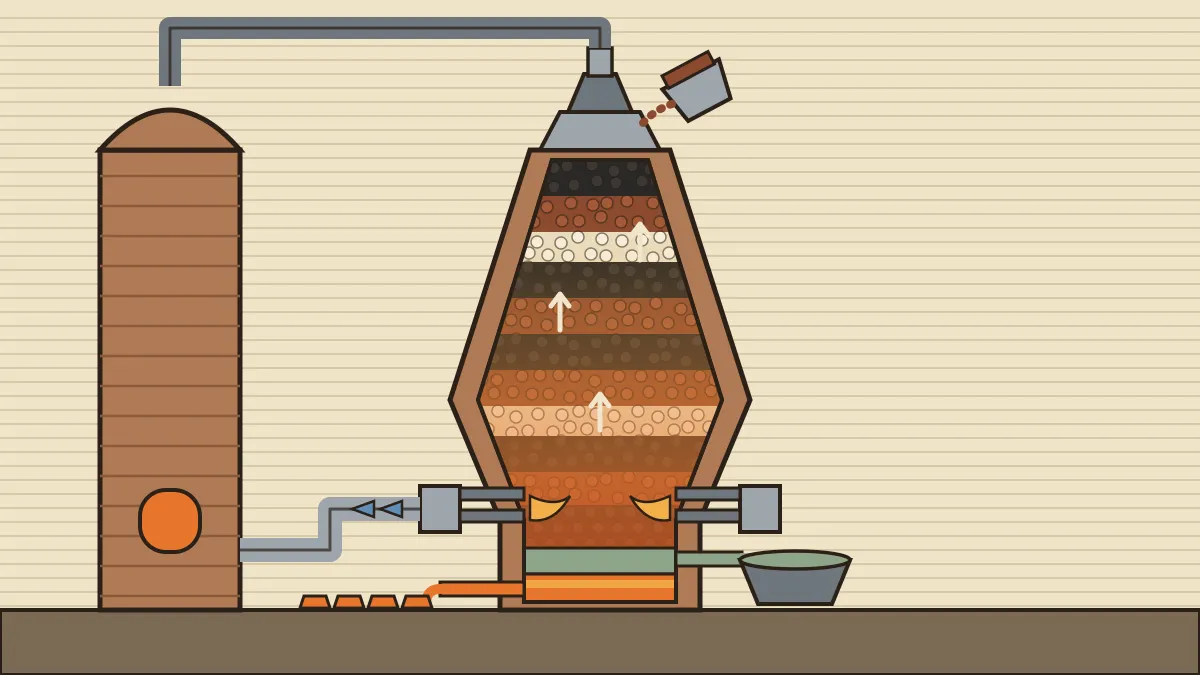
Molten iron collects at the bottom with the lighter slag floating on it, and each is tapped through its own hole. The gases leaving the top still contain carbon monoxide, so they are burnt in tall brick stoves to pre-heat the incoming air. The iron from a blast furnace, called pig iron, is hard but brittle because it holds roughly 4 per cent carbon with silicon, sulphur and phosphorus. In the Ministry's data, this molten iron appears as hot metal: 56.3 million tonnes in April to October 2026.
| Product | Carbon | Character |
|---|---|---|
| Pig iron | About 4% | Brittle; raw material for the next step |
| Cast iron | High (2 to 4%) | Hard and brittle; poured into moulds for pipes and manhole covers |
| Wrought iron | Almost none | Tough, malleable; chains and gates |
| Steel | Up to about 1.5% | Strong and workable; made by burning out excess carbon with oxygen in a converter |
Steel is an alloy of iron and carbon, the reason NDA 2023-II could ask which alloy contains a non-metal. Stainless steel adds chromium (and usually nickel) so a protective oxide film forms, which links to the rusting story on our corrosion page, and other alloys are covered under alloys and metal properties.
Aluminium and Copper: Two Electrolytic Stories
Aluminium is the most abundant metal in the Earth's crust, but its only commercial ore is bauxite. Bauxite carries iron(III) oxide, titanium dioxide and silica, which are removed by digesting the powdered ore with sodium hydroxide under pressure. Alumina dissolves as sodium aluminate, the impurities settle, and pure aluminium hydroxide is precipitated and heated to give pure alumina. This is leaching.
Alumina melts at over 2,000 °C, too high for practical electrolysis. In the Hall-Heroult process it is dissolved in molten cryolite at about 900 to 1,000 °C and electrolysed in a carbon-lined steel tank. The cryolite lowers the melting point and lets the melt conduct current.
The process uses a great deal of electricity, which is why aluminium smelters are built near cheap power. Recycling scrap saves most of it, which fits the push on recovering metals described on our critical minerals page.
Copper follows a different route. The ore is concentrated by froth flotation, roasted, and self-reduced to blister copper, about 98 per cent pure. The last step is electrolytic refining, and every exam asks its details:
| Part | What it is |
|---|---|
| Anode | A block of impure copper (dissolves) |
| Cathode | A thin sheet of pure copper (grows thicker) |
| Electrolyte | Acidified copper sulphate solution |
| Anode mud | Less reactive impurities (silver, gold) drop to the bottom as a valuable sludge |
The same electrolytic idea refines silver, zinc and tin. Other refining methods fit the metal: liquation for low-melting metals like tin and lead, poling (stirring with green wood) for copper, and distillation for volatile metals such as zinc and mercury. The cell chemistry behind these is on our batteries and electrochemical cells page.
(1) Cryolite is a solvent for alumina, not the aluminium ore. (2) In the blast furnace, carbon monoxide is the direct reducing agent, not coke itself. (3) In the thermite reaction, aluminium is the reducing agent and the products are molten iron and aluminium oxide, not molten aluminium.
How UPSC Has Asked It: Past Papers Solved
These are actual CDS and NDA questions since 2018. UPSC asks metallurgy through terms (roasting, calcination), ores and refining, with an occasional alloy question.
What is the name of the process that converts sulphide ores into oxides by heating strongly in the presence of excess air?
(a) Calcination (b) Roasting (c) Smelting (d) Incineration
Answer: (b). Roasting uses excess air on sulphide ores. Calcination works on carbonates in limited air, and smelting is the reduction step.
Which of the following statements are true for the reaction of Fe₂O₃ with aluminium? 1. It is known as the 'thermite reaction'. 2. The heat evolved is used for welding purpose. 3. Aluminium metal acts as an oxidizing agent. 4. Molten Fe and Al are formed at the end of the reaction.
(a) 1 and 2 (b) 1 and 3 (c) 2 and 4 (d) 1 and 4
Answer: (a). Statements 1 and 2 are true. Statement 3 is false because aluminium is oxidised, so it is the reducing agent. Statement 4 is false because the products are molten iron and aluminium oxide.
Aluminium is manufactured from
(a) Copper ore (b) Bauxite ore (c) Mica ore (d) Manganese ore
Answer: (b). Bauxite, Al₂O₃·2H₂O, is the only commercial ore of aluminium.
In electrolytic refining of copper, the electrolyte is a solution of
(a) acidified copper chloride (b) acidified copper sulphate (c) potassium chloride (d) sodium sulphate
Answer: (b). The electrolyte is acidified copper sulphate. Using a chloride would release chlorine gas at the anode, and the other two salts contain no copper.
Cinnabar is an ore of which one of the following?
(a) Copper (b) Zinc (c) Mercury (d) Manganese
Answer: (c). Cinnabar is mercuric sulphide, HgS. It is roasted in air to give mercury vapour, which is condensed.
Which one among the following pairs of mine and mineral is NOT correctly matched?
(a) Bailadila – Iron Ore (b) Zawar – Zinc (c) Ghatsila – Copper (d) Kudremukh – Bauxite
Answer: (d). Kudremukh in Karnataka is known for iron ore, not bauxite. The other three pairs are correct.
Which one of the following metal is NOT an essential component in stainless steel?
(a) Iron (b) Nickel (c) Chromium (d) Tin
Answer: (d). Stainless steel is iron with chromium and usually nickel. Tin is not part of it. Nickel is present in the common grades, so tin is the clear outsider.
Four of the seven questions ask for a name: the process, the ore, the mine or the electrolyte. Learn the ore table and the roasting/calcination line once and you can answer these in seconds.
Practice MCQs (with answers)
- A mineral from which a metal can be extracted economically is called
- gangue
- flux
- an ore
- slag
- Froth flotation is used to concentrate
- oxide ores
- sulphide ores
- bauxite
- native gold
- The conversion of ZnCO₃ into ZnO by heating is called
- roasting
- smelting
- calcination
- leaching
- Which substance is used as the flux to remove silica in the extraction of iron?
- Calcium oxide from limestone
- Coke
- Silica itself
- Cryolite
- The electrolyte used for refining blister copper is
- molten sodium chloride
- acidified copper sulphate
- dilute sodium hydroxide
- molten cryolite
- Alumina is dissolved in molten cryolite in order to
- lower its melting point and let it conduct
- oxidise it
- remove silica from it
- reduce it to the metal
- Which metal is obtained by the electrolysis of its fused chloride?
- Zinc
- Copper
- Lead
- Sodium
- In the thermite reaction, aluminium acts as
- an oxidising agent
- a catalyst
- a flux
- a reducing agent
1-c, 2-b, 3-c, 4-a, 5-b, 6-a, 7-d, 8-d. Q2: sulphides are wetted by oil, so they ride up in the froth. Q3: ZnCO₃ is a carbonate and loses CO₂, which is calcination; roasting would apply to ZnS. Q4: the flux must be basic to neutralise acidic silica, so it is CaO. Q6: cryolite is a solvent and a conductor in the melt, not a reducing agent. Q8: aluminium is oxidised to Al₂O₃ as the iron oxide is reduced.
Quick Revision
- Mineral vs ore (economic) vs gangue (waste). Native: gold, silver, platinum. Steps: crush, concentrate, calcine/roast, reduce, refine.
- Concentration: gravity (heavy oxides), magnetic, froth flotation (sulphides), leaching (bauxite with NaOH; gold and silver with NaCN).
- Calcination: carbonate, limited air, loses CO₂ or H₂O. Roasting: sulphide, excess air, gives oxide and SO₂.
- Flux + gangue = slag: CaO + SiO₂ → CaSiO₃. Blast furnace: coke, ore, limestone; CO reduces Fe₂O₃; waste gas pre-heats the air.
- Pig iron about 4% C; steel up to about 1.5% C (alloy of iron and carbon); stainless steel has chromium (and usually nickel).
- Thermite: Fe₂O₃ + 2Al → Al₂O₃ + 2Fe; welds rail tracks. Self-reduction: Cu₂S, PbS; blister copper. Cinnabar: roast, then the oxide decomposes.
- Hall-Heroult: alumina in molten cryolite, graphite anodes burn away. Sodium: fused NaCl (Down's). Copper refining: impure anode, pure cathode, acidified CuSO₄, anode mud (Ag, Au).
- Ores: haematite (Fe), bauxite (Al), cinnabar (Hg), galena (Pb), zinc blende and calamine (Zn). Mines: Bailadila and Kudremukh (iron), Zawar (zinc), Ghatsila (copper). Steel, April to October 2026: 99.1 Mt crude, 99.3 Mt consumed.
Frequently asked questions
What is the difference between roasting and calcination?
Calcination heats an ore, usually a carbonate or hydrated oxide, in limited air so that it loses carbon dioxide or water. Roasting heats an ore, usually a sulphide, in excess air to turn it into an oxide and release sulphur dioxide. Neither process melts the ore.
Why is limestone added to a blast furnace?
Limestone decomposes to calcium oxide, a basic flux, which combines with acidic silica in the ore to form molten calcium silicate. This slag floats on the molten iron, is tapped separately and protects the iron from air.
How is aluminium extracted from bauxite?
Bauxite is first purified with hot sodium hydroxide solution to give pure alumina. The alumina is then dissolved in molten cryolite and electrolysed at about 900 to 1,000 degrees Celsius, in the Hall-Heroult process. Aluminium collects at the cathode and the graphite anodes burn away as carbon dioxide.
What is the thermite reaction used for?
In the thermite reaction, aluminium reduces iron(III) oxide to molten iron, releasing a great deal of heat. The molten iron is used to weld railway tracks and to repair heavy broken parts. Aluminium is the reducing agent in the reaction.
How is blister copper refined?
Blister copper is refined by electrolysis. The impure copper is the anode, a thin sheet of pure copper is the cathode and the electrolyte is acidified copper sulphate. Pure copper deposits on the cathode, while silver and gold collect below the anode as anode mud.
Related CDS / OTA Science topics
Science is a third of the CDS GS paper
Cavalier's CDS/OTA batches teach physics, chemistry and biology from first principles, with numericals and weekly PYQ tests.