On 20 November 2026 the Ministry of Coal opened the bids for the 16th round of commercial coal mine auctions (together with the second attempt of the 15th round). Twenty-six blocks across eight states were on offer, and the combined offer drew 85 bids for 18 blocks. Sixteen of the 26 blocks attracted more than one bidder, and 20 firms bid for the first time. The same day, core-industries data showed October coal output up 23.1 per cent and steel up 7.3 per cent. Both stories are about one stretch of land: most of India's coal, iron ore and big steel plants lie on the eastern plateau. That is why the examiner keeps asking which coalfield is in which state, which river feeds which plant, and which plant was built with whose help. Four NDA papers from 2021 to 2025 asked exactly that.
Two Ages of Coal, Five River Valleys
Coal in India belongs to two geological ages. Gondwana coal formed a little over 200 million years ago, in swampy river basins of the old southern landmass. Tertiary coal is only about 55 million years old and lies in the young rocks of the north-east. The Geological Survey of India (GSI) put the country's total coal resource at 4,00,715 million tonnes on 1 April 2025, to a depth of 1,200 metres. Of that, Gondwana coal is 3,99,021 million tonnes. Tertiary coal is only 1,695 million tonnes, under half of one per cent. So when a question says "most of India's coal", think Gondwana, and think peninsular river valleys.
Gondwana coal sits in long, narrow troughs that follow rivers. Learn the valleys as a table.
| River valley | States | Coalfields to remember |
|---|---|---|
| Damodar | Jharkhand, West Bengal | Jharia (largest field), Bokaro, Giridih, Karanpura, Ramgarh, Raniganj |
| Son | Madhya Pradesh, Chhattisgarh, Uttar Pradesh | Singrauli (part lies in Uttar Pradesh), Sohagpur, Umaria |
| Mahanadi | Odisha, Chhattisgarh | Talcher, Ib valley, Korba, Raigarh |
| Godavari | Telangana | Singareni (Kothagudem, Ramagundam) |
| Wardha | Maharashtra | Chanda–Wardha, Kamptee |
The Damodar valley is the oldest and best known. Mining began at Raniganj in 1774, and Jharia and Raniganj together are still the names every map question hangs on. Jharia holds the country's best coking coal. Its seams have been burning underground since 1916.
Now the states. GSI's 2025 inventory ranks them by total resource:
| Rank | State | Total resource (million tonnes) | Main fields |
|---|---|---|---|
| 1 | Odisha | 1,00,976 | Talcher, Ib valley |
| 2 | Jharkhand | 93,254 | Jharia, Bokaro, Karanpura |
| 3 | Chhattisgarh | 85,263 | Korba, Raigarh, Hasdeo–Arand |
| 4 | West Bengal | 34,386 | Raniganj |
| 5 | Madhya Pradesh | 33,564 | Singrauli, Sohagpur |
| 6 | Telangana | 23,289 | Singareni |
| 7 | Maharashtra | 13,587 | Chanda–Wardha |
The top three states hold about 70 per cent of the national resource. Add West Bengal, Madhya Pradesh, Telangana and Maharashtra and the seven states hold about 96 per cent.
Odisha leads in total resource, but Jharkhand leads in the "measured" (best-proved) category: about 60,290 million tonnes against Odisha's 55,010. Older books rank Jharkhand first, so read which year and category a question uses. The top three states have stayed the same.
Coking Coal, Lignite and the Tertiary Fields
Not all coal is equal. The ranks rise with carbon content: peat, lignite, bituminous, anthracite. Our energy resources page covers the ladder. The practical split for India is simpler: coking coal, which makes the coke that smelts iron ore in a blast furnace, and non-coking coal, which burns in power stations.
- Coking coal is scarce. Of the 4,00,715 million tonnes, only about 37,373 million tonnes (roughly 9 per cent) is coking. The rest, over 3,60,000 million tonnes, is non-coking. Much of it is high in ash, so steelmakers import part of their need.
- Tertiary coal is the north-eastern exception. It occurs in Assam (Makum), Meghalaya (Darrangiri, Cherrapunji, Mewlong, Langrin), Nagaland and Arunachal Pradesh (Namchik–Namphuk), with a small field at Kalakot in Jammu and Kashmir. It is high in sulphur. In Meghalaya's Jowai and Cherrapunji areas it is dug through narrow tunnels known as rat-hole mining, which the National Green Tribunal has declared illegal.
- Lignite, the soft brown coal, is a separate resource of about 47,371 million tonnes. Tamil Nadu holds about 37,524 million tonnes, close to four-fifths of it, mostly at Neyveli. Rajasthan (6,661) and Gujarat (2,722) follow.
Damodar = Jharia, Bokaro, Raniganj (coking coal and the steel belt). Mahanadi = Talcher, Korba (power). Godavari = Singareni (the south's only major field). Meghalaya and Assam = Tertiary coal. Neyveli = lignite.
Why India, Africa, South America and Australia share Gondwana rocks is explained on our plate tectonics page.
Why Steel Plants Sit on the Chotanagpur Plateau
Iron and steel is called the basic industry because every other industry uses its output. It is also a heavy industry: the raw materials and the finished goods are both bulky, so transport is the main cost. A blast furnace needs iron ore, coking coal and limestone in a ratio of roughly 4 : 2 : 1, plus a little manganese to harden the steel. Haul those loads from far and you pay for every kilometre, so the plant goes where ore and coal are close together, with a river for water and a railway for the rest.
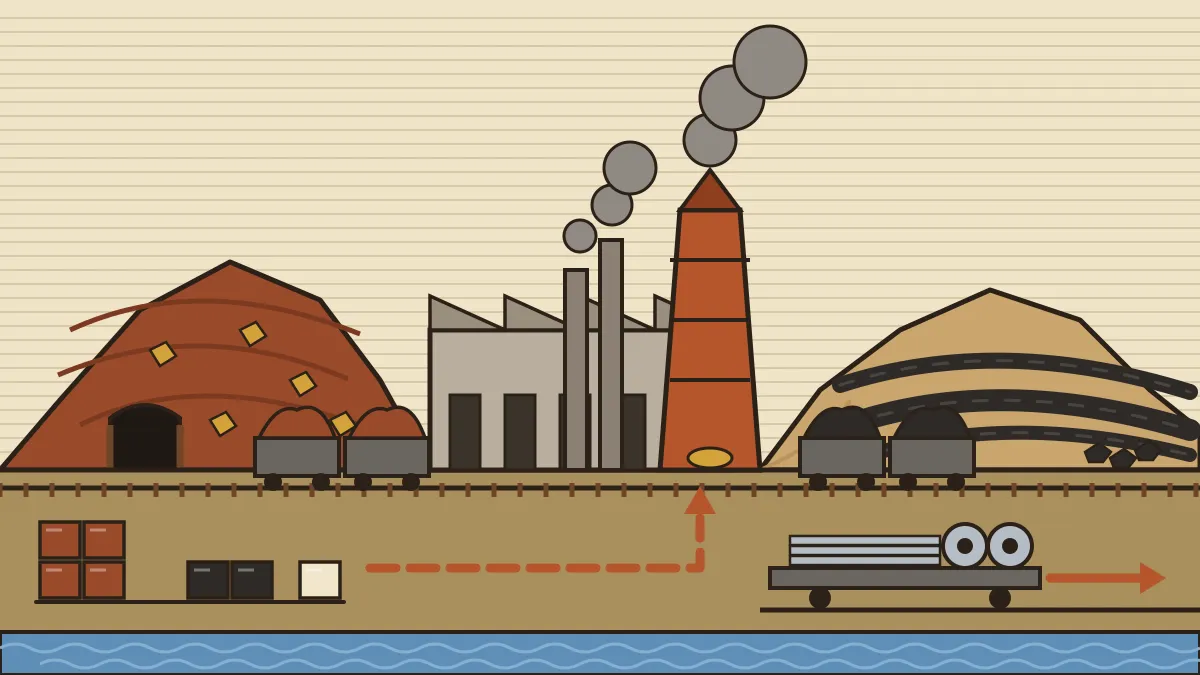
The Chotanagpur plateau, spread across Jharkhand, Odisha, West Bengal and Chhattisgarh, meets all of these conditions together. The Damodar valley gives the coking coal. The hill ranges of Singhbhum in Jharkhand and Sundargarh, Kendujhar and Mayurbhanj in Odisha give the ore, with famous mines at Noamundi, Gua, Kiriburu and Gorumahisani. A belt running south into Chhattisgarh adds Dalli–Rajhara and Bailadila. Add cheap labour and the Kolkata market to the east, and the region earns the nickname "Ruhr of India". Our minerals page lists the ore belts state by state.
Coal also loses weight when burnt, so thermal power stations crowd the coalfields and send electricity out by wire. Singrauli, Korba and Talcher are pit-head power centres.
The Plants, One by One
Seven names cover almost everything the examiner asks. Read the table once for the pattern, then for the details that identify each plant.
| Plant (state) | Origin | Identifying inputs |
|---|---|---|
| Jamshedpur (Jharkhand) | Tata Iron and Steel Company, 1907; the city is named after Jamsetji Tata; private sector | Stands where the Kharkai joins the Subarnarekha; coal from Jharia; ore from Noamundi and the Odisha hills |
| Burnpur (West Bengal) | Indian Iron and Steel Company (IISCO), set up in 1918 with iron production from 1922; nationalised in 1972 and now part of SAIL | Raniganj coal on the doorstep. The first modern ironworks was earlier, at Kulti (1870) |
| Bhilai (Chhattisgarh) | Soviet help; began production 1959 | Ore from Dalli–Rajhara; limestone from Nandini; water from the Tandula reservoir |
| Rourkela (Odisha) | West German help; 1959 | Ore from Sundargarh and Kendujhar; coal from Jharia; power from Hirakud; water from the Koel and Sankh rivers |
| Durgapur (West Bengal) | British help; 1959 | Raniganj coal; water and power from the Damodar Valley Corporation |
| Bokaro (Jharkhand) | Soviet help; company set up in 1964, first steel in 1972 | In the Damodar valley, beside the Bokaro coalfield; water and power from the DVC; ore from the Singhbhum–Odisha belt |
| Visakhapatnam (Andhra Pradesh) | Public sector (RINL), a later plant | A coastal plant: imported coking coal by sea, ore from Bailadila |
Bhilai, Rourkela and Durgapur started in 1959 under the Second Five Year Plan, each with a different partner: the Soviet Union, West Germany and Britain. Bokaro was the second Soviet-assisted plant. The public-sector plants were brought under the Steel Authority of India Limited (SAIL), formed in 1973.
Two plants break the rule. Visakhapatnam sits on the coast and imports its coal. Bhadravati in Karnataka began in 1923 on charcoal from nearby forests and ore from the Baba Budan hills, a favourite for "which plant is not near coal" questions.
Who Mines the Coal, and Where They Sit
The coal fields are run by a handful of public companies whose headquarters follow the coalfields. Coal India Limited (CIL) was formed in 1975, has its headquarters in Kolkata (not Ranchi), is a Maharatna company and is the world's largest single coal producer. It works through subsidiaries:
| Subsidiary | Headquarters | Region |
|---|---|---|
| Eastern Coalfields (ECL) | Sanctoria, West Bengal | Raniganj belt |
| Bharat Coking Coal (BCCL) | Dhanbad, Jharkhand | Jharia, the coking coal |
| Central Coalfields (CCL) | Ranchi, Jharkhand | Karanpura, Bokaro |
| Northern Coalfields (NCL) | Singrauli, Madhya Pradesh | Singrauli |
| Western Coalfields (WCL) | Nagpur, Maharashtra | Wardha valley |
| South Eastern Coalfields (SECL) | Bilaspur, Chhattisgarh | Korba, Raigarh |
| Mahanadi Coalfields (MCL) | Sambalpur, Odisha | Talcher, Ib valley |
| North Eastern Coalfields | Margherita, Assam | Tertiary coal |
Singareni Collieries Company Limited (SCCL) is not a CIL subsidiary. It is owned jointly by the Telangana government and the Centre, works the Godavari valley, and is the first and oldest government-owned coal company in India, with mining at Yellandu beginning in 1889. Neyveli lignite is worked by NLC India, a separate firm again. Our explainer on commercial coal mining traces how private firms entered after 2020.
That brings us back to the November auction. Since 2020 the Ministry has auctioned 145 coal mines across 15 rounds, bringing in 44 new companies. Captive and commercial mines produced 210.46 million tonnes in 2025-26, up 10.22 per cent. The terms are friendly: no end-use restriction, 100 per cent FDI through the automatic route and low upfront payments. Qualified bidders now go to an electronic auction on the MSTC portal. Whoever owns the mine, the coal still comes out of the same Gondwana troughs.
Coal that leaves the plateau moves by rail to power plants, and by sea from east-coast ports to the south. Kamarajar Port at Ennore in Tamil Nadu was commissioned in 2001 specifically to handle thermal coal.
Past Papers: Coal and Steel on the Map
Which one of the following coalfields is not located in Jharkhand?
(a) Jharia (b) Ramgarh (c) Deogarh (d) Umaria
Answer: (d). Umaria lies in Madhya Pradesh, in the Son valley. Jharia, Ramgarh and Deogarh are Jharkhand fields. Deogarh sounds like an Odisha name, but its coalfield is in Jharkhand.
Identify the Iron and Steel Plant on the basis of the given characteristics: • It receives coal from Jharia and iron-ore from Sundargarh and Kendujhar. • Power for the electric furnaces is procured from Hirakud. • Water is obtained from Koel and Sankh rivers.
(a) Bhilai Steel Plant (b) Durgapur Steel Plant (c) Rourkela Steel Plant (d) Bokaro Steel Plant
Answer: (c). Sundargarh and Kendujhar are in Odisha, as are Hirakud and the Koel–Sankh rivers. Bokaro also gets Jharia coal, but its power and water come from the DVC, not Hirakud.
Consider the following statements with regard to a steel plant: I. It was setup in 1964 with Russian collaboration II. It receives iron ore from the Rourkela region III. Water and Hydel power is supplied by the Damodar Valley Corporation. Identify the Steel Plant on the basis of the above facts:
(a) Bhilai Steel Plant (b) Bokaro Steel Plant (c) Rourkela Steel Plant (d) Durgapur Steel Plant
Answer: (b). Russian help and the DVC point to Bokaro. Bhilai had Russian help too but runs on the Tandula reservoir, not the DVC. Durgapur uses the DVC but had British help.
Which one of the following statements is NOT correct? (a) Bokaro steel plant is located in Damodar river basin (b) Jamshedpur steel plant is located on the confluence of Damodar and Barakar (c) Salem steel plant is located on the bank of Kaveri River (d) Bhilai steel plant obtains water from Tandula reservoir
Answer: (b). Jamshedpur stands where the Kharkai meets the Subarnarekha. The Damodar and Barakar do meet, but far to the east, near Dishergarh in West Bengal. Statements (a) and (d) are correct, and the official key treats (c) as acceptable too.
Which one of the following is the first and the oldest Government-owned coal mining company in India? (a) Neyveli Lignite Corporation (b) Singareni Collieries Company Limited (c) Coal India Limited (d) Mahanadi Coalfields Limited
Answer: (b). The question returned in 2026-I with shuffled options, and Singareni was again the answer. Coal India is the biggest, not the oldest.
Kamarajar Port was commissioned in 2001 to handle thermal coal requirements. It is situated along the coast of which Indian State?
(a) Andhra Pradesh (b) Odisha (c) Tamil Nadu (d) Karnataka
Answer: (c). Kamarajar (earlier Ennore) is near Chennai. Paradip is the Odisha coal port and could tempt a student who links coal with Odisha.
NDA asks identify the plant from its inputs or which field is in which state. CDS asks the company: headquarters, rank, age. Learn each plant as a trio of coal source + ore source + power or water source, and each coalfield with its state and river. The partner country (Russia, Germany, Britain) is the tie-breaker when two plants share an input.
Practice MCQs (with answers)
- Tertiary coal makes up roughly what share of India's total coal resource?
- Over 40 per cent
- Under 1 per cent
- About 10 per cent
- About a quarter
- Which set contains only coalfields of the Damodar valley?
- Jharia, Bokaro, Raniganj
- Talcher, Korba, Jharia
- Singareni, Ramagundam, Bokaro
- Singrauli, Raniganj, Chanda–Wardha
- Consider: 1. Gondwana coal is older than Tertiary coal. 2. Tertiary coal is mined in Meghalaya and Assam. 3. Tamil Nadu holds most of India's lignite. Which are correct?
- 1 and 2 only
- 2 and 3 only
- 1 and 3 only
- 1, 2 and 3
- A steel plant built with British help in 1959 uses Raniganj coal and the water and power of the DVC. It is:
- Bokaro
- Bhilai
- Durgapur
- Rourkela
- Iron ore, coking coal and limestone are needed in a blast furnace in the approximate ratio:
- 4 : 2 : 1
- 1 : 2 : 4
- 2 : 2 : 1
- 4 : 1 : 2
- The main reason the Chotanagpur plateau has India's heaviest cluster of steel plants is that:
- It has the largest ports
- It has the biggest oilfields
- It has fertile alluvial plains
- Iron ore, coking coal and limestone lie close together, with rail and river water
- Which of these is NOT a subsidiary of Coal India Limited?
- Western Coalfields
- Northern Coalfields
- Singareni Collieries
- Central Coalfields
- According to the GSI inventory of 1 April 2025, the state with the largest total coal resource is:
- Jharkhand
- Odisha
- Chhattisgarh
- West Bengal
1-b, 2-a, 3-d, 4-c, 5-a, 6-d, 7-c, 8-b.
Q2: Talcher is in the Mahanadi valley, Singareni in the Godavari and Chanda–Wardha in the Wardha valley, so only (a) is pure. Q7: Singareni belongs to the Telangana government and the Centre, not to CIL. Q8: Jharkhand led older lists and still leads in the measured category; for total resources Odisha is first.
Quick Revision
- Coal resource, 1 April 2025 (GSI): 4,00,715 million tonnes; Gondwana nearly all, Tertiary under 0.5%.
- Gondwana valleys: Damodar, Son, Mahanadi, Godavari, Wardha. Tertiary: Assam, Meghalaya, Nagaland, Arunachal.
- State order: Odisha, Jharkhand, Chhattisgarh (about 70%), then West Bengal, Madhya Pradesh, Telangana, Maharashtra. Jharkhand leads in "measured".
- Coking coal is only about 9%; Jharia is the prime field. Lignite: Neyveli, Tamil Nadu has about four-fifths.
- Furnace charge: ore : coking coal : limestone = 4 : 2 : 1.
- Plants: Jamshedpur (1907, Kharkai–Subarnarekha), Burnpur (1918), Bhilai, Rourkela, Durgapur (all 1959), Bokaro (1964, DVC), Visakhapatnam (coastal).
- Partners: Bhilai and Bokaro Soviet, Rourkela German, Durgapur British. SAIL formed 1973.
- CIL: Kolkata, formed 1975, Maharatna. Singareni is the oldest, not a CIL unit.
Frequently asked questions
Which are the main coalfields of the Damodar valley?
The Damodar valley in Jharkhand and West Bengal holds Jharia, Bokaro, Giridih, Karanpura, Ramgarh and Raniganj. Jharia is the largest field and the main source of coking coal, while Raniganj is the oldest, mined since 1774.
Which state has the most coal in India?
On the Geological Survey of India's inventory of 1 April 2025, Odisha has the largest total coal resource at about 1,00,976 million tonnes, followed by Jharkhand and Chhattisgarh. Jharkhand still leads in the measured category, so the answer depends on which measure a question uses.
Why are steel plants located near coalfields?
Steel needs about four parts of iron ore and two of coking coal for each part of limestone, and all three are heavy. Locating the plant where ore and coal are close together keeps haulage costs low. The Chotanagpur plateau also has rivers for water, rail links and a large market, which explains the cluster.
What is the difference between coking and non-coking coal?
Coking coal turns into hard, porous coke when heated without air, and that coke is the fuel and reducing agent in blast furnaces. Non-coking coal does not and is burnt in power stations and industry. Only about nine per cent of India's resource is coking, which is why part of the supply is imported.
Which is the oldest government-owned coal company in India?
Singareni Collieries Company Limited in Telangana is the oldest, with mining at Yellandu from 1889. It is owned jointly by the Telangana government and the Centre and is not a subsidiary of Coal India, which was formed in 1975.
Related CDS / OTA Geography topics
Geography is a quarter of the CDS GS paper
Cavalier's CDS/OTA and NDA batches teach map-based geography with a map drill every week and PYQ tests on every chapter.