On 20 November 2026 the Indian Navy took delivery of DSC A21, a diving support craft built by Titagarh Rail Systems in Kolkata and handed over at Naval Dockyard, Mumbai. It is a catamaran that will spend its life in salt water, the hardest place for steel to live: dissolved salts make iron rust far faster than in fresh water, so every ship needs a plan against corrosion. UPSC asks about rusting, galvanising, stainless steel and the green coat on copper regularly, and the questions are easy marks for a student who knows why each method works.
Why Iron Rusts: A Battery in a Water Drop
By Abhishek Thakur · Science faculty, The Cavalier · 15 years teaching NDA and CDS Science
Corrosion is the slow eating away of a metal by the air, water or chemicals around it. When the metal is iron or steel, the process is called rusting, and the product, rust, is hydrated iron(III) oxide, Fe2O3·xH2O. The word rusting belongs to iron alone.
A classic school experiment shows what rusting needs. Put three clean nails in three test tubes. In the first, leave the nail in ordinary water open to air. In the second, use boiled water (which has lost its dissolved air) and float a layer of oil on top. In the third, put the nail over anhydrous calcium chloride, a drying agent, and cork the tube. After a few days only the first nail has rusted. Rusting needs both oxygen and moisture. Take away either one and iron stays bright.
Chemically, a wet iron surface behaves like a tiny electric cell. One spot on the surface, usually a scratch or a place with less dissolved oxygen, becomes the anode. Iron atoms give up electrons there and go into the water as iron(II) ions. The electrons travel through the metal to a neighbouring spot where oxygen is plentiful, the cathode. There oxygen picks up the electrons.
Rusting is oxidation: iron loses electrons. It is also a chemical change, since rust is a new substance and drying cannot turn it back into iron.
Salt (seawater, road salt) makes the water a better conductor, so the little cell works faster. Acidic gases such as CO2 and SO2, scratches and strain, and warmth all speed rusting too.
An iron nail of mass 56 g rusts completely to Fe2O3 (ignore the water). What is the mass of the oxide?
Aluminium and chromium form a thin oxide layer that seals the metal. Rust does not. It is porous and flaky, and it falls away to expose fresh iron. That is why a rusty gate keeps getting worse until nothing is left.
The Reactivity Rule Behind Every Fix
Whether a metal protects iron or harms it depends on one thing: which of the two is more reactive. When two metals touch in a wet place, the more reactive one becomes the anode and corrodes, while the less reactive one is the cathode and is spared. The standard electrode potentials (in volts, for Mn+ + ne− → M) put the metals in order:
| Metal | Potential (V) | Against iron |
|---|---|---|
| Magnesium | −2.37 | Far more reactive: corrodes first |
| Aluminium | −1.66 | More reactive: corrodes first |
| Zinc | −0.76 | More reactive: sacrifices itself for iron |
| Iron | −0.44 | |
| Tin | −0.14 | Less reactive: iron is sacrificed for tin |
| Copper | +0.34 | Much less reactive: iron is sacrificed |
You need only the order Mg > Al > Zn > Fe > Sn > Cu. The same order is the reactivity series covered on our metals and reactivity page, and the cell idea is the one behind every battery in our article on electrochemical cells.
Six Ways to Stop Rust
Every method either keeps oxygen and water away, or makes something else corrode in the iron's place.
| Method | How it works | Where you see it |
|---|---|---|
| Painting, oiling, greasing | Barrier: blocks air and water. Fails once the film is scratched. | Bridges, gates, machine parts, rifle bolts |
| Galvanising | Coat of zinc, usually by dipping in molten zinc. Barrier and sacrificial protection. | Buckets, roofing sheets, fencing wire, electricity pylons |
| Tin plating | Barrier only. Tin is less reactive than iron. | Food cans |
| Alloying | Adding chromium (and nickel) makes stainless steel | Cutlery, hospital instruments, kitchen sinks |
| Sacrificial anode | A block of a more reactive metal is wired to the steel and corrodes instead | Ship hulls, underground pipelines, storage tanks |
Galvanised or tinned: the scratch test
Both zinc and tin coatings protect iron while the coat is whole. The difference shows when it is scratched and the iron is exposed to water.
- Galvanised iron. Zinc is more reactive, so in the wet scratch zinc becomes the anode and dissolves, and the iron is the cathode and stays safe. The coating keeps protecting even after damage.
- Tin plate. Tin is less reactive, so iron becomes the anode. The big tin surface drives the cell, and the exposed iron rusts faster than if it had no coating at all. This is why a dented tin can rusts through quickly.
A coating of a metal more reactive than iron (zinc) protects iron even when scratched. A coating of a metal less reactive than iron (tin, copper, nickel) protects only while it is unbroken.
Sacrificial Anodes and the Warship
Paint on a ship is chipped by ropes and floating debris, so shipbuilders add a second line of defence. Blocks of zinc or an aluminium alloy are bolted or welded to the hull, close to the propeller, rudder and sea inlets, in direct metal contact with the steel. In seawater the whole hull becomes one large cell. The zinc is the anode and slowly wears away. The steel is the cathode and is spared. The blocks are replaced at each dry-docking, which is far cheaper than replacing hull plate.
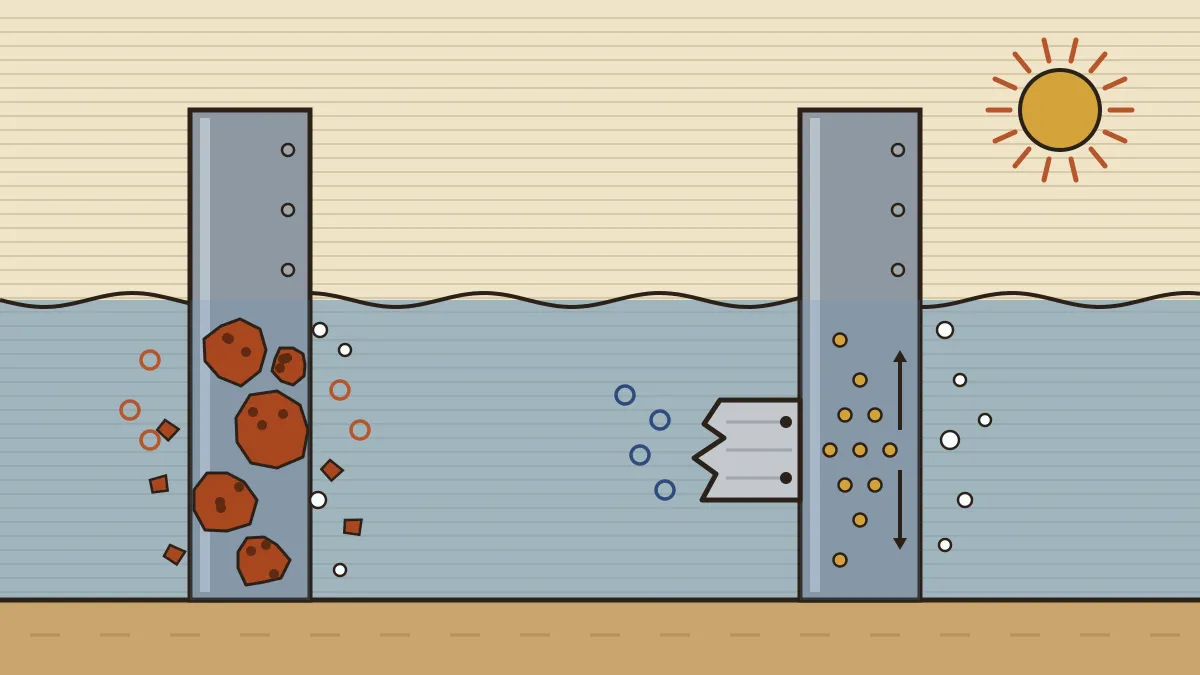
This is sacrificial protection, also called cathodic protection, because the steel is forced to act as the cathode. A second form, impressed-current protection, joins the steel to the negative terminal of a direct-current supply and connects an inert electrode to the positive terminal. Large ships, jetties and long pipelines use it.
Warship plate is itself a special alloy steel: see SAIL's DMR-249A naval steel. The craft that work underwater are covered in our piece on the diving support vessel Nipun.
Stainless Steel, Aluminium and Anodising
Some metals defend themselves. Aluminium sits well above iron in the reactivity series, yet an aluminium pan lasts for years. The reason is a thin, tough, transparent layer of aluminium oxide (Al2O3) that forms at once in air and seals the metal beneath. Chemists call this passivation: the metal is protected by its own oxide film.
Stainless steel uses the same trick. It is iron with at least 10.5% chromium, and the common kitchen grade also has about 8% nickel (the "18/8" steel). Chromium forms an invisible film of chromium oxide, and if a scratch breaks it, oxygen in the air seals the gap again. Remember that tin is not a component of stainless steel: the exam has tested that exact point.
Anodising is passivation made thicker on purpose. A clean aluminium article is made the anode in a bath of dilute sulphuric acid and current is passed. Oxygen is released at the anode and builds up the oxide layer on the metal. The hard layer resists corrosion and can be dyed, so anodised aluminium appears in aircraft parts, cookware and window frames. Magnesium and titanium can be anodised too.
It is the anode (positive electrode) that gets coated. Oxygen forms at the anode, not at the cathode. The examiner's usual false line is "oxygen is evolved at the cathode".
The Gupta-age Iron Pillar at Mehrauli, about seven metres tall and some 1,600 years old, has stood in Delhi's open air with little rust. Studies credit its high-phosphorus wrought iron and a thin protective film. More on that age is in our page on the Gupta period.
Copper, Silver and Others: Not All Corrosion Is Rust
| Metal | What forms | Cause |
|---|---|---|
| Copper and brass | Green coat of basic copper carbonate (cupric carbonate) | Moist air with CO2; the green roofs and statues of old cities |
| Silver | Black tarnish of silver sulphide, Ag2S | Sulphur compounds in the air, such as hydrogen sulphide, and in eggs and some foods |
| Aluminium | Invisible, protective Al2O3 | Oxygen of the air |
| Gold, platinum | None | Too unreactive; these are the "noble" metals |
Zinc is also amphoteric: it gives hydrogen with both hydrochloric acid and sodium hydroxide (Zn + 2NaOH → Na2ZnO2 + H2), and it displaces copper from copper sulphate. The acid side is on our acids and bases page.
How UPSC Has Asked It: Past Papers Solved
These are actual CDS and NDA questions since 2021. UPSC asks about this topic in three forms: is it an oxidation or a physical change, which metal protects iron, and what is the alloy or coating made of.
Which one of the following is not an oxidation reaction?
(a) Rusting of iron (b) Opening of soda bottle (c) Rancidity (d) Combustion
Answer: (b). Opening a soda bottle only lets dissolved carbon dioxide escape as pressure falls, which is a physical change. Rusting, rancidity (oxidation of fats and oils) and combustion all add oxygen to a substance.
In which one of the following cases do both physical and chemical changes take place?
(a) Burning of candle (b) Freezing of water (c) Cooking of food (d) Rusting of iron
Answer: (a). The wax first melts, which is physical, and then the vapour burns, which is chemical. Freezing is purely physical. Rusting makes a new substance, so it is purely chemical.
Which one of the following is not true for anodizing process?
(a) It makes aluminium corrosion resistant. (b) Metals like aluminium, titanium and magnesium can be anodized. (c) Clean aluminium article is the anode and oxygen gas is evolved at the cathode. (d) It is used in aircraft industry.
Answer: (c). The article is the anode, but the oxygen that thickens the oxide layer is released at that same anode. Evolution of oxygen "at the cathode" is the false part of the statement.
When copper reacts with moist carbon dioxide (CO₂) in air, it forms a green coating of which one of the following compounds?
(a) Cupric carbonate (b) Cuprous oxide (c) Copper nitrate (d) Copper sulphate
Answer: (a). The green layer is basic copper carbonate, called cupric carbonate in the options. The nitrate and sulphate need acids that air does not supply. NDA 2019-I asked the same question.
To protect steel and iron from rusting, a thin layer of which one of the following metals is applied?
(a) Magnesium (b) Zinc (c) Aluminium (d) Lead
Answer: (b). This is galvanising. Lead is less reactive than iron, so it cannot protect it sacrificially. NDA 2023-II repeated it as "Galvanization is a method of protecting iron from rusting by coating with a thin layer of ... zinc".
Which one of the following metal is NOT an essential component in stainless steel?
(a) Iron (b) Nickel (c) Chromium (d) Tin
Answer: (d). Stainless steel is iron with chromium and usually nickel. Tin appears on tin plate (food cans), not in stainless steel.
Consider the following statements: I. Zinc metal, when treated with both HCl (aq.) and NaOH (aq.) separately, produces molecular hydrogen. II. An aqueous copper sulphate solution cannot be kept in a zinc vessel. III. Lemon, tamarind and tomato are natural sources of citric acid, oxalic acid and tartaric acid, respectively. Which of the statements given above are correct?
(a) I and II only (b) II and III only (c) I and III only (d) I, II and III
Answer: (a). I is true because zinc is amphoteric. II is true because zinc displaces copper from its salt. III is false: tamarind gives tartaric acid and tomato gives oxalic acid, so the order given is swapped.
Rusting appears in questions on oxidation (NDA 2024-II asked "which is an example of oxidation: rusting of iron"), on physical versus chemical change, and on metal coatings. Always ask two things: which metal is more reactive, and does the change make a new substance.
Practice MCQs (with answers)
- Rust is mainly
- anhydrous iron(II) oxide
- hydrated iron(III) oxide
- iron(II) carbonate
- iron(III) chloride
- A nail kept in boiled water under a layer of oil does not rust because
- boiling makes iron passive
- oil reacts with iron to form a coat
- water cannot touch iron
- dissolved oxygen is absent
- A galvanised bucket is scratched so that bare iron shows, yet the iron does not rust quickly. The reason is that
- zinc is more reactive than iron and is oxidised in preference
- zinc is less reactive and covers the iron
- zinc oxide is magnetic
- iron cannot react in the presence of zinc
- A tin-plated can is deeply scratched and kept in a damp place. What happens to the exposed iron?
- Tin sacrifices itself and protects the iron
- Nothing, as tin still protects it
- The iron corrodes, and faster than without the tin
- The iron turns into tin
- Which of the following is used as a sacrificial anode on ship hulls?
- Zinc
- Copper
- Lead
- Tin
- Stainless steel resists rusting mainly because it contains
- a coating of tin
- a high percentage of carbon
- a paint of chromium
- chromium, which forms a thin self-repairing oxide film
- Aluminium is more reactive than iron, but an aluminium utensil lasts for years because
- aluminium does not react with oxygen
- a thin, tough oxide layer seals the surface
- aluminium is a noble metal
- its oxide dissolves in water
- Which statement about anodising is correct?
- The aluminium article is made the cathode
- It thins the natural oxide layer
- The article is the anode, and the oxide layer is thickened
- It is used only on iron
1-b, 2-d, 3-a, 4-c, 5-a, 6-d, 7-b, 8-c. Q3: zinc loses electrons in preference to iron, so the iron is protected even where the coat is broken. Q4: tin is less reactive than iron, so the iron is the anode and rusts faster. Q5: copper, lead and tin are all less reactive than iron and would make the steel corrode. Q7: aluminium protects itself by passivation, which is not the same as being unreactive.
Quick Revision
- Rust = hydrated iron(III) oxide, Fe2O3·xH2O. Needs oxygen and moisture. Rusting is an oxidation and a chemical change.
- Wet iron is a tiny cell. Anode: Fe → Fe²⁺ + 2e⁻. Cathode: O2 + 2H2O + 4e⁻ → 4OH⁻. Salt, acid, strain and warmth speed it up.
- Order of reactivity: Mg > Al > Zn > Fe > Sn > Cu. The more reactive metal in a wet contact corrodes first.
- Galvanising = zinc coat (barrier + sacrificial). Tin plating = barrier only; a scratched tin can rusts faster.
- Sacrificial anodes (zinc, magnesium, aluminium alloy) protect ship hulls and pipelines. Impressed current uses a DC supply.
- Stainless steel = iron + at least 10.5% chromium (and nickel in 18/8). No tin. Aluminium and chromium form self-sealing oxide films (passivation).
- Anodising: article is the anode, oxygen forms at the anode, oxide layer thickens. Used on aluminium, titanium, magnesium and in aircraft.
- Copper turns green (basic copper carbonate); silver turns black (Ag2S); gold and platinum do not corrode. Mehrauli Iron Pillar: Gupta age, high phosphorus.
Frequently asked questions
Why does iron rust but gold does not?
Iron gives up electrons to oxygen in the presence of moisture and forms rust. Gold is one of the least reactive metals, so air and water do not touch it.
Is rusting a physical or a chemical change?
Rusting is a chemical change, because a new substance, hydrated iron(III) oxide, is formed. It is also an oxidation reaction, as iron loses electrons. Drying the rusted object does not bring back the iron.
Why is zinc used for galvanising and not tin?
Zinc is more reactive than iron, so when the coating is scratched the zinc corrodes in preference and the iron stays protected. Tin is less reactive than iron, so a scratched tin coating makes the iron corrode faster.
What is a sacrificial anode?
A sacrificial anode is a block of a more reactive metal, such as zinc or magnesium, fixed to a steel structure in contact with it. In seawater or damp soil the block corrodes instead of the steel. It is replaced when it wears out.
Why does stainless steel not rust?
Stainless steel contains at least 10.5 per cent chromium. The chromium forms a thin invisible oxide film on the surface that seals the metal from air and water. If the film is scratched, it re-forms on exposure to oxygen.
Related CDS / OTA Science topics
Science is a third of the CDS GS paper
Cavalier's CDS/OTA batches teach physics, chemistry and biology from first principles, with numericals and weekly PYQ tests.