Our daily articles this year have met heat in three disguises: the urban heat island that keeps cities warm after dark, India's first geothermal wells at Puga, and a crystal in which heat travels like a wave. All three rest on one idea: heat moves from hot to cold in exactly three ways, and UPSC asks about them almost every year. Our pages on specific and latent heat and on convection and thermal expansion cover the basics. This article goes narrower: conduction with its formula, radiation with its laws, and the sums that decide questions.
The Three Paths of Heat
By Abhishek Thakur · Science faculty, The Cavalier · 15 years teaching NDA and CDS Science
Heat is energy that flows because of a temperature difference. It is measured in joules, while temperature is in kelvin. Put a kettle on a flame and all three paths of heat appear at once.
| Mode | What carries the heat | Medium needed? | Seen in the kettle |
|---|---|---|---|
| Conduction | Vibrating atoms and free electrons pass energy along, with no bulk movement | Yes: mainly solids | Heat runs along the metal handle, from the pot to your hand |
| Convection | Hot fluid itself rises, cold fluid sinks | Yes: liquids and gases only | Water circulates inside, rising in the middle and sinking at the sides |
| Radiation | Electromagnetic waves, mostly infrared | No: works in a vacuum | You feel warmth on your face beside the flame |
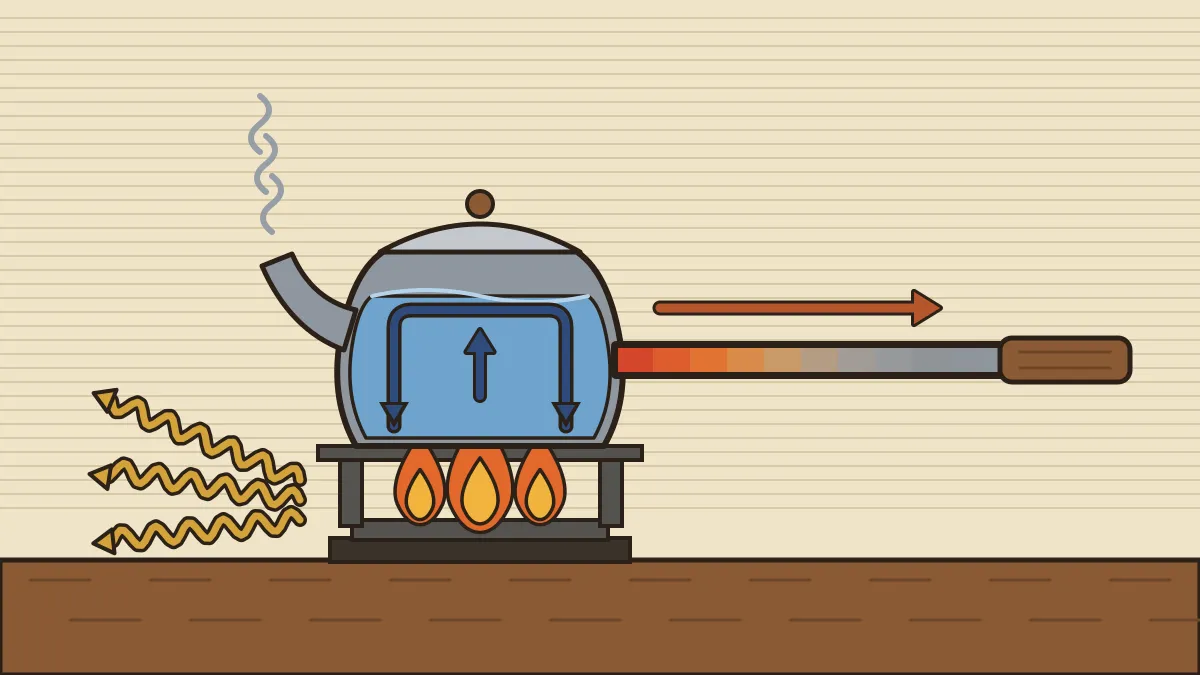
Speed matters. Radiation travels at the speed of light (3 × 10⁸ m/s), so sunlight reaches us in about eight minutes, while conduction and convection are far slower. The Sun's heat crosses empty space by radiation alone.
Temperature scales. The Celsius scale has 100 divisions between 0° (melting ice) and 100° (boiling water), and the Fahrenheit scale has 180 between 32° and 212°. Three formulae cover every question:
A hot day reaches 113°F. What is this in kelvin?
Conduction: Fourier's Law and Why Metals Feel Cold
In a steady state, the rate at which heat flows along a bar depends on four things:
So H rises with area and with the temperature difference, and falls with length. Double the length and the flow halves. K is a property of the material, and the table shows how extreme the range is.
| Material | K (W m−1 K−1) | Verdict |
|---|---|---|
| Silver | About 406 | Best metallic conductor |
| Copper | About 385 | Cooking-pot bases, heat sinks |
| Aluminium | About 205 | Light utensils, engine parts |
| Steel | About 50 | Poor for a metal |
| Glass, concrete | About 0.8 | Poor conductors |
| Wood | About 0.12 | Handles of pans |
| Glass wool, felt | About 0.04 | Good insulators |
| Air | About 0.024 | One of the poorest conductors |
A rod 0.5 m long and 4 cm² in cross-section has its ends at 100°C and 0°C. Find the heat flow for copper (K = 385) and for steel (K = 50).
Metals are good thermal conductors because free electrons carry energy as well as charge, which is why good electrical conductors are also good heat conductors. In non-metals only atomic vibrations carry the energy, and in gases the molecules are so far apart that conduction is very weak.
Why does a metal chair feel colder than a wooden one at the same temperature? Metal conducts heat away from your hand faster. Wool, blankets, snow and bird feathers keep heat in because they trap air, a poor conductor. A copper-bottomed pan spreads heat evenly, while its wooden handle protects your hand.
Cold does not "flow in". Heat always flows from hot to cold, and a blanket only slows the heat your body loses.
Convection: From a Boiling Pot to the Monsoon
In convection the fluid itself moves: heated fluid expands, becomes less dense and rises, and denser cold fluid sinks to replace it. Three points go beyond our convection page.
Land and sea. Land has a low specific heat, so it warms and cools quickly. Water has a high specific heat, so it changes temperature slowly. By day, the air above the land rises and cooler air blows in from the sea: the sea breeze. At night the pattern reverses into the land breeze. The monsoon is the same mechanism on the scale of a subcontinent and a season. In summer the land becomes far hotter than the Indian Ocean, low pressure develops over it and moist air is drawn in from the sea. In winter the flow reverses (see the Indian monsoon page).
Where convection fails. It cannot happen in a solid or in a vacuum, and it needs gravity. Inside a spacecraft a candle flame burns as a ball and soon smothers itself, because the hot gases do not rise away.
Placement. A room heater belongs low, since warm air rises and warms the room. An air-conditioner belongs high, since cold air sinks.
Radiation: Black Bodies, Stefan, Wien and the Greenhouse
All bodies above absolute zero emit electromagnetic waves, and most of the heat from a warm object is infrared. William Herschel found it in 1800 when a thermometer beyond the red end of the spectrum still warmed. Infrared waves are called heat waves, and water molecules absorb them readily (see the electromagnetic spectrum page).
Black body. A perfect absorber is a perfect emitter (Kirchhoff's law). Dark, rough surfaces absorb and emit more, while white and shiny surfaces reflect more. That is why we wear light clothes in summer, why pots are blackened at the base and why solar water heaters are painted black. A black body absorbs all radiation falling on it and, when hot, emits the full range of wavelengths. Lamp black and the Sun come close.
Stefan–Boltzmann law: the power radiated is proportional to the fourth power of the absolute temperature, H = σ A T4 (σ = 5.67 × 10⁻⁸ W m−2 K−4). Doubling the Kelvin temperature makes a body radiate 16 times as much. Wien's displacement law: the wavelength of peak emission is inversely proportional to temperature, λm T = 2.9 × 10⁻³ m K. A hotter body glows at shorter wavelengths: heated iron goes dull red, then yellow, then white. The Sun's surface is near 6,000 K and peaks in the visible. A person at 310 K peaks around 9 µm in the infrared, which is how thermal imagers see warm bodies and engines in the dark and heat-seeking missiles lock on to an exhaust.
Stefan: power goes as T4, so hotter means far more energy. Wien: peak wavelength goes as 1/T, so hotter means shorter wavelength. Both use kelvin, never Celsius.
Newton's law of cooling. A hot body loses heat at a rate proportional to its excess temperature over the surroundings, for a small difference. A cup of coffee on a table is the standard case. It cools fast at first, then slowly, and never goes below room temperature.
Greenhouse effect. The Sun's radiation, mostly visible light, passes through the atmosphere and warms the ground. The ground gives out longer-wavelength infrared, which water vapour, carbon dioxide, methane, nitrous oxide and CFCs absorb and re-emit, partly back to the surface. Without the natural effect, the Earth's average surface temperature would be around −18°C instead of the actual 15°C or so. The concern is the extra gases we add. (A garden greenhouse mostly works by stopping warm air escaping, but examiners expect the infrared explanation.)
Thermos flask. Invented by Sir James Dewar, it is a double-walled glass vessel. The vacuum between the walls blocks conduction and convection, the silvered walls reflect radiation back, and the cork or plastic supports, being poor conductors, finish the job. The inner wall is shiny to reduce radiation, not to give it out.
Two Sums That Decide the Question
10 g of steam at 100°C is passed into 200 g of water at 10°C in an insulated vessel. Find the final temperature. (Latent heat of steam 540 cal/g; specific heat of water 1 cal/g°C.)
A hot body at 300 K is heated to 600 K. By what factor does the power it radiates rise?
For expansion sums, the area coefficient is twice the linear one and the volume coefficient three times, so volume is 1.5 times area: an area coefficient of 1.6 × 10⁻⁵ per K means a volume coefficient of 2.4 × 10⁻⁵ per K. Heat as energy is covered in work, energy and power numericals.
How UPSC Has Asked It: Past Papers Solved
These are actual CDS and NDA questions, solved with the reasoning behind each wrong option.
In which of the following phenomena do heat waves travel along a straight line with the speed of light?
(a) Thermal conduction (b) Thermal convection (c) Thermal radiation (d) Both, thermal conduction and radiation
Answer: (c). Radiation is electromagnetic and travels in straight lines at the speed of light. In option (d), conduction is the trap: it is slow and needs matter.
Which one of the following heat transfers is an example of convection?
(a) Heating of food in a microwave oven (b) Boiling water in a pot on a gas stove (c) Feeling the warmth in sun (d) Heating a brass rod at one end and observing the temperature rise at the other end
Answer: (b). The water itself circulates. The microwave oven and sunshine are radiation, and the brass rod is conduction.
Which one among the following has the least coefficient of thermal conductivity?
(a) H2 (b) H2O (c) Cu (d) Al
Answer: (a). Gases conduct worst because their molecules are far apart. Water is a poor conductor for a liquid, but still conducts far better than hydrogen gas.
Which one of the following statements regarding a thermos flask is NOT correct?
(a) The walls of flask are separated by vacuum and made of glass which is a poor conductor of heat (b) The glass walls themselves have shiny surfaces (c) The surface of inner wall radiates good amount of heat and the surface of outer wall absorbs some of the heat that is radiated from the inner wall (d) The cork supports are poor conductors of heat
Answer: (c). A flask is built to minimise radiation. The silvered walls reflect heat and radiate poorly, so a wall that "radiates a good amount" defeats the design.
Given below are the four cases in which certain heat transfer is taking place: 1. Ice is melting in a glass full of water. 2. Water is boiling in an open container. 3. A metal rod is heated in a furnace. 4. A cup of coffee is allowed to cool on a table. In which of the above cases, the Newton's Law of Cooling is applicable?
(a) 1 only (b) 4 only (c) 1 and 4 only (d) 1, 2 and 3
Answer: (b). The law applies to a body cooling towards its surroundings. Melting and boiling happen at a constant temperature, and the rod is being heated, not cooled.
The temperature of a place on one sunny day is 113°F. The Kelvin scale reading of this temperature will be
(a) 318 K (b) 45 K (c) 62.8 K (d) 335.8 K
Answer: (a). 113°F is 45°C, and 45 + 273 = 318 K. Option (b) is the Celsius value, the stage before the final step.
An insulating container contains 250 g of water at 20°C. Steam at 100°C is passed through it, heating it up to 25°C. During this process, part of the steam also gets condensed, raising the mass of water to 252 g. If the specific heat of water is 1 Cal g−1 °C−1, then what is the value of the latent heat of steam?
(a) 530 Cal/g (b) 540 Cal/g (c) 550 Cal/g (d) 560 Cal/g
Answer: (c). Heat gained by the 250 g of water = 250 × 5 = 1250. The 2 g of steam gives 2L as it condenses and then 2 × 75 = 150 as the water cools from 100°C to 25°C. So 2L + 150 = 1250 and L = 550 Cal/g. Forgetting the 150 gives 625.
Three types recur: identify the mode, convert a temperature and run a calorimetry sum. Always finish the last step of a conversion.
Practice MCQs (with answers)
- Which mode of heat transfer does NOT need a material medium?
- Conduction
- Convection
- Radiation
- Conduction and convection
- At which temperature do the Celsius and Fahrenheit scales show the same number?
- −40
- 0
- 32
- −273
- A body at 27°C is heated until its Kelvin temperature doubles. Its new temperature in °C is
- 54
- 300
- 600
- 327
- A metal rod conducts heat at a steady rate H between ends held at fixed temperatures. If its length is doubled and the area is unchanged, the rate becomes
- H/4
- H/2
- H
- 2H
- If the Kelvin temperature of a black body is doubled, the energy it radiates per second becomes
- 2 times
- 4 times
- 8 times
- 16 times
- A steel chair feels colder than a wooden chair in the same room because steel
- conducts heat away from the hand faster
- has a lower temperature
- has a higher specific heat
- radiates cold
- As the temperature of a hot body rises, the wavelength at which it emits most strongly
- increases
- decreases
- stays the same
- becomes infinite
- In a thermos flask, the vacuum between the double walls mainly prevents heat loss by
- radiation only
- conduction only
- conduction and convection
- all modes including radiation
1-c, 2-a, 3-d, 4-b, 5-d, 6-a, 7-b, 8-c. Q3: 27°C = 300 K, doubling gives 600 K = 327°C; doubling the Celsius value is the trap. Q4: H ∝ 1/L. Q5: 2⁴ = 16. Q8: a vacuum has no matter to conduct or carry convection currents; the silvering handles radiation.
Quick Revision
- Heat = energy (joule); temperature = hotness (kelvin). °F = 9/5 °C + 32; K = °C + 273; −40° is the same in °C and °F; absolute zero = −273.15°C.
- Conduction: solids (metals best, by free electrons); H = KA ΔT/L; gases and air worst; wool, wood, glass wool insulate.
- Convection: fluids only, needs gravity; sea breeze by day (sea to land), land breeze by night; monsoon = seasonal sea breeze.
- Radiation: no medium, speed of light, infrared = heat waves; dark rough surfaces absorb and emit best; Sun's heat reaches Earth only by radiation.
- Stefan: H ∝ T⁴ (2× temperature = 16× power). Wien: λm ∝ 1/T; λmT = 2.9 × 10⁻³ m K. Use kelvin.
- Newton's cooling: coffee cooling on a table; not melting or boiling.
- Greenhouse gases: water vapour, CO₂, CH₄, N₂O, CFCs; without them Earth would be near −18°C.
- Thermos (Dewar): vacuum (no conduction or convection), silvered walls (reflect radiation), cork supports.
- Steam into water: L × m + m × c × (100 − T) = M × c × (T − T₀). Latent heat of steam about 540 cal/g.
Frequently asked questions
What are the three modes of heat transfer?
Heat moves by conduction, convection and radiation. Conduction passes energy through a solid without any bulk motion, convection carries it with a moving fluid, and radiation sends it as electromagnetic waves that need no medium.
Why do metals feel colder than wood at the same temperature?
Metals have high thermal conductivity because free electrons carry energy quickly. A metal object draws heat out of your hand faster than wood does, so it feels colder at the same temperature.
What is the difference between Stefan's law and Wien's law?
Stefan's law says the power radiated by a body is proportional to the fourth power of its absolute temperature. Wien's law says the wavelength of its strongest emission is inversely proportional to the absolute temperature. Both use kelvin.
How does a thermos flask keep liquids hot?
A thermos has a vacuum between two silvered glass walls. The vacuum stops conduction and convection, and the silvering reflects radiation back. The supports conduct poorly too.
How is the monsoon related to convection?
In summer the land heats faster than the sea because of its lower specific heat. Air over the land rises, creating low pressure, and moist air flows in from the sea. It is the sea-breeze mechanism working over a whole season.
Related CDS / OTA Science topics
Physics is a dependable scorer in CDS and NDA
Cavalier's CDS/OTA batches teach physics from first principles with numericals, formula drills and weekly PYQ tests.