On 25 November 2026 the Department of Fertilizers announced that six new urea plants have been approved under the National Investment Policy for Urea (NIPU) 2026, with an investment of about ₹54,000 crore. All six are brownfield projects, that is, built on existing sites: MFL Madras (Chennai), NFL Nangal (Punjab), KRIBHCO Shahjahanpur (Uttar Pradesh), Matix Panagarh (West Bengal), Chambal Gadepan (Rajasthan) and IIPL Jagdishpur (Uttar Pradesh), each with a capacity of 12.7 lakh tonnes a year. India uses about 400 lakh tonnes of urea a year, and domestic production touched a record 314.07 lakh tonnes in 2023-24. Every one of these plants rests on one reaction, the Haber-Bosch process, which takes nitrogen from air and turns it into ammonia. UPSC has asked about it in CDS and NDA science papers repeatedly, usually through urea, nitrogen fertilisers or the properties of nitrogen.
The Problem: Nitrogen Is Too Stable
By Abhishek Thakur · Science faculty, The Cavalier · 15 years teaching NDA and CDS Science
About 78 per cent of the air is nitrogen, yet plants cannot use it. The two atoms in an N2 molecule are joined by a triple bond (N≡N), one of the strongest bonds in chemistry, and it takes a great deal of energy to break. The molecule is also non-polar, so the forces between N2 molecules are weak van der Waals forces, which is why nitrogen is a gas that boils at a very low temperature. The result is an unreactive gas: it does not burn, it barely dissolves in water and it does not react with oxygen in air at ordinary temperatures.
Nitrogen and oxygen do combine, but only where there is a lot of energy: N2 + O2 → 2NO is endothermic, so it needs very high temperatures such as lightning or a car engine. That is the reason air does not slowly turn into nitrogen oxides. Nature has one other route: Rhizobium bacteria in the root nodules of pulses (see microbes in human welfare) fix nitrogen using an enzyme. For centuries these were the only major sources of fixed nitrogen, together with manure and Chile saltpetre. By 1900 a growing world was running short, and the chemists' task was to fix nitrogen on an industrial scale.
The Haber-Bosch Process
Fritz Haber showed in 1909 that nitrogen and hydrogen could be combined over a catalyst into ammonia, and Carl Bosch at BASF scaled the process up to a factory in 1913. Haber received the Nobel Prize in Chemistry for 1918 and Bosch shared the 1931 prize. The reaction is:
N2(g) + 3H2(g) ⇌ 2NH3(g) ΔH = −92 kJ (that is, −46 kJ per mole of NH3)
Three things about this equation decide the factory design. It is reversible. It is exothermic. And it takes four volumes of gas to two, so the volume shrinks. Le Chatelier's principle turns each of these into a condition.
| Factor | What the equilibrium prefers | What the plant does |
|---|---|---|
| Pressure | High pressure, because the reaction reduces the number of gas molecules | About 200 atmospheres or more |
| Temperature | Low temperature, because the forward reaction releases heat | But low temperature makes the reaction too slow, so a compromise of about 700-750 K (roughly 450 degrees Celsius) |
| Catalyst | None: a catalyst does not change the equilibrium yield, only the time taken to reach it | Finely divided iron, with a promoter such as molybdenum (or oxides of potassium and aluminium) |
| Feed ratio | Nitrogen and hydrogen in the ratio 1 : 3 by volume | Hydrogen from natural gas and steam; nitrogen from air |
| Removing the product | Taking NH3 out pulls the equilibrium forward | The gas is cooled until ammonia liquefies; the leftover N2 and H2 are recycled |
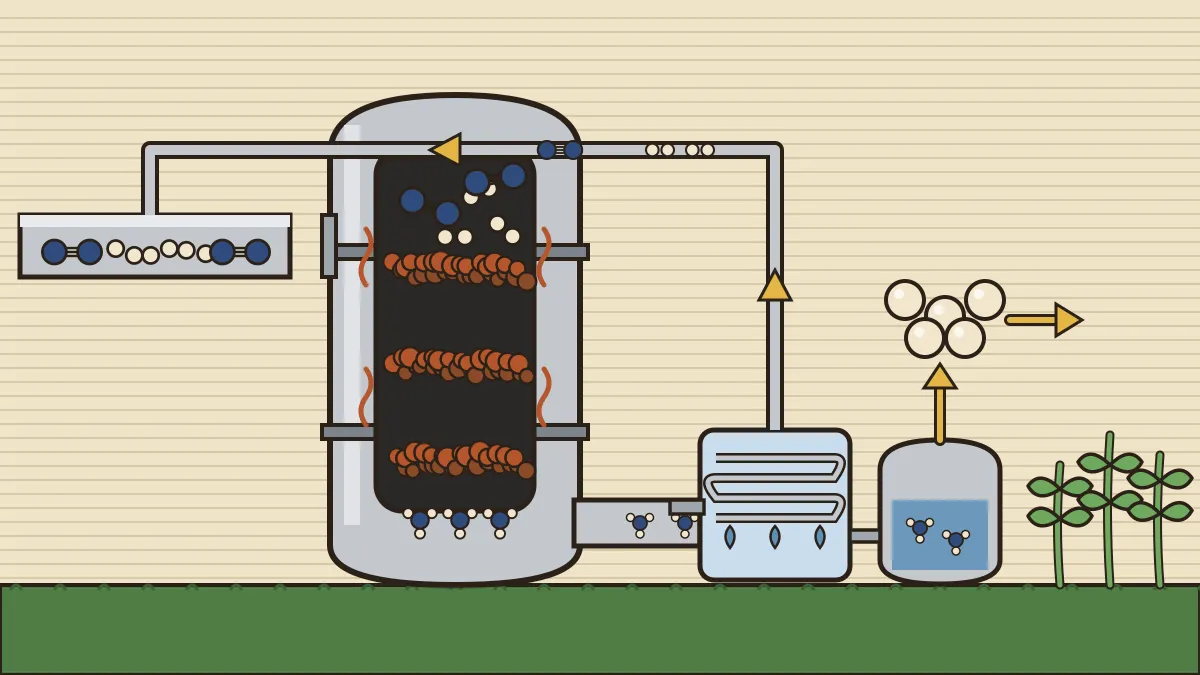
Only about 10 to 15 per cent of the gas turns into ammonia on each pass over the catalyst. The factory does not wait for a better yield; it takes the ammonia out, sends the rest back and goes round again, so that nearly all the nitrogen and hydrogen is used in the end. A second trap is catalyst poisoning: sulphur compounds such as hydrogen sulphide poison the iron, so the feed gas must be cleaned first. Promoters work the other way and make the catalyst more active. The source of the hydrogen also matters; our hydrogen article covers how it is made. Most Indian urea plants take it from natural gas, and "green ammonia" would take it from the electrolysis of water.
An iron catalyst does not make the process give a higher yield. It makes the reaction fast enough at a temperature that is low enough to give a decent yield. A question that says "the catalyst shifts the equilibrium towards ammonia" is false.
From Ammonia to Urea
Ammonia is a gas that is awkward to store and apply, so most of it is converted into solid fertilisers. The commonest is urea, CO(NH2)2, made by reacting ammonia with carbon dioxide at high pressure and temperature (about 180 degrees Celsius) in two steps:
2NH3 + CO2 → NH2COONH4 (ammonium carbamate) → CO(NH2)2 + H2O
The carbon dioxide is not bought separately: it comes out of the hydrogen plant, so a urea complex uses its own waste gas. Wohler's synthesis of urea from ammonium cyanate in 1828 was the first time an organic compound was made from an inorganic one; that was a laboratory curiosity, while the modern route is the ammonia-carbon dioxide one. Urea is made in the body too, from protein breakdown in the liver, and it is the main nitrogen waste of mammals.
Molar mass of CO(NH2)2 = 12 + 16 + 2 × (14 + 2) = 60 g/mol. Nitrogen = 28 g, hydrogen = 4 g. So N = 28/60 = 46.7%, about 47%, and H = 4/60 = 6.7%, about 7%. Urea has more nitrogen than any common solid fertiliser, which is the reason it dominates.
2NH3 + CO2 → CO(NH2)2 + H2O. Two moles of NH3 (2 × 17 = 34 g) give one mole of urea (60 g). A plant making 12.7 lakh tonnes of urea needs at least 12.7 × 34/60 = 7.2 lakh tonnes of ammonia, and in practice somewhat more because no process is perfect.
| Compound | Formula | Nitrogen by mass | Note |
|---|---|---|---|
| Anhydrous ammonia | NH3 | 82% | Highest, but a gas stored under pressure |
| Urea | CO(NH2)2 | 47% | Highest among common solids |
| Ammonium nitrate | NH4NO3 | 35% | Strong oxidiser; explosive when stored badly |
| Ammonium sulphate | (NH4)2SO4 | 21% | Also supplies sulphur |
| Diammonium phosphate (DAP) | (NH4)2HPO4 | 18% N in the commercial grade (pure compound 21%), plus phosphorus | Supplies two nutrients |
Nitrogen (N), phosphorus (P) and potassium (K) are the three main nutrients; nitrogen builds proteins and chlorophyll. Elemental nitrogen (N2) is, of course, not a fertiliser, and neither is ammonium sulphide or a compound with no available nitrogen, such as potassium chloride (which is a potash fertiliser). Urea is not a phosphorus fertiliser. The subsidy side of the story, including neem-coated urea and the nutrient-based subsidy, is in our fertiliser subsidy article.
What Happens in the Field and the Port
Once in the soil, urea is converted by the enzyme urease to ammonium and then, through nitrification by soil bacteria, to nitrate, which plants take up. Nitrate is very soluble and is easily washed out. When it reaches lakes it feeds algae, and the excess growth and later decay use up the dissolved oxygen: this is eutrophication. In drinking water, high nitrate is a health risk for infants. Neem-coating slows the conversion and keeps nitrogen in the soil longer, and part of the reason for modernising old plants is energy. PIB notes that the old Nangal unit uses 6.498 Gcal per tonne against an industry average of 5.95 and a new norm of 5, so replacing it with a modern unit saves fuel as well as adding capacity.
Ammonia also leads to nitric acid by the Ostwald process: ammonia is oxidised over a platinum-rhodium catalyst to nitric oxide, which is further oxidised to nitrogen dioxide and absorbed in water. Nitric acid reacts with ammonia to give ammonium nitrate, both a fertiliser and an explosive ingredient. In August 2020 the stored ammonium nitrate at the Beirut port exploded, a case the CDS paper has used.
Haber: ammonia (iron catalyst). Ostwald: nitric acid from ammonia (Pt-Rh). Contact: sulphuric acid (V2O5, or platinum in older plants). Examiners offer the three names with the wrong products.
How UPSC Has Asked It: Past Papers Solved
These are real CDS and NDA questions. They ask for the named process, the nitrogen content of urea, which compounds are fertilisers and the stability of nitrogen.
Which among the following is the popular method for manufacture of ammonia?
(a) Ostwald's process (b) Haber-Bosch process (c) Electric furnace process (d) Electrolysis process
Answer: (b). Haber-Bosch. Ostwald's process starts with ammonia and makes nitric acid, so it is the tempting wrong option.
Which one of the following statements about fertilizers is not correct?
(a) Urea is a phosphorus-containing fertilizer. (b) Application of fertilizer to the soil increases fertility of the soil. (c) Urea can be prepared by action of ammonia and carbon dioxide under high pressure and at high temperature. (d) Urea contains more nitrogen than other fertilizers.
Answer: (a). Urea contains nitrogen, not phosphorus. The other statements match what we saw: it is made from NH3 and CO2 under pressure and heat, and it has the highest nitrogen content among common solid fertilisers.
What are the approximate percentages by mass of nitrogen and hydrogen respectively in urea?
(a) 43% and 5% (b) 47% and 5% (c) 43% and 7% (d) 47% and 7%
Answer: (d). Urea is 60 g/mol with 28 g of nitrogen and 4 g of hydrogen: 46.7% and 6.7%. Options that give 43% or 5% come from forgetting that there are four hydrogens or miscounting the mass.
Which one of the following is not a nitrogen fertilizer?
(a) (NH4)2SO4 (b) NH4NO3 (c) N2 (d) (NH2)2CO
Answer: (c). Elemental nitrogen cannot be used by plants. The other three are ammonium sulphate, ammonium nitrate and urea.
Which one of the following is not used as fertilizer?
(a) Ammonium nitrate (b) Ammonium sulphide (c) Ammonium phosphate (d) Ammonium sulphate
Answer: (b). Ammonium sulphide is a toxic, foul-smelling compound used in the laboratory. The other three are fertilisers; note that the names differ by one syllable.
In August 2020, a blast has taken place at Beirut killing about one hundred people and thousand wounded. The blast was caused by
(a) dynamite (b) ammonium nitrate (c) RDX (d) mercury nitride
Answer: (b). A large quantity of ammonium nitrate, a fertiliser and strong oxidiser, was stored at the port and exploded.
Dinitrogen (N2) and dioxygen (O2) are the main constituents of air but they do not react with each other to form oxides of nitrogen because
(a) the reaction requires initiation by a catalyst (b) oxides of nitrogen are unstable (c) the reaction is endothermic and requires very high temperature (d) the stoichiometry of N2 and O2 in air is not ideal for the reaction to take place
Answer: (c). N2 + O2 → 2NO absorbs heat and needs very high temperature. Option (a) is the common guess, but even a catalyst would not remove the energy requirement.
Four of the seven are really one question: which compounds are fertilisers and which are not. Memorise the five in the table, remember that N2 and ammonium sulphide are not on it, and add the 47% figure for urea.
Practice MCQs (with answers)
- The catalyst used in the Haber process for ammonia is
- nickel
- platinum
- vanadium pentoxide
- finely divided iron
- Which change increases the equilibrium yield of ammonia in N2 + 3H2 ⇌ 2NH3 (exothermic)?
- Raising the temperature
- Removing the catalyst
- Raising the pressure
- Adding a catalyst
- The approximate percentage of nitrogen by mass in urea is
- 21%
- 47%
- 82%
- 35%
- Urea is manufactured industrially by reacting ammonia with
- carbon dioxide
- carbon monoxide
- nitric oxide
- sulphur dioxide
- The industrial synthesis of ammonia is associated with
- Fritz Haber and Carl Bosch
- Ostwald and Birkeland
- Wohler and Liebig
- Solvay and Le Chatelier
- Which of the following is NOT a nitrogen fertiliser?
- Ammonium nitrate
- Urea
- Ammonium sulphate
- Potassium chloride
- Which statement about nitrogen gas is correct?
- Its atoms are joined by a double bond
- It is highly reactive at room temperature
- It has a triple bond and is largely unreactive at room temperature
- It is a triatomic gas
- Nitric acid is manufactured from ammonia by the
- Haber process
- Ostwald process
- Contact process
- Solvay process
1-d, 2-c, 3-b, 4-a, 5-a, 6-d, 7-c, 8-b. Q1: nickel is for hydrogenation of oils, platinum for the Ostwald process, V2O5 for the Contact process. Q2: pressure favours the side with fewer gas molecules; raising temperature lowers the yield of an exothermic reaction; a catalyst never changes the equilibrium yield. Q3: 21% is ammonium sulphate, 35% ammonium nitrate and 82% ammonia. Q6: potassium chloride supplies potassium, not nitrogen. Q8: the Contact process makes sulphuric acid and the Solvay process makes sodium carbonate.
Quick Revision
- N2: triple bond, non-polar, inert; N2 + O2 → 2NO is endothermic (lightning, engines).
- Haber-Bosch: N2 + 3H2 ⇌ 2NH3, ΔH = −92 kJ (−46 kJ per mole of NH3); about 200 atm, 700-750 K, iron catalyst with molybdenum promoter; H2S poisons the catalyst. Haber (1909), Bosch (1913).
- Le Chatelier: high pressure and low temperature favour yield; the catalyst only speeds the approach. Unreacted gas is recycled, and ammonia is liquefied and removed.
- Urea: 2NH3 + CO2 → carbamate → CO(NH2)2 + H2O; 60 g/mol, 47% N, 7% H. CO2 comes from the hydrogen plant.
- N fertilisers: urea 47%, ammonium nitrate 35%, ammonium sulphate 21%, DAP (N and P). Not fertilisers: N2, ammonium sulphide.
- Ostwald: NH3 to HNO3 (Pt-Rh). Contact: H2SO4. Ammonium nitrate caused the Beirut blast (2020).
- Hook (25 Nov 2026): 6 brownfield urea plants, 12.7 LMT each, about ₹54,000 crore, under NIPU-2026; demand about 400 LMT a year.
Frequently asked questions
Why is the Haber process run at 450 degrees Celsius and not lower?
The forward reaction is exothermic, so a low temperature would give more ammonia at equilibrium, but it would be far too slow. Around 450 degrees Celsius (700 to 750 K) with an iron catalyst gives a workable speed with a reasonable yield, so the plant treats this as a compromise.
Does a catalyst increase the amount of ammonia made?
No. A catalyst only speeds up the forward and backward reactions equally, so equilibrium is reached sooner. The amount of ammonia at equilibrium depends on temperature, pressure and concentrations, not on the catalyst.
How is urea made from ammonia?
Ammonia reacts with carbon dioxide at high pressure and about 180 degrees Celsius to form ammonium carbamate, which loses water to give urea, CO(NH2)2. The carbon dioxide comes from the plant that makes hydrogen for the ammonia.
Why is urea the most used nitrogen fertiliser?
Urea holds about 47 per cent nitrogen by mass, more than any other common solid fertiliser, so a given amount supplies more nitrogen and costs less to transport. It is also easy to store and apply as prills or granules.
Why are new urea plants being built in India?
India uses about 400 lakh tonnes of urea a year and imports the shortfall. The six plants approved under NIPU-2026 are meant to replace old, energy-hungry units or expand existing ones, so that domestic production rises and the import bill falls.
Related CDS / OTA Science topics
Science is a big slice of the CDS GS paper
Cavalier's CDS/OTA batches teach physics, chemistry and biology from first principles, with numericals and weekly PYQ tests.