On 11 November 2026 the Union Cabinet approved the Nutrient Based Subsidy (NBS) rates for Rabi 2026-27, covering phosphatic and potassic (P&K) fertilisers from 1 October 2026 to 31 March 2027. The bill is about ₹62,370 crore, which is ₹24,418 crore more than the ₹37,952 crore for Rabi 2025-26, a rise of roughly 64%. The government's reason is the recent trend in world prices of urea, DAP, potash and sulphur. Behind that one number lies the way India feeds its crops: two different subsidy systems, one fixed price that has barely moved, and a soil that is paying for it.
Two Systems: Urea Under Control, Phosphate and Potash Under NBS
By Hitendra Deswal · Economics faculty, The Cavalier
The Centre does not treat all fertilisers alike. Urea, the nitrogen fertiliser, is sold at a statutory maximum retail price (MRP) fixed by the Centre. Everything else that carries a subsidy, mainly DAP, other phosphates, potash and complex NPKS grades, falls under the Nutrient Based Subsidy scheme, in force from 1 April 2010. Under it the Centre fixes a rupee-per-kilogram subsidy for each nutrient, and the company fixes the price (watched by the government, which has issued rules on a "reasonable" MRP). The Department of Fertilizers says 28 grades of P&K fertiliser are covered.
| Feature | Urea | P&K fertilisers (DAP, MOP, NPKS) |
|---|---|---|
| Scheme | Urea subsidy, under the New Urea Policy 2015 | Nutrient Based Subsidy, since 1 April 2010 |
| Farm-gate price | Fixed by the Centre: ₹266.50 per 45-kg bag (the statutory ₹242 plus neem-coating charges and taxes) | Set by companies under government watch; DAP has been held near ₹1,350 per 50-kg bag |
| How subsidy is set | Government pays the gap between the cost of making or importing urea and the farmer's price | Fixed ₹ per kg of N, P, K and S, announced for each season |
| Seasons | Continuous | Kharif 1 April to 30 September; Rabi 1 October to 31 March |
| Nutrient | About 46% nitrogen | DAP is 18% N and 46% P2O5; MOP is potash |
Before 2010, urea's cost-plus approach had been in place since the Retention Price Scheme of 1977, which paid each plant its cost and an assured return; it was replaced in stages from 2003. Nutrients other than nitrogen were meanwhile decontrolled in the early 1990s. That left farmers with cheap nitrogen and expensive everything else. NBS was meant to give a subsidy on the nutrient content and so encourage balanced use. The urea price, however, stayed frozen.
Urea: ₹266.50 per 45-kg bag. DAP: ₹1,350 per 50-kg bag. Compare the cost per kg of nitrogen and of phosphate.
The subsidy is paid to fertiliser companies, not to farmers. Under the "DBT in fertilisers" system, it is released on actual sales recorded on Aadhaar-linked point-of-sale (PoS) machines. The farmer gets it only as a lower price at the counter. Do not confuse this with PM-KISAN, which sends cash to the farmer's account.
Neem Coating, Bharat Brand and PoS: Plugging the Leaks
A cheap, fixed-price input invites diversion: urea meant for farms can be sold to industry (it goes into plywood, resins and dyes) or smuggled across a border. Three measures tackle this.
- Neem-coated urea (2015). The Centre made 100% neem coating compulsory for all domestically produced urea. The coating slows the release of nitrogen, which improves nutrient use, and makes the urea unfit for industrial use. In the same year the New Urea Policy 2015 aimed to raise domestic output, improve energy efficiency in plants and rein in the subsidy bill. Bags were later cut from 50 kg to 45 kg.
- Aadhaar-linked PoS sales and iFMS. Each sale is tied to a buyer. The Integrated Fertiliser Management System tracks fertiliser from factory to retailer. The Department says it covers over 14 crore Aadhaar-linked buyers and more than 2.5 lakh retailers.
- One Nation One Fertiliser (24 August 2022). All companies, public, cooperative and private, must sell subsidised fertilisers under a single "Bharat" brand, under the Pradhan Mantri Bhartiya Janurvarak Pariyojana (PMBJP). Today urea, DAP, MOP and NPKS all carry it.
Soil Health Cards, begun in 2014-15, tell a farmer which nutrients the plot lacks. By 13 March 2026 the Centre had issued 25.89 crore of them. For the wider farm-policy map, see our page on agricultural economics, and for how the grain side of the same system works, read food security, FCI and buffer stocks.
The NPK Distortion: Cheap Nitrogen, Tired Soil
Plants need nitrogen (N), phosphorus (P) and potassium (K) in a rough balance. The usual benchmark for most Indian soils is 4 : 2 : 1. The Economic Survey tracked the ratio actually used by farmers:
| Year | N : P : K used | Reading |
|---|---|---|
| 2009-10 | 4 : 3.2 : 1 | Close to the benchmark |
| 2019-20 | 7 : 2.8 : 1 | Nitrogen racing ahead |
| 2023-24 | About 10.9 : 4.1 : 1 | Far from 4 : 2 : 1 |
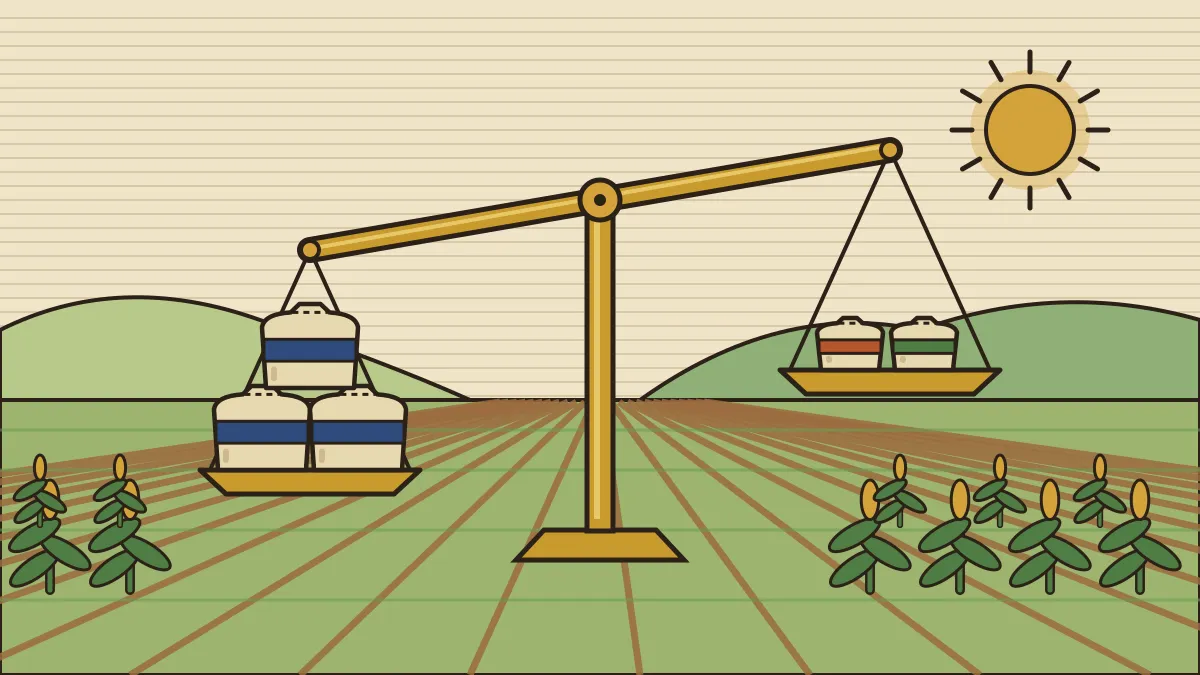
The Survey blames price distortions that favour nitrogen. When one nutrient is far cheaper than the others, farmers over-apply it, and no amount of monitoring changes that signal. Excess nitrogen cuts soil organic matter, speeds up the loss of micronutrients, leaches nitrate into groundwater and gives a weaker crop response, so more fertiliser is needed for the same yield. In 2026 Union Agriculture Minister Shivraj Singh Chouhan said that heavy urea and DAP use raises acidity and greenhouse-gas emissions; the June 2026 Khet Bachao Abhiyan campaign aimed to reach one crore farmers with this message. Our note on Indian soils shows which soils are short of what.
Possible cures now in play:
- Nano urea and nano DAP. IFFCO launched liquid nano urea in 2021, followed by nano DAP, both sprayed on the leaves. IFFCO says a 500 ml bottle can replace one 45-kg bag, which would cut the quantity of nitrogen reaching the soil. The Centre promotes them through PM Kisan Samriddhi Kendras and Kisan drones, while Gujarat gives a 50% subsidy on nano fertilisers. Scientists still debate how well they work in the field, so treat claims of replacement with care.
- PM-PRANAM (PM Programme for Restoration, Awareness Generation, Nourishment and Amelioration of Mother Earth), approved on 28 June 2023 for 2023-24 to 2025-26. A state that cuts its use of urea, DAP, NPK and MOP below its three-year average earns 50% of the subsidy saved. Of that grant, 70% can go into assets such as alternative-fertiliser production units, and the rest into rewarding farmers and panchayats. Only five States/UTs had cut use in 2025-26, saving a mere 0.18 lakh tonnes.
- A price fix proposed by the Economic Survey: raise the urea price modestly and give the farmer an equal per-acre cash transfer, so that the nutrient price reflects scarcity but the farmer's income does not fall.
The Bill, the Imports and the Argument
The Centre now spends close to ₹2 lakh crore a year on fertiliser subsidy, according to PIB. Between 2022-23 and July 2025 the total came to ₹6.77 lakh crore. A bigger subsidy bill widens the fiscal deficit, as we explain on our government budgeting page.
On the government's June 2026 figures, the landed price of a 45-kg bag of urea is over ₹4,000. The farmer pays ₹266.50.
That gap exists because India depends on imports. Domestic urea output touched a record 314.07 lakh tonnes in 2023-24 and was 306.67 lakh tonnes in 2024-25, yet India still imports a large share of its urea, about 56 lakh tonnes in 2024-25 and over one crore tonnes in 2025-26, roughly 15 to 25% of consumption. Ammonia, the raw material for urea, is almost wholly imported, as is LNG, the gas that makes it. Potash (MOP) has no domestic production at all. So when the West Asia conflict of 2026 disrupted gas and shipping through the Strait of Hormuz, India raised its stocks and bought through joint tenders. The government says that Kharif 2026 opened with about half of the season's fertiliser need already in stock. Our June 2026 article on the fertiliser self-reliance push covers that episode. For the long run, the coal-gasification mission and green ammonia are the answers (see our hydrogen page), with SECI supply agreements signed for 6.7 lakh tonnes a year of green ammonia for fertiliser units.
The argument. A new technology looks risky to a farmer, so a subsidy helps him try it. Critics say that once a technology pays for itself, the subsidy should end. They add that much of the benefit goes to the fertiliser industry and to farmers in prosperous irrigated regions, not to the poorest. Defenders reply that farming is risky, most farmers are poor, and removing the subsidy raises the cost of cultivation, especially for small and marginal farmers. A good answer states both.
How UPSC Has Asked It: Past Papers Solved
These are actual CDS and NDA questions. They test three things: where subsidy money goes, the chemistry of urea, and the fiscal effect of subsidies.
As per the Budget Estimates of expenditure on major subsidies during 2019-20, the maximum expenditure was likely to be on
(a) urea subsidy (b) petroleum subsidy (c) food subsidy (d) fertilizer subsidy
Answer: (c). Food subsidy was the largest, at about ₹1.84 lakh crore, against roughly ₹80,000 crore for fertilisers. Urea is only part of the fertiliser bill, so (a) cannot beat (d).
Which one of the following is an example of a price floor?
(a) Minimum Support Price (MSP) for Jowar in India (b) Subsidy given to farmers to buy fertilizers (c) Price paid by people to buy goods from ration shops (d) Maximum Retail Price (MRP) printed on the covers/packets of goods sold in India
Answer: (a). MSP is a minimum, a floor. An MRP is a ceiling, and the fertiliser subsidy and ration-shop price lower what the buyer pays.
Fertilizers are used to obtain higher yields of crops. However, all nutrients are usually not available in fertilizers. Which one of the following nutrients is usually not available in fertilizers?
(a) Iron (b) Potassium (c) Nitrogen (d) Phosphorus
Answer: (a). The three main fertiliser nutrients are N, P and K. Iron is a micronutrient and is not usually supplied in ordinary fertilisers.
Which one of the following statements about fertilizers is not correct?
(a) Urea is a phosphorus-containing fertilizer. (b) Application of fertilizer to the soil increases fertility of the soil. (c) Urea can be prepared by action of ammonia and carbon dioxide under high pressure and at high temperature. (d) Urea contains more nitrogen than other fertilizers.
Answer: (a). Urea, CO(NH2)2, has no phosphorus. It is made from ammonia and CO2, and with about 46% nitrogen it is the richest common nitrogen fertiliser.
What are the approximate percentages by mass of nitrogen and hydrogen respectively in urea?
(a) 43% and 5% (b) 47% and 5% (c) 43% and 7% (d) 47% and 7%
Answer: (d). CO(NH2)2 has a mass of 60 u, with 28 u of nitrogen and 4 u of hydrogen. N = 28 ÷ 60 = 46.7%, and H = 4 ÷ 60 = 6.7%.
Which one of the following is not a nitrogen fertilizer?
(a) (NH₄)₂SO₄ (b) NH₄NO₃ (c) N₂ (d) (NH₂)₂CO
Answer: (c). Nitrogen gas is not a fertiliser, since plants cannot use it directly. The other three are ammonium sulphate, ammonium nitrate and urea.
India's fiscal deficit widens significantly due to increased Government spending on subsidies while tax revenue remains unchanged. Which one of the following is the most likely consequence?
(a) Inflation will rise, interest rates will fall, and private investment will increase (b) Inflation will rise, interest rates may rise, and private investment may slow down (c) Inflation will fall, interest rates will rise, and private investment will increase (d) Inflation will fall, interest rates will fall, and GDP growth will accelerate
Answer: (b). A larger deficit means more borrowing, which can push interest rates up and crowd out private investment. Demand pressure adds to inflation.
Subsidy questions are about direction and size: food is the biggest subsidy, fertiliser second. Chemistry questions test urea's 46% nitrogen and its formula. A scheme question usually asks for a date or a name (NBS 2010, neem coating 2015, Bharat brand 2022, PM-PRANAM 2023).
Practice MCQs (with answers)
- A 45-kg bag of subsidised urea costs the farmer ₹266.50. This price is
- set each season by the company
- decided by state governments
- fixed by the Centre
- set by the world market
- The Nutrient Based Subsidy scheme began on
- 1 April 2010
- 1 April 2015
- 1 April 2000
- 24 August 2022
- The N:P:K ratio usually quoted as suitable for most Indian soils is
- 1 : 1 : 1
- 10 : 4 : 1
- 2 : 4 : 1
- 4 : 2 : 1
- Neem coating of urea mainly
- lowers the import price of urea
- slows nitrogen release and limits diversion to industry
- adds phosphorus
- raises the retail price
- Under One Nation One Fertiliser, subsidised fertilisers are sold under the brand
- Bharat
- Kisan
- Annapurna
- Gobar
- Under PM-PRANAM, a state earns incentive money when it
- imports more urea
- raises the urea MRP
- cuts chemical fertiliser use below its three-year average
- buys more DAP
- Liquid nano urea was launched by
- NFL
- IFFCO
- KRIBHCO
- RCF
- Which fertiliser material is almost entirely imported by India?
- Single super phosphate
- Urea
- Neem-coated urea
- Muriate of potash
1-c, 2-a, 3-d, 4-b, 5-a, 6-c, 7-b, 8-d. Q1: urea's price is a Centre-fixed MRP, but P&K prices are company-set under NBS. Q2: NBS began on 1 April 2010; the New Urea Policy and neem coating came in 2015. Q6: the incentive is 50% of the subsidy saved. Q8: urea is partly imported, but potash has no domestic production.
Quick Revision
- Urea: Centre-fixed MRP, ₹266.50 per 45-kg bag; about 46% N; subsidy covers the gap to cost. P&K (DAP, MOP, NPKS): NBS from 1 April 2010; a fixed ₹ per kg of nutrient, set each season; 28 grades; DAP about ₹1,350 per 50-kg bag.
- Seasons: Kharif 1 April to 30 September; Rabi 1 October to 31 March. Rabi 2026-27 NBS: ₹62,370 crore, up ₹24,418 crore from ₹37,952 crore (Cabinet, 11 November 2026).
- Leakage control: 100% neem-coated urea (2015); Aadhaar-linked PoS and iFMS; Bharat brand from 24 August 2022 (PMBJP). Subsidy goes to companies, not farmers.
- NPK ratio: benchmark 4:2:1; 4:3.2:1 (2009-10), 7:2.8:1 (2019-20), about 10.9:4.1:1 (2023-24). Cause: cheap nitrogen.
- Corrections: Soil Health Card (2014-15); nano urea (IFFCO, 2021); PM-PRANAM (28 June 2023): 50% of subsidy saved as grant, 70% of it for assets; Economic Survey's per-acre transfer idea.
- Money and imports: subsidy near ₹2 lakh crore a year; record urea output 314.07 lakh tonnes (2023-24); urea imports about 15 to 25% of use; potash wholly imported; ammonia almost wholly imported; green ammonia supply deals for 6.7 lakh tonnes a year.
Frequently asked questions
What is the difference between urea subsidy and NBS?
Urea is sold at a price fixed by the Centre (₹266.50 for a 45-kg bag), and the Centre pays the manufacturer the gap between cost and that price. Phosphatic and potassic fertilisers such as DAP are under the Nutrient Based Subsidy scheme, started on 1 April 2010. Under it the Centre fixes a rupee-per-kilogram subsidy for each nutrient every season, and the company sets the retail price.
Does the fertiliser subsidy go to farmers?
No, the subsidy is paid to fertiliser companies. Under direct benefit transfer in fertilisers, it is released after each sale is recorded on an Aadhaar-linked point-of-sale machine. The farmer receives the benefit as a lower price at the shop, unlike PM-KISAN, which pays cash into bank accounts.
Why is the N:P:K ratio a problem in India?
Farmers use far more nitrogen than phosphorus and potash because urea is the cheapest nutrient. The Economic Survey reports a ratio of about 10.9:4.1:1 in 2023-24 against a benchmark of about 4:2:1. Excess nitrogen harms soil organic matter and groundwater and weakens the crop response.
What is nano urea?
Nano urea is a liquid form of nitrogen fertiliser developed by IFFCO and sprayed on the leaves. The company says a 500 ml bottle can replace a 45-kg bag of urea. The government is promoting it through farm centres and drone spraying, although scientists continue to debate its field performance.
What is One Nation One Fertiliser?
It is a scheme in force from 24 August 2022 under which all companies sell subsidised fertilisers under one common brand, Bharat. It covers urea, DAP, MOP and NPKS grades. The aim is to cut cross-country movement, avoid brand confusion and ensure timely supply.
Related CDS / OTA Economics topics
Schemes and numbers are an easy GS score
Cavalier's CDS/OTA batches turn schemes into one-page flow charts and test them every week with PYQs.