On 27 November 2026, the Ministry of Science and Technology announced a new way to build white LEDs that stay stable, can be sprayed onto glass or flexible plastic, and can change from cool to warm white just by changing the current. The work came from the Centre for Nano and Soft Matter Sciences (CeNS), Bengaluru, with IIT Delhi. It is a small step in a long story, because lighting is one of the few places where three generations of physics sit side by side in one hardware shop. A filament bulb glows because it is hot. A tube light glows because a gas is excited and a coating re-emits the light. An LED glows because electrons and holes meet in a crystal. UPSC loves exactly this comparison, and it asks the facts behind it again and again: the filament metal, the gas in the bulb, the primary colours, the energy bill.
What White Light Is: Colours, Mixing and Colour Temperature
By Abhishek Thakur · Science faculty, The Cavalier · 15 years teaching NDA and CDS Science
White light is not a colour of its own. It is a mixture. A prism splits sunlight into its spectrum (the dispersion we cover on our dispersion page), and putting the colours back together restores white. Our eyes need far less than the whole spectrum, though. The retina has three kinds of cone cells, sensitive mainly to red, green and blue. So if a lamp supplies just the right amounts of those three, or a blue plus a yellow, the brain sees white. This is why a phone screen and a white LED can fake white with only a few colours.
| Mixing | Primary colours | What they make |
|---|---|---|
| Additive (mixing lights: screens, LEDs, stage lamps) | Red, green, blue | Red + green = yellow; green + blue = cyan; red + blue = magenta; all three = white |
| Subtractive (mixing pigments and dyes: paint, printing) | Cyan, magenta, yellow | Each pigment absorbs part of the light; all three together approach black |
School paint boxes say red, yellow and blue. That is for pigments, and even there it is only a rough guide. The primary colours of light are red, green and blue. A question that says "primary colours of light" with "yellow" in an option is a trap (see NDA 2021-I below).
Two lamps can both look white and still feel different. That difference is the colour temperature, measured in kelvin. A hot body glows with a colour that depends on its temperature, and the lamp is named after the black body it resembles. A low value means a warm, yellow-red light; a high value means a cool, bluish light.
| Label | Colour temperature | Feel | Example |
|---|---|---|---|
| Warm white | About 2,700 to 3,000 K | Yellowish, cosy | Filament bulb, warm LED |
| Neutral white | About 4,000 K | Balanced | Offices, shops |
| Cool daylight | About 5,000 to 6,500 K | Bluish-white | Daylight tube, cool LED |
The physics behind it is Wien's displacement law: the wavelength at which a hot body radiates most strongly is inversely proportional to its absolute temperature (λmax × T = 2.9 × 10⁻³ m·K). The Sun's surface is at about 5,800 K, so its peak is near 500 nm, in the green-blue part of the spectrum. A bulb filament is far cooler, and that is the root of its problem, as the next section shows.
The Filament Bulb: Light as a By-product of Heat
Thomas Edison in the USA and Joseph Swan in Britain each built practical carbon-filament lamps around 1879. Tungsten filaments took over in the early 1900s and are still the heart of an incandescent bulb. A current passes through a thin coil, the filament resists it, and electrical energy turns into heat (P = I²R). The filament gets so hot that it glows. This is incandescence: light made by a hot solid.
| Part | Choice | Why |
|---|---|---|
| Filament | Tungsten | It has the highest melting point of any metal, about 3,400 °C, and a high resistance. It can glow white-hot near 3,000 K without melting |
| Shape | A fine coil, often coiled again | A long thin wire gives high resistance in a small space, and coiling loses less heat to the gas |
| Gas | Argon (with a little nitrogen), at low pressure | It is chemically inert, so the hot tungsten does not burn, and it slows the evaporation of the filament, which lengthens the bulb's life |
| Glass bulb | Sealed | Keeps out oxygen, so the filament does not burn away |
The gas in an ordinary bulb is argon (or nitrogen), never oxygen and not helium. Oxygen would burn the filament. Helium conducts heat away too well. UPSC asked exactly this in CDS 2024-II.
Where does the energy go? A filament at 3,000 K has its peak emission by Wien's law at λ = 2.9 × 10⁻³ ÷ 3,000 ≈ 970 nm. That is in the infrared, outside the visible range (about 400 to 700 nm). Only the short-wavelength tail of the curve is visible. Only roughly 5 to 10 per cent of a filament bulb's electrical energy comes out as visible light, and the rest is heat. That is why a bulb is too hot to touch. The Stefan-Boltzmann law (E = eAσT⁴) shows why a hotter filament would be better, because the power radiated rises as T⁴, and why it cannot be hotter: tungsten would evaporate. The principle of heat radiation is explained on our heat transfer page.
A halogen lamp is an improved filament bulb. A trace of a halogen (iodine or bromine) in a small quartz envelope returns evaporated tungsten to the filament, which lets it run hotter and give a whiter light for longer. It is still a hot-wire lamp and still wasteful.
An incandescent bulb has a filament of resistance 200 Ω carrying 2 A. Only 20% of its power becomes light. If it burns for 10 hours and electricity costs ₹5 per unit, what does the light cost?
Discharge Lamps and the Fluorescent Tube
A second way to make light uses a gas instead of a hot solid. When a current passes through a gas at low pressure, electrons collide with the gas atoms and lift their electrons to higher energy levels. When those electrons drop back, each atom emits a photon of a fixed energy, so the light has the gas's characteristic colour. This is the same atomic physics behind line spectra. The glow is made without heating a filament, so it wastes much less energy.
| Lamp | Gas | Colour |
|---|---|---|
| Neon sign | Neon | Red-orange |
| Street lamp (low-pressure) | Sodium vapour | Yellow (about 589 nm) |
| Camera flash, searchlight | Xenon | Bright, near-daylight white |
| Tube light, CFL | Mercury vapour with argon | Invisible ultraviolet first, then white through a coating |
Mercury vapour produces mostly ultraviolet (about 254 nm), which we cannot see and which would harm the eyes. So the inner wall of a fluorescent tube is coated with a phosphor, a powder that absorbs ultraviolet and re-emits visible light. This is fluorescence. The re-emitted photon always has less energy than the absorbed one, which is why UV (high energy) can become white light (lower energy), but visible light cannot become UV. A blend of phosphors sets whether the tube looks warm or cool. A CFL (compact fluorescent lamp) is a folded tube working in the same way.
- Old tubes need a starter to heat the electrodes and a choke (ballast), which gives a high-voltage kick to start the discharge and then limits the current. Modern lamps use an electronic ballast.
- A tube gives roughly three to five times more light per watt than a filament bulb.
- It contains a small amount of mercury, so a broken or dead tube or CFL should be disposed of as e-waste and not thrown into household garbage.
The LED, and How It Makes White
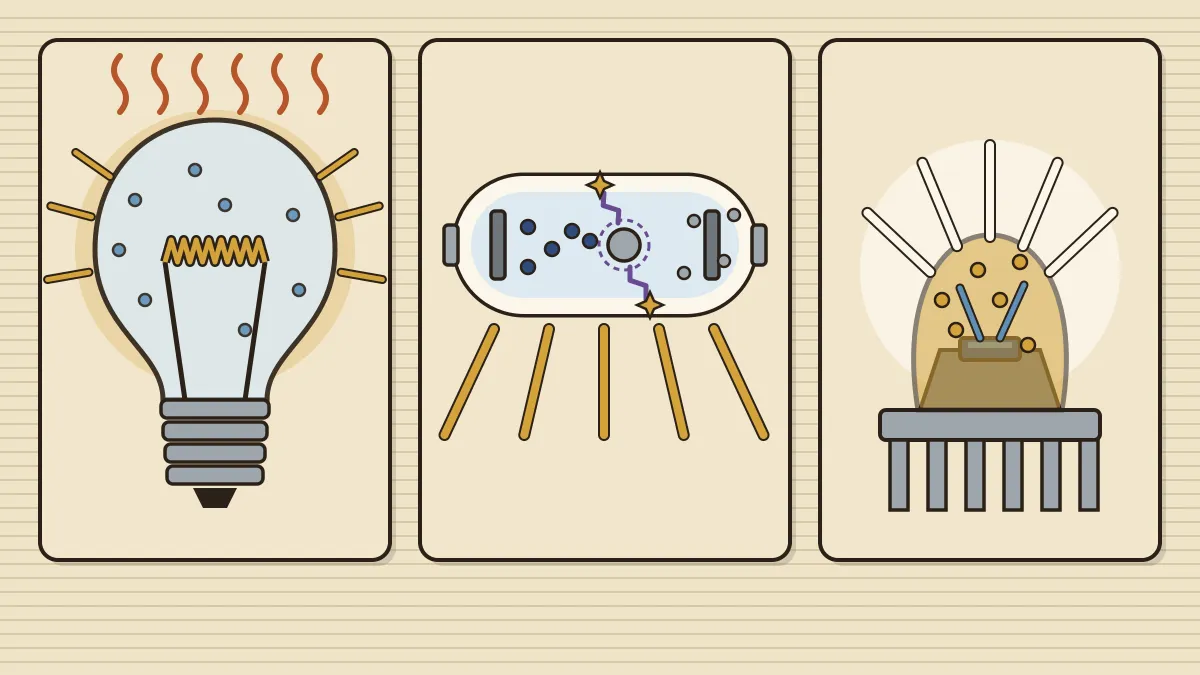
An LED (light-emitting diode) is a p-n junction made of a compound semiconductor. When it is forward-biased, electrons and holes meet at the junction and recombine, and each recombination releases a photon. The junction itself, bias and band gap are on our semiconductors page. The point to add here is that the colour is fixed by the band gap of the material, because the photon carries roughly the gap energy:
The first visible LED (red) appeared in 1962. A blue LED was much harder, because it needs gallium nitride crystals of high quality. Isamu Akasaki, Hiroshi Amano and Shuji Nakamura solved that, and received the 2014 Nobel Prize in Physics for it. The blue LED matters because with red and green already available, blue completes the set that gives white.
There are two ways to get white out of an LED:
- Phosphor-converted white LED (almost every bulb you buy). A blue LED chip is covered with a yellow-emitting phosphor. Part of the blue light passes straight through, part is absorbed and re-emitted as yellow, and the eye adds blue + yellow as white. A little red phosphor gives a warmer tone.
- RGB mixing. Separate red, green and blue LEDs are driven together. This allows any colour, as in stage lights and screens, but costs more.
The tube light and the white LED both use a phosphor. The tube's phosphor converts ultraviolet; the white LED's phosphor converts blue. Only the filament makes light by heating. An LED runs on DC, so a bulb carries a small driver circuit to convert mains AC, and it still gives off some heat at the junction, so it carries a heat sink.
The News: Perovskite Nanocrystals for Tunable White LEDs
A phosphor-converted white LED has two drawbacks, according to the PIB release. The commercial phosphors rely on expensive rare-earth elements and complex, high-temperature manufacturing, and once the lamp is built, the tone of white is fixed. The Bengaluru team looked at all-inorganic halide perovskite nanocrystals (chemical formula CsPbX₃, where X is chlorine, bromine or iodine). These are bright, cheap and emit pure colours. Green-emitting CsPbBr₃ and red-emitting CsPbI₃ crystals, mixed with a blue chip, could in principle make white.
The snag is anion exchange. When green and red nanocrystals touch, their halide ions swap places, and the two colours blur into an unwanted orange within minutes. The researchers locked the colours in with a dual protection:
- They treated the crystal surface with lead selenide to reduce halide vacancies, which are the pathway ions use to move.
- They added an ultrathin aluminium oxide (alumina, Al₂O₃) coat, only about 5 to 6 nanometres thick, by atomic layer deposition, as a barrier between adjacent colour layers.
The layers were put down by spray coating with micropatterning on both rigid glass and flexible PET plastic. In the best versions the white LEDs ran continuously for up to 24 hours with stable emission, even when heated and cooled, and the tone could be made dimmer or warmer simply by changing the electric current. The paper appeared in the journal Small. The release itself notes the open problem: the toxicity of lead must be handled and a greener version found before the technology reaches the market.
Efficiency, Energy Sums and India's LED Drive
The measure that compares lamps is luminous efficacy: lumens of light per watt of electricity. The figures below are rough, but the order never changes.
| Lamp | Light per watt (approximate) | Typical life (approximate) | How light is made |
|---|---|---|---|
| Filament bulb | 10 to 15 lumens per watt | About 1,000 hours | Hot tungsten wire |
| CFL or tube light | 50 to 70 | About 8,000 to 10,000 hours | Mercury discharge plus phosphor |
| LED | 100 or more | 25,000 hours or more | p-n junction plus phosphor |
A 9 W LED gives about the same light as a 60 W filament bulb. Both burn for 5 hours a day. How many units are saved in 20 days, and what is the saving at ₹7 per unit?
The country-scale version of that sum is the UJALA scheme (Unnat Jyoti by Affordable LEDs for All), launched by the Prime Minister on 5 January 2015 and run by Energy Efficiency Services Limited (EESL). Bulk buying pulled the price of an LED bulb down from about ₹450 to ₹500 in 2014 to ₹70 under the scheme, and more than 36 crore LED bulbs have been distributed. The case for LEDs is also tied to the power sector: lights are on during the evening peak, so cutting each bulb's load by more than four-fifths flattens it. For the circuit rules used above, see our resistors page, and for the other end of the light story see how solar cells run an LED in reverse, turning light into electricity.
How UPSC Has Asked It: Past Papers Solved
These are actual NDA and CDS questions. They fall into three types: what is in the bulb, which device converts what, and colour or energy arithmetic.
Why is argon gas used along with tungsten wire in an electric bulb?
(a) To increase the life of the bulb (b) To reduce the consumption of electricity (c) To make the emitted light colored (d) To reduce the cost of the bulb
Answer: (a). Argon is inert and slows the evaporation of the hot tungsten, so the filament lasts longer. It does not change the power drawn or the colour of the light.
Which one of the following metals is most commonly used for making filament of incandescent electric bulbs?
(a) Aluminium (b) Silver (c) Copper (d) Tungsten
Answer: (d). Tungsten has the highest melting point of all metals. Copper, silver and aluminium would melt long before they glowed white.
Which one among the following statements for the gases mentioned below is not correct?
(a) Hydrogen has 3 isotopes (b) Helium is a commonly used gas in electric bulbs (c) Oxygen is used to burn fuel in rocket engines in spacecraft (d) Nitrogen can be used in gaseous form to replace air in food packaging
Answer: (b). Bulbs are filled with argon (or nitrogen), not helium. The other three are correct: hydrogen has protium, deuterium and tritium, rockets use liquid oxygen as the oxidiser, and nitrogen flushing keeps packed food fresh.
Which one of the following does not convert electrical energy into light energy?
(a) A candle (b) A light-emitting diode (c) A laser (d) A television set
Answer: (a). A candle turns the chemical energy of wax into light and heat. An LED, a laser and a television all start from electrical energy.
An incandescent electric bulb converts 20% of its power consumption into light, and the remaining power is dissipated as heat. The bulb's filament has a resistance of 200 Ω and 2 A current flows through it. If the bulb remains ON for 10 h and the rate of electricity charge is ₹5/unit, then which among the following is the correct amount for the money spent on producing light?
(a) ₹5 (b) ₹6 (c) ₹7 (d) ₹8
Answer: (d). P = I²R = 800 W, so 10 hours use 8 units. Twenty per cent of that is 1.6 units, and 1.6 × ₹5 = ₹8. The tempting ₹40 is the cost of all the energy.
Which of the following are the primary colours of light?
(a) Yellow, Red and Green (b) Blue, Red and Green (c) Violet, Red and Yellow (d) Indigo, Violet and Green
Answer: (b). Red, green and blue are the additive primaries. Yellow is a secondary colour of light (red plus green), and violet and indigo are spectrum colours rather than primaries.
In which one of the following devices, the light energy is converted into the electrical energy?
(a) Light-emitting diode (b) Laser diode (c) Solar cell (d) Transistor
Answer: (c). A solar cell turns light into electricity. The LED and the laser diode do the reverse, and a transistor is an amplifier or switch.
Memorise the direction of every energy change. Filament: electrical to heat to a little light. Tube light: electrical to UV to visible, through a phosphor. LED: electrical straight to light. Solar cell and photocell: light to electricity. Candles and flames start from chemical energy, so they are the usual odd one out.
Practice MCQs (with answers)
- Most of the electrical energy supplied to an ordinary filament bulb leaves as
- visible light
- ultraviolet light
- heat (infrared radiation)
- sound
- The ultraviolet radiation inside a fluorescent tube is produced by
- mercury vapour
- the tungsten electrodes' coating
- argon alone
- the phosphor on the glass wall
- Equal amounts of red, green and blue light, when mixed, give
- black
- yellow
- cyan
- white
- The 2014 Nobel Prize in Physics was awarded for the invention of
- the filament lamp
- the blue light-emitting diode
- the transistor
- the integrated circuit
- In most commercial white LED bulbs, white light is obtained from
- an ultraviolet tube and a coating of argon
- a red chip heated by a filament
- a single green chip
- a blue chip covered with a yellow-emitting phosphor
- A bulb filament is made of tungsten mainly because tungsten
- is soft and cheap
- has a very high melting point
- is a good electrical insulator
- is a noble gas
- A lamp described as having a low colour temperature (about 2,700 K) gives
- a warm, yellowish-white light
- a cool, bluish-white light
- mostly ultraviolet light
- no visible light
- A 9 W LED replaces a 60 W bulb. If both are used 5 hours a day, the energy saved in 20 days is
- 1.02 units
- 2.55 units
- 5.1 units
- 10.2 units
1-c, 2-a, 3-d, 4-b, 5-d, 6-b, 7-a, 8-c. Q2: mercury atoms make the UV; the phosphor only converts it to visible light, so option (d) is the tempting wrong answer. Q5: blue plus yellow is perceived as white. Q7: a low kelvin value means warm light, as in a filament bulb. Q8: saving = (60 − 9) × 5 × 20 ÷ 1000 = 5.1 units.
Quick Revision
- White light is a mix. Primary colours of light: red, green, blue (all three = white). Secondary: yellow, cyan, magenta. Pigment primaries: cyan, magenta, yellow.
- Colour temperature in kelvin: low = warm (about 2,700 K), high = cool (6,500 K). Wien: λmax × T = 2.9 × 10⁻³ m·K. The filament at 3,000 K peaks near 970 nm (infrared).
- Filament bulb: tungsten (highest melting point, about 3,400 °C) in argon (to slow evaporation and lengthen life). About 5-10% light, the rest heat. Halogen lamp returns tungsten with iodine or bromine.
- Gas discharge: neon red-orange, sodium yellow, xenon flash white, mercury UV. Tube light: mercury UV (about 254 nm) to phosphor to visible; needs choke and starter in older sets; contains mercury.
- LED: forward-biased p-n junction, E (eV) = 1240 ÷ λ (nm). Blue LED (gallium nitride): Akasaki, Amano, Nakamura, Nobel 2014. White LED = blue chip + yellow phosphor, or RGB mixing.
- Typical light per watt: filament 10 to 15, CFL 50 to 70, LED 100+. Life: 1,000, 8,000 to 10,000, 25,000+ hours.
- News: CeNS Bengaluru and IIT Delhi stabilised CsPbX₃ perovskite white LEDs with lead selenide and a 5 to 6 nm alumina coat; tone tunable by current; lead toxicity is the open problem.
- UJALA: launched 5 Jan 2015, run by EESL, over 36 crore LED bulbs.
Frequently asked questions
Why is argon used in electric bulbs?
Argon is an inert gas, so it does not react with the white-hot tungsten filament. It also slows the evaporation of the filament, which makes the bulb last longer. Oxygen would burn the filament, and helium would carry away too much heat.
What are the primary colours of light?
The primary colours of light are red, green and blue. Mixing them in the right proportions gives white light, and mixing two at a time gives the secondary colours yellow, cyan and magenta. The primaries for paints and printing inks are different: cyan, magenta and yellow.
How does a tube light produce light?
A current passing through low-pressure mercury vapour excites the mercury atoms, which emit ultraviolet radiation. A phosphor coating on the inner wall of the tube absorbs the ultraviolet and re-emits visible light. This is fluorescence.
How is white light made in an LED?
Most white LEDs use a blue LED chip covered with a yellow-emitting phosphor. Some of the blue light passes through and some is turned into yellow, and the eye sees the mixture as white. Some lamps instead mix separate red, green and blue LEDs.
Why is an LED more efficient than a filament bulb?
A filament bulb makes light by heating a wire, and most of its energy leaves as infrared heat, with only a small share (roughly 5 to 10 per cent) as visible light. An LED turns electrical energy directly into light at a p-n junction, so it gives several times more light per watt and lasts far longer.
Related CDS / OTA Science topics
Science is a third of the CDS GS paper
Cavalier's CDS/OTA batches teach physics, chemistry and biology from first principles, with numericals and weekly PYQ tests.