On 19 November 2026, the birth anniversary of Indira Gandhi (born 19 November 1917), Lok Sabha Speaker Om Birla paid floral tributes at her portrait in the Central Hall of Samvidhan Sadan. PIB's note recalled that President R. Venkataraman had unveiled that portrait on 19 November 1987. Indira Gandhi was Prime Minister from 1966 to 1977 and again from 1980 until 1984, and her name is tied for ever to one event in the Constitution's history: the National Emergency of June 1975. For the exam it is also a gift. Almost every rule in Article 352 as it reads today exists because of what happened in 1975, so if you know the story you can reconstruct the rules.
Three Emergencies, and the Grounds for the First
By Aditya Tiwari · Polity faculty, The Cavalier · Lawyer, 10 years teaching law and Polity
Part XVIII of the Constitution (Articles 352 to 360) gives the Centre extraordinary powers. Our emergency provisions page covers all three kinds. This article goes deep on the first, because it is the most tested and the most misunderstood.
| Type | Article | Ground |
|---|---|---|
| National Emergency | 352 | War, external aggression or armed rebellion |
| President's Rule (State Emergency) | 356 | Failure of constitutional machinery in a state |
| Financial Emergency | 360 | Threat to the financial stability or credit of India |
There is no "health emergency" in the Constitution, however loosely the phrase is used in the news. Under Article 352 the President can proclaim an emergency when the security of India, or any part of it, is threatened by war, external aggression or armed rebellion. He need not wait for the war to start: an imminent danger is enough. An emergency on the ground of war or external aggression is an External Emergency; one on the ground of armed rebellion is an Internal Emergency.
| Proclaimed | Ground | Background |
|---|---|---|
| October 1962 | External aggression | Chinese attack in the North-East Frontier Agency (now Arunachal Pradesh). It stayed in force until January 1968, so no fresh proclamation was needed in the 1965 war with Pakistan. |
| December 1971 | External aggression | War with Pakistan, which led to the creation of Bangladesh |
| June 1975 | "Internal disturbance" | Declared while the 1971 emergency was still on. Both were revoked in March 1977. |
The original Article 352 listed "internal disturbance" as the third ground, and the 1975 proclamation used it. The words were too vague, so the 44th Amendment (1978) replaced them with armed rebellion. Today, "internal disturbance" is NOT a ground. CDS 2021-II asked exactly that.
June 1975: What Went Wrong
On 12 June 1975 the Allahabad High Court set aside Indira Gandhi's election to the Lok Sabha in the Raj Narain case. Within two weeks, on the night of 25 June 1975, President Fakhruddin Ali Ahmed proclaimed an Emergency on the ground of internal disturbance. The proclamation had been made on the Prime Minister's advice without consulting the Cabinet, which was told only afterwards as a fait accompli. Press censorship, mass arrests of opposition leaders and a series of constitutional amendments followed.
- 38th Amendment (1975). Made the President's satisfaction in declaring an emergency immune from judicial review. It also allowed several proclamations on different grounds to run side by side.
- 39th Amendment (1975). Put the election of the Prime Minister and the Speaker beyond the courts' reach. The Supreme Court struck this part down.
- 42nd Amendment (1976). The "Mini-Constitution", as it touched so many Articles. It added "socialist", "secular" and "integrity" to the Preamble, inserted the Fundamental Duties (Article 51A) and the directive principle of equal justice and free legal aid (Article 39A), and raised the term of the Lok Sabha from five to six years. It also let the President limit an emergency to a part of India.
- ADM Jabalpur v Shivkant Shukla (1976). By a majority of four to one, the Supreme Court held that while Article 359 was in force even the right to life and personal liberty could not be enforced in court. Justice H.R. Khanna dissented alone. The Court overruled this reasoning in the 2017 privacy judgment, which we explain on our right to privacy page.
The Emergency lasted 21 months. In the 1977 election the Congress lost and the Janata Party formed the government. It appointed the Shah Commission, which did not justify the declaration, and passed the 44th Amendment Act (1978) to make a repeat difficult. Our amendments page puts all of these in one list, and the June 2026 article on the 1975 Emergency covers the anniversary debate.
The 44th Amendment's Locks, Before and After
| Question | Position in 1975 | After the 44th Amendment (1978) |
|---|---|---|
| Ground | War, external aggression or internal disturbance | War, external aggression or armed rebellion |
| Who decides? | The Prime Minister's advice alone, as in 1975 | The written recommendation of the Cabinet, not just the Prime Minister's advice |
| Parliament's approval | Within two months, by simple majority | Within one month, by a special majority of each House |
| Duration | Once approved, as long as the Cabinet wished | Six months, renewable for six months at a time with fresh approval |
| Ending it | President could revoke on his own; Lok Sabha had no control | President must revoke if the Lok Sabha passes a resolution of disapproval |
| Courts | President's satisfaction shielded from review (by the 38th Amendment, 1975) | Shield removed by the 44th; the Supreme Court in Minerva Mills (1980) said it can be challenged for malafides or wholly irrelevant grounds |
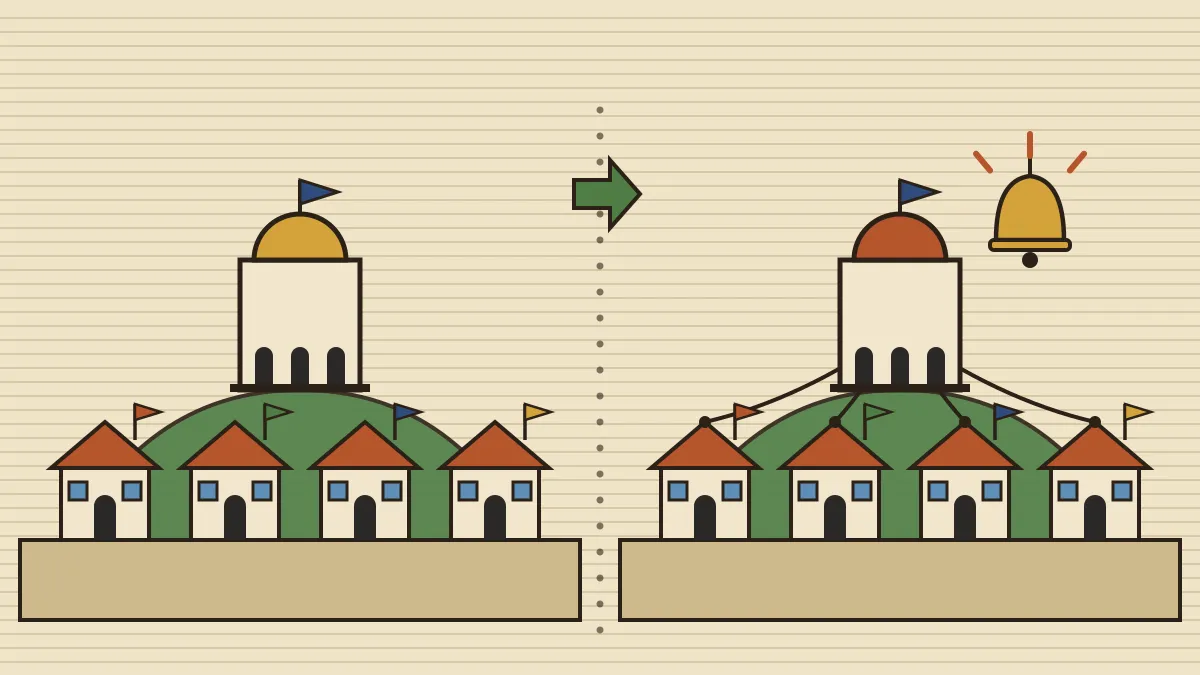
The special majority. A resolution approving the proclamation, or its continuation, needs a majority of the total membership of each House and at least two-thirds of the members present and voting. A resolution of disapproval is different: it is passed by the Lok Sabha alone, and by simple majority. If one-tenth of Lok Sabha members give a written notice to the Speaker (or to the President when the House is not sitting), a special sitting must be held within 14 days to consider it.
When the Lok Sabha is dissolved. If the Lok Sabha is dissolved while the proclamation is in force, or during the one-month window before approval, the proclamation survives until 30 days after the new House first meets, provided the Rajya Sabha has approved it in the meantime.
What Changes While It Lasts
A National Emergency does not suspend the state governments or state legislatures. It places them under the control of the Centre. Ambedkar said in the Constituent Assembly that the Constitution is framed to work as a federal system in normal times but as a unitary system in an Emergency.
| Area | Effect |
|---|---|
| Executive (Article 353) | The Centre may give directions to a state on any matter. In normal times it can do so only on specified matters. |
| Legislative (Article 353) | Parliament may make laws on the State List. Such laws lapse six months after the Emergency ends. The President can issue ordinances on state subjects. |
| Financial (Article 354) | The President may modify the division of tax revenue between Centre and states until the end of that financial year |
| Life of the House | Parliament may extend the Lok Sabha by one year at a time, but never beyond six months after the Emergency ends. The Fifth Lok Sabha (1971–77) was extended twice. The same applies to state assemblies. |
The 42nd Amendment also allowed an Emergency to be limited to a part of India, and made the executive and legislative effects reach any other state if the security of India is threatened by activities in the area under Emergency.
Fundamental Rights: Articles 358 and 359. Students mix these up, so learn them side by side.
| Article 358 | Article 359 | |
|---|---|---|
| Rights affected | The six freedoms of Article 19 only | Any rights named in the President's order, except Articles 20 and 21 |
| How | Automatic on proclamation | Only by a Presidential order |
| What is suspended | The rights themselves (the State may make laws against them) | Only the right to move court to enforce them; the rights stay alive |
| Which emergency | Only external (war, external aggression) | Both external and internal |
| Area and duration | Whole country, whole Emergency | Whole or part, for the time the order says |
Two safeguards from the 44th Amendment apply to both. Only laws related to the Emergency are shielded from challenge, and not every law passed during it. And after 1978, Article 20 (protection in respect of conviction for offences) and Article 21 (life and personal liberty) can never have their enforcement suspended. This is the direct answer to ADM Jabalpur. Read more on those rights on our liberty rights page.
Article 358 is automatic and covers Article 19 in an external Emergency. Article 359 is by order and covers other rights, never 20 and 21.
How UPSC Has Asked It: Past Papers Solved
Questions come as statements on the safeguards, the Articles 358/359 difference, or direct recall of amendments.
Which one of the following is not a circumstance for proclamation of Emergency by the President of India under Article 352 of the Constitution of India?
(a) War (b) External aggression (c) Internal disturbance (d) Armed rebellion
Answer: (c). "Internal disturbance" was replaced by "armed rebellion" in 1978. Note that the 1975 Emergency itself used the old words.
When a Proclamation of Emergency is in operation, the right to move a Court for the enforcement of all Fundamental Rights remains suspended, except
(a) Article 20 and Article 21 (b) Article 21 and Article 22 (c) Article 19 and Article 20 (d) Article 15 and Article 16
Answer: (a). The 44th Amendment barred suspension of the right to move court for Articles 20 and 21. Option (b) is tempting, but Article 22 (arrest and detention) is not protected.
Which among the following Fundamental Rights is not suspended when an Emergency is declared?
(a) Protection in respect of conviction for offences (b) Right to constitutional remedies (c) Right to move freely throughout the territory of India (d) Equality before law
Answer: (a). That is Article 20. Right to move freely is Article 19(1)(d), which Article 358 suspends in an external emergency. The right to constitutional remedies (Article 32) is itself what Article 359 suspends.
Which one of the following is not mentioned as a form of Emergency in the Constitution of India?
(a) National Emergency (b) State Emergency in terms of Proclamation of President's Rule in a State (c) Financial Emergency (d) Health Emergency
Answer: (d). The three are Articles 352, 356 and 360. There is no health emergency in the Constitution.
Which one among the following was eliminated by the 44th Amendment Act of the Parliament?
(a) Right against Exploitation (b) Right to Constitutional Remedies (c) Right to Property (d) Right to Education
Answer: (c). The Janata Government's 44th Amendment removed the right to property from the list of Fundamental Rights (Article 31); it became an ordinary legal right in Article 300A. The same Amendment also tightened Emergency rules.
Which one of the following Directive Principles was inserted by the Constitution (42nd Amendment) Act, 1976?
(a) The State shall minimise inequalities in income (b) Equal justice and free legal aid (c) Promotion of co-operative societies (d) Provision for early childhood care
Answer: (b). The 42nd Amendment inserted Article 39A. Option (a) was added by the 44th Amendment (Article 38(2)), co-operatives came with the 97th and early childhood care with the 86th.
Article 352 of the Constitution of India contains provisions related to
(a) financial emergency (b) failure of constitutional machinery in States (c) suspension of the enforcement of rights conferred in Part III of the Constitution (d) general emergency
Answer: (d). Article 352 is the "general" or National Emergency. Option (a) is Article 360, (b) is Article 356 and (c) is Article 359.
Match each Article to one phrase: 352 = National, 356 = State, 360 = Financial, 358 = Article 19, 359 = other rights except 20 and 21. If an option says "internal disturbance" or lets Article 21 be suspended, it describes the pre-1978 law.
Practice MCQs (with answers)
- A National Emergency under Article 352 can be proclaimed on the ground of
- internal disturbance
- financial instability
- war, external aggression or armed rebellion
- failure of constitutional machinery in a state
- Since the 44th Amendment, a proclamation of Emergency must be approved by both Houses of Parliament within
- one month
- two months
- three months
- six months
- After approval by Parliament, a National Emergency continues at one time for
- three months
- six months
- one year
- two years
- The President must revoke a proclamation of Emergency if
- the Rajya Sabha passes a resolution disapproving it
- the Supreme Court issues a direction
- one-fourth of the states ask for it
- the Lok Sabha passes a resolution disapproving its continuation
- Which Article automatically suspends the six freedoms under Article 19 when an Emergency is proclaimed on the ground of war or external aggression?
- Article 358
- Article 359
- Article 353
- Article 360
- How many times has a National Emergency been proclaimed in India so far?
- Once
- Twice
- Three times
- Four times
- The Amendment popularly called the "Mini-Constitution", which also lengthened the Lok Sabha's term to six years, is the
- 38th
- 42nd
- 44th
- 52nd
- The Supreme Court held that a proclamation of Emergency can be challenged on grounds of malafides or irrelevant facts in
- Kesavananda Bharati case
- Golaknath case
- ADM Jabalpur case
- Minerva Mills case
1-c, 2-a, 3-b, 4-d, 5-a, 6-c, 7-b, 8-d. Q2: it was two months until 1978. Q4: only the Lok Sabha's resolution binds the President, not the Rajya Sabha's. Q6: 1962, 1971 and 1975. Q7: the 44th Amendment restored the five-year term. Q8: ADM Jabalpur (1976) is the tempting answer; it upheld the suspension of habeas corpus and was later overruled.
Quick Revision
- Article 352 = National Emergency. Grounds: war, external aggression, armed rebellion (imminent danger is enough). "Internal disturbance" replaced by "armed rebellion" in 1978 (44th).
- Three proclamations: October 1962 (China), December 1971 (Pakistan), June 1975 (internal; revoked March 1977, 21 months).
- Safeguards (44th, 1978): Cabinet's written advice; Parliament's approval in one month by special majority; six months at a time, renewable; Lok Sabha disapproval forces revocation (one-tenth notice, special sitting in 14 days); shield on judicial review removed.
- Effects: the Centre directs states on any matter (353); Parliament legislates on the State List; revenue division modified (354); Lok Sabha extended one year at a time.
- Article 358: Article 19, automatic, external emergency only. Article 359: by order; Articles 20 and 21 never suspended.
- 42nd (1976): Preamble words, Fundamental Duties (51A), Article 39A, six-year Lok Sabha term. 44th (1978): right to property removed from FRs (Article 300A). ADM Jabalpur (1976) overruled in 2017. Shah Commission appointed 1977.
Frequently asked questions
Under which Article is a National Emergency declared?
A National Emergency is declared by the President under Article 352 when the security of India or any part of it is threatened by war, external aggression or armed rebellion. The President can act on the ground of imminent danger too, and only on the written recommendation of the Union Cabinet.
How many times has a National Emergency been declared in India?
Three times: in October 1962 during the Chinese attack, in December 1971 during the war with Pakistan, and in June 1975 on the ground of internal disturbance. The 1971 and 1975 proclamations were both revoked in March 1977.
What changes did the 44th Amendment make to the Emergency provisions?
The 44th Amendment replaced internal disturbance with armed rebellion, required the Cabinet's written recommendation, cut the time for Parliament's approval to one month, demanded a special majority, limited each approval to six months, let the Lok Sabha force an end to the Emergency, and ensured that the enforcement of Articles 20 and 21 cannot be suspended.
What is the difference between Articles 358 and 359?
Article 358 automatically suspends the six freedoms of Article 19, and only when the Emergency is declared on the ground of war or external aggression. Article 359 lets the President, by an order, suspend the right to move court for enforcing other Fundamental Rights, but never for Articles 20 and 21.
Does a National Emergency suspend state governments?
No. State governments and legislatures continue to function. But the Centre can give directions to a state on any matter, Parliament can make laws on State List subjects, and the division of revenue can be altered. That is why the system is said to become unitary during an Emergency.
Related CDS / OTA Polity topics
Polity is a steady scorer in the CDS GS paper
Cavalier's CDS/OTA batches teach the Constitution article by article, with weekly PYQ tests.