The Ministry of Youth Affairs and Sports, with MyGov and My Bharat, has opened the Constitution Day Quiz 2026 from 18 to 26 November. The quiz ends on 26 November, the day in 1949 when the Constituent Assembly adopted the Constitution. It has 500 cash winners. The text those winners will be quizzed on is not the 1950 original. Parliament has changed it 106 times, the latest being the Nari Shakti Vandan Adhiniyam of 2023. UPSC asks about these amendments every year, usually as "which amendment did X". Hold them as four stories.
Four Eras of Amendment
By Aditya Tiwari · Polity faculty, The Cavalier · Lawyer, 10 years teaching law and Polity
The procedure for amending the Constitution (Article 368, the three majorities, the basic structure doctrine) is on our amendment-procedure page. This article is about the content. Numbers are given by the year the Act was passed, as in standard textbooks; some Acts came into force a year later.
| Era | The story | Amendments to know |
|---|---|---|
| 1951–1970 Building the new state | Land reform against the property right; language states; absorbing French and Portuguese territories | 1st, 7th, 9th, 10th, 12th, 13th, 14th, 21st |
| 1971–1978 Parliament against the courts | Parliament's power to amend, the Emergency, the "Mini-Constitution" and its reversal | 24th, 25th, 26th, 38th, 39th, 42nd, 44th |
| 1985–2003 New democratic machinery | Anti-defection law, voting age 18, Delhi, Panchayats and Municipalities, a cap on ministers | 52nd, 61st, 69th, 73rd, 74th, 91st |
| 2005–2023 Tax, justice and quotas | OBC quotas in education, cooperatives, the judges' commission, GST, EWS, women's seats | 93rd, 97th, 99th, 101st, 103rd, 106th |
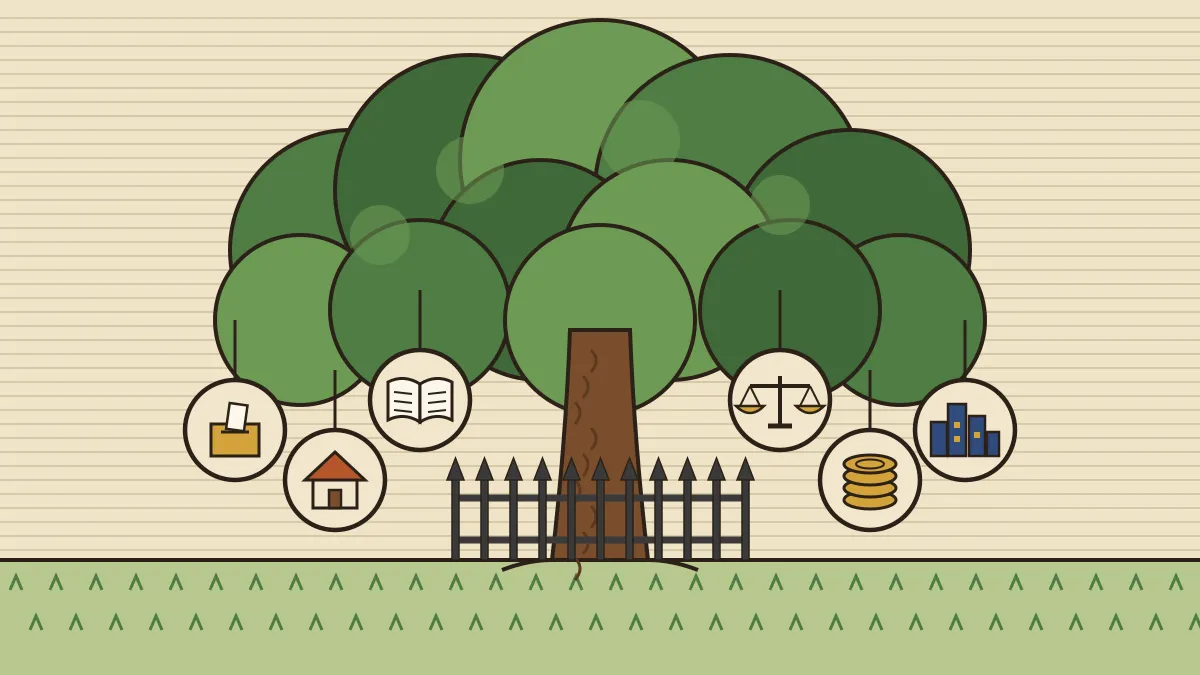
Parliament can add branches. Since Kesavananda Bharati (1973) it cannot cut the trunk, the basic structure. Several amendments below were tested against that rule, and two were struck down in whole or part.
Parliament Against the Courts: the 24th to the 44th
The 1950s fight was over land. The 1st Amendment (1951) added the Ninth Schedule to shield land-reform laws from the courts. It also allowed reasonable restrictions on speech on grounds such as public order and friendly relations with foreign states, and made special provision for backward classes (Article 15(4)).
The Supreme Court's Golak Nath ruling (1967) said Parliament could not touch Fundamental Rights. Parliament answered with a series.
| Amendment | Year | What it did |
|---|---|---|
| 24th | 1971 | Parliament may amend any part, including Fundamental Rights; the President must assent to an amendment Bill |
| 25th | 1971 | Property compensation became an "amount"; Article 31C protects laws that further the Directive Principles in Article 39(b) and (c) |
| 38th | 1975 | Made the declaration of a National Emergency immune from judicial review (later deleted by the 44th) |
| 39th | 1975 | Placed election disputes of the President, Vice-President, Prime Minister and Speaker beyond the courts; the Supreme Court struck it down in the Indira Gandhi (Raj Narain) case |
Then came the 42nd Amendment (1976), passed during the Emergency, known as the Mini-Constitution for the number of Articles it touched. The 44th Amendment of 1978, under the Janata government, undid its worst parts. Examiners love to ask which one did what.
| Subject | 42nd Amendment (1976) | 44th Amendment (1978) |
|---|---|---|
| Preamble | Added Socialist, Secular and Integrity ("Unity of the Nation" became "Unity and Integrity of the Nation") | No change |
| Duties | Added Part IVA, Article 51A: Fundamental Duties (the 86th Amendment added the eleventh in 2002) | No change |
| Directive Principles | Added 39A (free legal aid), 43A (workers in management), 48A (environment) | Added Article 38(2): reduce inequalities in income, status and opportunity |
| Lists | Moved five subjects from the State List to the Concurrent List: education, forests, weights and measures, protection of wild animals and birds, administration of justice | No change |
| Cabinet advice | Made the President bound by the Council of Ministers' advice | Allowed the President to send it back once for reconsideration |
| Courts | Barred court challenge to any amendment (Minerva Mills struck this down in 1980); added Part XIVA on Tribunals | Deleted Article 329A (the 39th's bar on courts in the Prime Minister's and Speaker's election disputes) and the 38th's bar on reviewing an Emergency |
| Property | Widened Article 31C to all Directive Principles | Removed it from Fundamental Rights; now only a legal right under Article 300A |
| Emergency | Allowed a National Emergency in part of India only | "Internal disturbance" became "armed rebellion"; needs the Cabinet's written advice; approval within one month by a special majority; renewed every six months |
The 44th removed it from the Fundamental Rights, not the 42nd. The 42nd gave us the Preamble words and the Duties. The 44th gave us the stricter Emergency rules. Our emergency-provisions page goes through them one by one, and the Preamble page covers the three words.
Redrawing the Map: Amendments That Made States and Languages
The 7th Amendment (1956) carried out the States Reorganisation Act: it ended the Part A, B and C classification, produced 14 states and 6 Union Territories on 1 November 1956, and allowed a common High Court for two or more states. Most later map changes were also amendments, because they touched the First or Fourth Schedule.
| Amendment | Year | Change |
|---|---|---|
| 9th | 1960 | Transfer of part of Berubari to Pakistan, after the Supreme Court said Article 3 cannot cede territory |
| 10th, 12th, 14th | 1961, 1962, 1962 | Dadra and Nagar Haveli; Goa, Daman and Diu; Puducherry became Union Territories |
| 13th | 1962 | Article 371A for Nagaland (the 16th state, formed 1963) |
| 35th | 1974 | Sikkim became an associate state (new Article 2A and Tenth Schedule) |
| 36th | 1975 | Sikkim became the 22nd state; Article 371F added; 2A and the Tenth Schedule repealed |
| 56th | 1987 | Goa became the 25th state |
| 69th | 1991 | Delhi became the National Capital Territory, with an Assembly and Council of Ministers (Article 239AA) |
| 100th | 2015 | Land Boundary Agreement with Bangladesh: India transferred 111 enclaves and received 51 |
The pattern of Sikkim is a favourite. The 35th is the associate-state step and the 36th the full-state step. UPSC asked for the 36th in CDS 2018-I and the 35th in NDA 2021-II, and options always put the two side by side. The full story of states and their order is on our reorganisation-of-states page.
The Eighth Schedule grew by amendment, and the sums are easy marks. It began with 14 languages. The 21st (1967) added Sindhi (15). The 71st (1992) added Konkani, Manipuri and Nepali (18). The 92nd (2003) added Bodo, Dogri, Maithili and Santhali (22). The 96th (2011) only renamed "Oriya" as "Odia". The total is 22.
New Machinery: Parties, Voters, Villages and Ministers
| Amendment | Year | What changed |
|---|---|---|
| 52nd | 1985 | Anti-defection law: the Tenth Schedule |
| 61st | 1988 | Voting age lowered from 21 to 18 (in force 1989) |
| 73rd | 1992 | Panchayats: Part IX, the Eleventh Schedule, in force 24 April 1993 |
| 74th | 1992 | Municipalities: Part IXA, the Twelfth Schedule, in force 1 June 1993 |
| 86th | 2002 | Article 21A (education, ages 6–14, a Fundamental Right); Article 45 rewritten; eleventh Fundamental Duty (51A(k)) |
| 91st | 2003 | Council of Ministers capped at 15% of the House; defectors cannot become ministers; split exemption removed from the Tenth Schedule |
| 97th | 2011 | Cooperative societies: a Fundamental Right to form them (19(1)(c)), Article 43B, Part IXB |
Four of these have fuller pages on this site. The anti-defection law is on the Tenth Schedule page; the 91st Amendment closed its split loophole. Local government is on the local-governance page, with the city side in our article on the 74th Amendment and city mayors. The 86th Amendment, which brought in Article 21A, is covered on our children's-rights page, and the duties side on the Fundamental Duties page.
Tax, Courts and Quotas: 1999 to 2023
| Amendment | Year | What changed |
|---|---|---|
| 93rd | 2005 | Article 15(5): quotas for OBCs in educational institutions, other than minority institutions |
| 99th | 2014 | National Judicial Appointments Commission; struck down by the Supreme Court on 16 October 2015 |
| 101st | 2016 | GST: Articles 246A and 279A (the GST Council); GST began on 1 July 2017 |
| 102nd | 2018 | Constitutional status for the National Commission for Backward Classes (Article 338B) |
| 103rd | 2019 | 10% EWS quota: Articles 15(6) and 16(6) |
| 105th | 2021 | States may again prepare their own lists of socially and educationally backward classes |
| 106th | 2023 | One-third seats for women in the Lok Sabha, State Assemblies and the Delhi Assembly, to operate after the first Census and delimitation that follow it |
Two of these are traps in different ways. The 99th is the only one in this list struck down in full, so it is a "which amendment was invalidated" answer. The 106th does not reserve seats in the Rajya Sabha or in State Legislative Councils, a point UPSC used in CDS 2025-II. Panchayat seats for women come from the 73rd instead. Our women's-reservation page covers the details, and the GST article takes the 101st further.
In April 2026 the Lok Sabha took up the Constitution (131st Amendment) Bill to enable the women's quota through delimitation. PIB reported on 18 April that the amendment did not get the special majority that Article 368(2) requires. A Bill can have more than half the House behind it and still fall. The numbers below are illustrative, not the actual vote: suppose 528 members vote, 300 for and 228 against.
The Bill carries the number 131 because amendment Bills are numbered in their own series, which counts Bills that never became law. No 107th Amendment Act exists. The Constitution still has 106 amendments.
How UPSC Has Asked It: Past Papers Solved
These are actual CDS and NDA questions since 2018. They test "which amendment" with numbers as options.
Under which one of the following Amendment Acts was Sikkim admitted into the Union of India?
(a) 35th (b) 36th (c) 37th (d) 38th
Answer: (b). The 36th (1975) made Sikkim a full state. The 35th, option (a), made it only an associate state a year earlier.
Which one of the following Directive Principles was inserted by the Constitution (42nd Amendment) Act, 1976?
(a) The State shall minimise inequalities in income (b) Equal justice and free legal aid (c) Promotion of co-operative societies (d) Provision for early childhood care
Answer: (b). Article 39A came with the 42nd. Option (a) is the 44th's Article 38(2), (c) the 97th's Article 43B and (d) the 86th's rewritten Article 45.
Through the Forty Second Amendment to the Constitution of India, which of the following was/were inserted into its Preamble? 1. 'Liberty of thought, expression and belief' was substituted by 'Liberty of thought, expression, belief, faith and worship'. 2. The expression 'Unity of the Nation' was substituted by 'Unity and Integrity of the Nation'.
(a) 1 only (b) 2 only (c) Both 1 and 2 (d) Neither 1 nor 2
Answer: (b). The liberty wording, "faith and worship", was already in the 1950 Preamble. Only the change from "Unity" to "Unity and Integrity" is the 42nd's.
Which one among the following was eliminated by the 44th Amendment Act of the Parliament?
(a) Right against Exploitation (b) Right to Constitutional Remedies (c) Right to Property (d) Right to Education
Answer: (c). The 44th removed the right to property from Part III and made it a legal right under Article 300A. Right to Education arrived later, with the 86th.
Which one of the following amendments to the Constitution of India has introduced reservations in education and in public employment for people from the Economically Weaker Sections (EWS) of society?
(a) The 101st (b) The 102nd (c) The 122nd (d) The 103rd
Answer: (d). The 103rd (2019) inserted Articles 15(6) and 16(6). The 101st is GST and the 102nd gave the backward-classes commission constitutional status.
Which of the following statements as per the Constitution of India is/are correct? 1. Provision for the reservation of seats for women in the Lok Sabha and the Rajya Sabha has been made vide 106th Amendment of the Constitution. 2. There are provisions for the reservation of seats for women in the Legislative Assemblies and Legislative Councils of the States. 3. There are provisions for the reservation of seats for women in Panchayats.
(a) 1 and 2 (b) 2 and 3 (c) 1 only (d) 3 only
Answer: (d). The 106th covers the Lok Sabha, State Assemblies and the Delhi Assembly, not the Rajya Sabha or Legislative Councils, so statements 1 and 2 fail. Seats for women in Panchayats exist, through the 73rd.
UPSC does not ask for texts of amendments. It asks number-to-subject, with a neighbouring amendment as the wrong option. Learn each number with its neighbour: 35 and 36, 42 and 44, 101 and 102 and 103.
Practice MCQs (with answers)
- The Ninth Schedule was added by the
- 1st Amendment
- 7th Amendment
- 24th Amendment
- 42nd Amendment
- Voting age was reduced from 21 to 18 years by the
- 52nd Amendment
- 61st Amendment
- 73rd Amendment
- 91st Amendment
- The amendment that made the President bound to give assent to a constitutional amendment Bill is the
- 1st
- 7th
- 24th
- 44th
- Which amendment struck down by the Supreme Court in 2015 sought to create the National Judicial Appointments Commission?
- 97th
- 98th
- 101st
- 99th
- How many languages are in the Eighth Schedule today?
- 22
- 18
- 24
- 15
- Which one of the following was NOT added by the 42nd Amendment?
- The word "Socialist" in the Preamble
- Part IVA on Fundamental Duties
- Article 39A on free legal aid
- Article 300A on the legal right to property
- The 74th Amendment Act gave constitutional status to
- Panchayats
- Municipalities
- Cooperative societies
- The GST Council
- The 103rd Amendment Act introduced
- GST
- one-third seats for women
- 10% reservation for economically weaker sections
- the National Commission for Backward Classes
1-a, 2-b, 3-c, 4-d, 5-a, 6-d, 7-b, 8-c. Q3: the 24th (1971) made assent compulsory, as a reply to Golak Nath. Q5: 14 originally, plus Sindhi (21st), Konkani, Manipuri and Nepali (71st) and four languages (92nd) is 22. Q6: Article 300A came from the 44th, which removed property from the Fundamental Rights. Q7: the 73rd is Panchayats and the 74th Municipalities.
Quick Revision
- 106 amendments; the latest is the 106th (2023, women's seats). Constitution adopted 26 November 1949, in force 26 January 1950.
- 1st (1951): Ninth Schedule. 7th (1956): states reorganised. 24th (1971): Parliament can amend FRs; President must assent.
- 42nd (1976): Socialist, Secular, Integrity; Fundamental Duties; 39A, 43A, 48A; five subjects to Concurrent List. 44th (1978): property out of FRs (Article 300A); "armed rebellion"; Article 38(2); restored judicial review. 38th: Emergency not reviewable (deleted by 44th).
- States: 10th, 12th, 14th (Union Territories); 13th Nagaland; 35th Sikkim associate state; 36th Sikkim 22nd state; 56th Goa; 69th Delhi NCT; 100th Bangladesh enclaves (111 out, 51 in).
- Eighth Schedule: 14 → 15 (21st) → 18 (71st) → 22 (92nd).
- 52nd anti-defection; 61st voting age 18; 73rd Panchayats; 74th Municipalities; 86th Article 21A; 91st 15% cap on ministers; 97th cooperatives.
- 99th NJAC (struck down 2015); 101st GST; 102nd NCBC; 103rd EWS 10%; 106th women's quota, Lok Sabha, State Assemblies and Delhi, not Rajya Sabha or Councils.
- Special majority: more than half of total membership AND two-thirds of those present and voting.
Frequently asked questions
How many amendments has the Indian Constitution had?
The Constitution has been amended 106 times, the latest being the 106th Amendment Act of 2023 on women's reservation. A Bill numbered as the 131st Amendment Bill in 2026 failed in the Lok Sabha, so it did not become an amendment.
Why is the 42nd Amendment called the Mini-Constitution?
The 42nd Amendment of 1976 changed a very large number of provisions. It added Socialist, Secular and Integrity to the Preamble, inserted Fundamental Duties, added new Directive Principles and moved five subjects to the Concurrent List. The 44th Amendment of 1978 reversed some of its changes.
Which amendment removed the right to property from the Fundamental Rights?
The 44th Amendment of 1978. It deleted the right to property from Part III and made it an ordinary legal right under Article 300A. The Constitution therefore still protects property, but a person can no longer go straight to the Supreme Court under Article 32 for it.
Which amendments gave constitutional status to Panchayats and Municipalities?
The 73rd Amendment Act of 1992 gave constitutional status to Panchayats through Part IX and the Eleventh Schedule, in force from 24 April 1993. The 74th Amendment Act of 1992 did the same for Municipalities through Part IXA and the Twelfth Schedule, in force from 1 June 1993.
What is the Constitution Day Quiz 2026?
It is an online quiz run by the Ministry of Youth Affairs and Sports with MyGov and My Bharat, open from 18 to 26 November 2026 in English and Hindi. There are 500 winners: the top 100 receive ₹5,000 each and the next 400 receive ₹2,000 each. Constitution Day itself is 26 November, which marks the adoption of the Constitution in 1949.
Related CDS / OTA Polity topics
Polity is a fifth of the CDS GS paper
Cavalier's CDS/OTA batches teach the Constitution through tables, timelines and weekly PYQ tests, so article and amendment numbers stay in memory.