India observes Constitution Day on 26 November, the day in 1949 when the Constituent Assembly adopted the Constitution. A favourite exam question rests on a detail of that date: only a few provisions, such as those on citizenship and elections, came into force that day. The rest, including the emergency provisions, waited until 26 January 1950. Few chapters caused the framers more argument. Dr B.R. Ambedkar defended Part XVIII by saying a federal Constitution could be "unitary" in a crisis, while members like H.V. Kamath said no democratic constitution had a parallel to the chapter. Seventy-seven years on, the chapter is still the most dependable scorer in CDS polity, because every rule in it is a number or a name. Our page on the basics of emergency provisions gives the first pass. This article goes into the machinery, article by article, and the court cases that limit it.
The Layout of Part XVIII: One Switch, Three Emergencies
By Aditya Tiwari · Polity faculty, The Cavalier · Lawyer, 10 years teaching law and Polity
The Constitution names three emergencies: the National Emergency (Article 352), the State Emergency or President's Rule (Article 356) and the Financial Emergency (Article 360). But Part XVIII has more articles than that, and the examiner likes the ones in between.
| Article | What it does | Hook to remember |
|---|---|---|
| 352 | Proclamation of Emergency on war, external aggression or armed rebellion | Cabinet's decision in writing |
| 353 | Effect of the proclamation on Union–State executive and legislative power | Centre may direct a State on any matter |
| 354 | Modifies the sharing of taxes between Centre and States (Articles 268 to 279) | Money; lasts to the end of that financial year |
| 355 | Duty of the Union to protect every State and ensure it is governed by the Constitution | A duty, not a power |
| 356 | Failure of constitutional machinery in a State | President's Rule |
| 357 | Who makes laws for a State under President's Rule | President's Acts |
| 358 | Automatic suspension of Article 19 | War or external aggression only |
| 359 | Suspension of the enforcement of Part III rights by Presidential order | Never Articles 20 and 21 |
| 359A | Special version for Punjab, inserted in 1988 and repealed in 1989 | Repealed |
| 360 | Financial Emergency | Never proclaimed |
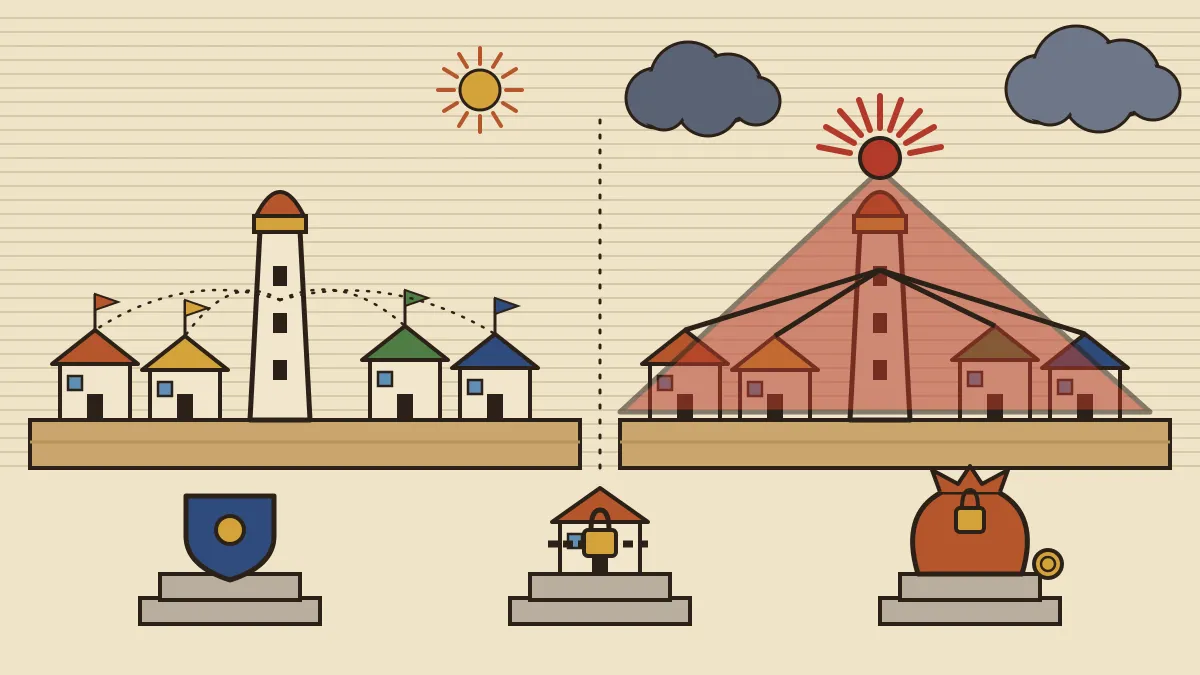
The two ideas to hold are these. First, Article 353 is how a National Emergency changes the federal balance: the Centre may direct any State on any matter, Parliament may legislate on the State List, and the President may issue ordinances on State subjects. The State governments and legislatures are not suspended; they are put under the Centre's override. Second, President's Rule is the opposite. The State's government is displaced, but its citizens' Fundamental Rights are untouched. How Article 352 was misused is told in our page on the 1975 Emergency, and its 50th anniversary is covered in a current-affairs explainer. The Centre's normal law-making reach over States is set out on Union, State and Concurrent Lists.
Three Clocks: Approval, Duration and Majority
Each emergency has three clocks: how long the President's proclamation lasts without Parliament, how long an approved proclamation lasts, and how many members must vote. The numbers differ, and the starting points of the six-month periods differ too.
| National (352) | President's Rule (356) | Financial (360) | |
|---|---|---|---|
| Approval needed within | 1 month | 2 months | 2 months |
| Majority | Special | Simple | Simple |
| First period after approval | 6 months, counted from the second approving resolution | 6 months, counted from the date of issue | No limit |
| Renewal | Every 6 months, no ceiling | Every 6 months, ceiling of 3 years | None needed |
| Revocation by Lok Sabha | Yes: a simple-majority resolution forces revocation | No such clause | No such clause |
A special majority means a majority of the total membership of the House and at least two-thirds of those present and voting. Only a National Emergency needs it, and only for approval and continuation. A resolution to disapprove is easier: it is passed by the Lok Sabha alone, by a simple majority. If one-tenth of Lok Sabha members give notice in writing, a special sitting must be held within 14 days.
A National Emergency is proclaimed on 10 March. The Lok Sabha approves it on 2 April and the Rajya Sabha on 5 April. President's Rule is proclaimed in a State on 10 March too, and Parliament approves it on 5 April.
President's Rule is proclaimed while the Lok Sabha is dissolved, and the Rajya Sabha approves it within two months.
President's Rule can run for a maximum of three years, but beyond one year Parliament may renew it only if two conditions hold: a National Emergency is in force in the whole of India or in the State concerned, and the Election Commission certifies that assembly elections cannot be held. The 44th Amendment (1978) added this. The one exception was Punjab, where the rule imposed on 11 May 1987 was allowed five years by the 64th, 67th and 68th Amendments.
President's Rule: From Article 355 to the Bommai Tests
Article 355 puts the duty on the Union to protect every State against external aggression and internal disturbance, and to ensure its government runs "in accordance with the provisions of this Constitution". Article 356 is how the Centre carries out that duty when a State breaks down. The President may act on the report of the Governor "or otherwise", so a report is not legally essential. Article 365 adds a second route: if a State ignores a Union direction, the President may hold that its government cannot be carried on constitutionally.
Once the proclamation is made, the President may take over the State government's functions (except those of the High Court), and declare that Parliament will exercise the State legislature's powers. Under Article 357 Parliament may hand that law-making to the President, whose laws are called President's Acts. The council of ministers is dismissed and the Governor runs the State with advisers or the chief secretary. The assembly is suspended or dissolved. The High Court's powers stay as they were.
The power was used freely. President's Rule was imposed for the first time in Punjab in 1951, and by 2019 it had been used well over a hundred times. After the Janata victory of 1977 the Centre dismissed nine Congress-ruled State governments, and Congress did the same to nine opposition-ruled States in 1980. It was the S.R. Bommai v. Union of India (1994) judgment, by a nine-judge bench, that set the limits. The Court laid down tests that CDS has turned into statements.
| Bommai proposition | What it means |
|---|---|
| Proclamation is judicially reviewable | The President's satisfaction is not final |
| Centre must show relevant material | The Court checks relevance, not adequacy; mala fide or extraneous grounds invalidate it |
| Court may restore the government | It can revive a dismissed ministry and an assembly that was dissolved |
| Assembly only suspended until Parliament approves | Dissolution comes only after both Houses approve the proclamation |
| Majority is tested on the floor of the House | A Governor's private opinion that a ministry has lost its majority is not enough |
| Secularism is a basic feature | A State government acting against it can be dismissed; the Court upheld the 1992 action in three BJP-ruled States |
| A new Union government cannot dismiss State governments just because they belong to rival parties | This is what happened in 1977 and 1980, and Bommai marks it improper |
The Sarkaria Commission (1988), whose list the Court adopted, gives proper cases (a hung assembly where no coalition is possible, a State defying a constitutional direction, internal subversion) and improper ones (maladministration or corruption alone, intra-party quarrels, defeat of the ruling party in a Lok Sabha election, and a Governor's report without a floor test). In Rameshwar Prasad (2006), the Court held the 2005 dissolution of the Bihar Assembly unconstitutional. Ambedkar had hoped Article 356 would be a "dead letter"; Kamath was among the members who opposed it. A CDS question on "a matter of last resort" tests this quotation, and the answer is Article 356.
Article 360: The Emergency That Has Never Been Declared
The President may proclaim a Financial Emergency if the financial stability or credit of India or any part of it is threatened. It needs approval within two months by a simple majority and, once approved, continues until revoked, with no need to renew. The power is large: the Centre may direct States to observe canons of financial propriety and may require them to reduce the salaries of all or any class of their servants and to reserve all money bills for the President. It can also reduce the salaries of Union servants, including judges of the Supreme Court and High Courts.
It has never been proclaimed, not even during the balance-of-payments crisis of 1991. The reasons are easy to see: the power attacks the autonomy of States and the independence of the judiciary together. Critics in the Constituent Assembly said so.
An attack across the border: Article 352 on the external ground, which also brings Article 358 into play. Armed rebellion in one district: Article 352 for that part of the territory only, and Article 359 (not 358). Hung assembly, no government can be formed: Article 356. State defies a Union direction: Article 356 through Article 365. A State short of money: not a ground for 356 (the Sarkaria list calls financial strain alone improper). Article 360 is for a threat to the financial stability or credit of India.
How UPSC Has Asked It: Past Papers Solved
These questions run from 2015. Notice that nearly all test one of three things: the fixed list (grounds, forms), the quotation and case, and the fundamental-rights carve-out.
Which one of the following is not mentioned as a form of Emergency in the Constitution of India?
(a) National Emergency (b) State Emergency in terms of Proclamation of President's Rule in a State (c) Financial Emergency (d) Health Emergency
Answer: (d). The three forms are Articles 352, 356 and 360. The Constitution does not use the word "emergency" for President's Rule, but the examiner counts it.
Which one of the following is not a circumstance for proclamation of Emergency by the President of India under Article 352 of the Constitution of India?
(a) War (b) External aggression (c) Internal disturbance (d) Armed rebellion
Answer: (c). The 44th Amendment replaced "internal disturbance" with "armed rebellion". Note that Article 355 still speaks of "internal disturbance", which is a duty, not a ground for 352.
When a Proclamation of Emergency is in operation, the right to move a Court for the enforcement of all Fundamental Rights remains suspended, except
(a) Article 20 and Article 21 (b) Article 21 and Article 22 (c) Article 19 and Article 20 (d) Article 15 and Article 16
Answer: (a). The 44th Amendment bars suspension of the enforcement of Articles 20 and 21. Article 22 is not protected, which is why (b) tempts.
Which among the following Fundamental Rights is not suspended when an Emergency is declared?
(a) Protection in respect of conviction for offences (b) Right to constitutional remedies (c) Right to move freely throughout the territory of India (d) Equality before law
Answer: (a). Article 20 is protected. The right to move freely is in Article 19(1)(d), suspended under Article 358 (for war or external aggression). Article 32 can be suspended under 359, and so can the enforcement of Article 14.
Which one of the following Articles was defended by Dr. B. R. Ambedkar on the plea that it would be used as 'a matter of last resort'?
(a) Article 352 (b) Article 359 (c) Article 356 (d) Article 368
Answer: (c). Ambedkar hoped the power to take over a State would remain a "dead letter" and be used only as a last resort. Article 352 was also debated, but the quotation belongs to the State-level power.
Under Article 355 of the Constitution of India, it is the duty of the Union to
(a) protect States against external aggression and internal disturbance (b) allow the extension of executive powers of the Union to any State (c) declare that the powers of the legislature of a State shall be exercisable by or under the authority of the Parliament (d) allow the Parliament to include or exclude any caste, race or tribe into the list of the Scheduled Castes or Scheduled Tribes
Answer: (a). Option (c) describes Article 356(1)(b), the power; Article 355 is the duty behind it.
Which of the following provision(s) of the Constitution of India became effective from 26th November 1949? 1. Elections 2. Citizenship 3. Emergency provisions 4. Appointment of the Judges
(a) 1 only (b) 1 and 2 only (c) 1, 2 and 3 (d) 2 and 4
Answer: (b). The provisions on citizenship and elections (with a few others) took effect on 26 November 1949. The emergency chapter, like most of the Constitution, came into force on 26 January 1950.
When two options differ by one article number, ask whether the question wants a power (352, 356, 360), a duty (355), an effect (353, 354, 357) or a rights clause (358, 359).
Practice MCQs (with answers)
- A National Emergency proclaimed on 1 June is approved by the second House on 20 June. When does it lapse if not renewed?
- 1 December
- 20 December
- 1 July
- 20 July
- President's Rule proclaimed on 1 June and approved on 20 June lapses, unless renewed, on
- 20 December
- 1 July
- 1 December
- 1 August
- Which article makes it the Union's duty to protect a State against internal disturbance?
- 355
- 352
- 356
- 360
- Which article lets the President modify the sharing of taxes between Centre and States during a National Emergency?
- 353
- 357
- 358
- 354
- Beyond one year, President's Rule can be extended only if a National Emergency is in force and
- the Election Commission certifies that elections cannot be held
- the Supreme Court permits it
- the Governor recommends it
- the Lok Sabha passes a special majority resolution
- In Bommai, the Supreme Court held that after a proclamation under Article 356 the State assembly may be dissolved
- immediately by the President
- on the Governor's report
- only after the Election Commission certifies
- only after Parliament approves the proclamation
- Which of the following may the Centre direct during a Financial Emergency?
- Dissolution of State assemblies
- Reduction of salaries of High Court judges
- Suspension of Article 21
- Transfer of the State List to the Union List
- The Lok Sabha can force the revocation of a National Emergency by
- a special majority resolution
- a motion of no confidence
- a simple-majority resolution of disapproval
- a vote in both Houses
1-b, 2-c, 3-a, 4-d, 5-a, 6-d, 7-b, 8-c. Q1: the 352 clock counts from the second approving resolution, 20 June, so six months end on 20 December. Q2: the 356 clock counts from issue, 1 June, so it ends on 1 December. Q7: Article 360(4) allows salary cuts for Union servants, including High Court and Supreme Court judges. Q8: disapproval needs only a simple majority in the Lok Sabha.
Quick Revision
- Part XVIII: 352 proclamation, 353 effect, 354 revenues, 355 duty, 356 President's Rule, 357 legislation, 358 Article 19, 359 enforcement of rights (not 20 and 21), 359A Punjab (repealed), 360 Financial Emergency.
- 352: approval 1 month, special majority, 6 months from the second resolution, renewable without limit; Lok Sabha disapproves by simple majority. Cabinet's written decision (352(3)).
- 356: approval 2 months, simple majority, 6 months from issue, maximum 3 years; beyond 1 year needs a National Emergency plus an Election Commission certificate. Punjab 1987: five years.
- 360: approval 2 months, simple majority, no limit and no renewal; includes salary cuts for judges. Never used.
- If the Lok Sabha is dissolved, the proclamation survives until 30 days after the new House first sits (Rajya Sabha approval needed).
- Bommai (1994): reviewable; relevant material; restore government; suspend, then dissolve after approval; floor test. Minerva Mills (1980): 352 reviewable. Rameshwar Prasad (2006): Bihar dissolution invalid. Ambedkar: "dead letter".
- Three National Emergencies: 1962, 1971, 1975. Constitution Day: 26 November (adopted 1949; emergency chapter in force 26 January 1950).
Frequently asked questions
What are the three emergencies in the Indian Constitution?
They are the National Emergency under Article 352, caused by war, external aggression or armed rebellion, President's Rule under Article 356 when a State's constitutional machinery fails, and the Financial Emergency under Article 360. Only the first and third are called emergencies in the text. President's Rule is often called the State Emergency.
How long can President's Rule last?
It must be approved by Parliament within two months and then lasts six months from the date of issue, renewable every six months up to a maximum of three years. After one year, renewal needs a National Emergency in force and an Election Commission certificate that elections cannot be held. Punjab in 1987 was allowed five years by constitutional amendments.
What did the Bommai case decide?
In 1994 a nine-judge bench held that a proclamation under Article 356 can be reviewed by courts and that the Centre must show relevant material. It may restore a dismissed government, and an assembly can be dissolved only after Parliament approves the proclamation. Whether a ministry has a majority must be tested on the floor of the House.
Which Fundamental Rights cannot be suspended in an Emergency?
The enforcement of Article 20, protection in respect of conviction for offences, and Article 21, the right to life and personal liberty, cannot be suspended. The 44th Amendment of 1978 introduced this. Article 19 is suspended automatically only if the Emergency is on the ground of war or external aggression.
Has a Financial Emergency ever been declared in India?
No. Article 360 has never been used, not even during the balance-of-payments crisis of 1991. It would let the Centre direct States to follow financial propriety, cut salaries of public servants and judges, and reserve State money bills for the President.
Related CDS / OTA Polity topics
Polity is the most predictable part of the GS paper
Cavalier's CDS/OTA batches teach the Constitution article by article, with trap-spotting drills and weekly PYQ tests.