On Sunday, 22 November 2026 the Union Home and Cooperation Minister, Amit Shah, will attend a cooperative function at Itanagar. The Ministry of Cooperation announced it on 21 November, the day after the annual Cooperative Week (14 to 20 November) ended. He will unveil an Arunachal Pradesh Cooperative Vision 2047, honour the best societies (a dairy society in Namsai, a fish farmers' society in Lower Subansiri), and open a foodgrain warehouse at Raga, run by a LAMPS, the Large-sized Adivasi Multipurpose Society that does in tribal areas what a village credit society does elsewhere. The event is one small stop in a large story. India has a ministry for cooperatives, a National Cooperation Policy, and a part of the Constitution devoted to them, and UPSC has begun to ask about all three. This article explains the constitutional side: what the Constitution says, why a court cut it down, and who now controls cooperatives.
From a Village Credit Society to a Constitutional Subject
By Aditya Tiwari · Polity faculty, The Cavalier · Lawyer, 10 years teaching law and Polity
A cooperative society is an association of people who join voluntarily to meet a shared economic need and run the enterprise democratically: one member, one vote, however many shares a member holds. Its profit is shared among members, not outside shareholders. The Indian story began with the debt of the peasant. After the famine years and the Deccan riots, the government looked at German-style credit societies, and the first law followed.
| Year | Step |
|---|---|
| 1904 | Co-operative Credit Societies Act: the first law, allowing only credit societies |
| 1912 | Co-operative Societies Act: societies for any purpose, and federations of societies, allowed |
| 1915 | Maclagan Committee: stressed audit, training and professional management |
| 1919 | Montagu–Chelmsford reforms make cooperation a provincial subject, which it has remained |
| 1942 | Multi-Unit Co-operative Societies Act, for societies working in more than one province |
| 1946 | Kaira District Milk Producers' Union (the future Amul) is registered at Anand |
| 1950 | Constitution: "co-operative societies" placed in Entry 32 of the State List |
| 2002 | Multi-State Co-operative Societies Act replaces the older central law |
| 2011–12 | 97th Amendment Act (in force 15 February 2012) |
| 2021 | Ministry of Cooperation created; Supreme Court partly strikes down the 97th Amendment |
| 2025 | National Cooperation Policy replaces the 2002 policy |
The logic of the 1950 arrangement was simple. Cooperatives are local, so the states make the laws, and every state has its own Cooperative Societies Act and its own Registrar. Only a society whose members and business spread across more than one state falls to Parliament, under the Union List entry on corporations "with objects not confined to one State". Both ends of that division matter for the court case below. The success stories (Amul and the milk cooperatives that grew into Operation Flood, described on our Operation Flood page) sat side by side with a long list of failures: elections postponed for years, boards handed to government nominees, sick banks that nobody audited.
The 97th Amendment: Three Changes to the Constitution
The Constitution (Ninety-seventh Amendment) Act, 2011, which took effect on 15 February 2012, was meant to cure those failures by giving cooperatives constitutional protection. It made exactly three changes.
| Where | Change | Effect |
|---|---|---|
| Part III, Article 19(1)(c) | Words "co-operative societies" added | Citizens may "form associations or unions or co-operative societies": a fundamental right, subject to reasonable restrictions (see our page on Articles 19 to 22) |
| Part IV, Article 43B (new) | Directive Principle | The State shall endeavour to promote voluntary formation, autonomous functioning, democratic control and professional management of cooperative societies |
| New Part IXB | Articles 243ZH to 243ZT (13 articles) | Rules for incorporation, board, elections, supersession, audit and returns |
Article 43B joins two earlier Directive Principles on economic organisation: Article 43 (living wage and cottage industries) and Article 43A (workers' participation in management, from the 42nd Amendment). The full list is on our Directive Principles page. Part IXB is the heart of the amendment. It copies the style of Parts IX (panchayats) and IXA (municipalities), described on our local governance page: a constitutional guarantee of regular elections and limits on the state's power to take over.
| Subject | Rule in Part IXB |
|---|---|
| Board size | As the state law provides, but not more than 21 directors |
| Reserved seats | One seat for SC/ST and two for women, where the society has such members |
| Term | Five years for elected directors and office bearers |
| Co-opted experts | Up to two, in addition to the 21; they cannot vote in elections or become office bearers |
| Elections | Held before the term ends, under an independent election authority set up by state law |
| Supersession | A board cannot be superseded or kept under suspension for more than six months (one year for cooperative banks other than multi-state ones); not at all if the society has no government shareholding, loan or guarantee |
| Audit | At least once every financial year, within six months of its close, by an auditor from an approved panel |
| General body, returns | Annual general body meeting and filing of returns within six months of the year-end |
| Offences | State law must make false returns, disobedience of summons and corrupt election practices offences |
| Multi-state societies | Same rules, but "State Legislature" is read as Parliament and "State Government" as the Central Government |
The 97th Amendment is cooperatives. The 91st (2003) capped the Council of Ministers at 15 per cent of the House (CDS 2018-I offered "97th" as a wrong option). The 86th gave Article 21A, the 73rd and 74th gave Parts IX and IXA, and the 101st brought GST. Also keep apart: Article 243ZH–243ZT (cooperatives), 243A–243O (panchayats), 243P–243ZG (municipalities).
The Court Steps In: Rajendra N. Shah, 2021
The amendment did not survive intact. In 2013 the Gujarat High Court struck down Part IXB in a petition by Rajendra N. Shah, and the Union appealed. On 20 July 2021 a three-judge bench of the Supreme Court decided Union of India v. Rajendra N. Shah. By a 2 to 1 majority (Justices R.F. Nariman and B.R. Gavai for the majority, with Justice K.M. Joseph dissenting) it held that Part IXB is invalid in so far as it applies to cooperative societies registered in the states.
The reason was procedural, but it went to the heart of federalism. Article 368(2) has a proviso: an amendment that changes the representation of states, or affects the legislative powers listed in the Seventh Schedule, must also be ratified by the legislatures of at least half the states. "Co-operative societies" is a State List subject (Entry 32). The 97th Amendment was passed by Parliament without any such ratification, so Part IXB, which governs a State List subject, was constitutionally defective. The procedure is explained on our Article 368 page. Compare the creation of a new state, which needs only an ordinary law (CDS 2021-I, solved below).
| Provision | Status after 2021 |
|---|---|
| Article 19(1)(c): "co-operative societies" | Stands. A change to a fundamental right needs no state ratification |
| Article 43B (Directive Principle) | Stands |
| Part IXB, for state-registered societies | Struck down (no ratification by half the states) |
| Part IXB, for multi-state cooperative societies (including those in Union Territories) | Stands: Parliament legislates on them under its own Union List power, so no ratification was needed (the "doctrine of severability") |
The verdict had a second consequence. The Ministry of Cooperation, created only two weeks earlier, was left with constitutional authority over multi-state societies, while the great majority of societies stay under their state Registrars and state laws. It explains why the Centre guides cooperatives through policy, money and model laws, and why it asks the states to amend their own Acts to match Part IXB.
(1) 97th Amendment, 2011, added 19(1)(c), 43B and Part IXB. (2) Supreme Court, July 2021: Part IXB falls for state societies because half the states never ratified it. (3) 19(1)(c), 43B and Part IXB for multi-state societies survive.
The Credit Pyramid and Who Governs It Today
About a quarter of India's cooperatives, roughly 2 lakh of about 8.45 lakh, are credit-type societies (PACS, credit and thrift societies and miscellaneous credit societies, counting from the Lok Sabha reply of 9 December 2025). The short-term farm credit system is a pyramid of three tiers, which the 2025 policy calls the backbone to be preserved: the village Primary Agricultural Credit Society (PACS), the District Central Cooperative Bank (DCCB) and the State Cooperative Bank (StCB). NABARD sits above them as refinancer. Deposits move up the pyramid and loans move down, as the illustration shows. Our page on decentralised grain storage in PACS shows the village tier turning into warehouses.
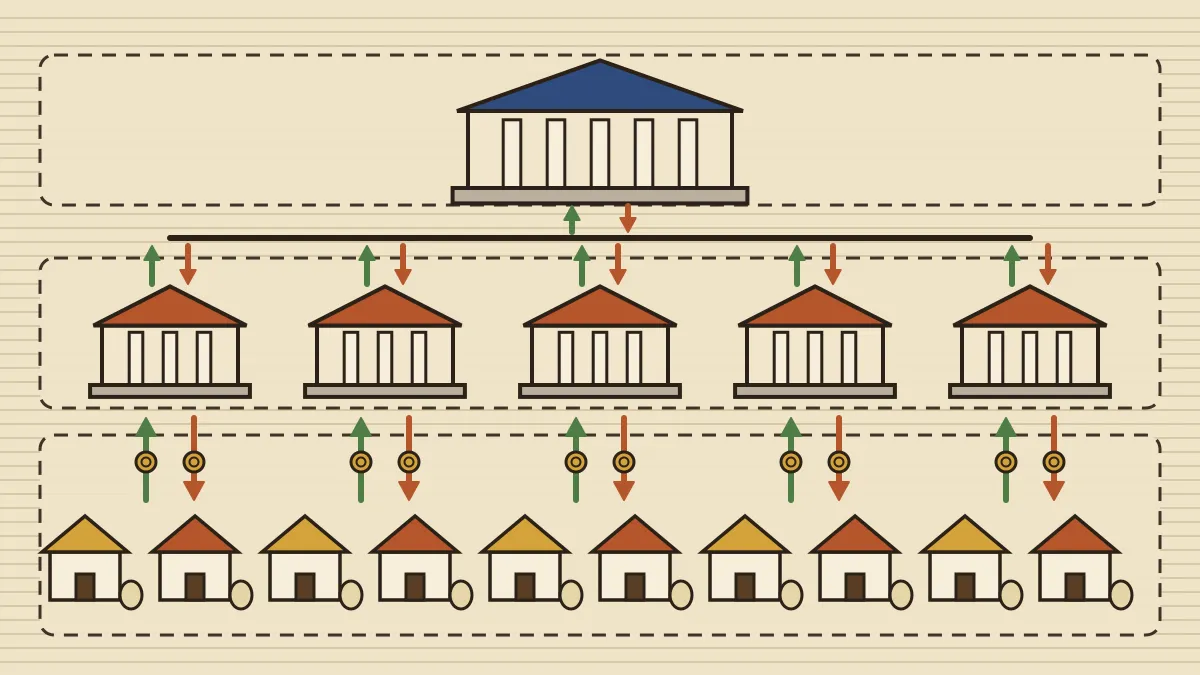
| Tier | Who it serves | Note |
|---|---|---|
| PACS | Farmers of a village or group of villages | The base of the pyramid; the government plans to bring cooperatives to panchayats that have none and to turn PACS into multipurpose centres |
| DCCB | The PACS of a district | Federation of the village societies |
| StCB | The DCCBs of a state | Apex; links the system to NABARD and the RBI |
| Urban Cooperative Banks | Town-dwellers, small traders, salaried people | Regulated by the RBI for banking and by the Registrar for management (see our note on UCBs and their umbrella body) |
The two-regulator problem exploded in September 2019, when the RBI restricted withdrawals from the Punjab and Maharashtra Co-operative (PMC) Bank, initially for six months (CDS 2020-I asked about it). In 2020 Parliament amended the Banking Regulation Act to give the RBI more direct powers over cooperative banks, mainly to protect depositors. Remember that this is a banking power and does not alter who registers or governs the society.
The Ministry of Cooperation was carved out of the agriculture ministry in July 2021, with the slogan Sahkar Se Samriddhi ("prosperity through cooperation"), and Amit Shah as its first minister (CDS 2021-II and CDS 2025-I both asked when it was set up). Its work includes:
- National Cooperation Policy, 2025, unveiled in July 2025 to replace the policy of 2002. PIB's National Cooperative Database figures put the total at about 8.45 lakh societies (8,45,187 on 15 November 2025) with about 30 crore members. The policy has six pillars and 16 objectives, and promotes digital registrar offices, model cooperative villages and entry into new sectors such as biogas and clean energy.
- Multi-State Co-operative Societies (Amendment) Act, 2023, which brought in a Co-operative Election Authority, a Co-operative Ombudsman and a fund to revive sick societies.
- The Tribhuvan Sahkari University at Anand, Gujarat, created by an Act of Parliament in 2025 from the Institute of Rural Management Anand. It is named after Tribhuvandas Patel, the cooperator who led the Kaira union that became Amul (see our note on the university and the cooperative movement).
- National multi-state societies for exports, organic products and seeds. The Itanagar programme includes seed mini-kits from one of them, the Bharatiya Beej Sahakari Samiti Ltd.
The Ministry's own history is told in our note on its fifth Foundation Day. Women's self-help groups, which also feature at the Itanagar fair, are a cousin of the cooperative; see our page on self-help groups and microfinance.
How UPSC Has Asked It: Past Papers Solved
The topic is young in the question papers. The questions below test the amendment numbers, the Directive Principles, the ministry and the cooperative-bank news.
When did the Union Government establish a separate 'Ministry of Cooperation' with the vision of 'Sahkar Se Samriddhi'?
(a) 2014 (b) 2016 (c) 2018 (d) 2021
Answer: (d). The Ministry was created in July 2021, and Amit Shah became its first minister. The same fact had already come up in CDS 2021-II (Q112), where "Ministry of Cooperation" was the right answer to "which ministry was recently formed".
Which one of the following Directive Principles was inserted by the Constitution (42nd Amendment) Act, 1976?
(a) The State shall minimise inequalities in income (b) Equal justice and free legal aid (c) Promotion of co-operative societies (d) Provision for early childhood care
Answer: (b). Article 39A, equal justice and free legal aid, came with the 42nd Amendment. The tempting option (c) is Article 43B, which came much later, with the 97th Amendment in 2011. Option (d) is Article 45, rewritten by the 86th Amendment in 2002, and (a) is Article 38(2), added by the 44th.
Which one of the following Amendments to the Constitution of India has prescribed that the Council of Ministers shall not exceed 15 percent of total number of members of the House of the People or Legislative Assembly in the States?
(a) 91st Amendment (b) 87th Amendment (c) 97th Amendment (d) 90th Amendment
Answer: (a). The 91st Amendment of 2003 capped ministries at 15 per cent (with a minimum of 12 ministers in a small state) and tightened the anti-defection law. The 97th, option (c), is the cooperatives amendment, which is why it works so well as a decoy.
Recently the Reserve Bank of India has imposed limitations, initially for a period of six months, on the withdrawal of amount by account holders of which one of the following banks?
(a) Lakshmi Vilas Bank (b) Yes Bank (c) Punjab and Maharashtra Co-operative Bank (d) South Indian Bank
Answer: (c). The RBI acted against the PMC Bank in September 2019. Lakshmi Vilas Bank and Yes Bank were commercial banks that faced separate trouble in 2020, and South Indian Bank was not restricted.
Which of the following statements with regard to the creation of a new state or alteration of boundaries of states is/are correct? 1. An amendment has to be moved in the Parliament under Article 368 of the Constitution of India. 2. Ratification by one half of the states is necessary after the amendment is made by the Parliament. 3. The legislation can be passed by a simple majority of both Houses of Parliament.
(a) 1 and 3 only (b) 2 only (c) 3 only (d) 2 and 3 only
Answer: (c). Articles 2 to 4 let Parliament form or reshape states by an ordinary law, which is expressly not an amendment under Article 368. This is the contrast with the 97th Amendment, which was a real Article 368 amendment touching a State List subject and so needed ratification by half the states.
Practice MCQs (with answers)
- The Directive Principle on promotion of cooperative societies was added to the Constitution as
- Article 43B
- Article 43A
- Article 40
- Article 48A
- Part IXB of the Constitution, on cooperative societies, consists of
- Articles 243A to 243O
- Articles 243ZH to 243ZT
- Articles 243P to 243ZG
- Articles 244 to 244A
- Under Part IXB, the maximum number of directors on the board of a cooperative society is
- 11
- 15
- 21
- 25
- In the Seventh Schedule, "co-operative societies" appears as an entry in
- Entry 5 of the State List
- Entry 25 of the Concurrent List
- Entry 41 of the Union List
- Entry 32 of the State List
- After the Supreme Court judgment of 2021, Part IXB continues to operate for
- only multi-state cooperative societies
- all cooperative societies
- only cooperative banks
- no cooperative society
- Under Part IXB, an elected board of an ordinary cooperative society (not a bank) cannot be superseded or suspended for more than
- three months
- six months
- one year
- two years
- Part IXB provides for the reservation of seats on a cooperative society board for
- two SC/ST members and one woman
- one-third women only
- one SC/ST member and two women
- no category
- Which institution refinances the State Cooperative Banks in the short-term credit structure?
- SIDBI
- EXIM Bank
- National Housing Bank
- NABARD
1-a, 2-b, 3-c, 4-d, 5-a, 6-b, 7-c, 8-d. Q2: 243A–243O is Part IX (panchayats) and 243P–243ZG is Part IXA (municipalities). Q4: Entry 5 is local government, a different State List subject. Q5: the Court preserved Part IXB for multi-state societies because Parliament has its own power over them. Q6: for cooperative banks other than multi-state ones the limit is one year, so check whether the question says "bank". Q7: one SC/ST seat and two women's seats, for societies that have members from those categories.
Quick Revision
- Laws: 1904 (credit only), 1912 (all types, federations), 1919 (provincial subject), 1942 (multi-unit), 2002 (Multi-State Act, amended 2023).
- 97th Amendment, 2011 (in force 15 Feb 2012): Article 19(1)(c) (right to form cooperative societies), Article 43B (DPSP), Part IXB (Articles 243ZH–243ZT).
- Part IXB: board of at most 21; term 5 years; 1 SC/ST and 2 women seats; up to 2 co-opted experts; independent election authority; supersession at most 6 months (1 year for non-multi-state banks); annual audit within 6 months.
- Subject is Entry 32, State List; multi-state societies fall to Parliament. Amendment touching a State List subject needs ratification by half the states (Article 368(2) proviso).
- Union of India v. Rajendra N. Shah, 20 July 2021 (2:1): Part IXB struck down for state societies, valid for multi-state societies; 19(1)(c) and 43B untouched. Gujarat High Court had struck it down in 2013.
- Credit pyramid: PACS, DCCB, StCB, with NABARD above. Urban cooperative banks: RBI plus Registrar. PMC Bank crisis: September 2019.
- Ministry of Cooperation: July 2021 ("Sahkar Se Samriddhi"). National Cooperation Policy: 2025. about 8.45 lakh societies, about 30 crore members. Tribhuvan Sahkari University, Anand: 2025. Cooperative Week: 14–20 November.
- Do not confuse: 91st (15% ministers), 86th (Article 21A), 73rd/74th (Parts IX/IXA), 97th (cooperatives).
Frequently asked questions
Which Articles deal with cooperative societies in the Constitution?
Three places deal with them. Article 19(1)(c) makes the right to form co-operative societies a fundamental right, Article 43B is a Directive Principle on promoting them, and Part IXB (Articles 243ZH to 243ZT) lays down rules on boards, elections, audit and supersession. All three were added by the 97th Amendment, which came into force on 15 February 2012.
Why did the Supreme Court strike down Part IXB in 2021?
In Union of India v. Rajendra N. Shah, decided on 20 July 2021, the Court held by a 2 to 1 majority that the 97th Amendment affected a State List subject, so under Article 368(2) it needed ratification by at least half of the state legislatures. That ratification was never obtained, so Part IXB fell for cooperatives registered in the states.
What remains of Part IXB after that verdict?
Part IXB continues to apply to multi-state cooperative societies, including those in Union Territories, because Parliament can legislate on them without state ratification. The 2012 changes to Article 19(1)(c) and the addition of Article 43B were not struck down, so the right to form cooperatives and the Directive Principle both stand.
Who regulates cooperative societies in India?
Most cooperatives are registered under state Acts and supervised by the state Registrar, since the subject is on the State List. Multi-state societies come under the Central Registrar and the Multi-State Co-operative Societies Act, 2002. Cooperative banks also face RBI regulation on banking matters, and NABARD refinances the credit structure.
What is the three-tier short-term cooperative credit structure?
It has the Primary Agricultural Credit Society at the village level, the District Central Cooperative Bank at the district level and the State Cooperative Bank at the state level. Deposits flow upward and loans flow downward, and NABARD refinances the system from above. The National Cooperation Policy 2025 aims to preserve this structure and strengthen it.
Related CDS / OTA Polity topics
A topic that now appears in GS every year
Cavalier's CDS/OTA batches teach Polity from the Constitution itself, with article-wise tables and weekly PYQ tests.