On 15 November 2026 the PIB released a Backgrounder on the Lakhpati Didi Initiative. By June 2026, it says, 3.76 crore rural women from Self-Help Group (SHG) households had been enabled as Lakhpati Didis, with a target of six crore by March 2029. The delivery machinery is the DAY-NRLM, which as of 12 November 2026 had mobilised about 10.13 crore SHG members into 94.40 lakh SHGs. It rests on three decades of experiments in lending small sums to people whom banks turned away. The thread for CDS runs from microfinance to SHGs and bank linkage, then DAY-NRLM, then RBI's rules for lenders.
Microfinance and the Credit Gap
By Hitendra Deswal · Economics faculty, The Cavalier
Microfinance means providing small loans, and often savings and insurance, to poor households that have no collateral and no access to ordinary banks. The poor are not bad borrowers. They are simply expensive to serve: the loan is tiny, the borrower has nothing to mortgage, and the bank branch may be miles away. So many fall back on the moneylender, who charges very high interest, keeps no records and may harass the borrower. Microfinance tries to close that gap by replacing collateral with group responsibility.
The famous pioneer is Muhammad Yunus. In 1976, as an economics professor at Chittagong University, he began lending tiny sums to poor villagers near the campus (the village of Jobra). The project became the Grameen Bank in Bangladesh in 1983. Borrowers, almost all of them women, took loans in small groups, and the whole group lost access to credit if one member defaulted. Yunus and the Grameen Bank shared the 2006 Nobel Peace Prize. India took a different route:
| Model | Who lends | How the group works |
|---|---|---|
| Grameen (Bangladesh) | The Grameen Bank itself | Small groups of borrowers, with group pressure and group responsibility in place of collateral |
| SHG-Bank Linkage (India) | A bank lends to the group | Members save first, lend to each other, and the bank then lends to the group as a whole |
| Joint Liability Group (JLG) | A bank or MFI | An informal group (usually 4–10 members, often farmers or small traders) that guarantees each other's loans |
The SHG and the Bank Linkage Programme
A Self-Help Group is a small voluntary group of people, usually women from one neighbourhood and similar backgrounds, who meet regularly, save a fixed small sum and lend the pooled money to each other. NABARD-linked guidelines speak of about 10–20 members, and school texts often say 15–20. The group fixes the savings amount, loan purposes, interest and repayment, and keeps its own records. After a year or two of regular savings, it becomes eligible for a bank loan sanctioned in the name of the group. If one member fails to repay, the others follow it up. That peer pressure is the substitute for collateral, so banks lend to poor women without a mortgage.
The institutional push came from NABARD. In 1992 it launched a pilot to link 500 SHGs with banks. In 1996 the RBI brought SHG lending into the mainstream of bank business as part of priority sector lending. This became the SHG-Bank Linkage Programme (SBLP), the main microfinance channel in India.
An SHG has 15 members, each saving ₹100 a month. A member needs ₹3,000. The group lends it at 2% per month. A village moneylender would charge, say, 5% per month.
Monthly pool = 15 × ₹100 = ₹1,500; after 10 months, about ₹15,000.
Group interest = 2% of ₹3,000 = ₹60 a month (24% a year). Moneylender interest = 5% of ₹3,000 = ₹150 a month (60% a year).
The member saves ₹90 a month, and the ₹60 she pays does not leave the village: it goes into the group's own fund, which grows.
SHGs also gather into higher tiers. Under DAY-NRLM, SHGs form Village Organisations (VOs), and VOs form Cluster Level Federations (CLFs). These federations negotiate with banks, manage funds, and support livelihoods that a single group could not run alone.
DAY-NRLM: The Government's SHG Engine
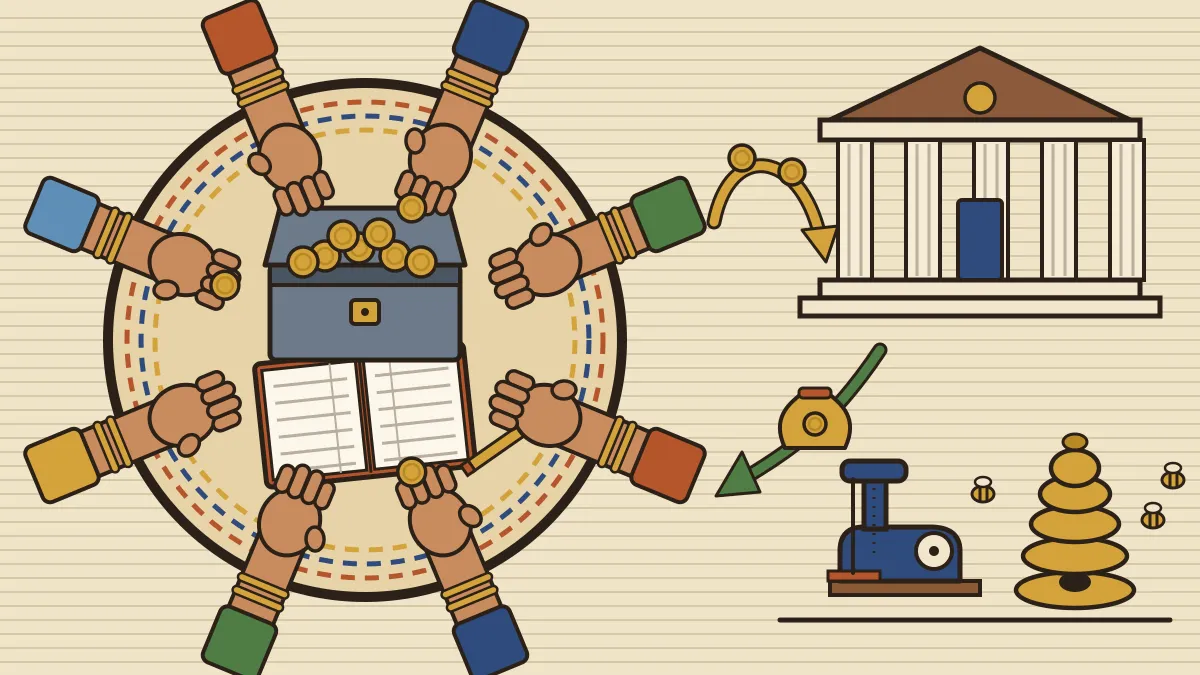
The government's flagship is the National Rural Livelihoods Mission (NRLM), run by the Ministry of Rural Development. It was launched in June 2011 under the brand name Aajeevika, taking over from the older Swarnajayanti Gram Swarozgar Yojana (SGSY). It was renamed the Deendayal Antyodaya Yojana-National Rural Livelihoods Mission (DAY-NRLM) in 2015. Its core promise is universal social mobilisation: at least one woman from every poor rural household brought into an SHG and its federations.
| Tool | What it does |
|---|---|
| Revolving Fund | Seed money to a new SHG (₹20,000–30,000 in the latest annual report) as an incentive to build thrift and a corpus |
| Community Investment Fund | Routed to SHGs through federations for livelihoods and collective activities; part of it, the Vulnerability Reduction Fund, helps the very poor |
| Interest subvention | Women SHGs in rural areas get bank loans at a concessional 7% a year up to ₹3 lakh, and the government compensates banks for the gap; the scheme now covers all districts |
| SVEP | Start-up Village Entrepreneurship Programme (launched 2016, a sub-scheme of DAY-NRLM): support for small rural businesses |
A women's SHG takes a ₹3 lakh loan under the interest-subvention scheme. Find the interest for a year at 7% (simple interest, ignoring repayments).
Interest = 3,00,000 × 7 ÷ 100 = ₹21,000 a year, or ₹1,750 a month. At a typical moneylender's 60% a year the same sum would cost ₹1,80,000. That gap is the reason the scheme exists.
From SHG to Lakhpati Didi
A Lakhpati Didi is an SHG member whose household earns at least ₹1 lakh a year (about ₹8,300 a month), counted after expenses and sustainable across seasons. The test is household income, not the woman's own earnings. The PIB records this timeline:
| When | Milestone |
|---|---|
| June 2011 | DAY-NRLM launched |
| 15 August 2023 | Initiative announced; target 2 crore women |
| February 2024 | Interim Budget raises the target to 3 crore; Lakhpati Didi portal launched |
| August 2024 | 1 crore Lakhpati Didis |
| December 2025 | 3 crore, ahead of schedule |
| February 2026 | New target: 6 crore by March 2029 |
| June 2026 | 3.76 crore achieved; 5.70 crore identified as potential |
The method is community-led. Trained Community Resource Persons identify potential Lakhpati Didis, record household income, prepare an individual business plan, and women then get about three years of coordinated help: training, finance, assets and markets. An independent IIM Ahmedabad assessment of 6,531 respondents in 17 states and UTs reported a 61% rise in average monthly household income and a 61.7% rise in monthly savings. See also the news analysis of the delivery machinery.
MFIs, RBI Rules and the Andhra Crisis
Not all microlending runs through SHGs. Microfinance institutions (MFIs), mostly non-banking finance companies, lend small collateral-free loans, usually to joint-liability groups. Their growth went wrong in Andhra Pradesh in 2010. Many poor women had borrowed from several MFIs at once, there were reports of over-indebtedness and harsh recovery, and on 15 October 2010 the State issued an ordinance curbing MFI lending and recovery. MFI lending in the State largely froze. The RBI appointed the Malegam Committee, which reported in January 2011. On its advice the RBI created a distinct category, the NBFC-MFI, with its own rules.
In March 2022 the RBI replaced the scattered rules with one framework, the Regulatory Framework for Microfinance Loans Directions, 2022, in force from 1 April 2022. It applies to all regulated lenders (banks, small finance banks, NBFCs), not just NBFC-MFIs.
| Feature | 2022 framework |
|---|---|
| Definition | A collateral-free loan to a household with annual income up to ₹3 lakh (the same limit in rural and urban areas) |
| Household | Husband, wife and their unmarried children |
| Repayment burden | Repayments on all loans must stay within 50% of household income |
| Pricing | The old margin caps for NBFC-MFIs were dropped, and lenders set rates under a board-approved policy; rates must not be usurious |
| Prepayment | No penalty for early repayment |
The 50% rule answers the Andhra problem directly: it stops lenders piling loan on loan until a household cannot pay. School texts also note that many micro-credit borrowers spend loans on consumption, not enterprise. Good microfinance needs a repayable loan and a viable livelihood, and Lakhpati Didi tries to supply the second.
An SHG is a savings-first group that borrows as a group. An MFI is a lender. A JLG is a small guarantee group with no savings requirement.
MUDRA in one paragraph
The Pradhan Mantri MUDRA Yojana (PMMY), launched on 8 April 2015, finances small income-generating businesses in manufacturing, trading and services, including activities allied to agriculture. MUDRA does not lend to the public itself; loans go through member lending institutions: banks, NBFCs and MFIs. The tiers are Shishu (up to ₹50,000), Kishor (above ₹50,000 up to ₹5 lakh), Tarun (above ₹5 lakh up to ₹10 lakh) and, since 24 October 2024, Tarun Plus (above ₹10 lakh up to ₹20 lakh, for those who repaid an earlier Tarun loan). It is collateral-free. The bigger picture of small enterprise is on the MSME page, and the wider banking structure on the banking page. For poverty and livelihood policy, see human development and poverty.
Past Papers, Solved
Which one of the following statements about a borrower from a Microfinance Company is not correct?
(a) The borrower should not have annual income beyond a limit. (b) The borrower should not seek loan amount beyond a limit. (c) The borrower should not refuse to offer a collateral. (d) The borrower should not refuse to pay any rate of interest offered.
Answer: (c). The defining feature of a microfinance loan is that it is collateral-free. Statement (c) says the opposite, so it is the incorrect one. An income limit and a collateral-free loan are both part of the definition.
Which of the following statements about Government programmes/schemes is/are correct? 1. Skill Training of Rural Youth (STRY) is a programme meant for improving skills of the rural youth in different thematic areas of agriculture. 2. Deendayal Antyodaya Yojana – National Rural Livelihoods Mission (DAY – NRLM) focuses on creating income generation opportunities for Self-Help Group (SHG) women. 3. Start-up Village Entrepreneurship Programme (SVEP) is meant for creating an enabling rural business development ecosystem for supporting all women except for those engaged with Self-Help Groups (SHGs).
(a) 1, 2 and 3 (b) 1 and 2 only (c) 2 and 3 only (d) 3 only
Answer: (b). Statement 2 is the heart of the mission. Statement 3 is wrong because SVEP is itself a sub-scheme of DAY-NRLM, so it supports enterprises of SHG families too, and it excludes no one. Dropping 3 leaves option (b) alone.
Which one of the following is the earliest launched scheme of the Government of India?
(a) Deendayal Antyodaya Yojana (b) Pradhan Mantri Gram Sadak Yojana (c) Saansad Adarsh Gram Yojana (d) Deendayal Upadhyaya Grameen Kaushalya Yojana
Answer: (b). PMGSY began in December 2000. The other three belong to the 2014 family of schemes launched from September to October 2014.
Which one of the following statements is not correct?
(a) The 'Swarna Jayanti Shahari Rozgar Yojana' is an urban self-employment programme. (b) Drought-Prone Area Programme and Desert Development Programme were launched in 1970s. (c) The 'Sampoorna Grameen Rozgar Yojana' was launched after restructuring the Integrated Rural Development Programme' in 2001. (d) The 'Swarna Jayanti Gram Swarozgar Yojana' is a rural self-employment programme.
Answer: (c). It was the SGSY (1999), the parent of NRLM, that restructured the IRDP. SGRY (2001) merged two wage-employment schemes. The other three statements are correct.
The 'Stand-Up India Scheme' is related to which one of the following issues?
(a) Social security during old age (b) Providing technical knowhow to young, educated or skilled workers from rural areas (c) Promoting entrepreneurship amongst women, SC and ST communities (d) Insurance cover to people in the age group of 18-50 years
Answer: (c). Stand-Up India (2016) supports bank loans to at least one SC/ST borrower and one woman borrower per bank branch for a new enterprise. Option (a) is the pension schemes and (d) is the insurance schemes. See the Stand-Up India update.
Expect a scheme-matching or "not correct" statement with a trap word such as exclusively or except. Keep the founding year, parent ministry and target group of each scheme in one line.
Practice MCQs (with answers)
- Muhammad Yunus and the Grameen Bank were awarded the Nobel Peace Prize in
- 1998
- 2006
- 2009
- 2012
- NABARD's pilot project to link SHGs with banks began in
- 1982
- 1987
- 1992
- 2002
- In the SHG-Bank Linkage model, the substitute for collateral is mainly
- the group's joint responsibility for repayment
- a mortgage on the member's land
- a deposit of gold
- a guarantee from the RBI
- Under the Lakhpati Didi initiative, a Lakhpati Didi is an SHG member whose household earns at least
- ₹50,000 a year
- ₹75,000 a year
- ₹2 lakh a year
- ₹1 lakh a year
- DAY-NRLM is run by the Ministry of
- Finance
- Rural Development
- Women and Child Development
- Micro, Small and Medium Enterprises
- Under RBI's 2022 framework, a microfinance loan is a collateral-free loan to a household with annual income up to
- ₹1 lakh
- ₹2 lakh
- ₹5 lakh
- ₹3 lakh
- Under PM MUDRA Yojana, a Shishu loan is one of
- up to ₹50,000
- above ₹50,000 up to ₹5 lakh
- above ₹5 lakh up to ₹10 lakh
- above ₹10 lakh up to ₹20 lakh
- In the DAY-NRLM community structure, the correct order from the smallest to the largest unit is
- Cluster Level Federation, Village Organisation, SHG
- Village Organisation, SHG, Cluster Level Federation
- SHG, Village Organisation, Cluster Level Federation
- SHG, Cluster Level Federation, Village Organisation
1-b, 2-c, 3-a, 4-d, 5-b, 6-d, 7-a, 8-c. Q1: Yunus's prize came in 2006, shared with the bank he founded. Q3: a bank lends to a poor SHG without mortgage because members hold each other accountable. Q6: the cap is ₹3 lakh a year; do not confuse it with the ₹1 lakh Lakhpati Didi household test. Q7: Shishu is the smallest tier; Kishor, Tarun and Tarun Plus follow it.
Quick Revision
- Microfinance = small collateral-free credit (plus savings, insurance) for the poor. Yunus: Jobra 1976, Grameen Bank 1983, Nobel Peace 2006 (shared with the bank).
- SHG: savings-first group, mostly women, about 10–20 members; bank loan to the group. NABARD pilot 1992 (500 SHGs); RBI mainstreamed it 1996. Tiers: SHG, Village Organisation, Cluster Level Federation.
- JLG: informal group of about 4–10 guaranteeing each other's loans. MFI: a lender.
- DAY-NRLM: Ministry of Rural Development; launched June 2011 as Aajeevika (successor to SGSY, 1999); renamed 2015. Tools: Revolving Fund, CIF, interest subvention (7% up to ₹3 lakh), SVEP (2016).
- Lakhpati Didi: household income at least ₹1 lakh a year after expenses. Announced 15 August 2023. PIB, June 2026: 3.76 crore achieved; target 6 crore by March 2029; IIM-A: income up 61%. DAY-NRLM, 12 Nov 2026: 10.13 crore members, 94.40 lakh SHGs.
- Andhra Pradesh, October 2010: ordinance after over-indebtedness; Malegam Committee led to NBFC-MFI.
- RBI 2022 framework (from 1 April 2022): collateral-free loan, household income up to ₹3 lakh, repayments within 50% of income, no prepayment penalty, rates not usurious.
- MUDRA (8 April 2015): Shishu up to ₹50,000; Kishor up to ₹5 lakh; Tarun up to ₹10 lakh; Tarun Plus up to ₹20 lakh (24 Oct 2024). Refinances, does not lend directly.
Frequently asked questions
What is the difference between an SHG and a microfinance institution?
A Self-Help Group is a small savings group, usually of women, that pools its own money, lends to its members and later borrows from a bank as a group. A microfinance institution is a lender, usually a non-banking finance company, that gives small collateral-free loans, often to joint-liability groups. The SHG is a borrower and saver, while the MFI is a financial institution.
What was the SHG-Bank Linkage Programme?
It is the NABARD-led programme that lets banks lend to Self-Help Groups without collateral. NABARD began a pilot in 1992 to link 500 SHGs with banks, and in 1996 the RBI made lending to SHGs a mainstream part of bank business under priority sector lending.
What is DAY-NRLM?
The Deendayal Antyodaya Yojana-National Rural Livelihoods Mission is the Ministry of Rural Development's mission to organise rural poor women into SHGs and federations and link them to banks, skills and markets. It began in June 2011 as the National Rural Livelihoods Mission, branded Aajeevika, and was renamed DAY-NRLM in 2015. As of 12 November 2026 it had about 10.13 crore SHG members in 94.40 lakh SHGs.
Who is a Lakhpati Didi?
A Lakhpati Didi is a member of a rural SHG whose household earns at least ₹1 lakh a year, calculated after expenses and sustainable across seasons. The PIB reports that 3.76 crore women had been enabled as Lakhpati Didis by June 2026, against a target of six crore by March 2029.
What does the RBI's 2022 framework say about microfinance loans?
The framework, effective from 1 April 2022, defines a microfinance loan as a collateral-free loan to a household with annual income up to ₹3 lakh. It limits total loan repayments to 50 percent of household income, bars prepayment penalties, and asks lenders to price loans under a board-approved policy without charging usurious rates. It applies to all regulated lenders, not only NBFC-MFIs.
Related CDS / OTA Economics topics
Rural credit and schemes are scoreable in every CDS economy section
Cavalier's CDS/OTA batches teach banking, rural development and government schemes through tables, timelines and weekly PYQ tests.