On 20 November 2026 Union Culture Minister Gajendra Singh Shekhawat flagged off the Yuva Somnath Yatra from Safdarjung Railway Station, Delhi. More than 1,100 students are travelling by special train to Veraval and Somnath in Gujarat (20 to 25 November) under the Somnath Swabhiman Parv. The Ministry of Culture says over 35,000 devotees from 17 states have already visited under the same initiative. The 75th anniversary of the temple's reconstruction was marked on 11 May 2026. Somnath belongs to the world of c. 750 to 1200 CE: the Rajput kingdoms, the Chaulukya rulers of Gujarat and the raiders from Ghazni. That period links the Gupta age to the Delhi Sultanate, and it is a favourite of the CDS and NDA history papers.
The Tripartite Struggle for Kannauj (c. 750 to 1000)
By Narendra Singh · GS faculty, The Cavalier · 15 years teaching GS
After Harsha died in the 7th century, northern India split into small kingdoms. The city of Kannauj, Harsha's capital, remained the prize. Whoever held it controlled the Ganga valley, so from about 750 to 1000 three large kingdoms fought for it. Historians call this the tripartite struggle, meaning a contest among three parties. None of them won for long. (An earlier ruler of Kannauj, Yashovarman, had been a patron of poets, but his kingdom faded.)
| Rashtrakutas | Pratiharas | Palas | |
|---|---|---|---|
| Region | Northern Deccan; capital Malkhed (Manyakheta) | Avanti (Malwa) and southern Rajasthan, then Kannauj | Bengal and much of Bihar |
| Key rulers | Dhruva; Amoghavarsha | Nagabhata II; Mihira Bhoja (c. 836 to 885) | Gopala (elected by nobles); Dharmapala |
| Known for | The Kailasa temple at Ellora (Krishna I) | Checking the Arabs in Sind; Bhoja's coins with the Varaha (boar) incarnation | Buddhist patronage: Nalanda, Vikramashila, Somapura; a friendship treaty with Tibet; sea trade with South-East Asia |
- The Pratiharas first rose by defeating the foreigners the sources call mlechchhas, probably the Arabs, who had occupied Sind. They then took their armies east and captured Kannauj by the end of the 8th century.
- The Palas ruled for about 400 years. Gopala was chosen by the nobles when the previous ruler left no heir. His son Dharmapala lost to a Rashtrakuta king, rebuilt his army and attacked Kannauj.
- Bhoja recovered Kannauj for the Pratiharas and held it for decades, though the Rashtrakutas checked his advance into the south. An Arab merchant, Sulaiman, wrote in about 851 of a powerful king of "Juzr" (Gurjara), usually taken to be the Pratihara kingdom under Bhoja.
- When the Rashtrakutas attacked again in 916, all three kingdoms were already exhausted. Within a hundred years each had declined, and the Pratihara realm broke into smaller states, some of which became Rajput kingdoms.
The three were Rashtrakutas, Pratiharas and Palas. The Cholas and the later Chalukyas of the south appear only afterwards: Chola armies threatened the weakened Pala kingdom, and the later Chalukyas took over the lands where the Rashtrakutas had ruled. An option that names the Cholas as one of the three for Kannauj is wrong.
The Rajput Clans and Their Literature
The Rajputs' origins are debated. Some historians connect them to Central Asian tribes who settled in India after the Hun invasions, although the Rajputs themselves always claimed to be kshatriyas. Their family histories linked them to the sun family (surya-vamsha) or the moon family (chandra-vamsha). Four important clans claimed descent from fire instead: the Agnikula clans.
| Agnikula clan | Other name | Where it ruled |
|---|---|---|
| Pratiharas | Pariharas | Around Kannauj, once the Ganga valley was theirs |
| Chauhans | Chahamanas | Central Rajasthan (Shakambhari, later Ajmer); Delhi after they beat the Tomaras |
| Solankis | Chaulukyas | Gujarat and Kathiawar; capital Anahilapataka (modern Patan) |
| Paramaras | Pawars | Malwa; capital Dhar |
Other clans mattered too. The Chandellas held Bundelkhand (their capital at Khajuraho, famous for its temples), the Guhilas held Mewar, and the Tomaras built the city of Dhillika (Delhi) before the Chauhans took it. Prithviraj III of the Chauhans is the hero of the ballad Prithviraj Raso by the poet Chand Bardai. All of these clans began as vassals of the Pratiharas and Rashtrakutas and later declared independence.
| Work | Author | What it is |
|---|---|---|
| Rajatarangini | Kalhana (12th century) | Chronicle of the kings of Kashmir, the best-known historical work of the period |
| Prithvirajavijaya | Jayanaka | Poem on the life of Prithviraj III Chauhan |
| Vikramankadevacharita | Bilhana | Biography of the Chalukya king Vikramaditya VI |
| Gita Govinda | Jayadeva | Sanskrit lyric poem on Radha and Krishna, from Bengal |
The Rajatarangini deals with the Utpala dynasty of Kashmir too. Its founder Avantivarman (9th century) is remembered for caring about his subjects' livelihood, and his minister Suyya carried out engineering works that raised grain output and lowered its price. Kashmir, Nepal, Kamarupa and Utkala also had kingdoms of their own, although the hill kingdoms stood apart from the Rajput contests.
Why These Kingdoms Were Weak: Land Grants and Feudatories
The more important change was in how kings paid for their government. Officers were given the revenue of villages instead of salaries. At first they had no ownership, but by the medieval period many claimed the land itself. Brahmins were also given grants (agrahara or brahmadeya) and paid no further dues to the king. Powerful officers handed villages to subordinates, and so a chain of intermediaries grew between peasant and king.
- Revenue was now divided between the king and the feudatories, so the king had less to spend on his army.
- Feudatories obeyed less and, when strong enough, declared independence with titles like maharajadhiraja. The Rashtrakutas had themselves risen from feudatories of the Chalukyas, and the Chandellas broke from the Pratiharas.
- Disputes were settled by fighting, so the rulers spent revenue on wars with each other and were weak when threatened from outside.
- Peasants, mostly shudras, paid revenue and extra taxes and gave free labour. They had little reason to care whether the lord was Rajput or Turk.
Trade, meanwhile, was lively. Arab merchants on the west coast carried Indian saffron, silk, cotton and spices to western Asia and East Africa. The most important import was horses from Central Asia and Arabia, bought at huge prices. That is a quiet clue to what happened next: the invaders brought better cavalry and the Rajput lords never united against them.
Ghazni and Ghur: The Raids and the Conquest
Ghazni was a small kingdom in Afghanistan founded by a Turkish nobleman. Its ruler Mahmud wanted money to build an army for conquests in Central Asia, and India was known to be rich. His first raid in India began in the year 1000, and over about twenty-five years he made seventeen raids.
| Ruler | What he did | Why remembered |
|---|---|---|
| Mahmud of Ghazni (died 1030) | About 17 raids from 1000; sacked Kannauj in 1018, when the Pratihara king Rajyapala fled; marched to Somnath in 1025–26 | Raided for gold, mostly temple towns; annexed the Punjab; patron of Firdausi (Shahnama); brought Al-Biruni |
| Muhammad of Ghur (died 1206) | Fought Prithviraj III at Tarain in 1191 (defeated) and again in 1192 (won); left generals to hold conquered lands | Came to conquer and rule, not just to loot |
| Qutb-ud-din Aibak | Governed Muhammad's Indian lands; became sultan in 1206 | Start of the Delhi Sultanate (see our Delhi Sultanate page) |
Al-Biruni lived in India for years and wrote the Kitab-ul-Hind in Arabic, a careful account of Indian science, religion and customs. The Ghurid conquest then spread east: Bakhtiyar Khalji overran Bihar and Bengal in the years around 1200, and Nalanda and Vikramashila fell to his armies. The reasons the Turks won are those of the previous section: feudal disunity, rulers who fought each other, and cavalry. The Rajputs' own society did not suddenly fail. Mahmud of Ghazni's raids terrified the north but did not set up an Indian state, which Muhammad of Ghur's did.
The Chaulukyas, Somnath and the Temples They Built
Somnath sits at Prabhas Patan on the Kathiawar coast, on the Arabian Sea, and counts as one of the twelve jyotirlinga shrines of Shiva. Mahmud marched across the desert in 1025 and, according to the PIB backgrounder, attacked the temple in January 1026, the first recorded attack on it, carrying away its wealth. The ruler of Gujarat then was the Chaulukya king Bhima I (c. 1022 to 1064).
| Chaulukya ruler or work | Contribution |
|---|---|
| Mularaja I (mid-10th century) | Founded the line at Anahilapataka (Patan), after overthrowing the Chavda king |
| Bhima I | Ruled during Mahmud's raid; the Sun Temple at Modhera dates from his reign (after 1026–27); the first Dilwara (Vimala Vasahi) Jain temples at Mount Abu belong to this time (1031) |
| Rani-ki-vav, Patan | A great stepwell raised by Queen Udayamati in memory of Bhima I; a UNESCO World Heritage Site (2014) |
| Siddharaja Jayasimha (c. 1092 to 1142) and Kumarapala (c. 1143 to 1172) | Height of the dynasty; Kumarapala patronised the Jain scholar Hemachandra; the PIB backgrounder records that he restored the Somnath temple in the 12th century |
| Vaghelas | Succeeded the Chaulukyas; Vastupala and Tejapala built the Luna Vasahi at Dilwara (1230); the last Vaghela king, Karna, lost Gujarat to an army of Alauddin Khalji in 1299 |
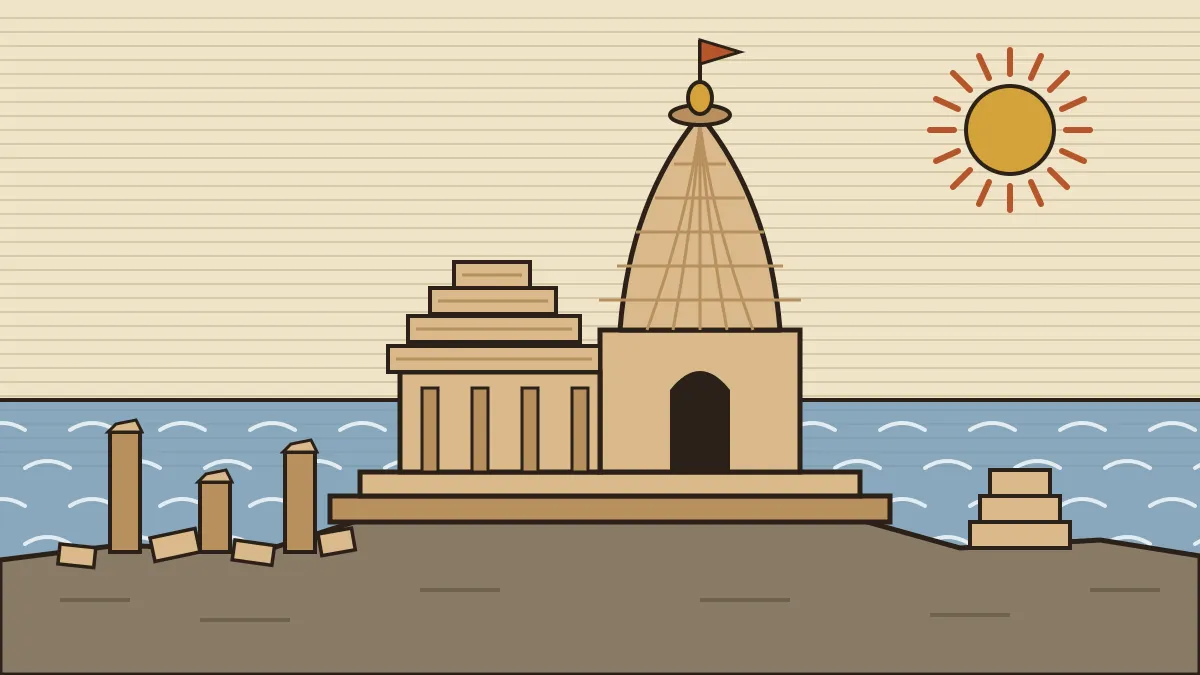
This school of Gujarat and western Rajasthan is called the Maru-Gurjara style, known for fine carving in stone and marble. It builds on the Nagara tradition of a curving tower over the sanctum. Modhera shows a Sun Temple on a tank with a carved assembly hall, covered further in our article on the sun temples of India. The Rajput clans also left forts: at Chittor, Ranthambhor and Gwalior.
Somnath itself was damaged and rebuilt several times over the centuries, and the Chaulukyas are only one chapter. In the 18th century Ahilyabai Holkar of Indore consecrated a new temple at Somnath. After Independence, Sardar Patel visited the ruins in 1947 and resolved to rebuild the temple, and K. M. Munshi is remembered as its principal supporter. President Rajendra Prasad installed the jyotirlinga on 11 May 1951. The PIB backgrounder describes the present temple's style as Kailash Mahameru Prasad, a Chaulukya-style design of western India. For the background to Patel's work, read our article on Rashtriya Ekta Diwas and the integration of the princely states.
How UPSC Has Asked It: Past Papers Solved
These are actual CDS and NDA questions since 2018. The period is asked as who belonged to which group, who wrote what and which monument is in the news.
Which of the following clans are included in the Agnikula Rajputs? 1. Pratiharas. 2. Chaulukyas. 3. Paramaras. 4. Chahamanas. Select the correct answer from the code given below:
(a) 1 and 3 only (b) 1, 3 and 4 only (c) 1, 2, 3 and 4 (d) 2 and 4 only
Answer: (c). All four, as the table above shows. The Chahamanas are the Chauhans and the Chaulukyas are the Solankis, so option (b) fails by leaving one of them out.
Which of the following is/are NOT historical biography/biographies? 1. Dipavamsa. 2. Harshacharita. 3. Vikramankadevacharita. 4. Prithvirajavijaya. Select the correct answer from the code given below:
(a) 1 only (b) 2 and 3 only (c) 2, 3 and 4 only (d) 1, 2, 3 and 4
Answer: (a). Harshacharita (Banabhatta, on Harsha), Vikramankadevacharita (Bilhana, on the Chalukya king Vikramaditya VI) and Prithvirajavijaya (on Prithviraj III Chauhan) are biographies of kings. The Dipavamsa is a Pali chronicle of Sri Lanka.
Yashovarman was ruler of which one of the following kingdoms?
(a) Kannauj (b) Mewar (c) Marwar (d) Kalinga
Answer: (a). Yashovarman ruled Kannauj in the early 8th century, before the tripartite struggle. Mewar was Guhila land, and Marwar came much later.
Al-Biruni's Kitab-ul-Hind was written in which language?
(a) Arabic (b) Persian (c) Urdu (d) Turkish
Answer: (a). Al-Biruni came with Mahmud of Ghazni and wrote in Arabic. The Persian choice is the trap: Firdausi's Shahnama, also from Mahmud's court, is in Persian.
Consider the following statements with reference to the Utpala dynasty of Kashmir: 1. Avantivarman, the founder, devoted his energies to the economic upliftment of his subjects. 2. Avantivarman's period in Kashmir is known for the engineering operations under his minister Suyya, resulting in the enormous increase of grains and fall in prices. Which of the statements given above is/are correct?
(a) 1 only (b) 2 only (c) Both 1 and 2 (d) Neither 1 nor 2
Answer: (c). Both statements repeat what the Rajatarangini records about Avantivarman and Suyya's irrigation and flood-control works.
Which one among the following villages was recently declared as India's first 24x7 solar-powered village?
(a) Mawlynnong, Meghalaya (b) Modhera, Gujarat (c) Ziro village, Arunachal Pradesh (d) Malana, Himachal Pradesh
Answer: (b). Modhera is the village of the Chaulukya-era Sun Temple, which explains why history and current affairs meet in one question.
Consider the following statements about Rana Kumbha of Mewar: 1. He wrote a commentary on Jayadeva's Gitagovinda. 2. He wrote four dramas in which he is said to have made use of four provincial languages. 3. He erected Kirtistambha in Chitor in commemoration of his victory over Gujarat. Which of the statements given above is/are correct?
(a) 1, 2 and 3 (b) 2 and 3 only (c) 1 and 2 only (d) 3 only
Answer: (c). Kumbha was a scholar-king and wrote on the Gita Govinda, which ties back to Jayadeva above. Statement 3 is the false one: the victory tower Kumbha built at Chittor is the Vijaya Stambha, usually linked to his victory over Mahmud Khalji of Malwa (some accounts add Gujarat's forces), not to Gujarat alone, and the Kirti Stambha there is the older Jain tower raised by a merchant.
UPSC rarely asks dates here. It asks groupings (Agnikula clans, the three Kannauj powers), authors (Kalhana, Bilhana, Al-Biruni) and places in the news (Modhera, Somnath). Learn each name with its home region and its work.
Practice MCQs (with answers)
- The three powers in the tripartite struggle for Kannauj were
- Pratiharas, Palas and Cholas
- Pratiharas, Palas and Rashtrakutas
- Chalukyas, Palas and Rashtrakutas
- Gahadavalas, Palas and Pratiharas
- The founder of the Pala dynasty, chosen by the nobles of Bengal, was
- Dharmapala
- Devapala
- Mahipala
- Gopala
- Which dynasty ruled from Anahilapataka (Patan) in Gujarat?
- Chaulukya (Solanki)
- Chahamana (Chauhan)
- Paramara
- Chandella
- Kalhana's Rajatarangini is a chronicle of the kings of
- Bengal
- Gujarat
- Kashmir
- Malwa
- Which stepwell at Patan, built in memory of a Chaulukya king and a UNESCO World Heritage Site, is a famous example of the dynasty's art?
- Adalaj ni Vav
- Rani-ki-vav
- Chand Baori
- Agrasen ki Baoli
- Mahmud of Ghazni's raid on the Somnath temple took place in
- 1001
- 1191
- 1206
- 1025–26
- In the Second Battle of Tarain (1192), Muhammad of Ghur defeated
- Jaichand of Kannauj
- Bhima II of Gujarat
- Prithviraj III of the Chauhans
- Paramardi of the Chandellas
- The spread of revenue grants to officers in the early medieval period tended to make
- kings weaker and feudatories stronger
- kings richer and armies larger
- peasants freer from taxes
- trade impossible
1-b, 2-d, 3-a, 4-c, 5-b, 6-d, 7-c, 8-a. Q1: the Cholas were a southern power and never one of the three. Q2: Gopala was elected, and his son Dharmapala made the dynasty great. Q6: 1001 falls among Mahmud's early raids, while 1191 and 1206 belong to Ghur. Q7: Prithviraj III won the first battle in 1191 and lost the second. Q8: divided revenue left the king with less to pay his army.
Quick Revision
- Tripartite struggle for Kannauj, c. 750 to 1000: Rashtrakutas (Deccan, Malkhed; Amoghavarsha), Pratiharas (Avanti then Kannauj; Mihira Bhoja), Palas (Bengal, Bihar; Gopala, Dharmapala). Sulaiman's "Juzr" (c. 851) is usually taken to be the Pratihara realm under Bhoja.
- Agnikula Rajputs: Pratiharas (Pariharas), Chauhans (Chahamanas), Solankis (Chaulukyas), Paramaras (Pawars). Chandellas (Khajuraho), Guhilas (Mewar), Tomaras (Delhi).
- Works: Rajatarangini (Kalhana, Kashmir), Prithvirajavijaya, Vikramankadevacharita (Bilhana), Gita Govinda (Jayadeva), Prithviraj Raso (Chand Bardai).
- Land and revenue grants created feudatories: weaker kings, constant wars, free labour for the peasants, and horses as the main import.
- Mahmud of Ghazni: about 17 raids, Kannauj 1018, Somnath 1025–26, died 1030; Al-Biruni wrote the Kitab-ul-Hind in Arabic; Firdausi, Shahnama, Persian.
- Muhammad of Ghur: Tarain 1191 (lost), 1192 (won); murdered 1206; Aibak became sultan. Bakhtiyar Khalji overran Bihar and Bengal around 1200.
- Chaulukyas: Anahilapataka (Patan); Modhera Sun Temple and Dilwara under Bhima I; Rani-ki-vav (UNESCO 2014); Kumarapala and Hemachandra; Vaghelas end 1299 with Alauddin's army.
- Somnath: rebuilt in 1951 (Rajendra Prasad, 11 May 1951); Yuva Somnath Yatra flagged off on 20 November 2026.
Frequently asked questions
What was the tripartite struggle?
It was the long contest from about 750 to 1000 among the Rashtrakutas of the Deccan, the Pratiharas of Avanti and Rajasthan and the Palas of Bengal and Bihar for control of Kannauj, the city that commanded the Ganga valley. None held it for long, and all three were exhausted by the time Turkish invaders arrived.
Who are the Agnikula Rajputs?
Four Rajput clans who claimed descent from a sacrificial fire and not from the sun or the moon: the Pratiharas, the Chauhans (Chahamanas), the Solankis (Chaulukyas) and the Paramaras (Pawars). They were the most important clans of the period.
Which dynasty ruled Gujarat when Mahmud of Ghazni attacked Somnath?
The Chaulukya (Solanki) dynasty, with its capital at Anahilapataka (Patan), ruled Gujarat. The king in 1025 to 1026 was Bhima I. The Modhera Sun Temple and the earliest Dilwara temples date from his reign.
How did Mahmud of Ghazni differ from Muhammad of Ghur?
Mahmud of Ghazni raided India about seventeen times, mainly for gold and temple wealth, and annexed only the Punjab. Muhammad of Ghur wanted to conquer and rule northern India. He defeated Prithviraj III at the Second Battle of Tarain in 1192 and left generals such as Qutb-ud-din Aibak to hold the land.
Why did the Rajput kingdoms fail to resist the Turks?
They were divided and fought each other constantly. Revenue grants had created powerful feudatories, so kings had less money for armies and less control over their vassals. The Turkish invaders also brought strong cavalry, while the Rajput rulers never formed a common front.
Related CDS / OTA History topics
History is a fixed share of every CDS GS paper
Cavalier's CDS/OTA batches teach ancient, medieval and modern history as one connected story, with weekly PYQ tests.