On 16 and 17 November 2026 the Prime Minister was in Manila for the 23rd India-ASEAN Summit and the 21st East Asia Summit. India's links with Southeast Asia run through the sea, and the most famous Indian war fleet to cross the Bay of Bengal was sent by the Chola empire. In 1025 its navy crossed to the Malay Peninsula and Sumatra. The same dynasty gave south India the clearest picture we have of medieval village government, and it built the temple tower at Thanjavur. UPSC asks about the Cholas almost every cycle. This article takes the navy, the village sabha and the temples in turn. The early (Sangam) Cholas are on our South Indian dynasties page. Here we stay with the Imperial Cholas, c. 850 to 1279.
From Vijayalaya to Rajendra I: Who Did What
By Narendra Singh · GS faculty, The Cavalier · 15 years teaching GS
In the mid-ninth century the Kaveri delta was held by a small chiefly family, the Muttaraiyar, who served the Pallavas of Kanchipuram. Vijayalaya, from the old Chola family of Uraiyur, took the delta from them around 850, built the town of Thanjavur and raised a temple there to the goddess Nishumbhasudini.
| King | Reign (approx.) | Remember him for |
|---|---|---|
| Vijayalaya | c. 846–871 | Captured Thanjavur from the Muttaraiyar; founder of the Imperial line |
| Aditya I | 871–907 | Defeated the Pallavas and took their northern lands (Tondaimandalam) |
| Parantaka I | 907–955 | Took Madurai and the title Maduraikonda; beaten by the Rashtrakutas at Takkolam (949); the Uttaramerur village rules belong to his reign |
| Rajaraja I | 985–c. 1014 | Cheras, Pandyas, northern Sri Lanka, the Maldives; the land survey; the Brihadisvara temple at Thanjavur (consecrated 1010) |
| Rajendra I | c. 1014–1044 | Ganga expedition (title Gangaikonda Chola); new capital Gangaikondacholapuram; the 1025 naval raid on Srivijaya |
| Kulottunga I | 1070–1122 | Joined the Chola and Eastern Chalukya (Vengi) lines |
Rajaraja I (985 onward) is the first great organiser. He beat the Cheras, the Pandyas and parts of Mysore, campaigned in the Vengi country of the Andhra delta, and saw that command of the sea would make the Cholas stronger still. A naval expedition took northern Sri Lanka and the Maldive Islands. He also ordered a land survey and reorganised the revenue system. His son Rajendra I was bolder. The Chola army marched up the east coast through Orissa to the Ganga and threatened the Pala king of Bengal. Rajendra returned south, took the title Gangaikonda Chola ("the Chola who took the Ganga") and founded Gangaikondacholapuram, a new capital near Thanjavur.
The empire weakened after Kulottunga I. Wars with the Hoysalas, Pandyas and the Chalukya successors drained it, and by the end of the 13th century the Chola kingdom was gone.
Karikala and the Venni battle belong to the early Sangam Cholas of about the first two centuries CE. Vijayalaya, Rajaraja and Rajendra belong to the Imperial Cholas, 700 years later. UPSC mixes them in options, so attach each name to its era.
How the Chola State Worked: Mandalam to Village
The Chola king was the most powerful person in the land, yet he was expected to take advice from a council of ministers and his preceptor (purohita). The empire was split into provinces called mandalams. Each mandalam had several valanadus, and each valanadu had groups of villages. Peasant settlements were called ur, and groups of them formed a nadu. The village council and the nadu assembly dispensed justice and collected taxes. Rich Vellala peasants had a large say in the nadu, working under the supervision of the central government. The king honoured some of them with titles such as muvendavelan and araiyar and gave them posts at court.
Revenue came from two sources: tax on land and its produce, and tax on trade. The land tax was generally collected through the village councils. Inscriptions name the kinds of land:
| Land category | Meaning |
|---|---|
| Vellanvagai | Land of non-Brahmana peasant owners |
| Brahmadeya | Land gifted to Brahmanas, usually tax-free |
| Shalabhoga | Land set aside for the upkeep of a school |
| Devadana / tirunamattukkani | Land gifted to temples |
| Pallichchhandam | Land donated to Jaina institutions |
Each brahmadeya village was run by an assembly of landholding Brahmanas, the sabha (also called the mahasabha), and in non-brahmadeya villages the council was called the ur. In towns, associations of traders called nagarams sometimes did administrative work. Merchants formed guilds to protect their interests, among them the Manigramam and the Nanadesi, which traded within the peninsula and with Southeast Asia and China.
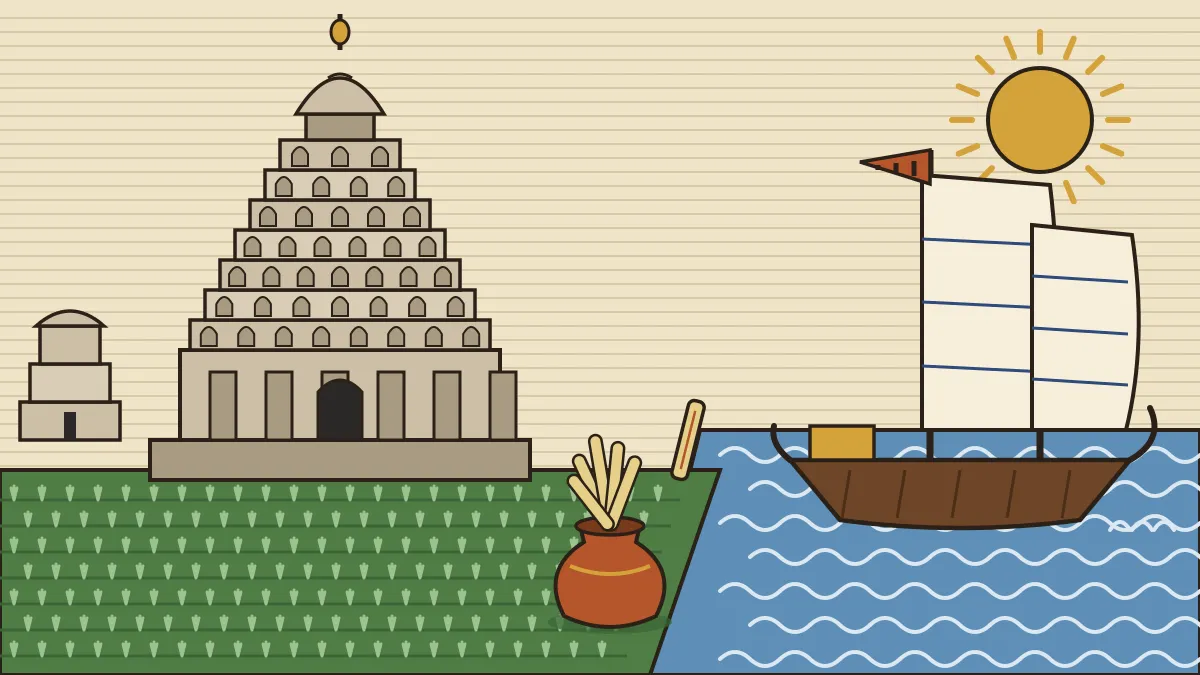
Irrigation underpinned all of it. Rulers and villagers built embankments, canals, wells and large tanks in the Kaveri delta, often for two crops a year. Planning and sharing that water gave the village bodies real work to do.
The Uttaramerur Inscriptions: Lots, Not Elections
The best-known record of local government comes from Uttaramerur in present-day Tamil Nadu. Stone inscriptions on the walls of the Vaikuntha Perumal temple, dated to the reign of Parantaka I (around 919 and 921), lay down how the sabha was to be formed. The village was divided into thirty wards, and committees were chosen from them each year, one for tanks, one for gardens, one for temples and so on.
The rules for membership were strict:
- The candidate must own land from which land revenue is collected, and have a house of his own.
- He must be between 35 and 70 years of age.
- He must know the Vedas and be well-versed in administration, and honest.
- Anyone who served on a committee in the last three years could not serve again.
- Anyone who had not submitted accounts, for himself and his relatives, was barred.
The names of eligible persons were written on palm-leaf tickets, placed in an earthen pot, and a young boy drew out one ticket for each committee. This is the kudavolai system, an early form of selection by lot.
Uttaramerur was not a modern election. Only landowners of a certain age and learning could stand, women were not included, and the "ballot" was a lottery among the qualified. Examiners like to test the conditions, so learn the ages: 35 to 70, not 30 to 60. The one thing it does show is a village that governed itself under a strong king, with written rules and audited accounts.
Temples, Bronzes and the Chola Age of Culture
Chola temples became the centre of a settlement, a craft workshop and a landowner. Land endowments paid priests, musicians, dancers and craftsmen. The two giants are Thanjavur, the Brihadisvara (Rajarajesvara) temple built by Rajaraja I and consecrated in 1010, and Gangaikondacholapuram, built by Rajendra I. Along with the Airavatesvara temple at Darasuram, they make up the UNESCO World Heritage site of the "Great Living Chola Temples".
The Chola style is the Dravida style. Its signature is the vimana, the stepped pyramidal tower over the sanctum, capped by a dome-like crown. At Thanjavur it is the tallest of its age. The architect, Kunjaramallan Rajaraja Perunthachchan, carved his own name into the wall. Inside, early Chola wall paintings were uncovered beneath later layers in the twentieth century. Chola kings built many Shiva temples, including those at Chidambaram, Thanjavur and Gangaikondacholapuram. The Vaishnava temple at Srirangam belongs to a different tradition, and the Nagapattinam vihara was Buddhist. Sekkizhar's Periyapuranam and Kamban's Tamil Ramayana belong to the Chola age. See our Bhakti movement page for the Nayanars and Alvars.
Bronzes. Bronze images were cast earlier under the Pallavas, but the finest were made under the Cholas between the 10th and 12th centuries, by the lost-wax method. Craftsmen such as the sthapatis of Svamimalai (near Kumbakonam) still use it. The great icon is the Nataraja, Shiva as lord of the dance. Read it as a set of meanings:
| Feature | Meaning |
|---|---|
| Balanced on the right leg, foot on the apasmara | The apasmara is the demon of ignorance or forgetfulness |
| Left leg raised (bhujangatrasita stance) | Tirobhava: kicking away the veil of maya (illusion) from the devotee's mind |
| Upper right hand holds the damaru | His favourite instrument, keeping the beat (tala) |
| Upper left hand carries a flame | Fire |
| Main right hand in abhaya hasta | Reassurance: do not fear |
| Ring of flames (jvala mala) | The garland of flames around the figure |
The Sengol, a staff of authority placed in the new Parliament building in May 2023, was presented as rooted in the Chola tradition of handing over power, and UPSC asked about it (NDA 2023-II).
How UPSC Has Asked It: Past Papers Solved
These are actual CDS and NDA questions. Most Chola questions ask who did what, where was the temple or what do the sabha rules say.
Who among the following Chola kings encouraged the Sailendra ruler of Sri Vijaya to build a Buddhist Vihara in Negapatnam?
(a) Parantaka I (b) Rajaraja I (c) Rajendra I (d) Kulottunga I
Answer: (b). The vihara was built by the Sailendra king of Srivijaya in Rajaraja I's reign, and Rajaraja granted the village of Anaimangalam for its upkeep. Rajendra I is the tempting wrong answer because he is the Srivijaya king in most minds. He raided Srivijaya some twenty years later.
At which one of the following places was a Shiva temple not constructed under the patronage of the Chola rulers?
(a) Chidambaram (b) Thanjavur (c) Gangaikonda Cholapuram (d) Naneghat
Answer: (d). Naneghat is a mountain pass in Maharashtra associated with the Satavahanas. The other three are Chola Shiva temples.
Which one among the following is a temple of the Vaishnavite tradition?
(a) Srirangam (b) Chidambaram (c) Gangaikonda Cholapuram (d) Thanjavur
Answer: (a). Srirangam (Ranganathaswamy) is the Vishnu temple. Chidambaram, Thanjavur and Gangaikondacholapuram are Shiva temples. The same option set can be turned round: "Which is not Vaishnavite?"
With reference to the eligibility criteria for becoming the member of a 'Sabha' as laid down in the Uttarmerur inscription, consider the following statements: 1. The candidate should have his own house and his own plot of land 2. The candidate should be within 60 years of age and above 30 years
(a) 1 only (b) 2 only (c) Both 1 and 2 (d) Neither 1 nor 2
Answer: (a). Statement 1 is correct: the candidate must own land that pays revenue and have his own house. Statement 2 is false because the age limits were 35 to 70, not 30 to 60.
'Sengol', installed in the new Parliament building of India, was seen as a symbol of the path of service, duty and nation in which Empire of the past?
(a) Gupta Empire (b) Shunga Empire (c) Pandyan Empire (d) Chola Empire
Answer: (d). The sengol was linked to the Chola tradition of transferring power. The Pandyas are the tempting second choice because both are Tamil dynasties.
Three of the five questions turn on one swapped detail: the wrong king, the wrong place, the wrong age. Learn each king's one big achievement and the 35–70 age rule.
Practice MCQs (with answers)
- Who captured Thanjavur from the Muttaraiyar and began the Imperial Chola line?
- Aditya I
- Parantaka I
- Rajaraja I
- Vijayalaya
- The title "Gangaikonda Chola" was taken by
- Rajaraja I
- Rajendra I
- Kulottunga I
- Parantaka I
- In the Chola administrative hierarchy, a province was called a
- nadu
- mandalam
- ur
- valanadu
- In Chola inscriptions, land gifted to Brahmanas was called
- brahmadeya
- vellanvagai
- shalabhoga
- pallichchhandam
- The Uttaramerur inscriptions are associated with
- the working of village assemblies
- Chola temple architecture
- the Srivijaya expedition
- the Sangam age
- The Chola naval expedition against Srivijaya took place in about
- 895
- 1010
- 1025
- 1190
- Which of these is a World Heritage "Great Living Chola Temple"?
- Konark
- Meenakshi temple, Madurai
- Airavatesvara temple, Darasuram
- Kailasa temple, Ellora
- In the Chola Nataraja, the demon under Shiva's foot, who stands for ignorance, is
- Bhairava
- Mahishasura
- Tripurasura
- Apasmara
1-d, 2-b, 3-b, 4-a, 5-a, 6-c, 7-c, 8-d. Q1: Aditya I and Parantaka I came after Vijayalaya. Q3: a nadu is a group of villages (ur) and a valanadu sits inside a mandalam, so the province is the mandalam. Q7: Konark and Ellora are not Chola, and Madurai's Meenakshi temple is Pandya-Nayaka. Q8: Apasmara represents ignorance or forgetfulness.
Quick Revision
- Vijayalaya (c. 850) took Thanjavur. Aditya I beat the Pallavas. Parantaka I (907–955): Madurai, Takkolam defeat (949), Uttaramerur rules.
- Rajaraja I (985–c. 1014): Brihadisvara, Thanjavur (1010); Sri Lanka and Maldives; land survey; Nagapattinam vihara grant (Anaimangalam). Rajendra I (to 1044): Ganga march, Gangaikondacholapuram, Srivijaya raid c. 1025 (Kadaram = Kedah).
- Hierarchy: mandalam → valanadu → nadu → ur. Local bodies: sabha (brahmadeya), ur, nagaram (towns), guild manigramam.
- Land: vellanvagai, brahmadeya, shalabhoga, devadana/tirunamattukkani, pallichchhandam.
- Uttaramerur: 30 wards, committees by lot (kudavolai); members aged 35–70, own house and revenue-paying land, no repeat within 3 years, accounts submitted.
- Dravida style, vimana; Great Living Chola Temples = Thanjavur, Gangaikondacholapuram, Darasuram. Bronzes by lost wax; Nataraja: right leg on apasmara, raised left leg = tirobhava, damaru in the upper right hand.
- Do not confuse Imperial Cholas with Karikala's Sangam Cholas. Chola emblem: tiger.
Frequently asked questions
Who were the Imperial Cholas?
The Imperial Cholas were the dynasty that rose around 850 under Vijayalaya, who took Thanjavur from the Muttaraiyar, and ruled much of south India until the 13th century. Their greatest kings were Rajaraja I and Rajendra I, who built a navy, conquered Sri Lanka and raided Southeast Asia.
Why did Rajendra I attack Srivijaya in 1025?
Srivijaya controlled the Strait of Malacca, the sea route to Southeast Asia and China, and appears to have interfered with Indian shipping and with merchants seeking direct trade with South China. Rajendra I sent a large navy. Chola inscriptions record the capture of Kadaram, usually identified with Kedah. It was a raid and did not become a permanent rule.
How did the Uttaramerur sabha choose its members?
Inscriptions at Uttaramerur dated to the reign of Parantaka I describe a lottery called kudavolai. Names of eligible landowners were written on palm-leaf tickets and placed in a pot, and a young boy drew one ticket for each committee. Candidates had to be 35 to 70 years old, own land and a house, and know the Vedas and administration.
What is special about the Brihadisvara temple at Thanjavur?
Rajaraja I built it, and it was consecrated in 1010. Its pyramidal tower, the vimana, was the tallest of its time, and the temple is part of the UNESCO site called the Great Living Chola Temples, together with Gangaikondacholapuram and Darasuram. It also holds early Chola wall paintings.
What does the Nataraja bronze show?
The Chola Nataraja shows Shiva dancing in a ring of flames. His right foot rests on the demon of ignorance, apasmara, and his raised left leg signifies tirobhava, kicking away the veil of illusion. His upper right hand holds the damaru drum and his upper left carries a flame.
Related CDS / OTA History topics
History is a quarter of the CDS GS paper
Cavalier's CDS/OTA batches teach history through timelines, maps and weekly PYQ tests, so dates stop being a blur.