On 13 November 2026 the Prime Minister greeted the nation on the start of Chhath Mahaparv, the four-day festival of faith and sun worship, and noted that the first day, nahay-khay, had begun (PIB). Devotees stand in rivers and ponds at dusk and at dawn and offer water to the setting and the rising sun. The habit of honouring the sun is one of the oldest in Indian religion, and it left behind some of the most recognisable stone monuments in the country: the chariot-shaped temple at Konark, the stepped tank at Modhera and the ruined colonnades at Martand in Kashmir. For the examiner they are a ready-made set of "who built what, and when" questions, and they also open up the grammar of temple architecture.
From Vedic Hymn to Temple Image: How Surya Became a Temple God
By Narendra Singh · GS faculty, The Cavalier · 15 years teaching GS
The people of the early Vedic age worshipped the forces of nature that ruled their lives: the sky, the rain, fire, the dawn and the sun. In the Rig Veda, Surya is the sun-god. He is called the "eye" of the gods Mitra and Varuna, who watches everything that men do. A second solar deity, Savitr, is the one to whom the famous Gayatri mantra is addressed. The tenth book holds the Surya Sukta, the hymn of Surya's daughter and her marriage. You can read more on this age in our page on Vedic society, literature and religion.
In the Vedic age there was no temple at all; the sun was honoured with fire and verse. The idea of an image of the sun in a shrine grew much later. The earliest sculptures of Surya turn up at Mathura in the first three centuries CE, among the first Brahmanical images found there, along with Shiva, Lakshmi and Balarama. The Kushana-age Surya looks nothing like the later Surya. He rides a chariot and wears a heavy coat, a salwar-like lower garment and boots, with a sword in one hand and a lotus in the other.
By the Gupta age the sun cult had royal and merchant backing. A well-known inscription from Mandasor records that a guild of silk-weavers built a sun temple there in 436 CE and repaired it in 473 CE. The first structural stone temples of north India also come from this period, and Surya's temple grew out of that tradition. Our page on the Gupta period, art, literature and coins covers that background.
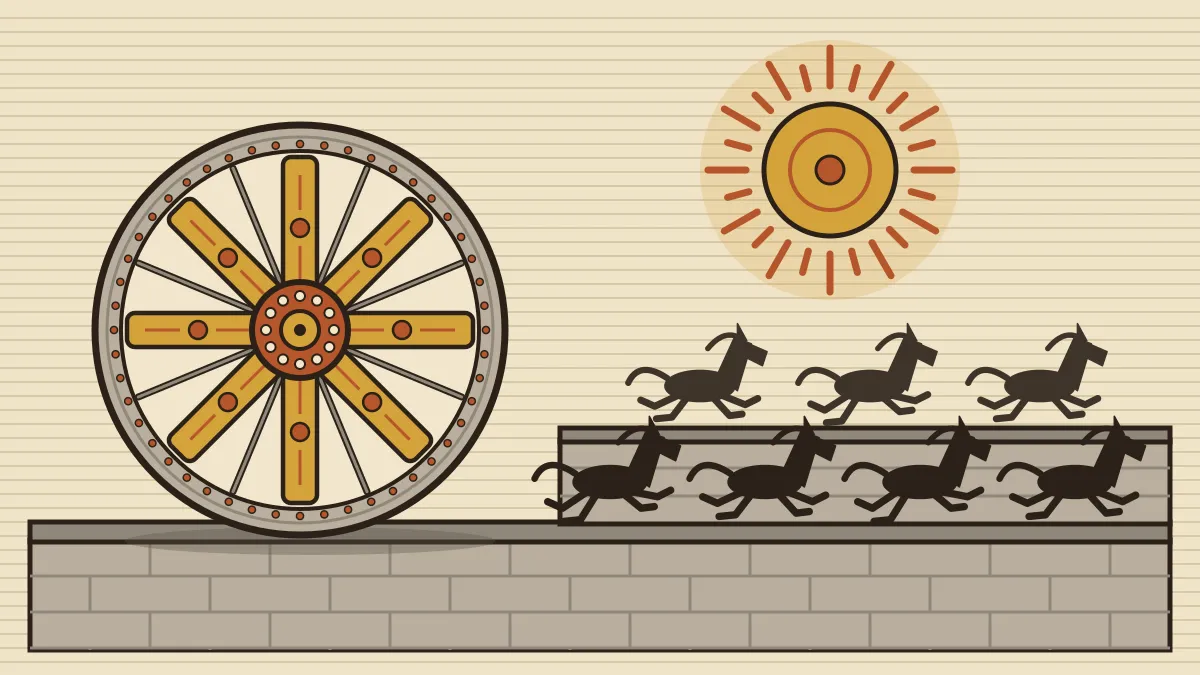
The seven horses are usually read as the seven days of the week or the seven colours of light. Remember the chariot and the horses: they explain what the sculptors of Konark set out to build.
Konark: A Temple Shaped Like a Chariot
On the shore of the Bay of Bengal in Odisha stand the ruins of the Sun Temple at Konark. Its name is usually explained as kona (corner) and arka (sun). It was built by Narasimhadeva I of the Eastern Ganga dynasty in the middle of the 13th century (c. 1240-1260). He ruled from about 1238 to 1264, and the temple is traditionally said to have been built to mark his victory over the Muslim ruler of Bengal in the 1240s. The Jagannath temple at Puri is the work of an earlier Ganga king, Anantavarman Chodaganga. Chodaganga is Puri; Narasimhadeva I is Konark.
The Eastern Gangas (Odisha, capital in Kalinga) are not the Western Gangas (Karnataka, who carved the Gomateshwara statue at Shravanabelagola). A question that says "Ganga" is testing whether you know which one. The Gajapatis (from 1435) came after the Gangas in Odisha.
| Feature | What to remember |
|---|---|
| Builder and date | Narasimhadeva I, Eastern Ganga, mid-13th century |
| Shape | The whole temple is a giant chariot of the sun-god, set on a high platform |
| Wheels | Twelve pairs (24) of huge carved wheels, each about 3 metres across |
| Horses | A team of galloping horses carved at the entrance staircase; the sun-god's team is traditionally seven |
| Surviving hall | The jagamohana (porch or dance-hall) survives; the main tower over the sanctum, said to have been about 70 m high, fell in the 19th century |
| Cult images | Three images of Surya in niches on the outer walls of the main sanctum, facing different directions |
| Recognition | UNESCO World Heritage Site, 1984; European sailors called it the "Black Pagoda", a landmark for ships |
The wheels are the famous part. Local guides and many popular accounts describe them as sundials. The shadow of the hub and spokes falls on the beaded rim, and the eight broad spokes divide the day into eight three-hour segments, with finer divisions between them. Treat "exact to the minute" as a popular claim, but the idea is real: the wheel is a clock. The Konark wheel also appears on the back of the ₹10 note.
The eastern face of the temple was aligned so that the first rays of dawn would enter along the axis. The walls carry musicians, dancers, animals and kings. Konark also shows a medieval king using a temple to make a political statement: the Eastern Gangas faced the Muslim rulers of Bengal and the Delhi Sultanate to the north. Our page on Delhi Sultanate governance and technology tells you who was pressing from the north.
Modhera: A Temple Built to Meet the Equinox Sun
In the Mehsana district of Gujarat stands the Sun Temple at Modhera, built by Bhima I of the Chaulukya dynasty (also written Chalukya of Gujarat or Solanki) around 1026-27. Bhima's reign (c. 1022-1064) was also the time when Mahmud of Ghazni raided Somnath, about 1025-26. The same king's queen Udayamati commissioned the stepwell Rani ki Vav at Patan, and his minister Vimala Shah built the white-marble Jain temples at Mount Abu.
| Part of Modhera | What it is |
|---|---|
| Surya Kund | A huge rectangular stepped tank in front of the temple. Small shrines are carved in between its steps; the often-quoted count is 108 |
| Guda mandapa and sanctum | The inner hall and shrine. The sanctum walls are left plain, because the temple faces east and at the equinoxes the sunrise falls straight into the shrine |
The pattern is clear. The Chaulukya builders put the water in front, the hall in the middle and the shrine behind it, and lined the whole axis up with the sunrise. The carving shows the influence of Gujarat's old woodcarving tradition. Modhera is a monument protected by the Archaeological Survey of India and is no longer used for worship.
The village has come back into the news in a different way. In October 2022 Modhera was declared India's first village with round-the-clock solar power, as a tribute to the sun-god of its famous temple. NDA 2023-I asked exactly that (see the past papers below).
Martand: The Sun Temple of Kashmir, and Others
The Martand Sun Temple stands on a plateau near Mattan in Anantnag district of Jammu and Kashmir. Martanda is another name of the sun. It was built in the 8th century by Lalitaditya Muktapida of the Karkota dynasty. Almost everything we know of this king comes from Kalhana's Rajatarangini, the 12th-century chronicle of Kashmir, which celebrates him as a great conqueror. His reign is dated about 724-760 CE, though sources vary by a few years.
Martand is a ruin today, and a protected monument of the Archaeological Survey of India. Kashmir's temple style mixed Gandhara influence from the north-west with the post-Gupta traditions of the plains, and Martand's shrine stood inside a colonnaded courtyard. The ruin is usually said to date from damage in the late 14th or early 15th century; the common attribution to Sultan Sikandar is disputed by some historians. The Karkota period is regarded as the most significant for architecture in Kashmir. Another famous Karkota-era temple is Pandrethan (8th-9th century), built on a plinth in the middle of a water tank and probably dedicated to Shiva.
Lalitaditya Muktapida is a Karkota king. The Utpala dynasty (from 855 CE, founded by Avantivarman) came later. In CAPF 2025 the pair "Lalitaditya: Utpala dynasty" was the planted error. Likewise Bhima I belongs to the Chaulukyas of Gujarat, and Lakshmikarna is a Kalachuri-Chedi king, not a Pala.
Other sun temples. Katarmal near Almora in Uttarakhand is a Katyuri-era hill temple, variously dated between the 9th and 13th centuries. In the south, Suryanar Koyil near Kumbakonam is the Navagraha temple whose main deity is Surya; it belongs to the Dravida tradition covered in our page on South Indian dynasties and Sangam literature. They are asked far less often than the big three.
The Grammar of the Temple: Nagara, Rekha Deul, Pidha Deul
Two broad orders of temple are recognised: Nagara in the north and Dravida in the south. A third, Vesara, is sometimes named as a blend of the two. In a Nagara temple the tower over the sanctum is a shikhara that curves inward as it rises, the whole temple stands on a stone platform, and elaborate gateways and boundary walls are not usual. In a Dravida temple the tower is a stepped pyramid (vimana), the temple stands in a walled courtyard, and a gateway (gopuram) marks the entrance. The sanctum is always the garbhagriha, directly beneath the tallest tower.
| Term | Meaning | Where you see it |
|---|---|---|
| Garbhagriha | The inner sanctum, "womb-house" | Every Hindu temple |
| Latina / rekha-prasada | A simple shikhara, square at the base, curving inward to a point | Deogarh (Gupta); early Nagara temples |
| Deul | The Odisha word for the sanctum tower, vertical until near the top and then curving sharply inward | Konark, Puri, Bhubaneswar |
| Rekha deul | The curvilinear tower over the sanctum | Lingaraja temple, Bhubaneswar |
| Pidha deul | A tower of horizontal stepped tiers, like a pyramid of slabs | The porch roof of many Odisha temples; Konark's surviving hall |
| Jagamohana | The Odisha word for the mandapa, the porch or hall before the sanctum | Konark's surviving structure |
The tradition of the free-standing temple with a tower begins in the Gupta age. The Dashavatara temple at Deogarh (early 6th century) is the classic late-Gupta example, with a curving shikhara. The Bhitargaon temple is built of brick instead. Odisha's temples form a distinct sub-style within the Nagara order: a square plan, a lavishly carved exterior and a plain interior, and usually a boundary wall.
How UPSC Has Asked It: Past Papers Solved
UPSC asks about sun temples in three ways: which king built it, which dynasty a king belongs to, and a feature of the temple style. The first three blocks are CDS and NDA questions. The last two are from the UPSC CAPF (ACs) 2025 paper, which tests exactly the same chapter.
Which one among the following villages was recently declared as India's first 24x7 solar-powered village?
(a) Mawlynnong, Meghalaya (b) Modhera, Gujarat (c) Ziro village, Arunachal Pradesh (d) Malana, Himachal Pradesh
Answer: (b). Modhera was declared India's first round-the-clock solar-powered village in October 2022, a fitting choice because of its Sun Temple. Mawlynnong is known as the cleanest village, Ziro for its valley, and Malana for its isolated culture.
In the 10th Mandala of the Rigveda, which one of the following hymns reflects upon the marriage ceremonies?
(a) Surya Sukta (b) Purusha Sukta (c) Dana Stutis (d) Uma Sutra
Answer: (a). The Surya Sukta is the hymn of Surya's daughter and her marriage. The Purusha Sukta, also in the tenth book, deals with the origin of society and the creation of the world (it is the first source of the four varnas). The Dana Stutis are verses praising donors.
Consider the following statements: 1. Dasavatara temple at Deogarh is a Gupta period building 2. Bhitargaon temple is built of dressed stone
(a) 1 only (b) 2 only (c) Both 1 and 2 (d) Neither 1 nor 2
Answer: (a). Deogarh is an early-6th-century Gupta temple. Bhitargaon is also Gupta, but it is a brick temple with terracotta panels. The trap is to assume that because the first statement is true, the second is as well.
With reference to the history of Orissa, consider the following statements: 1. Anantavarman Chodaganga consolidated Orissa into a powerful kingdom and was patron of Sanskrit and Telugu literature. 2. Anantavarman Chodaganga built the great temple of the Sun God at Konark in Puri district. 3. Narasimha I effectively checked the external invasion and maintained prosperity in the kingdom. How many statements given above are correct?
(a) 1 (b) 2 (c) 3 (d) None
Answer: (b). Statement 2 is the false one: Konark is the work of Narasimhadeva I, while Chodaganga is associated with the Jagannath temple at Puri. That leaves statements 1 and 3, so two are correct. Mixing up the two Ganga kings is the whole point of the question.
Consider the following pairs (King : Dynasty): 1. Lakshmikarna : Pala 2. Bhima I : Chalukyas of Gujarat 3. Jayapala : Shahiya dynasty 4. Lalitaditya Muktapida : Utpala dynasty of Kashmir. How many pairs given above are correctly matched?
(a) 1 (b) 2 (c) 3 (d) 4
Answer: (b). Pairs 2 and 3 are correct. Lakshmikarna was a Kalachuri king, not a Pala, and Lalitaditya Muktapida belonged to the Karkota dynasty, not the Utpala. Two wrong pairs, two right ones.
Almost every wrong option in this chapter is a swap: the right king with the wrong dynasty, the right temple with the wrong builder, the right building with the wrong material. Learn the trio "temple, king, dynasty" as one unit, and add one detail (wheels, kund, plinth in a tank) to anchor it.
Practice MCQs (with answers)
- The Sun Temple at Konark was built by
- Anantavarman Chodaganga
- Narasimhadeva I
- Bhima I
- Lalitaditya Muktapida
- The Sun Temple at Modhera was built in the reign of a king of the
- Karkota dynasty
- Eastern Ganga dynasty
- Chaulukya (Solanki) dynasty
- Katyuri dynasty
- The ruined Martand Sun Temple lies in
- Anantnag district, Jammu and Kashmir
- Almora district, Uttarakhand
- Mehsana district, Gujarat
- Puri district, Odisha
- In Odisha temple architecture, the curvilinear tower over the sanctum is called
- pidha deul
- jagamohana
- vimana
- rekha deul
- How many pairs of carved wheels does the Konark temple have?
- 8
- 12
- 7
- 24
- Which of the following sun temples is inscribed as a UNESCO World Heritage Site (1984)?
- Modhera
- Martand
- Konark
- Katarmal
- The Kushana-age images of Surya found at Mathura show him wearing
- boots and a heavy coat
- a dhoti and a garland only
- a lion-skin and a crown of flowers
- a plain robe with a shaven head
- Which of the following pairs is NOT correctly matched?
- Martand : Karkota dynasty
- Modhera : Chaulukya dynasty
- Konark : Eastern Ganga dynasty
- Katarmal : Eastern Ganga dynasty
1-b, 2-c, 3-a, 4-d, 5-b, 6-c, 7-a, 8-d. Q2: Modhera is Chaulukya (Solanki) work. Q4: the rekha deul is the tower over the sanctum; the pidha deul is the tiered roof, and the jagamohana is the hall in front. Q5: the 24 wheels are 12 pairs. Q6: Modhera and Martand are protected by the ASI but are not on the UNESCO list; Konark is. Q8: Katarmal is a Katyuri-period temple of Uttarakhand, not Ganga work.
Quick Revision
- Vedic age: Surya and Savitr (Gayatri mantra); Surya Sukta in book 10 of the Rig Veda is a marriage hymn. First images at Mathura: boots and coat. Later: seven horses.
- Konark (Odisha): Narasimhadeva I, Eastern Ganga, mid-13th century; 12 pairs of wheels, chariot shape, UNESCO 1984, "Black Pagoda"; jagamohana survives, tower fell. Chodaganga built Puri.
- Modhera (Mehsana, Gujarat): Bhima I, Chaulukya/Solanki, 1026-27; Surya Kund (108 shrines in the common count); sanctum faces the equinox sunrise; first solar-powered village (Oct 2022).
- Martand (Mattan, Anantnag, Kashmir): Lalitaditya Muktapida, Karkota, 8th century; source Kalhana's Rajatarangini; Pandrethan nearby is built in a tank.
- Nagara north, Dravida south, Vesara a blend. Odisha: deul (tower), rekha deul (curved), pidha deul (stepped), jagamohana (hall). Gupta: Deogarh (stone, shikhara), Bhitargaon (brick).
- Traps: Eastern vs Western Ganga; Karkota vs Utpala; Kumaon vs Garhwal (Jageshwar); Lakshmikarna is Kalachuri.
Frequently asked questions
Who built the Konark Sun Temple and when?
The Konark Sun Temple was built by Narasimhadeva I of the Eastern Ganga dynasty in the middle of the 13th century, roughly between 1240 and 1260. It stands on the Odisha coast and is traditionally said to have been built to mark his victory over the Muslim ruler of Bengal. It was inscribed as a UNESCO World Heritage Site in 1984.
Why is Konark called the Black Pagoda?
European sailors gave Konark the name Black Pagoda because the dark tower served as a landmark for ships along the Odisha coast. The word pagoda was a general European term for Indian temples and has no link to Buddhism.
What is special about the Modhera Sun Temple?
Modhera in Gujarat was built by Bhima I of the Chaulukya dynasty in about 1026-27. It has a large stepped tank, the Surya Kund, in front of the temple, and an assembly hall open on all sides. The sanctum faces east so that at the equinoxes the rising sun falls directly into the shrine. In 2022 the village was declared India's first round-the-clock solar-powered village.
Who built the Martand Sun Temple in Kashmir?
The Martand Sun Temple near Mattan in Anantnag district was built in the 8th century by Lalitaditya Muktapida of the Karkota dynasty. Most of what is known about the king comes from Kalhana's Rajatarangini. The temple is now in ruins and is a protected monument of the Archaeological Survey of India.
What do rekha deul, pidha deul and jagamohana mean?
These are Odisha temple terms. The rekha deul is the curved tower over the sanctum, the pidha deul is a tower or roof made of horizontal stepped tiers, and the jagamohana is the porch or hall in front of the sanctum. The surviving hall at Konark is its jagamohana.
Related CDS / OTA History topics
History is the biggest block of the CDS GK paper
Cavalier's CDS/OTA batches teach ancient, medieval and modern history with maps, timelines and weekly PYQ tests.