The fifth Kashi Tamil Sangamam opens in Varanasi on 28 November 2026 and runs to 12 December, with about 1,400 delegates from Tamil Nadu travelling to Varanasi, Prayagraj and Ayodhya (PIB, 27 November). The programme celebrates the Thirukkural, but the road it travels is far older than any book. Kashi and Kanchipuram are both counted among India's seven sacred cities (Sapta Puri), one in the north and one in the far south, and a Kashi Vishwanatha temple even stands in the Karnataka town of Pattadakal. Fourteen centuries ago the two ends of the subcontinent were linked by war and by worship: the Pallavas of Kanchi and the Chalukyas of Badami fought for the land between the Krishna and the Tungabhadra, and each built temples that still stand. UPSC asks about both dynasties almost every year, most often as "who built what" and "who defeated whom".
Two Rival Powers
By Narendra Singh · GS faculty, The Cavalier · 15 years teaching GS
After the Satavahanas faded around the third century, the peninsula broke into small states. By the early seventh century three had come out on top: the Pallavas of Kanchi, the Chalukyas of Badami and the Pandyas of Madurai. The Pandyas were a weak third, so the story is mostly Pallava against Chalukya. For the earlier Tamil kingdoms, see our page on the Sangam age.
| Pallavas | Chalukyas of Badami | |
|---|---|---|
| Capital | Kanchipuram (Kanchi), with the port of Mamallapuram | Vatapi (modern Badami, Karnataka); Aihole was an early centre |
| Region | Northern Tamil Nadu and southern Andhra, the Tondaimandalam country | The western Deccan, around the Krishna-Tungabhadra doab |
| Name | Possibly from pallava, "creeper", linked by some historians with Tamil tondai | Claimed a noble descent, though they were probably a local Kannada family |
| Greatest kings | Mahendravarman I (c. 600-630); Narasimhavarman I Mamalla (630-668); Narasimhavarman II Rajasimha | Pulakeshin II (c. 610-642); Vikramaditya II (733-745) |
| Temple style | Dravida, from cave to monolith to structural stone | Experiments in both northern and southern forms at Aihole, Badami and Pattadakal |
| End | Slowly eclipsed by the Cholas from the ninth century | Overthrown by their feudatories, the Rashtrakutas, in about 757 |
Both dynasties were champions of Brahmanical religion. They performed Vedic sacrifices and granted villages to Brahmanas. Yet they quarrelled over loot, prestige and the fertile doab between the two rivers. The Tungabhadra became the natural frontier that the Pallavas tried again and again to cross.
The Long War, Date by Date
The war has a famous source on the Chalukya side: the Aihole inscription of 634 CE, composed by the court poet Ravikirti. It is a Sanskrit eulogy of Pulakeshin II. It is exaggerated, as all praise poems are, but it tells us that Pulakeshin stopped Harsha on the Narmada and even plays on the name: after his defeat, the poet says, "Harsha" (happiness) was no longer happy.
| Date (CE) | Event |
|---|---|
| c. 610s | Pulakeshin II wrests the Vengi region, between the Krishna and the Godavari, from the Pallavas. A branch of the family rules there as the Eastern Chalukyas of Vengi. |
| c. 618-630 | Pulakeshin II halts Harshavardhana's advance south on the Narmada. |
| Early 7th century | Pulakeshin II presses Mahendravarman I and advances close to Kanchi; the Pallavas lose their northern provinces. |
| c. 642 | Narasimhavarman I occupies Vatapi. Pulakeshin II is probably killed. The Pallava king takes the title Vatapikonda, "conqueror of Vatapi". |
| 733-745 | Vikramaditya II invades Kanchi and defeats the Pallava king Nandivarman II in about 740, ending Pallava supremacy in the far south. |
| c. 757 | The Rashtrakutas overthrow the Chalukyas of Badami. |
Notice how the winner flips every generation. That is why exam questions usually name the capital that was captured. Pulakeshin II also exchanged an embassy with the Persian king Khusrau II, a sign of the Deccan's sea trade with Iran and Arabia. The Chinese pilgrim Xuanzang travelled through both kingdoms in the 640s. Neither kingdom could hold the other down for long, which is exactly why each poured so much wealth into monuments that proclaimed victory.
Narasimhavarman I (Mamalla) took Vatapi and founded the style of the Pancha Rathas. Narasimhavarman II (Rajasimha), about 70 years later, built the Shore Temple and the Kailasanatha temple in Kanchi.
Four Pallava Styles, from Cave to Structural Temple
The Pallavas moved south Indian temple building from rock-cut caves to monoliths to freestanding stone temples in about a century. Historians name four phases after the ruling king.
| Style | Period | What was built | Where |
|---|---|---|---|
| Mahendra | c. 600-630 | Cave temples with plain pillared halls, cut into hillsides. The Mandagapattu inscription of Mahendravarman I boasts that he made a temple for Brahma, Vishnu and Shiva without brick, timber, metal or mortar. | Mandagapattu, Pallavaram and other sites |
| Mamalla | c. 630-668 | Monolithic rathas and cave mandapas, richly carved: the five Pancha Rathas, each cut out of a single rock, and the great relief of the Descent of the Ganga (Arjuna's penance) | Mamallapuram (Mahabalipuram) |
| Rajasimha | c. 700-728 | Structural temples built of cut stone blocks: the Shore Temple and the Kailasanatha temple, with lion-based pillars | Mamallapuram; Kanchipuram |
| Nandivarman | late 8th century | Smaller structural temples, such as the Vaikuntha Perumal temple (dedicated to Vishnu) | Kanchipuram |
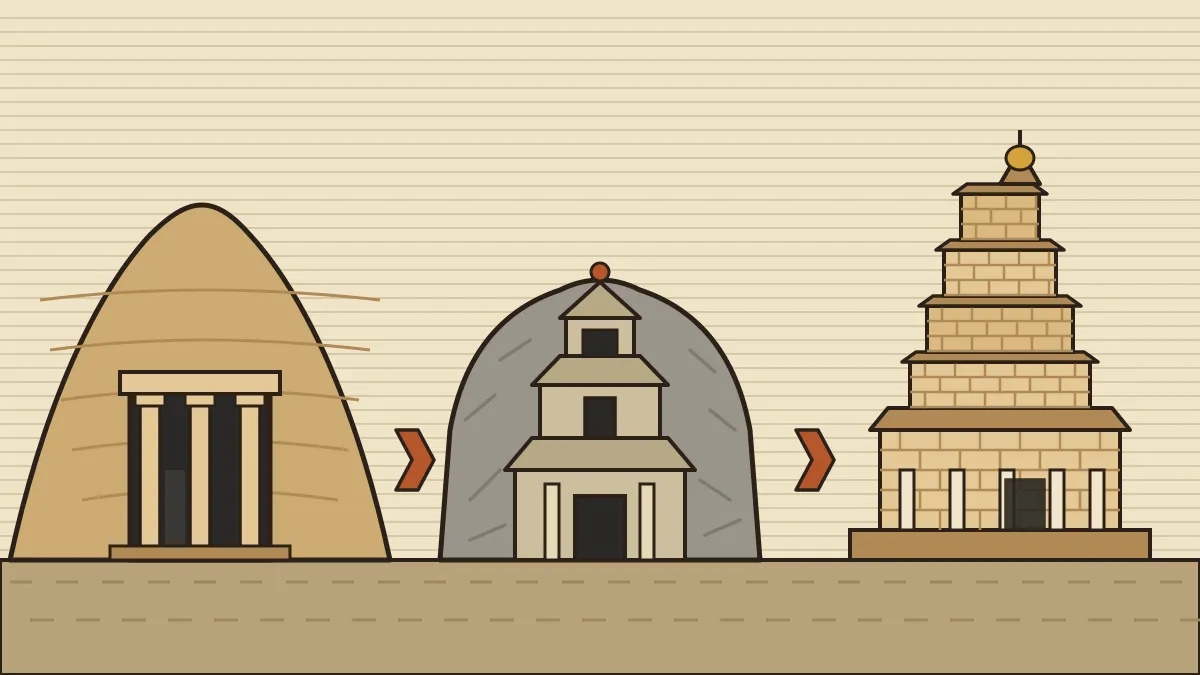
The Mahendra-style and Mamalla-style temples are carved out of living rock. The Rajasimha-style temples are assembled from blocks. The towers over the sanctum grew taller in each century and became the vimana and later the great gateway towers of the Tamil country. The whole group at Mamallapuram, including the Shore Temple, is a UNESCO World Heritage Site (1984). Mahendravarman I was also a writer, who composed the Sanskrit farce Mattavilasa Prahasana, and a patron of music. He began as a Jaina and was won over to Shaivism by the saint Appar. One of the Mamallapuram caves, the Adivaraha cave, carries royal portraits of Simhavishnu and Mahendravarman. UPSC has asked exactly that.
There are two Kailasa temples. The Kailasanatha at Kanchipuram is a structural Pallava temple of about 700 CE. The Kailasa at Ellora was carved top-down out of one hill by the Rashtrakutas, who ended Chalukya rule. A statement that the Kanchi Kailasanatha is "hewn from solid rock" is false, as NDA 2026-II found out (below).
Aihole, Badami, Pattadakal
The Chalukyas worked in a different landscape, with sandstone cliffs instead of granite shores, and they experimented. Three neighbouring sites in Karnataka tell the story, and they also show how a style forms: first caves, then temples assembled from stone.
| Site | What to remember |
|---|---|
| Aihole | An early capital and trading town. Well over 100 temples, which is why it is called a laboratory of temple design. The Durga temple has an apsidal (rounded) end. The Meguti Jaina temple carries the Ravikirti inscription of 634 CE. Aihole was also the home of the Ayyavole merchant guild. |
| Badami (Vatapi) | The capital. Four rock-cut cave temples: Shiva, two for Vishnu and one Jaina. A Vishnu cave carries an inscription of 578 CE from the reign of Mangalesha. |
| Pattadakal | Coronation site, with about ten temples of the seventh and eighth centuries, a UNESCO World Heritage Site (1987). The Papanatha temple (c. 680) has a low northern-style tower; the Virupaksha temple (c. 740) is purely southern in form, with a tall storied tower and sculptures from the Ramayana. |
The Virupaksha temple was built by Queen Lokamahadevi to celebrate her husband Vikramaditya II's victories over the Pallavas, and its plan echoes the Kailasanatha temple at Kanchi. In other words, the victor borrowed the loser's design. A Kashivishvanatha temple stands in the same Pattadakal group, which is the Kashi link mentioned at the top. The Deccan blend of northern and southern forms is sometimes called Vesara. For the northern tradition that Papanatha borrows from, see our page on the temples of India.
Kanchi, Bhakti and Changing Society
The same age gave south India its devotional movement. The Nayanars (63 Shaiva saints) and the Alvars (12 Vaishnava saints) travelled from town to town singing hymns in Tamil, the language of ordinary people rather than priests. They came from many castes. The Shaiva hymns of Appar, Sambandar and Sundarar form the Thevaram. The Alvars' verses, compiled in the 10th century by Nathamuni, became the Nalayira Divya Prabandham. Women had a place: Karaikkal Ammaiyar is among the Nayanars, and Andal is the one woman among the Alvars. Our page on bhakti and Sufi movements traces what came next, and the Cholas, who inherited both the saints and the temple tradition, are in our article on the Imperial Cholas.
| Change | What happened |
|---|---|
| Language of charters | Early Pallava land grants are in Prakrit; from about 400 CE they switch to Sanskrit. Tamil spreads through the saints' hymns and temple inscriptions. |
| Land grants | Villages given to Brahmanas (brahmadeya) were exempt from tax and forced labour; the grants list many immunities. |
| Three village types | Ur (ordinary peasant villages), sabha (Brahmana villages) and nagaram (merchant settlements) |
| Kalabhra revolt | In the sixth century the Kalabhras overthrew many kings and cancelled Brahmana grants. The Pandyas and the Pallavas under Simhavishnu overthrew them, and Pallava power revived. |
Mamallapuram, the Pallava port, is still in the news. Our article on India's lighthouses covers Mahabalipuram's 1887 lamp.
How UPSC Has Asked It: Past Papers Solved
These are actual CDS and NDA questions since 2018. UPSC rarely asks dates here. It asks which monument, which dynasty, which saint group.
The royal portraits of Simhavishnu and Mahendravarman are found in which cave temple at Mamallapuram?
(a) Varaha Cave (b) Ramanuja Cave (c) Adivaraha Cave (d) Trimurti Cave
Answer: (c). The Adivaraha cave has the portraits of the two Pallava kings. The Varaha cave is a different Mamallapuram cave, famous for its sculpted panels, which is the tempting wrong option.
Consider the following statements : I. The Kailasanatha temple of Kanchi is the earliest Pallava temple hewn from solid rock. II. The Vaikuntha Perumal temple at Kanchi is a rare Pallava temple dedicated to Lord Vishnu. Which of the statements given above is/are correct ?
(a) I only (b) II only (c) Both I and II (d) Neither I nor II
Answer: (b). Statement I is false: the Kailasanatha is a structural temple of c. 700 CE, and the earliest Pallava rock-cut temples are the Mahendra-style caves. Statement II is true: the Pallava temples are overwhelmingly Shaiva, and the Vaikuntha Perumal is the notable Vishnu temple.
Which of the following dynasties of South India issued their documents first in Prakrit and later in Sanskrit?
(a) The Cholas of Tamil Nadu (b) The Pandyas of the post-Sangam Age (c) The Pallavas of Tondaimandalam (d) The Gangas of Kalinganagara
Answer: (c). The early Pallava charters are in Prakrit, and from about the fourth century the dynasty moved to Sanskrit, as the Kadambas and Chalukyas also did.
Who were the Nayanars?
(a) Those who were immersed in devotion to Vishnu (b) Those who were devotees of Buddha (c) Leaders who were devotees of Shiva (d) Leaders who were devotees of Basaveshwara
Answer: (c). The Nayanars were the Shaiva saints. Option (a) describes the Alvars, the Vaishnava group.
Who were Alvars?
(a) Those who immersed in devotion to Vishnu (b) Devotees of Shiva (c) Those who worshipped abstract form of God (d) Devotees of Shakti
Answer: (a). The Alvars were the Vaishnava saints. The same paper asked about both groups, so learn them as a pair.
Who among the following is not a woman Nayanar saint?
(a) Karaikkal Ammaiyar (b) Mangayarkkarasiyar (c) Andal (d) Isaignaniyar
Answer: (c). Andal is a woman saint of the Alvar (Vaishnava) group. Karaikkal Ammaiyar, Mangayarkkarasiyar and Isaignaniyar are the three women among the Nayanars.
Who was/were the 10th century composer(s) of the Nalayira Divya Prabandham?
(a) Alvars (b) Nayanars (c) Appar (d) Sambandar
Answer: (a). The Nalayira Divya Prabandham is the Alvars' collection of 4,000 verses, which Nathamuni compiled in the tenth century. Appar and Sambandar are Nayanars, whose verses form the Thevaram.
The bhakti questions come as matched pairs (Alvar-Vishnu, Nayanar-Shiva) and as one trap name, Andal. The architecture questions test two things: which style belongs to which Pallava king, and structural versus rock-cut.
Practice MCQs (with answers)
- The Aihole inscription of 634 CE, composed by Ravikirti, praises
- Pulakeshin II
- Kirtivarman II
- Vikramaditya II
- Mangalesha
- The ancient Chalukya capital Vatapi is the modern town of
- Aihole
- Badami
- Pattadakal
- Kanchipuram
- Narasimhavarman I assumed the title Vatapikonda after
- defeating Harsha
- founding Kanchi
- defeating the Kadambas
- capturing Vatapi
- The Shore Temple at Mamallapuram is an example of the
- Mahendra style of rock-cut caves
- Mamalla style of monoliths
- Rajasimha style of structural temples
- Chalukyan Vesara style
- The Virupaksha temple at Pattadakal was built by Queen Lokamahadevi to commemorate
- Vikramaditya II's victories over the Pallavas
- Pulakeshin II's defeat of Harsha
- Mangalesha's conquest of the Kalachuris
- the founding of Badami
- The Pancha Rathas of Mamallapuram are
- structural temples of Rajasimha
- monolithic shrines of the Mamalla period
- Chalukyan cave temples
- Rashtrakuta rock-cut temples
- Which Kanchi temple, of the Nandivarman period, is dedicated to Vishnu?
- Kailasanatha
- Shore Temple
- Vaikuntha Perumal
- Virupaksha
- Which of the following pairs is correctly matched?
- Rajasimha: Pancha Rathas
- Narasimhavarman I: Kailasanatha temple at Kanchi
- Pulakeshin II: Shore Temple
- Mahendravarman I: Mandagapattu cave inscription
1-a, 2-b, 3-d, 4-c, 5-a, 6-b, 7-c, 8-d. Q4: the Shore Temple is built of cut blocks, not carved from rock, so it belongs to Rajasimha's phase. Q5: Mangalesha did fight the Kalachuris, a true fact but not the occasion for the Virupaksha. Q8: the Pancha Rathas are Narasimhavarman I's, the Kailasanatha is Rajasimha's, and the Shore Temple is Pallava, not Chalukya.
Quick Revision
- Pallavas: capital Kanchipuram, port Mamallapuram; Mahendravarman I (c. 600-630), Narasimhavarman I Mamalla (630-668), Narasimhavarman II Rajasimha (c. 700-728). Chalukyas of Badami: capital Vatapi (Badami); Pulakeshin II (c. 610-642), Vikramaditya II (733-745); ended c. 757 by the Rashtrakutas.
- Pulakeshin II stopped Harsha on the Narmada; his eulogy is the Aihole inscription (634 CE, Ravikirti). Narasimhavarman I took Vatapi (c. 642), title Vatapikonda. Vikramaditya II took Kanchi (defeat of the Pallavas c. 740).
- Pallava styles: Mahendra (caves; Mandagapattu), Mamalla (Pancha Rathas, Descent of the Ganga), Rajasimha (Shore Temple, Kailasanatha, structural), Nandivarman (Vaikuntha Perumal). Adivaraha cave: portraits of Simhavishnu and Mahendravarman. Mamallapuram: UNESCO 1984.
- Chalukyan sites: Aihole (over 100 temples; Durga temple; Meguti with the inscription), Badami (four caves; 578 CE inscription), Pattadakal (UNESCO 1987; Papanatha c. 680, Virupaksha c. 740 by Lokamahadevi).
- Kailasanatha (Kanchi) is structural; Kailasa (Ellora) is rock-cut and Rashtrakuta.
- Nayanars (63, Shaiva, Thevaram) and Alvars (12, Vaishnava, Nalayira Divya Prabandham, compiled by Nathamuni). Andal is an Alvar; Karaikkal Ammaiyar is a Nayanar.
- Pallava charters: Prakrit first, then Sanskrit. Village types: ur, sabha, nagaram. Kalabhra rule ended by the Pandyas and the Pallavas under Simhavishnu.
- Kashi Tamil Sangamam 5.0: 28 November to 12 December 2026, Varanasi, theme Thirukkural.
Frequently asked questions
Who were the Pallavas?
The Pallavas were a dynasty that ruled from Kanchipuram over northern Tamil Nadu and southern Andhra Pradesh from about the sixth to the ninth century. Their great kings were Mahendravarman I, Narasimhavarman I Mamalla and Narasimhavarman II Rajasimha. They are remembered for cave temples, monolithic rathas and structural stone temples.
Why did the Pallavas and Chalukyas fight?
Both wanted to control the fertile land between the Krishna and the Tungabhadra rivers, and each raided the other's wealthy capital. Pulakeshin II almost reached Kanchi, Narasimhavarman I occupied Vatapi around 642 CE, and Vikramaditya II overran Kanchi in the eighth century.
What are the four Pallava architectural styles?
They are the Mahendra style (rock-cut caves), the Mamalla style (monolithic rathas and carved mandapas at Mamallapuram), the Rajasimha style (structural temples such as the Shore Temple and the Kailasanatha) and the Nandivarman style (smaller structural temples such as the Vaikuntha Perumal).
What is Pattadakal famous for?
Pattadakal in Karnataka is a UNESCO World Heritage Site (1987) with about ten Chalukyan temples of the seventh and eighth centuries. The best known are the Papanatha, in a northern style, and the Virupaksha, built by Queen Lokamahadevi to celebrate the victories of Vikramaditya II over the Pallavas.
Who were the Alvars and Nayanars?
The Alvars were twelve Vaishnava saints and the Nayanars were sixty-three Shaiva saints, active in Tamil Nadu from about the seventh century. They sang devotional hymns in Tamil. The Alvars' verses are compiled in the Nalayira Divya Prabandham, and the Nayanars' hymns form the Thevaram.
Related CDS / OTA History topics
Ancient history rewards exact names
Cavalier's CDS/OTA batches teach ancient India through sources, dynasty tables and weekly PYQ tests.