The fifth Kashi Tamil Sangamam will run from 28 November to 12 December 2026. In the run-up, PIB reported on 22 November that students of Banaras Hindu University photographed the Kamakoteeshwar Temple near Harishchandra Ghat, and that a bhajan evening was held at the Vishwanath Temple on the BHU campus. The Ministry of Education launched the Sangamam in 2022 to celebrate the old link between Kashi and Tamil Nadu. Its name borrows a word from Tamil history: cankam, a gathering of poets. That gathering gave India its earliest body of Tamil literature and, with it, the best window on the deep south before the Pallavas. For CDS and NDA, "Sangam" is a reliable source of one-line questions: who wrote what, which port, which class, and which Sangam you are being asked about.
The Sangam and Its Library
By Narendra Singh · GS faculty, The Cavalier · 15 years teaching GS
The word Sangam comes from the Sanskrit sangha, an assembly. Later Tamil tradition says three Sangams were held at Madurai and earlier cities, lasting thousands of years and attended by thousands of poets. Historians treat those numbers as legend. What they accept is that poets gathered under Pandya patronage at Madurai, and that the poems were composed in roughly the last centuries BCE and the first three centuries CE. The texts were collected and edited later, and the exact dates are still debated, so examiners ask about the texts, not the years.
| Group | What it contains | Remember |
|---|---|---|
| Tolkappiyam | A treatise on Tamil grammar and poetics, by Tolkappiyar | Usually counted among the Sangam-age works. Not by Panini, whose grammar is Sanskrit |
| Ettuthokai (Eight Anthologies) | Short poems of love and war, including Narrinai, Kuruntokai, Aingurunuru, Patirruppattu, Paripadal, Kalittokai, Akananuru and Purananuru | Patirruppattu praises Chera kings |
| Pattuppattu (Ten Idylls) | Ten longer poems, including Maduraikkanchi and Pattinappalai | Pattinappalai describes Puhar (Kaveripattinam) |
| Twin epics | Silappadikaram by Ilango Adigal and Manimekalai by Sathanar | Kovalan and Kannagi in the first; Kovalan's daughter in the second |
| Tirukkural | 1,330 couplets on ethics, politics and love, by Thiruvalluvar | A didactic work usually placed just after the Sangam period |
The poems divide into two moods. Akam ("inner") poems deal with love, and never name the lovers. Puram ("outer") poems deal with kings, war, generosity and death. Akam poems are arranged by five landscapes, called tinai, and each landscape has its own god, mood and way of life.
| Tinai | Landscape | Chief deity (as in Tolkappiyam) | Way of life |
|---|---|---|---|
| Kurinji | Hills | Murugan | Hunting, honey, millets |
| Mullai | Forest and pasture | Mayon (Vishnu) | Herding |
| Marutham | Fertile plains | Indiran (Indra) | Paddy farming |
| Neithal | Coast | Varunan | Fishing, salt, pearls |
| Palai | Dry, scorched land | Korravai | Raiding, hardship |
The Sangam is the Tamil poets' assembly. The Sangama dynasty, founded by Harihara and Bukka in 1336, is the first dynasty of the Vijayanagara Empire, nearly 1,200 years later. One CAPF paper put them side by side to catch the careless. The Vijayanagara story is on our Vijayanagara page.
The Three Crowns: Chola, Pandya, Chera
The tip of the peninsula, called Tamilakam, held three kingdoms. Asoka's Rock Edicts II and XIII name the Cholas, Pandyas, Satiyaputras and Keralaputras as neighbours who lay outside his empire and were independent of Mauryan rule. Greek writers knew the Pandyas early: Megasthenes mentions a Pandya kingdom in the far south.
| Chola | Pandya | Chera | |
|---|---|---|---|
| Emblem | Tiger | Fish (two carp) | Bow |
| Region | Kaveri delta and the north-east | The far south: Madurai, Tirunelveli, Ramanathapuram | The west coast: the Kerala belt |
| Capital | Uraiyur (inland), with Puhar as the port | Madurai | Vanji (often identified with Karur) |
| Port | Puhar (Kaveripattinam) | Korkai (pearls) | Muziris (Muchiri) and Tondi |
| Famous king | Karikala | Nedunjeliyan | Senguttuvan |
| Known for | Victory at Venni, embankments on the Kaveri, cotton cloth | Pearls, Madurai, embassy to Augustus | Pepper, Roman trade, the Kannagi temple |
Karikala (traditionally placed around the end of the first century CE) is credited with defeating a Chera-Pandya alliance at Venni, founding Puhar and raising embankments along the Kaveri. The later Kallanai, the old stone dam across the river, is traditionally linked with his name. Pattinappalai, a poem on Puhar, was written in his praise. Senguttuvan, the "Red Chera", is the hero of the Silappadikaram. He is remembered for establishing the cult of Kannagi, the wife who burned Madurai after her husband was wrongly executed. Nedunjeliyan is the Pandya who won the battle of Talaiyalanganam, and the Pandyas also sent an embassy to the Roman emperor Augustus.
These were not centralised empires. Their rulers behaved more like chiefs, who received gifts and shared them out, than kings with a tax bureaucracy. The poems show chiefs such as Pari (the generous patron of the poet Kapilar) rewarding bards with gold, horses, even elephants. Compare this with the Mauryan state in our Mauryan administration article: there, officials, spies and a standing army; here, kin, gifts and bards.
Examiners swap kings and dynasties freely. Fix the three pairs: Karikala-Chola-Puhar, Senguttuvan-Chera-Silappadikaram, Nedunjeliyan-Pandya-Madurai. The great Chola kings with the navy and the Thanjavur temple, such as Rajaraja I, came about 800 years later (see the Imperial Cholas page).
Village, Chief and Plough: Society in the Poems
Before the poems, there are graves. Across the uplands of the peninsula the dead were buried in megaliths: stone circles, cists and urns with black-and-red ware and iron tools. These people did little wet-rice farming. The shift to the river valleys and deltas, where iron ploughs, paddy and irrigation created surplus, is what built the three kingdoms. The poems then describe the new villages, and early Tamil literature names the classes by their relation to land.
| Tamil term | Meaning |
|---|---|
| Vellalar | Large landowners; the rich peasantry who held most of the land |
| Uzhavar | Ploughmen, the working farmers |
| Adimai | Slaves and bonded labourers |
| Arasar | The ruling class |
| Masattuvan | Successful merchants (setthis or satthavahas in Prakrit) |
Brahmanas appear in the Tamil land for the first time in this age, as poets and priests, and kings performed Vedic sacrifices. Yet caste distinctions were far weaker than in the north: the poems know the four-varna scheme only faintly. The older local god was Murugan, and the Jaina and Buddhist monks who arrived by about the second century BCE left their traces in cave shelters. Inscriptions in Tamil-Brahmi, in the Madurai region, show that writing in Tamil existed well before the Christian era.
Pepper for Gold: The Roman Trade
Wealth came from the sea. When Egypt became a Roman province and sailors learned to ride the monsoon winds straight across the Arabian Sea (a discovery traditionally credited to a navigator called Hippalus), the voyage from the Red Sea to Malabar shrank to weeks. A Greek merchant's guide of about the first century CE, the Periplus of the Erythraean Sea, lists the ports and cargoes. The Roman writer Pliny the Elder complained that India was draining Rome of gold.
| From the Tamil coast to Rome | From Rome to the Tamil coast |
|---|---|
| Pepper (the Sanskrit name yavanapriya means "dear to the Greeks"), cardamom, ginger | Gold and silver coins, found in hoards across the south |
| Pearls from the Pandya coast, ivory, tortoiseshell | Wine in clay amphorae, lamps, glass |
| Muslin, silk and cotton cloth, beryl and other gems | Coral, tin, lead |
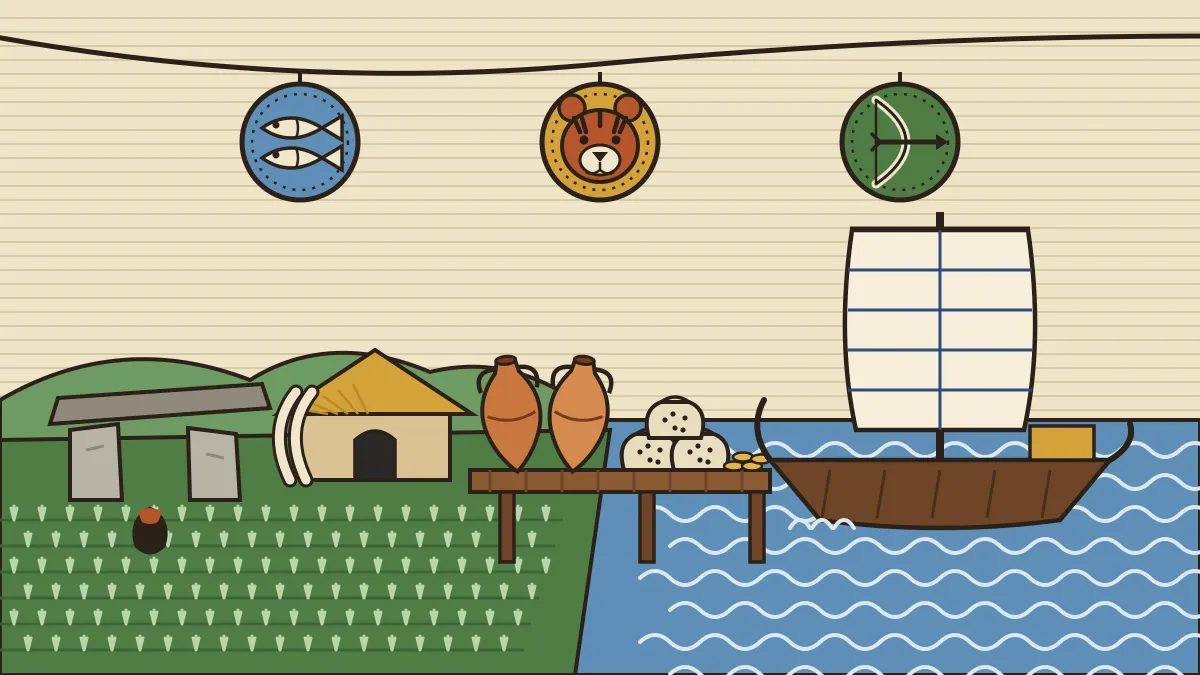
Archaeology backs the poems. Arikamedu, near Pondicherry, was dug by Mortimer Wheeler in 1945 and is usually identified with the Periplus port of Poduke. It yielded Roman pottery and a bead-making industry. Bead workshops are also found at Kodumanal in Tamil Nadu. The trade also built the cities: Puhar had a large dock, and its customs officers stamped goods before they went into the warehouses, as Pattinappalai describes. When Rome's own economy faltered in the third century CE, the trade thinned, and the Tamil kingdoms declined with it. A long, poorly documented period of the Kalabhras followed, until the Pallavas and Pandyas revived in the sixth century.
Pair each clue with its port.
The trade also explains the later history of the region. Merchants and monks carried Tamil, Prakrit and Pali around the Bay of Bengal, and the southern kingdoms that followed learned the value of ports and navies. The Gupta empire of the north, by contrast, is covered in our Gupta period article. For the wider Buddhist network that links these coasts to Central Asia (and to the SCO Civilisational Dialogue Forum held in Delhi on 20-22 November 2026), see Buddhist councils, schools and art.
After the Sangam: What Came Next
The Pallavas of Kanchipuram, who rose from the sixth century, issued their earliest charters in Prakrit and then moved to Sanskrit, with Tamil later joining. CDS 2023-II turned that pattern into a question (see the past papers). With them came the bhakti saints, the Nayanmars and Alvars, who wrote devotional hymns in Tamil rather than Sanskrit, so the Sangam age is the root of a Tamil literary tradition that never broke.
1. Which text? Grammar = Tolkappiyam; epic = Silappadikaram or Manimekalai; ethics = Tirukkural. 2. Which class? Landowner = vellalar, ploughman = uzhavar, slave = adimai. 3. Which port or product? Korkai = pearls, Muziris = pepper, Puhar = Chola port. 4. Which Sangam? Poets of Madurai, not the Vijayanagara dynasty.
How UPSC Has Asked It: Past Papers Solved
These are actual CDS questions (and one CAPF question) on the Tamil kingdoms. The pattern is clear: UPSC asks the Sangam age through classes, ports, texts and authors, almost never through dates.
According to the Tamil Sangam texts, who among the following were the large landowners?
(a) Gahapatis (b) Uzhavars (c) Adimais (d) Vellalars
Answer: (d). Vellalar were the large landowners. The tempting wrong option is Gahapati: that word is used for landholders in Pali (Buddhist) texts of the north, not in the Sangam poems. Uzhavars plough, and adimais are slaves.
Which one among the following terms was used in the Sangam Texts for ploughmen?
(a) Vellalar (b) Uzhavar (c) Gahpati (d) Adimai
Answer: (b). The same table as above, asked from the other end. Uzhavar = ploughman. Check the question: it asks for the worker, not the owner.
Which one of the following was an important Pandya port, celebrated for its pearls in Sangam poems and Greek accounts?
(a) Muchiri (b) Korkai (c) Puhar (d) Arikamedu
Answer: (b). Korkai, on the Gulf of Mannar coast, was the Pandya pearl port. Muchiri (Muziris) was the Chera pepper port, Puhar the Chola port, and Arikamedu a trading settlement on the east coast near Pondicherry.
Who is the author of Manimekalai?
(a) Kovalan (b) Sathanar (c) Ilango Adigal (d) Tirutakkatevar
Answer: (b). Manimekalai was written by Sathanar. Ilango Adigal wrote the Silappadikaram, and Kovalan is a character in it, not an author. Tirutakkatevar is a Jaina poet of the later Jivaka Chintamani, which is a Tamil epic from after the Sangam period.
The Tolkappiyam is
(a) A work of grammar (b) A Tamil poem in praise of Rajendra Chola (c) An ancient didactic work in Tamil (d) A drama composed by a Chera King
Answer: (a). It is the oldest surviving Tamil grammar. The didactic work in option (c) describes the Tirukkural, a different text.
Which of the following dynasties of South India issued their documents first in Prakrit and later in Sanskrit?
(a) The Cholas of Tamil Nadu (b) The Pandyas of the post-Sangam Age (c) The Pallavas of Tondaimandalam (d) The Gangas of Kalinganagara
Answer: (c). The early Pallava charters, issued from Kanchipuram, were in Prakrit and then in Sanskrit. This is the dynasty that ends the Sangam age in the textbooks.
Which one of the following dynasties ruled under the suzerainty of Kingdom of Vijayanagar
(a) Sangamas, Saluvas, Tuluvas and Aravidus (b) Sangamas, Hoysalas, Aravidus and Tuluvas (c) Hoysalas, Saluvas, Poligars and Sangamas (d) Yadavas of Devagiri, Hoysalas, Saluvas and Aravidus
Answer: (a). The four Vijayanagara dynasties were Sangama, Saluva, Tuluva and Aravidu. The Hoysalas and Yadavas were rivals that Vijayanagara replaced. The name echo with "Sangam" is a pure coincidence, and a trap.
Two of the seven questions test the class terms, two test texts and authors, and the rest test a port, the Pallavas and the Sangam-Sangama trap. Learn the class table and the text table once and most of them take under 20 seconds.
Practice MCQs (with answers)
- Which of the following is a treatise on Tamil grammar?
- Silappadikaram
- Tolkappiyam
- Manimekalai
- Purananuru
- The battle of Venni and the founding of Puhar are credited to
- Senguttuvan
- Nedunjeliyan
- Karikala
- Elara
- The Pandya port famed for its pearls was
- Korkai
- Muziris
- Puhar
- Tondi
- In early Tamil literature, slaves are called
- vellalar
- uzhavar
- adimai
- arasar
- The Silappadikaram was composed by
- Sathanar
- Tolkappiyar
- Thiruvalluvar
- Ilango Adigal
- The Sangama dynasty is associated with
- the Pandyas of Madurai
- the Vijayanagara Empire
- the Cholas of Uraiyur
- the Kalabhras
- The emblem on the flag of the Cheras was
- fish
- tiger
- elephant
- bow
- Which of the following was imported into the Tamil country from Rome, rather than exported from it?
- Wine in amphorae
- Pepper
- Pearls
- Muslin
1-b, 2-c, 3-a, 4-c, 5-d, 6-b, 7-d, 8-a. Q2: Senguttuvan was a Chera and Nedunjeliyan a Pandya; Elara was a Chola who ruled Sri Lanka, but is not the Venni hero. Q4: Vellalar are landowners, uzhavar ploughmen and arasar the ruling class. Q6: "Sangama" is the first Vijayanagara dynasty, founded in 1336. Q7: fish = Pandya, tiger = Chola, bow = Chera. Q8: Rome sent gold, wine, glass and lamps and took away pepper, pearls and cloth.
Quick Revision
- Sangam = poets' assembly at Madurai under Pandya patronage; poems of about the last centuries BCE to the 3rd century CE. Akam = love, Puram = kings and war. Five tinai: kurinji, mullai, marutham, neithal, palai.
- Tolkappiyam = grammar. Ettuthokai (8) and Pattuppattu (10). Silappadikaram = Ilango Adigal; Manimekalai = Sathanar. Tirukkural = Thiruvalluvar, 1,330 couplets.
- Chola: tiger, Uraiyur/Puhar, Karikala. Pandya: fish, Madurai/Korkai, Nedunjeliyan. Chera: bow, Vanji/Muziris, Senguttuvan.
- Vellalar = landowners; uzhavar = ploughmen; adimai = slaves; masattuvan = merchants. Gahapati is a northern (Pali) term.
- Exports: pepper, pearls, ivory, muslin, beryl. Imports: gold, wine in amphorae, glass. Arikamedu = Roman pottery site (Wheeler, 1945).
- Megalithic burials with black-and-red ware came before the Sangam kingdoms. Tamil-Brahmi cave inscriptions near Madurai.
- Sangam is not Sangama (Vijayanagara, 1336). After Sangam: Kalabhras, then Pallavas (Prakrit then Sanskrit charters). Kashi Tamil Sangamam 5.0: 28 Nov to 12 Dec 2026.
Frequently asked questions
What was the Sangam in Tamil history?
The Sangam was an assembly of Tamil poets who gathered under the patronage of the Pandya kings at Madurai. The poems they composed, from about the last centuries BCE to the third century CE, are the earliest Tamil literature and the main source for the early Chola, Pandya and Chera kingdoms.
Who were the three kingdoms of the Sangam age?
The Cholas, Pandyas and Cheras. The Chola emblem was the tiger, the Pandya emblem was the fish and the Chera emblem was the bow. Their capitals were Uraiyur, Madurai and Vanji, and their chief ports were Puhar, Korkai and Muziris.
Which texts belong to the Sangam literature?
The Tolkappiyam (a grammar), the Ettuthokai or Eight Anthologies and the Pattuppattu or Ten Idylls form the core. The epics Silappadikaram and Manimekalai are usually called its companions, and the Tirukkural is a didactic work placed just after the Sangam period.
What did India trade with Rome in the Sangam age?
The Tamil coast sent pepper, pearls, ivory, muslin and gems to Rome and received gold and silver coins, wine in amphorae, glass and lamps in return. Excavations at Arikamedu and Roman coin hoards in the south confirm the trade, which declined after the third century CE.
How is the Sangam age different from the Sangama dynasty?
The Sangam age is the early Tamil period of poets and the three crowns, about 2,000 years ago. The Sangama dynasty, founded by Harihara and Bukka in 1336, was the first ruling house of the Vijayanagara Empire. The similar names are a common source of exam confusion.
Related CDS / OTA History topics
Ancient history rewards exact names
Cavalier's CDS/OTA batches teach ancient India through sources, dynasty tables and weekly PYQ tests.