On 26 November 2026 the Union Agriculture Minister released the final production estimates for 2025-26 and the first advance estimates for the 2026-27 kharif season. Foodgrain output touched a record 3,785.38 lakh tonnes. The kharif forecast, 1,671.43 lakh tonnes, came in despite a delayed monsoon, the return of El Niño and rain that the release put 35 to 40 per cent below normal. A kharif crop is a bet on the monsoon, and when the rain fails the thirstiest crops suffer first. UPSC rarely asks "which season is rice?" in isolation. It asks what a crop needs (temperature, rain, soil, frost-free days) and where it grows. This article gives you the logic behind the lists.
Three Seasons, Three Weather Systems
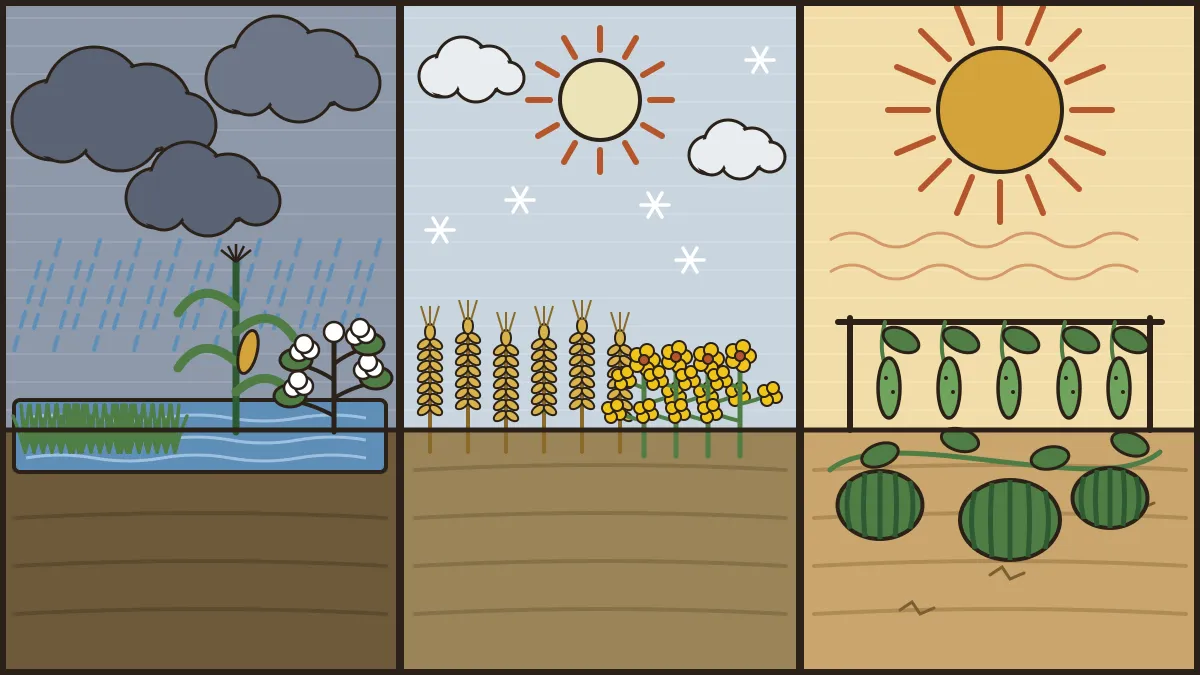
India's crop calendar follows its weather. Kharif crops are sown with the onset of the south-west monsoon and harvested in September-October. Rabi crops are sown in winter, from October to December, and harvested in summer, from April to June. Zaid is the short season in between, in the hot, dry summer months.
| Kharif | Rabi | Zaid | |
|---|---|---|---|
| Weather that drives it | South-west monsoon rain, heat and humidity | Cool, dry winter; some rain from western disturbances in the north-west | Dry summer heat; needs irrigation |
| Typical months | June-September | October-March | April-June |
| Northern states | Rice, cotton, bajra, maize, jowar, tur | Wheat, gram, rapeseed and mustard, barley | Vegetables, fruits, fodder |
| Southern states | Rice, maize, ragi, jowar, groundnut | Rice, maize, ragi, groundnut, jowar | Rice, vegetables, fodder |
Notice the south. Temperatures there stay high all year, so the north's sharp divide does not exist, and the same crop can be grown thrice in a year if soil moisture allows. That is why rice and groundnut appear under both kharif and rabi in the south. The three rice crops of the eastern states are named for their seasons. Aus is the early summer crop, Aman is the main monsoon-sown crop harvested in winter, and Boro is the irrigated winter-to-spring crop. Assam, West Bengal and Odisha can grow all three in one agricultural year.
Sowing versus harvest. "Rabi: October to March" and "sown October-December, harvested April-June" describe the same season from two ends. Season versus region. Ragi is kharif in the north, but the south can grow it in rabi too. If a question says "northern states", use the northern column.
Why the monsoon arrives late or weak in El Niño years is explained on our monsoon mechanism page and in the El Niño explainer of 2 June 2026.
Kharif: What Each Crop Needs
Kharif crops want heat and water together. They are tropical crops, grown in the months when the monsoon supplies both. The table gives the needs as the textbooks state them.
| Crop | What it needs | Where it grows |
|---|---|---|
| Rice | Temperature above 25°C, high humidity, annual rainfall above 100 cm; irrigation where rain is less | Plains of the north and north-east, coasts and deltas; canals and tubewells carry it to Punjab, Haryana and west UP |
| Maize | Temperature 21-27°C; old alluvial soil; a semi-arid crop on poorer soils | Karnataka, Madhya Pradesh, Bihar, Andhra Pradesh, Telangana, UP, Rajasthan |
| Jowar | Rain-fed, moist areas, hardly needs irrigation; a semi-arid crop | Maharashtra (over half of national output), Karnataka, Andhra Pradesh, Madhya Pradesh |
| Bajra | Hot, dry weather; sandy and shallow black soil; survives dry spells | Rajasthan, Uttar Pradesh, Maharashtra, Gujarat, Haryana |
| Ragi | Dry regions; red, light black, sandy and shallow black soils | Karnataka, Tamil Nadu, and hill states such as Himachal and Uttarakhand |
| Tur, moong, urad | Little moisture; marginal, rain-fed land in dry areas | Tur: Maharashtra (about one-third), UP, Karnataka, Gujarat, Madhya Pradesh |
| Groundnut | Rain-fed kharif crop of drylands | Gujarat, Rajasthan, Tamil Nadu, Telangana, Andhra Pradesh |
| Cotton | High temperature, light rain or irrigation, 210 frost-free days, bright sunshine and a clear sky at flowering; drier parts of black cotton soil; 6-8 months to mature | Gujarat, Maharashtra, Telangana; also Punjab, Haryana, north Rajasthan (irrigated) |
| Jute | High temperature while growing; well-drained fertile flood-plain soil renewed each year by silt | West Bengal (about three-fourths), Bihar, Assam, Odisha, Meghalaya |
Read the table for patterns. The crops that need the most water (rice, jute, sugarcane) sit on river plains and deltas. The ones that need the least (bajra, ragi, tur, groundnut) sit on dry plateaus. Cotton likes the drier parts of the black soil because rain at flowering harms it. Black (regur) soil holds moisture and suits cotton; the soils page shows why red and sandy soils suit millets. Maize has its own story, covered in the maize crop article.
Sugarcane grows in hot, humid weather at 21-27°C with 75-100 cm of rain, with irrigation where rain is less, and takes almost a year. In the Indo-Gangetic plain it is concentrated in Uttar Pradesh, and in western India in Maharashtra and Gujarat.
Rabi and Zaid: Cool Season, Hot Season
Rabi crops are temperate and subtropical crops. They want a cool growing season and sunny, dry weather when the grain ripens. In the north-west, western disturbances (winter storms that arrive from the Mediterranean region) bring light rain in January and February that wheat and gram can use.
| Crop | What it needs | Where it grows |
|---|---|---|
| Wheat | A cool growing season and bright sunshine at ripening; 50-75 cm of rain spread evenly over the season; mostly irrigated; rain-fed in Himalayan highlands and parts of the Malwa plateau | Two zones: the Ganga-Satluj plains in the north-west and the black soil region of the Deccan. About 85 per cent of the area lies in the north and centre. UP, MP, Punjab, Haryana, Rajasthan, Bihar |
| Gram | A subtropical crop; mostly rain-fed; one or two light showers or irrigations are enough | Madhya Pradesh, UP, Maharashtra, Andhra Pradesh, Telangana, Rajasthan; wheat has pushed it out of Punjab and Haryana |
| Rapeseed and mustard | Subtropical; frost-sensitive; about two-thirds of the area irrigated | Rajasthan (about one-third of output), Haryana, Madhya Pradesh |
Mark the frost point. Cotton needs frost-free days, so it is kharif. Mustard is frost-sensitive even though it is a winter crop. Wheat tolerates cold but is hurt by a sudden heat wave in March, when the grain is filling.
Zaid crops are grown after the rabi harvest, on irrigated land, in the hot spell before the monsoon. They are the watermelon, muskmelon and cucumber, summer vegetables and fodder crops. In the south, where rice can be raised nearly all year, zaid rice is also found. Some crops change their season by region, which is a favourite source of questions:
| Crop | In the north | In the south |
|---|---|---|
| Sesamum (til) | Kharif | Rabi |
| Groundnut | Kharif | Also grown in rabi |
The rabi prices that guide the farmer's choice are announced every autumn. See how the 2027-28 minimum support prices were set in our explainer on the rabi MSP.
Plantation Crops: No Season, Fixed Climate
Tea, coffee and rubber are perennial, so they do not follow the kharif-rabi cycle. Their climate needs are narrow, and UPSC asks them often.
| Crop | Climate and soil | Main regions |
|---|---|---|
| Tea | Tropical and subtropical climate; warm, moist, frost-free weather all year; frequent showers evenly spread; deep, fertile, well-drained, humus-rich soil on hill slopes. Tea prefers acidic soil, so lime is not a requirement. | Assam, Darjeeling and Jalpaiguri hills (West Bengal), Tamil Nadu, Kerala |
| Coffee | Tropical highland crop; India grows mostly the superior Arabica, first planted on the Baba Budan Hills | Western Ghats of Karnataka (over two-thirds of output), Kerala, Tamil Nadu |
| Rubber | An equatorial crop; moist, humid climate; rainfall above 200 cm; temperature above 25°C | Kerala, Tamil Nadu, Karnataka, Andaman and Nicobar, Garo hills |
Rain-fed, Dryland, Irrigated: Moisture Decides the Crop
Textbooks sort farming by the source of moisture as well as by season. Irrigated farming is either protective (water supplements rain and protects the crop from a dry spell) or productive (more water per hectare, to raise yield). Rain-fed farming is of two kinds. Dryland farming is largely confined to regions with annual rainfall below 75 cm, where hardy crops such as ragi, bajra, moong, gram and guar are grown, with soil-moisture conservation and rainwater harvesting. Wetland farming has rain in excess of the plants' needs during the monsoon, so these regions grow water-hungry crops such as rice, jute and sugarcane and may face floods and soil erosion.
Mixed cropping means growing two or more crops simultaneously on the same land with no fixed arrangement. Intercropping means growing them in a definite pattern, such as alternate rows. Crop rotation means growing different crops one after another on the same land, to protect the soil. Pulses fix nitrogen, so they fit well in a rotation; arhar is the exception.
Reading the 26 November Numbers
The PIB release turns this geography into figures. Final 2025-26 estimates, in lakh tonnes:
| Crop group | 2025-26 (final) | 2024-25 | Main season |
|---|---|---|---|
| Total foodgrains | 3,785.38 | 3,577.32 | Kharif and rabi |
| Rice | 1,551.54 | 1,501.84 | Kharif (Aus, Aman) and rabi (Boro) |
| Wheat | 1,220.64 | 1,179.45 | Rabi |
| Maize | 550.25 | 434.09 | Mainly kharif |
| Pulses | 272.40 | 256.83 | Both (gram is rabi, tur and urad kharif) |
| Oilseeds | 432.55 | 429.89 | Both (groundnut, soybean kharif; mustard rabi) |
Cotton was 280.06 lakh bales (each of 170 kg), and jute and mesta 94.28 lakh bales (each of 180 kg). The release also ranks India first in rice, pulses, jute, millets and spices, and second in wheat, cotton and groundnut (after China) and in sugarcane (after Brazil). Older textbooks say India is second in rice, so use an official release for "recent" data.
By what percentage did maize and wheat production grow in 2025-26?
Kharif foodgrain production for 2026-27 is estimated at 1,671.43 lakh tonnes, which is 97.67 lakh tonnes above the five-year average. What is the average?
The kharif forecast is a first advance estimate. It will be revised in later estimates once crop-cutting experiments give actual yields at harvest. It also announces a shift in policy: with rice and wheat in surplus, the focus is moving to pulses and oilseeds, through the National Pulses Mission and the National Oilseeds Mission. The jute story is in our jute explainer. The broader picture of farming types and the Green Revolution is on the agriculture geography page.
How UPSC Has Asked It: Past Papers Solved
These are actual CDS and NDA questions since 2018. Almost all test one thing: match a crop with the season or climate it needs.
Identify the crop on the basis of the following characteristics: 1. It is a kharif crop. 2. Aus, Aman and Boro are its three different growing periods in an agricultural year. 3. About one-fourth of the total cropped area of India is under its cultivation.
(a) Wheat (b) Rice (c) Pulses (d) Cotton
Answer: (b). Aus, Aman and Boro are the three rice crops of the eastern states, and rice covers about a quarter of India's cropped area. Wheat, the tempting second cereal, is rabi.
Which one of the following is a Rabi crop in the Northern States of India?
(a) Rice (b) Bajra (c) Barley (d) Ragi
Answer: (c). Barley is sown in winter and harvested in spring. Rice, bajra and ragi are all kharif crops in the north.
Which one of the following crops is generally benefitted by the rain caused by western disturbances in India?
(a) Rice (b) Wheat (c) Bajra (d) Cotton
Answer: (b). Western disturbances bring winter rain to the north-west, which helps wheat and other rabi crops. Rice, bajra and cotton are monsoon-season (kharif) crops and depend on the south-west monsoon.
Which of the following conditions is/are essential for tea cultivation? 1. Tropical and sub-tropical climate 2. Heavy rainfall ranging from 150 cm to 250 cm 3. Soil should contain good amount of lime
(a) 1, 2 and 3 (b) 1 and 2 only (c) 2 and 3 only (d) 1 only
Answer: (b). Tea needs a warm, moist, tropical or subtropical climate with heavy, well-spread rain. Statement 3 is the trap: tea prefers acidic soil, so a lime-rich soil does not suit it.
Which one of the following crops is not cultivated under dryland farming?
(a) Jowar (b) Ragi (c) Sugarcane (d) Groundnut
Answer: (c). Sugarcane needs 75-100 cm of rain or irrigation and a long growing season, so it is largely an irrigated crop. Jowar, ragi and groundnut are hardy, rain-fed dryland crops.
UPSC asks season, soil or climate, nearly always in the form of "which one is NOT" or a statement pair. The wrong options are usually a crop from the other season (wheat for rice, ragi for barley) or a plausible-sounding condition (lime for tea). Learn each crop's single defining need, then test every option against it.
Practice MCQs (with answers)
- Which of the following is a zaid crop?
- Watermelon
- Wheat
- Bajra
- Tur
- Which pair consists only of rabi crops in northern India?
- Bajra and gram
- Barley and tur
- Gram and mustard
- Maize and wheat
- Which set of conditions best suits cotton?
- Waterlogged clay and heavy rain throughout the year
- High temperature, light rain, about 210 frost-free days and black soil
- Cool weather, snow in winter and acidic soil
- Cold, cloudy weather at flowering
- Aus, Aman and Boro crops of rice are all grown within an agricultural year in
- Punjab and Haryana
- Rajasthan and Gujarat
- Maharashtra and Karnataka
- West Bengal and Assam
- Dryland farming in India is largely confined to regions where annual rainfall is below
- 50 cm
- 75 cm
- 100 cm
- 150 cm
- Sesamum (til) is grown in
- rabi in the north and kharif in the south
- rabi in both the north and the south
- zaid in the south only
- kharif in the north and rabi in the south
- Jute grows best on
- well-drained fertile flood-plain soils renewed every year by silt
- laterite soils of high rainfall hills
- dry sandy soils with under 40 cm rain
- frost-prone mountain soils
- According to the 26 November 2026 PIB release, maize production rose in 2025-26 to
- 434.09 lakh tonnes
- 172.09 lakh tonnes
- 550.25 lakh tonnes
- 740.80 lakh tonnes
1-a, 2-c, 3-b, 4-d, 5-b, 6-d, 7-a, 8-c. Q2: bajra, tur and maize are kharif; only gram and mustard (option c) are both rabi. Q3: cotton needs a long frost-free spell and clear weather at flowering. Q8: 434.09 was the 2024-25 figure; 172.09 is millets and 740.80 all nutri-cereals.
Quick Revision
- Kharif: sown with the monsoon (June-July), harvested September-October. Rabi: sown October-December, harvested April-June. Zaid: short summer season, irrigated. Sugarcane takes almost a year.
- Rice: above 25°C, above 100 cm rain; Aus, Aman, Boro in West Bengal, Assam, Odisha. Maize: 21-27°C. Bajra: sandy and shallow black soil. Ragi: red, black and sandy soils.
- Cotton: black soil, 210 frost-free days, clear sky at flowering, 6-8 months. Jute: flood-plain silt, West Bengal about three-fourths.
- Wheat: cool season, bright sun at ripening, 50-75 cm rain. Gram: one or two showers. Mustard: frost-sensitive. Western disturbances help rabi crops.
- Tea: warm, moist, frost-free, acidic soil. Coffee: Arabica, Karnataka. Rubber: above 200 cm rain, above 25°C.
- Dryland: below 75 cm rain (ragi, bajra, moong, gram, guar). Wetland: rice, jute, sugarcane. Mixed cropping: no pattern. Intercropping: a definite pattern.
- 2025-26 (final): foodgrains 3,785.38 lakh tonnes; rice 1,551.54; wheat 1,220.64; maize 550.25. Kharif 2026-27 (first advance): foodgrains 1,671.43 lakh tonnes, 97.67 above the five-year average.
Frequently asked questions
What are the three cropping seasons of India?
India has three cropping seasons. Kharif crops are sown with the south-west monsoon and harvested in September-October. Rabi crops are sown in October-December and harvested in April-June. Zaid is a short, irrigated season between them, in the hot summer months.
Why is cotton a kharif crop and not a rabi crop?
Cotton needs high temperature, light rain or irrigation, bright sunshine and about 210 frost-free days. That long frost-free spell is available only in the warm monsoon season, so cotton is sown with the monsoon and matures in six to eight months. A winter frost would kill the crop.
Why do western disturbances matter for wheat?
Western disturbances are winter storms that bring light rain to north-western India in January and February. Wheat is a cool-season crop that needs about 50-75 cm of rain spread over its growing period, and this winter rain supports it along with irrigation.
What is the difference between dryland and wetland farming?
Dryland farming is rain-fed farming in regions with annual rainfall below about 75 cm. It grows hardy crops such as ragi, bajra, moong and gram. Wetland farming is rain-fed farming where rain is more than the crop needs in the monsoon, and it grows water-hungry crops such as rice, jute and sugarcane.
What did the PIB release of 26 November 2026 announce?
Final 2025-26 estimates with a record 3,785.38 lakh tonnes of foodgrain, and first advance estimates for kharif 2026-27 at 1,671.43 lakh tonnes despite El Nino. The focus is now on pulses and oilseeds.
Related CDS / OTA Geography topics
Geography is a scoring section of the CDS GS paper
Cavalier's CDS/OTA batches teach Indian geography with maps, crop charts and weekly PYQ tests.