The first International Maize Conference opened in Hyderabad on 2 November 2026 and runs until 4 November. Its theme is "Maize Revolution for Food, Feed, Fodder, Fuel and Sustainability in the Changing World". Dr M.L. Jat, Secretary of DARE and Director General of ICAR, said production has reached about 55 million tonnes and should rise to 75 million tonnes within a decade. He added a fifth F, Farmers, to the old four. Maize is India's third cereal after rice and wheat and its fastest-growing one, and the E20 ethanol programme has made it a fuel crop too. For the exam it joins agriculture, climate and state-wise distribution, and even history, because it is a New World crop.
From Mexico to Makka: How Maize Reached India
Maize (Zea mays, a grass of the family Poaceae) was domesticated in southern Mexico about 9,000 years ago from a wild grass, teosinte. Spanish voyagers carried it to Europe after 1492 and it spread worldwide. Americans call it corn, and Hindi calls it makka. NCERT Class 12 gives the route: maize came to India through Africa and Spain, by the seventeenth century. Portuguese traders are also credited with carrying American crops to India's west coast (NDA 2018-II asked which crop they introduced: chilli).
NDA asked about maize's route in 2024-II and again in 2025-I. The second time, "Portugal" and "Africa and Spain" were separate options, and published answer keys disagree. NCERT Class 12 says maize came from Mexico via Africa and Spain; give that answer whenever it is offered.
Maize earns the title queen of cereals from its yield. It is a C4 plant, like sugarcane, jowar and bajra: it fixes carbon efficiently in heat and bright light, whereas rice and wheat are C3. It is also the crop in which Barbara McClintock found "jumping genes", which won her the 1983 Nobel Prize in Physiology or Medicine. Because yield potential is so high, the gap between what maize can give and what India's farms do give is the real story, as the tables below show.
What Maize Needs: Temperature, Rain, Soil and Flowering
| Factor | Requirement |
|---|---|
| Temperature | 21–27 °C (NCERT); seeds germinate above about 10 °C; frost and very hot spells at flowering both damage the crop |
| Rainfall | Roughly 50–100 cm, well spread; a rain-fed crop in kharif, and less thirsty than paddy |
| Soil | Fertile, well-drained loam; NCERT names old alluvial soil |
| Water | Waterlogging at flowering can cut yield by half or more, so it is sown on ridges with drainage furrows |
The monsoon sets the calendar for kharif maize, which is sown with the first good rains, so a late or erratic monsoon moves the whole schedule, flowering included. That is why timely sowing and ridge-and-furrow drainage both matter.
Flowering decides the harvest. Maize is monoecious: the male flowers form the tassel at the top and the female flowers the cob lower down. Each silk thread that sticks out of the cob leads to one potential kernel, and the kernel forms only if a pollen grain lands on that silk. Heat or drought at this stage leaves gaps in the cob.
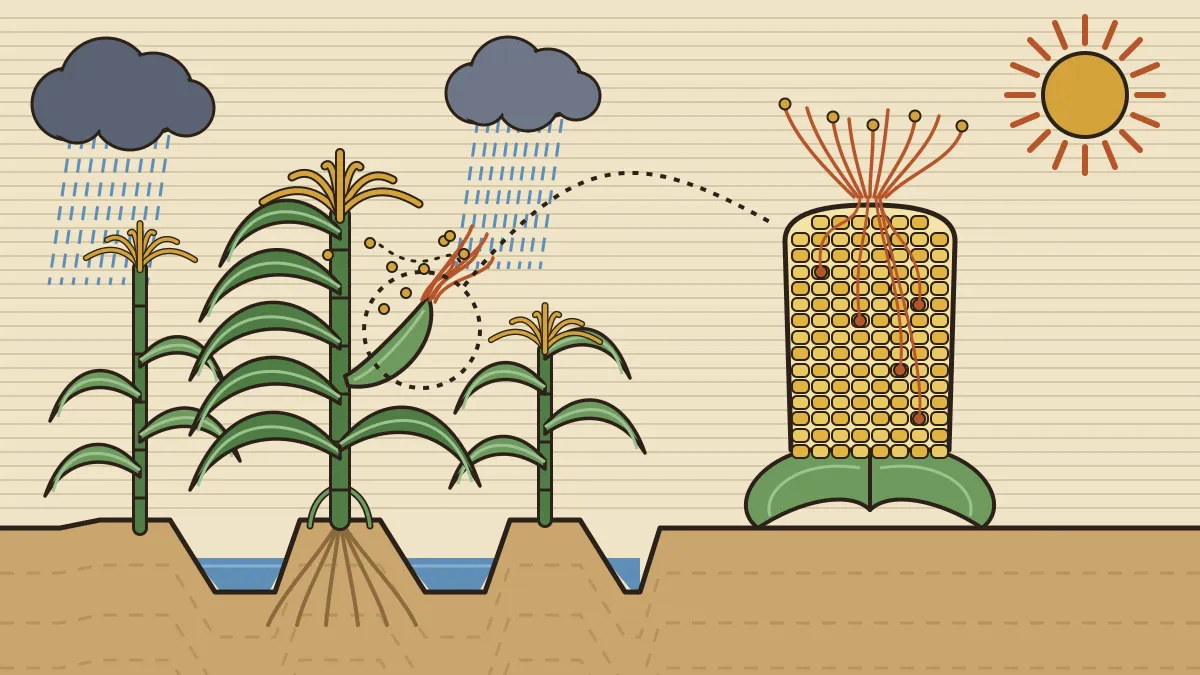
A cob has 16 rows of 35 kernels. How many silk threads must catch pollen for a full cob?
Three Seasons and the Leading States
Maize is mainly a kharif crop, sown with the monsoon in June–July and harvested in September–October. But IIMR counts three seasons, and the Third Advance Estimates for 2025-26 show how production splits.
| Season | Sowing | Where | 2025-26 output |
|---|---|---|---|
| Kharif | June–July | Mainly rain-fed fields of Madhya Pradesh, Maharashtra, Karnataka, Rajasthan, Uttar Pradesh | 30.5 million tonnes (55%) |
| Rabi | October–December | Irrigated fields of Bihar and peninsular India | 20.0 million tonnes (36%) |
| Spring or summer | January–February | Punjab, Haryana, western Uttar Pradesh | About 4.5 million tonnes (8%, by difference) |
India grew maize on 14.4 million hectares in 2025-26, giving 55.1 million tonnes at 3.82 tonnes per hectare. USDA ranks India 4th in area and 6th in output, behind the USA (432 million tonnes), China, Brazil, Argentina and the EU. The US yield is about 11.7 t/ha, three times India's.
| State | Area (million ha) | Output (million t) | Yield (t/ha) |
|---|---|---|---|
| Madhya Pradesh | 2.90 | 10.04 | 3.47 |
| Karnataka | 1.95 | 6.55 | 3.35 |
| Maharashtra | 2.21 | 5.69 | 2.56 |
| Bihar | 0.89 | 5.57 | 6.20 |
| Andhra Pradesh | 0.73 | 5.48 | 7.44 |
| Telangana | 0.93 | 5.44 | 5.83 |
| India | 14.40 | 55.09 | 3.82 |
These six states make 70% of the crop. Notice that Maharashtra, with more land than Karnataka, produces less, while Bihar and Andhra Pradesh grow nearly as much as Maharashtra on well under half its area, thanks to irrigated rabi crops. Dr Jat traced yield gaps particularly to crop management, and asked for a "systems-science" approach rather than just new seed.
If Maharashtra raised its yield to the national average on the same area, how much more maize would it grow?
NCERT-based lists name Karnataka, Madhya Pradesh, Uttar Pradesh, Bihar and Andhra Pradesh as the major states. Uttar Pradesh has the fourth-largest area, but its low yield (2.75 t/ha) leaves it only about ninth in output.
Feed, Starch, Food and Fuel: Where the Maize Goes
| Use | Share of maize | What it becomes |
|---|---|---|
| Poultry and animal feed | About 54% | Broiler, layer and cattle feed; the stalk is fodder |
| Ethanol | About 25% | Fuel for E20 petrol |
| Starch industry | About 14% | Starch, glucose, dextrose, sorbitol, paper, textiles, medicines |
| Food and processing | About 7% | Flour, grits, flakes, snacks, popcorn |
The shares are FICCI estimates and vary by source. The surprise is ethanol. The government's E20 programme blends 20% ethanol into petrol, and India reached about that level in late 2025, years ahead of the original 2030 target. Maize has become its biggest feedstock: distilleries used 125.75 lakh tonnes of it in the 2024-25 ethanol supply year (a Lok Sabha reply of December 2025). Our articles on E20 and the Ethanol Blending Programme have the details.
Maize-based distilleries were allotted 477.8 crore litres of ethanol. How much ethanol does one tonne of maize give?
Poultry explains the feed share. Maize supplies most of the energy in poultry rations, so feed costs, and with them egg and chicken prices, track maize prices. Exports are small, 1.27 million tonnes worth Rs 3,358 crore in 2025-26, mostly to Bangladesh, Vietnam and Nepal.
The risk is "food versus fuel". Dr Jat told the conference that maize must be targeted across seasons without compromising oilseeds and pulses. The same logic explains why our agricultural economics page treats crop diversification and MSP as one topic.
QPM, Baby Corn, Sweet Corn and Popcorn
| Type | What is special | Used as |
|---|---|---|
| QPM (quality protein maize) | Opaque-2 gene with modifiers gives nearly double the lysine and tryptophan of normal maize; bred at CIMMYT by Surinder Vasal and Evangelina Villegas (World Food Prize, 2000) | Nutritious food and feed |
| Baby corn | Young, unpollinated cob picked within days of silk emergence | Vegetable, salads |
| Sweet corn | Gene that keeps sugar from turning to starch; picked green | Boiled cobs, canned kernels |
| Popcorn | Hard outer layer holds moisture; heat builds steam pressure until the kernel bursts | Snack |
Much of India's maize is sown as hybrid seed, and farmers buy fresh seed each year because saved seed loses its vigour. The conference heard that 329 maize hybrids have been developed in five years, and asked for more public-sector hybrids to keep seed affordable. Popcorn shows what a new hybrid can do: on 24 August 2026 the Vice-President launched India's first non-GMO, high-expansion popcorn hybrid in Andhra Pradesh, ending a dependence on imported hybrid technology (see our popcorn hybrid explainer).
Fall Armyworm and Other Threats
The fall armyworm (Spodoptera frugiperda) is a moth from the Americas whose caterpillars feed inside the whorl of young maize plants, leaving ragged holes and sawdust-like droppings. It reached Africa in 2016 and was first reported in India in 2018, in Karnataka, and has since spread across maize states. The caterpillar has an inverted Y on its head and four dark spots on its eighth abdominal segment. Control is integrated: early sowing, pheromone traps, egg parasitoids such as Trichogramma, and sprays at the early larval stage. Intercropping maize with a pulse is also advised.
Other problems are stem borers, leaf blights, and aflatoxin, a toxin from a mould (Aspergillus flavus) that grows on damp stored grain. The conference's chief guest, Dr R.S. Paroda, stressed aflatoxin management for safe food and feed.
Maize against Rice, Wheat and Millets
| Crop | Season | Climate (NCERT) | Soil | Photo-synthesis | Output 2025-26 |
|---|---|---|---|---|---|
| Rice | Kharif | Above 25 °C; above 100 cm rain | Alluvial, clayey | C3 | 154.0 Mt |
| Wheat | Rabi | Cool growth, bright sun at ripening; 50–75 cm rain | Ganga–Satluj plains; Deccan black soil | C3 | 120.7 Mt |
| Maize | Kharif (also rabi, spring) | 21–27 °C; about 50–100 cm | Well-drained alluvial | C4 | 55.1 Mt |
| Bajra, jowar, ragi | Mainly kharif | Dry or rain-fed regions | Sandy, red, shallow black | C4 | 10.9, 4.4 and 2.0 Mt |
Maize is a coarse cereal but not a millet (Shree Anna). The default exam answer is "kharif", though rabi and spring maize exist. And farmers often grow maize with a pulse, so know the difference between intercropping (definite rows) and mixed cropping (no fixed pattern).
Maize also uses much less water than paddy, which is why Punjab and Haryana, where groundwater is falling, promote it as a diversification crop. For the wider picture of seasons and farming types, see our economic geography of agriculture page.
How UPSC Has Asked It: Past Papers Solved
Maize itself appears as a history question, while the crop calendar and cropping systems recur as geography. Six questions, solved.
Maize (makka) was introduced into India via
(a) America and England (b) Africa and Spain (c) France and Russia (d) Portugal and Italy
Answer: (b). This is the NCERT Class 12 line. Option (d) tempts because Portuguese traders brought other American crops, but it is not the textbook route.
Which one of the following is a Rabi crop in the Northern States of India?
(a) Rice (b) Bajra (c) Barley (d) Ragi
Answer: (c). Barley is sown in October–November and harvested in March–April. Rice, bajra and ragi are kharif crops.
Which one of the following crops is generally benefitted by the rain caused by western disturbances in India?
(a) Rice (b) Wheat (c) Bajra (d) Cotton
Answer: (b). Western disturbances bring winter rain to north-west India, which helps the rabi wheat crop. Rice, bajra and cotton are kharif crops that need the monsoon.
India has achieved the 10 percent Ethanol blending much ahead of the targeted date. Which one among the following greatly benefits from this?
(a) Cassava plantations (b) Maize farming (c) Sugar industry (d) Wine industry
Answer: (c). In 2022 most ethanol came from sugarcane juice and molasses. Option (b) is the tempting one, and today it would be a strong answer, since maize became the largest feedstock by 2024-25. The question carries a date.
Growing of two or more crops simultaneously on the same field in a definite pattern is known as
(a) mixed cropping (b) inter cropping (c) mixed farming (d) hybrid farming
Answer: (b). The phrase "definite pattern", usually rows, marks intercropping, for example maize rows alternating with a pulse. Mixed farming combines crops with livestock.
Identify the crop on the basis of the following characteristics: 1. It is a kharif crop. 2. Aus, Aman and Boro are its three different growing periods in an agricultural year. 3. About one-fourth of the total cropped area of India is under its cultivation.
(a) Wheat (b) Rice (c) Pulses (d) Cotton
Answer: (b). Aus, Aman and Boro are the three rice crops of eastern India, and rice covers about a quarter of the cropped area. Maize would fail clue 2, and wheat fails clue 1.
Agriculture questions repeat three things: which season a crop belongs to, which state leads, and the precise term (mixed cropping has no fixed pattern, intercropping has definite rows, rotation is one crop after another). Keep the season list and state pairs sharp.
Practice MCQs (with answers)
- According to NCERT, maize needs a temperature of about
- 10–15 °C
- 21–27 °C
- 30–35 °C
- above 40 °C
- In a maize plant, the male flowers are found in the
- cob
- silk
- tassel
- husk
- The fall armyworm, first reported in India in 2018, mainly damages
- maize
- cotton
- sugarcane
- wheat
- Baby corn is
- a genetically modified maize
- a dwarf variety grown for fodder
- maize harvested at full grain maturity
- the young, unpollinated cob picked soon after the silk appears
- Quality protein maize (QPM) is richer in
- starch and oil
- lysine and tryptophan
- vitamin A and iron
- calcium and sodium
- The largest single use of maize in India is
- human food
- starch
- poultry and animal feed
- export
- Which statement about maize is correct?
- It is a C3 plant, like rice and wheat
- It is grown only in the kharif season
- It is counted among the millets (Shree Anna)
- It is grown in kharif, rabi and spring seasons in different regions
- A state grows maize on 2 million hectares at 2.5 t/ha. If the yield rises to 3.5 t/ha on the same area, the extra output is
- 2 million tonnes
- 1 million tonnes
- 5 million tonnes
- 7 million tonnes
1-b, 2-c, 3-a, 4-d, 5-b, 6-c, 7-d, 8-a. Q2: the tassel is male, the silk is the female style. Q7: maize is a C4 coarse cereal, not a millet, and it is not kharif-only. Q8: (3.5 − 2.5) × 2 million ha = 2 million tonnes.
Quick Revision
- Zea mays; Mexico, about 9,000 years ago; reached India "through Africa and Spain" (NCERT Class 12). C4 crop; queen of cereals. Third cereal after rice and wheat.
- Needs 21–27 °C, about 50–100 cm of rain, well-drained alluvial soil; hates waterlogging. Tassel is male, silk is female; each pollinated silk gives one kernel.
- Seasons: kharif (June–July sowing, about 55% of output), rabi (Bihar and the south, about 36%), spring (Punjab, Haryana).
- 2025-26: 14.4 Mha, 55.1 Mt, 3.82 t/ha. Top states: Madhya Pradesh, Karnataka, Maharashtra, Bihar, Andhra Pradesh, Telangana. World: USA first; India 4th in area, 6th in output.
- Uses: poultry and animal feed 54%, ethanol 25%, starch 14%, food 7%. Maize is now the main ethanol grain; E20 reached in late 2025.
- QPM (lysine, tryptophan), baby corn (unpollinated), sweet corn (sugar), popcorn (hard coat, steam). Fall armyworm (2018, Karnataka); aflatoxin in damp grain.
- Mixed cropping: no pattern. Intercropping: definite rows. Barley and wheat are rabi; bajra, ragi, maize are kharif.
Frequently asked questions
What climate does maize need?
Maize needs a temperature of about 21 to 27 degrees Celsius, roughly 50 to 100 cm of well-spread rain and well-drained fertile soil, such as old alluvium. It is sensitive to waterlogging, frost and extreme heat at flowering.
Which states produce the most maize in India?
In the 2025-26 estimates the leading producers are Madhya Pradesh, Karnataka, Maharashtra, Bihar, Andhra Pradesh and Telangana, which together grow about 70% of the crop. Bihar, Andhra Pradesh and Telangana have the highest yields because of irrigated rabi maize.
Why is maize important for the E20 ethanol programme?
E20 means petrol blended with 20% ethanol. Maize has become India's largest ethanol feedstock, with about 125.75 lakh tonnes used in the 2024-25 ethanol supply year. That makes the crop a link between farm income, fuel imports and food security.
How did maize reach India?
Maize is native to Mexico and reached Europe after 1492. NCERT says it came to India through Africa and Spain, by the seventeenth century. Portuguese traders are also credited with carrying American crops to India.
What is the fall armyworm?
The fall armyworm is a moth whose caterpillars eat the leaves and growing point of young maize plants. It is native to the Americas and was first reported in India in 2018, in Karnataka. Farmers use pheromone traps, parasitoid wasps and early sprays to control it.
Related CDS / OTA Geography topics
Geography of India is a guaranteed block in every CDS GS paper
Cavalier's CDS/OTA batches teach Indian agriculture, resources and economic geography with maps, data tables and weekly PYQ-based tests.