White light-emitting diodes (LEDs) already light our homes, phones and streets, and they are very efficient. They also have limits. They depend on expensive rare-earth elements and on high-temperature manufacturing, and once an LED is built its shade of white is fixed. On 27 November 2026, the Ministry of Science and Technology reported a way around some of these limits: a stable, tunable and scalable white LED made from halide perovskite nanocrystals.
The work comes from the Centre for Nano and Soft Matter Sciences (CeNS), Bengaluru, an autonomous institute under the Department of Science and Technology (DST), together with IIT Delhi. The team, Gauri Sharma, Swati Khurana, Sameer Sapra and Pralay K. Santra, published it in the journal Small. To see why it matters, we need to start with how an LED works and why white is the hardest colour for it to make.
How an LED makes light
An LED is a semiconductor diode, a tiny two-layer device with a p-n junction. When current flows through it, electrons from the n-side meet "holes" from the p-side at the junction and fall into them. Each meeting releases energy as a photon, a particle of light. This is called electroluminescence. The colour of the light depends on the energy gap of the material, so a different semiconductor gives a different colour. Our note on semiconductors, the p-n junction and the diode explains the underlying physics.
LEDs were invented in the 1960s, and for a long time they came only in red and green. Blue was the stubborn colour. Without blue, you cannot build white by mixing, and you cannot excite the phosphors that make white from a single chip. The breakthrough came in the early 1990s, and the 2014 Nobel Prize in Physics went to Isamu Akasaki, Hiroshi Amano and Shuji Nakamura for inventing efficient blue LEDs, which made bright, energy-saving white light sources possible. The Nobel Committee noted that LEDs can last up to 100,000 hours, against about 10,000 for fluorescent lamps and 1,000 for incandescent bulbs.
Why white is difficult
White is not a colour of the spectrum. It is what the eye sees when several colours reach it together. A white LED can be made in two broad ways:
- Phosphor conversion. A blue chip lights a coating that absorbs some of the blue and re-emits yellow or red and green. Together they look white. This is how most bulbs on the market work (for example, a yellow phosphor such as cerium-doped yttrium aluminium garnet), and these phosphors depend on rare-earth elements.
- Colour mixing. Red, green and blue emitters are placed side by side. This gives control but needs three devices that must be matched.
Either way, the shade of white is fixed once the device is built. A warm, candle-like white and a cool, daylight white need different bulbs. The perovskite approach tries to make a single device whose white can be adjusted and whose ingredients are cheap and easy to process. Our note on the electromagnetic spectrum and its uses places visible light in its wider context.
What a perovskite is
The word comes from a mineral. Perovskite is calcium titanate (CaTiO3), found in the Ural Mountains and named in 1839 by the German mineralogist Gustav Rose after the Russian mineralogist Lev Perovski. In science, "perovskite" now means any material with the same crystal arrangement, written as ABX3: a large metal ion A, a smaller metal ion B and an anion X.
The perovskites in this news are all-inorganic halide perovskite nanocrystals, with the formula CsPbX3. Here Cs is caesium, Pb is lead and X is a halide: chlorine, bromine or iodine. Changing the halide changes the colour. CsPbBr3 emits green light and CsPbI3 emits red. A nanocrystal is a crystal only a few nanometres across, and at this size the colour can also be tuned by the crystal's dimensions. These materials are bright, give very pure colours, and can be made from solution, which is cheaper than conventional semiconductor processing.
The weakness: halide ions that will not stay put
To make white light from perovskites, you would stack a green layer and a red layer (with a blue source). Here is the problem, called anion exchange. When green CsPbBr3 and red CsPbI3 crystals touch, their halide ions migrate and swap between crystals. The two colours blend into an unwanted orange, and the blurring can happen within minutes. A white LED that turns orange is useless.
Ion migration is easiest where the crystal has vacancies, empty halide positions on its surface that let a neighbouring ion hop in. That is why the fix has two parts, and why the PIB describes it as a dual-protection strategy.
The fix: remove the doors, then wall the rooms
Step 1: reduce the vacancies. The team treated the crystal surface with lead selenide, which cut the halide vacancies on the surface. This removed the main route for ion movement without dimming the crystals or shifting their colour.
Step 2: add a transparent wall. The team then deposited an ultrathin coating of aluminium oxide (alumina, Al2O3), only about 5 to 6 nanometres thick, using atomic layer deposition (ALD). ALD builds a film one atomic layer at a time, by exposing the surface to alternating pulses of gases, so the coating is even and pinhole-free. The alumina layer is transparent to light but acts as a physical barrier that stops ions diffusing from one colour layer into the next.
With these two protections, the team made multi-layered white LEDs by a simple spray-coating technique combined with micropatterning. They built them on both rigid glass and flexible plastic (PET) bases. The best versions ran continuously for up to 24 hours with a stable white colour that stayed close to that of ideal white light even when heated and cooled. The shade of white could also be changed from cooler to warmer and dimmer simply by changing the electric current, which a conventional phosphor bulb cannot do.
What the finished device is
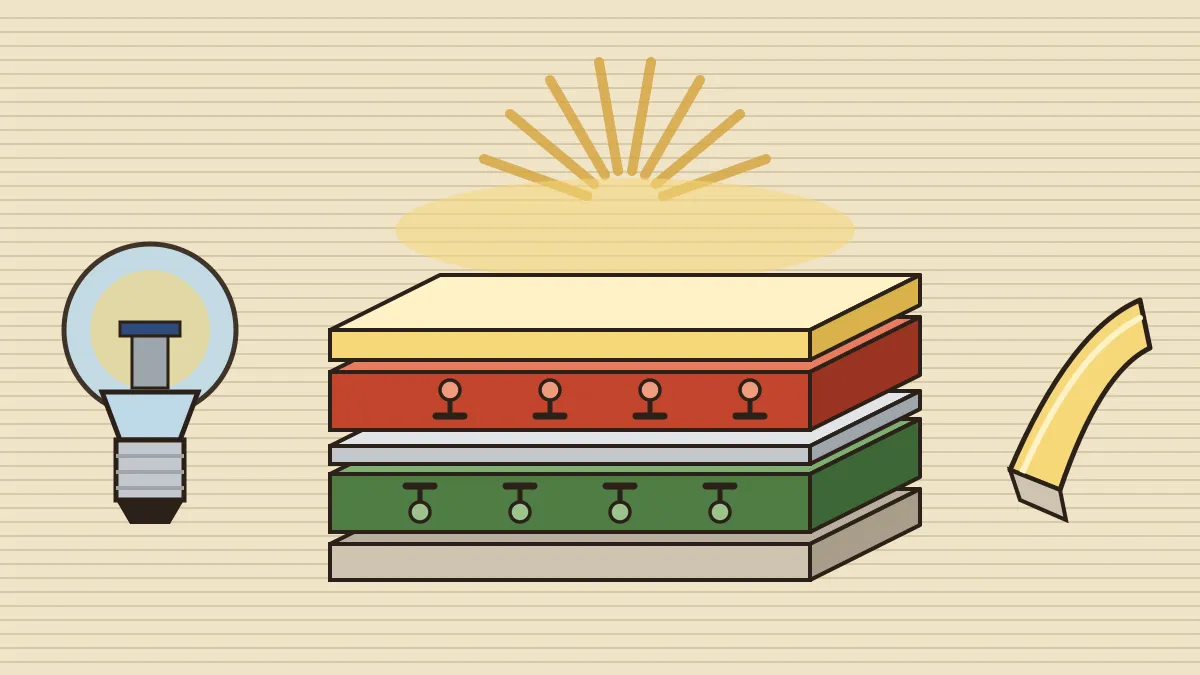
The devices in the paper are phosphor-converted white LEDs (pc-WLEDs), but with a twist. In a normal bulb the phosphor is a rare-earth powder. Here the "phosphor" is the perovskite itself: a green perovskite pattern and a red perovskite pattern, laid down by spray coating through a micropattern, which convert light from the excitation source (in this design type, usually a blue LED) into green and red. Blue, green and red together make white. The PIB figure shows the components and a photograph of a working device, built on glass and on flexible PET sheet.
"Tunable" has a practical meaning here. Lamp makers describe shades of white by their colour temperature: a low value gives the yellowish glow of a warm lamp and a high value the bluish white of daylight. A phosphor bulb is made for one shade. Because the tone of this device's white light changes with the electric current, one device can be moved towards a dimmer, warmer tone without being replaced. This is a laboratory demonstration of the principle, not a measured product specification.
A research line, not a one-off
This is the latest step in a programme at CeNS that PIB has reported before, and the sequence is a useful way to remember the problem:
- October 2021. A scalable sonochemical (ultrasound-driven) method to make perovskite nanocrystals and a demonstration of a white LED from their mixture, with stability left as the open question.
- February 2025. A team led by Pralay K. Santra reduced anion migration in green CsPbBr3 nanocrystals with an argon-oxygen plasma treatment that cross-links and immobilises the surface ligands, published in Nanoscale.
- November 2026. The dual lead selenide and alumina approach in a working white LED, published in Small.
PIB's 2025 release also compared the competition. OLEDs (organic LEDs) give vibrant colours and are thin and flexible but are costly and shorter-lived. QLEDs (quantum-dot LEDs) offer precise colour control but use toxic materials and scarce resources. Micro/mini-LEDs are bright and stable but expensive to make. Perovskite LEDs hope to combine the advantages of OLEDs and QLEDs.
The limits the researchers admit
The news is a step, not a product. Three cautions:
- Lead. The crystals contain lead, and the PIB states that the work needs refinement to handle the toxicity of lead and to find eco-friendly ways of making it before it reaches the market.
- Lifetime. Twenty-four hours is a laboratory result. A household LED is expected to last tens of thousands of hours, so durability has to improve by orders of magnitude.
- Scale. Spray coating is encouraging for scale, but only a manufacturing trial can show whether the process works on a production line.
Why India cares about better lighting
India has already shown what a switch to LEDs can do. The UJALA scheme, launched on 5 January 2015 as the Domestic Efficient Lighting Programme and run by Energy Efficiency Services Limited (EESL) with power distribution companies, had distributed 36.87 crore LED bulbs by January 2025. A 7 W LED gives about the same light as a 14 W CFL or a 60 W incandescent lamp, saving nearly 90% of the energy against the incandescent bulb. The share of LEDs in the lighting market was under 1% in 2013-14, and UJALA's bulbs cost ₹70 each through bulk buying. PIB calls it the world's largest zero-subsidy domestic lighting programme.
Lighting still accounts for a large share of the world's electricity. PIB puts it at nearly 20%, while the Nobel Committee in 2014 said about a quarter. Every improvement in the quality or the cost of an efficient light therefore adds up. Perovskites are also being studied for solar cells, where the same family of materials captures light instead of emitting it, a topic covered in our note on solar cells and the photovoltaic effect.
🔑 Revision block
The news. 27 November 2026: CeNS, Bengaluru (autonomous institute under DST) with IIT Delhi report a stable, tunable, scalable white LED from halide perovskite nanocrystals; team Gauri Sharma, Swati Khurana, Sameer Sapra, Pralay K. Santra; journal Small.
The material. Perovskite = CaTiO3, named 1839 by Gustav Rose after Lev Perovski; structure ABX3. Nanocrystals CsPbX3 (X = Cl, Br, I): CsPbBr3 green, CsPbI3 red.
The problem. Anion (halide) exchange: green and red crystals swap ions and blur to orange within minutes.
The fix. Lead selenide cuts surface halide vacancies; alumina (Al2O3), 5-6 nm, by atomic layer deposition, blocks diffusion. Spray-coated multilayers on glass and flexible PET; stable white for up to 24 hours; shade tuned by changing the current.
Limits. Lead toxicity; hours, not years, of life; scale-up untested.
Background. LEDs from the 1960s; blue LED by Akasaki, Amano, Nakamura, Nobel 2014 for white light; LEDs last up to 100,000 hours. UJALA: 5 January 2015, 36.87 crore bulbs by January 2025, 7 W LED = 60 W incandescent.
🎯 Practice MCQs
Q1. The mineral that gave perovskites their name has the chemical formula:
(a) CaCO3
(b) CaSiO3
(c) CaTiO3
(d) CaF2
→ (c)
Perovskite is calcium titanate. Calcium carbonate is limestone and calcium fluoride is fluorite.
Q2. In the perovskite nanocrystals CsPbX3, the letter X stands for:
(a) A noble gas
(b) A halogen such as chlorine, bromine or iodine
(c) An alkali metal
(d) A chalcogen such as sulphur
→ (b)
Changing the halide changes the colour: CsPbBr3 glows green and CsPbI3 glows red.
Q3. The colour blurring in layers of green and red perovskite nanocrystals arises mainly from:
(a) Evaporation of the solvent
(b) Cracking of the glass base
(c) Loss of electrons at the wires
(d) Migration of halide ions between neighbouring crystals
→ (d)
This anion exchange blends the colours into orange within minutes, which is why the layers had to be protected.
Q4. Consider the following statements about the new white LED:
1. It was developed by an autonomous institute under the Ministry of Education.
2. A transparent alumina layer a few nanometres thick acts as a barrier to ion diffusion between colour layers.
Which of the statements given above is/are correct?
(a) 1 only
(b) 2 only
(c) Both 1 and 2
(d) Neither 1 nor 2
→ (b)
CeNS, Bengaluru, is an autonomous institute under the Department of Science and Technology, not the Ministry of Education. The 5 to 6 nm alumina layer is applied by atomic layer deposition.
Q5. The 2014 Nobel Prize in Physics, for blue light-emitting diodes that made bright, energy-saving white light possible, was awarded to:
(a) Isamu Akasaki, Hiroshi Amano and Shuji Nakamura
(b) Peter Higgs and François Englert
(c) Andre Geim and Konstantin Novoselov
(d) Saul Perlmutter, Brian Schmidt and Adam Riess
→ (a)
Blue was the last primary colour to be made efficiently, and white by mixing or by phosphor needs it. The other options are the 2013, 2010 and 2011 physics laureates.
Q6. The UJALA scheme for energy-efficient LED bulbs was launched in:
(a) 2013
(b) 2014
(c) 2015
(d) 2017
→ (c)
UJALA began on 5 January 2015 as the Domestic Efficient Lighting Programme and had distributed about 36.87 crore bulbs by January 2025.
Q7. In the new perovskite white LED, the shade of white light can be shifted to a warmer, dimmer tone by:
(a) Replacing the glass base with plastic
(b) Adding more lead selenide
(c) Cooling the device in a freezer
(d) Changing the electric current passing through it
→ (d)
Tunability by current is one of the claimed advantages over a conventional phosphor bulb whose shade is fixed.
Q8. Consider the following statements:
1. A 7 W LED bulb gives about the same light as a 60 W incandescent lamp.
2. The perovskite white LEDs reported in November 2026 have been shown to run continuously for several years.
Which of the statements given above is/are correct?
(a) 1 only
(b) 2 only
(c) Both 1 and 2
(d) Neither 1 nor 2
→ (a)
This is the UJALA comparison. The perovskite devices ran for up to 24 hours in the best versions, far short of years.
📋 How this gets asked (PYQ pattern)
Applied-science questions on lighting and semiconductors are common in the CDS general science paper, and the patterns are stable.
The first is device principle: what an LED is, why it needs a p-n junction, and why it is more efficient than an incandescent or fluorescent lamp. The usual distractors confuse the LED with the laser diode or the photodiode, which work in the reverse direction.
The second is people and prizes: the Nobel Prize in Physics for blue LEDs in 2014, with the three Japanese-born laureates named in a single option. The examiner often places the laureates of neighbouring years as wrong options, as in Q5.
The third is news plus basic science: a fresh Indian result paired with one fundamental idea, here anion exchange, nanocrystals or atomic layer deposition. Learn what the technique does in one sentence and the institute that reported it. The fresh hooks this cycle are CeNS, Bengaluru, IIT Delhi, the 5 to 6 nm alumina layer and the 24-hour stability.
Preparing for CDS? Keep a one-page sheet of "applied physics and chemistry in the news", with one line each on LEDs, solar cells and nanomaterials. Revise the basics in our CDS/OTA study material, follow the daily CDS current affairs, and learn with experienced faculty in the upcoming Cavalier courses in Delhi.
Source: PIB / Ministry of Science & Technology, "New technology developed for stable, tunable and scalable white LEDs", 27 November 2026 (publication DOI 10.1002/smll.202512820); earlier PIB releases on CeNS perovskite work (5 October 2021; 21 February 2025); PIB / Ministry of Power, "UJALA: 10 Years of Energy-Efficient Lighting", 6 January 2025. Nobel Prize in Physics 2014 press release, Royal Swedish Academy of Sciences, 7 October 2014. Origin of the name perovskite from mineralogical references.
✍️ Written by Col D.N. Sharma — Science & general-studies faculty at The Cavalier. Reviewed by the Cavalier Faculty Desk.