On 27 November 2026, Union Minister of State (Independent Charge) for Science and Technology and Vice President of CSIR, Dr Jitendra Singh, inaugurated a Biosafety Level-3 (BSL-3) and Animal Biosafety Level-3 (ABSL-3) facility at the CSIR-Central Drug Research Institute (CDRI), Lucknow. He also opened a lecture theatre named for Dr B. Mukerji. The new laboratory will host research on Mycobacterium tuberculosis, the bacterium that causes TB, and on non-tuberculous mycobacteria (NTM), a related group of bacteria that also cause lung and other infections.
At the same event, CDRI signed collaboration agreements with the ICMR-National Institute of Research in Tribal Health, Jabalpur, the Uttar Pradesh University of Medical Sciences, Saifai, and Medanta Hospital, Lucknow. The Minister used the occasion to argue that India must move beyond being a supplier of generic medicines and become a discoverer of new ones.
The news looks like an infrastructure item, but it opens a large and testable topic: what the numbers in "BSL-3" mean, why some germs need a sealed laboratory, and who regulates such places in India.
What a "biosafety level" means
Biosafety levels (BSL) are a four-step scale of laboratory containment. The higher the number, the more dangerous the germ being handled and the stricter the barrier between the worker and the culture. The scale was developed in the United States, in the handbook Biosafety in Microbiological and Biomedical Laboratories, brought out by the Centers for Disease Control and Prevention (CDC) and the National Institutes of Health, and it is used worldwide.
| Level | Typical agents | Main controls | Examples |
|---|---|---|---|
| BSL-1 | Well-characterised agents not known to cause disease in healthy adults | Open bench, hand-washing, lab coats | Harmless laboratory strains of bacteria |
| BSL-2 | Agents of moderate hazard that cause disease by contact or ingestion, rarely by air | Biological safety cabinet for anything that can form aerosols, gloves, an autoclave, restricted access | Salmonella, Staphylococcus, hepatitis B virus |
| BSL-3 | Agents that can cause serious or potentially lethal disease by inhalation | Directional airflow, two self-closing doors, all work in a cabinet, no recirculation of air, medical surveillance of staff | Mycobacterium tuberculosis, Coxiella burnetii |
| BSL-4 | Dangerous agents with a high risk of life-threatening disease, usually without a vaccine or cure | Full-body positive-pressure suits or Class III cabinets, a separate building or isolated zone | Ebola, Marburg |
The "A" in ABSL stands for animal. An ABSL-3 suite applies BSL-3 rules to the rooms where infected animals are housed. This matters for drug discovery, because a new anti-tubercular compound must be tested in an animal model that actually carries the infection before it can go to human trials. CDRI's record, as cited in the PIB release, includes more than 50 animal models and over 30 in-vitro screening systems.
Why tuberculosis needs a level-3 laboratory
The deciding word is inhalation. TB spreads through droplets that stay in the air. A bacterium that can cause serious disease when breathed in is dangerous even in a small spill, so BSL-3 rules aim at one thing above all: keep the air inside the laboratory from reaching the worker or the outside world.
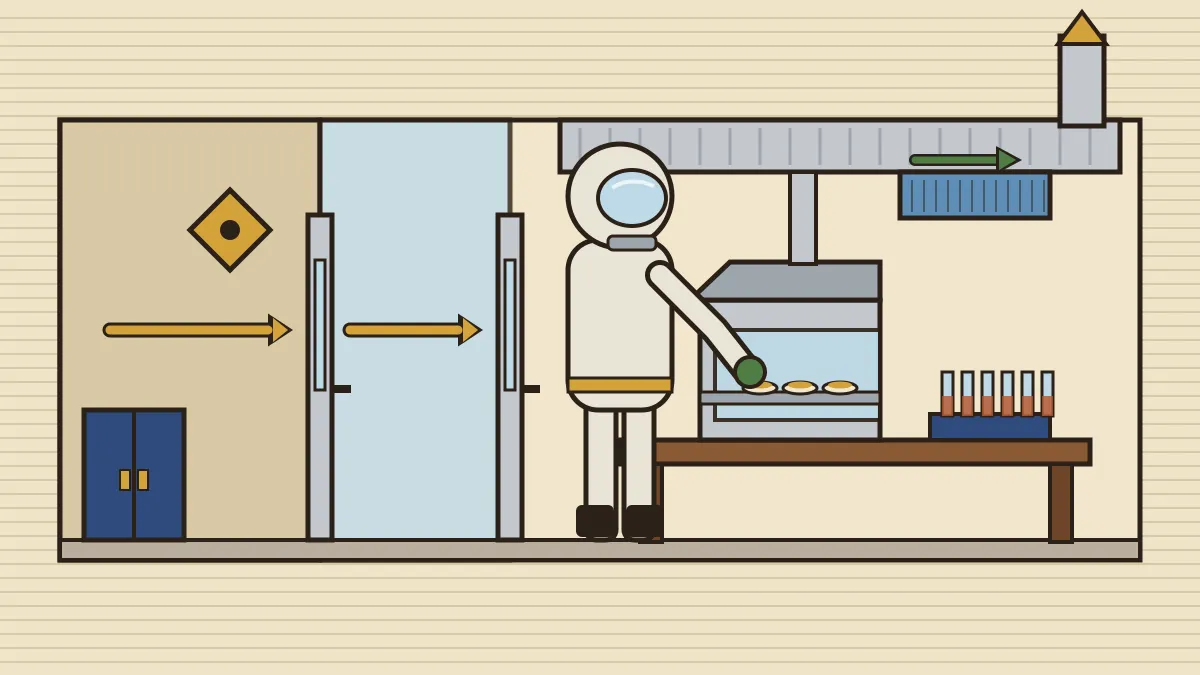
In practice, a BSL-3 laboratory has these features:
- Controlled entry. Access is through two self-closing doors, usually with an anteroom in between, so that the inner and outer doors are never open together.
- Directional airflow. The ventilation system pulls air into the laboratory from clean areas towards potentially contaminated ones, and it is designed so that the flow does not reverse even when something fails. The room is kept at lower pressure than its surroundings.
- No recirculation. Air from the laboratory is exhausted, with filtration, and not returned to other parts of the building.
- Cabinets. Every manipulation of live organisms is done inside a biological safety cabinet.
- People. Workers are trained, supervised and medically monitored, and entry is restricted to those with a reason to be inside.
The result is a sealed room with its own air path. It is not a place where ordinary students work. That is why a country builds only a limited number of them and places them in institutions that can run them well.
Containment is a risk judgement, not just a number. The World Health Organization's Laboratory Biosafety Manual, fourth edition (2020), moves away from a simple one-to-one link between a germ's risk group and a laboratory's level. It asks each laboratory to assess the agent, the procedure and the competence of the staff, and to apply core requirements plus extra controls where needed. Examiners may ask this as "risk assessment rather than fixed levels".
The TB problem that gives this lab its purpose
India has the world's largest TB burden, accounting for nearly 25% of global cases according to a PIB release of March 2026. The most recent figures, from the WHO Global TB Report 2025 as reported by the Health Ministry, are worth knowing:
- TB incidence fell 21%, from 237 per lakh population in 2015 to 187 per lakh in 2024, against a global decline of about 12%.
- Of an estimated 27 lakh cases in 2024, about 26.18 lakh were diagnosed, which pushes treatment coverage above 92%.
- TB mortality fell from 28 to 21 per lakh, and treatment success under the TB Mukt Bharat Abhiyan (launched December 2024) is 90%, against 88% globally.
Progress in diagnosis and treatment depends on a research pipeline: new drugs, shorter regimens and a better understanding of drug resistance. All of it needs bench work with live M. tuberculosis, and that needs level-3 space. Our notes on antibiotics and antimicrobial resistance and on viral and bacterial diseases cover the science, and our report on World AMR Awareness Week shows how resistance links to the One Health approach.
India's network of containment laboratories
There is no single national count of containment labs, because several bodies run or register them. The figures below come from PIB releases, each with its own date and scope, and are not meant to be added together.
- Health Ministry network (March 2025). Under the Department of Health Research scheme "Setting up of a Nationwide Network of Laboratories for Managing Epidemics and National Calamities", 165 biosafety laboratories were approved: 11 at BSL-3 and 154 at BSL-2. In addition, ICMR has 21 biosafety labs (one BSL-4, eight BSL-3 and twelve BSL-2).
- By institution. The same release lists 26 labs in institutes of the Department of Biotechnology, 11 in CSIR, 9 in ICAR, and five BSL/ABSL-3 labs funded by the Anusandhan National Research Foundation.
- Labs registered with DBT (December 2025). About 750 at BSL-2, 89 at BSL-3 and one at BSL-4.
A PIB release of September 2025 describes the National Institute of Virology, Pune (ICMR) as the country's only BSL-4 laboratory. The new CDRI facility adds to the CSIR group. Our note on recombinant DNA technology explains why the same containment logic applies to genetic engineering work.
The rules behind the doors
Containment in India is governed by a mix of law and technical guidelines:
- The Rules for the Manufacture, Use, Import, Export and Storage of Hazardous Micro-organisms, Genetically Engineered Organisms or Cells, 1989, notified under the Environment (Protection) Act, 1986 and administered by the Ministry of Environment, Forest and Climate Change.
- The Regulations and Guidelines for Recombinant DNA Research and Biocontainment, 2017, issued by the Department of Biotechnology.
- Institutional Biosafety Committees (IBSCs) in each institution, which oversee work locally and report to the Review Committee on Genetic Manipulation (RCGM) at the national level.
The Environment (Protection) Act is the parent law, and the 1989 Rules are among the most frequently asked items from it. The Department of Biotechnology's guidelines add the technical detail on containment.
CDRI in context: a 1951 laboratory with a long record
The Central Drug Research Institute was inaugurated on 17 February 1951 by Prime Minister Jawaharlal Nehru. It is a laboratory of the Council of Scientific and Industrial Research (CSIR), set up on 26 September 1942 as an autonomous body whose President is the Prime Minister. CSIR works under the Department of Scientific and Industrial Research and runs a network of national laboratories across the country.
The Minister's figures for CDRI are impressive:
- 13 drugs that have reached the market.
- More than 80 process technologies licensed and six diagnostic technologies.
- More than 12,000 research articles, 456 international and 586 Indian patents, and a library of about 90,000 compounds.
- More than 2,000 PhDs and over 10,000 trainees trained.
Centchroman (ormeloxifene) is the best-known product. It is a non-steroidal, once-a-week oral contraceptive, marketed commercially as Saheli and offered in the national programme as Chhaya. It entered the National Family Planning Programme in 2016, and more than 350 lakh strips have been distributed free through ASHA workers over the last five years.
The pipeline includes a standardised extract of Picrorhiza kurroa (kutki) for non-alcoholic fatty liver disease, now called MASLD, which has completed Phase III trials. Two compounds have entered Phase I: L-Ormeloxifene for contraception and S007-1500 for fracture healing.
India's pharmaceutical position, and what "innovation" means
The Minister placed the facility in a larger argument. India ranks third in the world in pharmaceutical production by volume and 11th by value. He said India meets over 50% of Africa's generic medicine requirements and about 40% of the generic drug demand in the United States. The next stage, he said, is to move up the value chain from copying known molecules to discovering new ones. That requires early-stage science in national laboratories, then development, trials and commercialisation by industry, a hand-over that CDRI's collaborations with Zydus, Cipla, Dr. Reddy's, Himalaya and Themis Medicare are meant to support.
What to watch
- Which labs open. Whether more BSL-3 labs appear outside the large metros, since the new one is in Lucknow.
- Drug-resistance work. Progress on new anti-TB compounds and on NTM, which are often resistant to standard TB drugs.
- The Phase III result. The progress of the Picrorhiza kurroa extract towards approval.
- Governance. How the many registries of containment labs are tied into a single national picture.
🔑 Revision block
The news. 27 November 2026: BSL-3/ABSL-3 facility and Dr B. Mukerji Lecture Theatre inaugurated at CSIR-CDRI, Lucknow by Dr Jitendra Singh (MoS-IC S&T, Vice President of CSIR). Research on M. tuberculosis and NTM; MoUs with ICMR-NIRTH Jabalpur, UPUMS Saifai, Medanta Lucknow.
Biosafety levels. BSL-1 harmless agents; BSL-2 moderate hazard, cabinets for aerosols; BSL-3 inhalation hazards (TB), two self-closing doors, directional airflow, no recirculation; BSL-4 deadliest agents (Ebola, Marburg), full-body suits. ABSL = animal facility.
Rules. Environment (Protection) Act, 1986 and 1989 Rules (hazardous micro-organisms/GMOs); DBT Recombinant DNA and Biocontainment Guidelines, 2017; IBSC and RCGM. WHO manual, 4th ed. (2020): risk assessment.
Counts. Health Ministry network: 165 labs (11 BSL-3, 154 BSL-2); DBT-registered: 750 BSL-2, 89 BSL-3, 1 BSL-4.
CDRI. Inaugurated 17 February 1951 by Nehru; CSIR set up 26 September 1942 (PM is President); Centchroman (Saheli/Chhaya), in the national programme from 2016; 13 drugs developed by CDRI have reached the market.
TB numbers. Incidence 237 to 187 per lakh (2015-24), a 21% fall against 12% globally; India holds nearly 25% of the global burden.
🎯 Practice MCQs
Q1. The BSL-3 and ABSL-3 facility inaugurated at CSIR-CDRI, Lucknow in November 2026 is meant mainly for research on:
(a) Ebola and Marburg viruses
(b) Mycobacterium tuberculosis and non-tuberculous mycobacteria
(c) Genetically modified crops
(d) Radioactive isotopes
→ (b)
Both are bacteria that cause serious disease through the air. Ebola and Marburg need BSL-4 containment, which is a much higher level.
Q2. Which biosafety level calls for full-body positive-pressure suits or Class III cabinets for work with dangerous agents that usually have no vaccine or cure?
(a) BSL-1
(b) BSL-2
(c) BSL-3
(d) BSL-4
→ (d)
BSL-4 is the highest level and is used for agents such as Ebola and Marburg. BSL-3 covers inhalation hazards such as tuberculosis.
Q3. Consider the following statements:
1. CSIR-CDRI was inaugurated in 1951 by Prime Minister Jawaharlal Nehru.
2. The President of CSIR is the Union Minister of Science and Technology.
Which of the statements given above is/are correct?
(a) 1 only
(b) 2 only
(c) Both 1 and 2
(d) Neither 1 nor 2
→ (a)
CDRI was inaugurated on 17 February 1951. The Prime Minister is the President of CSIR, and the Science Minister serves as its Vice President.
Q4. Centchroman, developed at CSIR-CDRI, is:
(a) A steroidal daily contraceptive pill
(b) An anti-malarial drug
(c) A non-steroidal once-a-week oral contraceptive
(d) A vaccine against tuberculosis
→ (c)
It is marketed as Saheli and offered in the national family planning programme as Chhaya, which it entered in 2016.
Q5. The Rules for the Manufacture, Use, Import, Export and Storage of Hazardous Micro-organisms, Genetically Engineered Organisms or Cells, 1989 are notified under:
(a) The Biological Diversity Act, 2002
(b) The Environment (Protection) Act, 1986
(c) The Drugs and Cosmetics Act, 1940
(d) The Epidemic Diseases Act, 1897
→ (b)
The Environment (Protection) Act is administered by the Ministry of Environment, Forest and Climate Change. The Department of Biotechnology adds technical guidelines.
Q6. According to the WHO Global TB Report 2025 as reported by the Health Ministry, India's TB incidence fell from 237 per lakh population in 2015 to about how much in 2024?
(a) 87 per lakh
(b) 127 per lakh
(c) 157 per lakh
(d) 187 per lakh
→ (d)
That is a 21% fall, almost double the global decline of about 12%.
Q7. The fourth edition of the WHO Laboratory Biosafety Manual (2020) bases decisions about containment mainly on:
(a) A fixed link between a germ's risk group and the laboratory's level
(b) The size of the country in which the laboratory is located
(c) A risk assessment of the agent, the procedure and the staff
(d) The number of staff working in the laboratory
→ (c)
It moves away from a one-to-one link between risk group and level and applies core requirements plus extra controls where the assessed risk needs them.
Q8. Consider the following statements about a BSL-3 laboratory:
1. Ventilation is arranged so that air flows from clean areas towards potentially contaminated areas.
2. Air from the laboratory may be freely recirculated to other parts of the building.
Which of the statements given above is/are correct?
(a) 1 only
(b) 2 only
(c) Both 1 and 2
(d) Neither 1 nor 2
→ (a)
Directional inward airflow and exhaust without recirculation to other areas are core BSL-3 features, so statement 2 is wrong.
📋 How this gets asked (PYQ pattern)
Health and biotechnology questions in the CDS general knowledge paper tend to follow three patterns.
The first is classification: which level, disease or category a given agent belongs to. The safe approach is to learn one anchor example per level, such as TB for BSL-3 and Ebola for BSL-4, and to remember that BSL stands for biosafety level, not a pathogen group.
The second is institutions and their products: which CSIR laboratory produced which drug, and which organisation runs which facility. CDRI and Centchroman is a standard pairing, as is the date of its inauguration, 1951.
The third is laws and bodies: the Environment (Protection) Act of 1986, the 1989 Rules, IBSC and RCGM, and the roles of DBT, ICMR and CSIR. Keep the three apart: ICMR is the health research body, DBT promotes biotechnology, and CSIR is the industrial research network. The fresh hooks this cycle are the 27 November 2026 inauguration, the BSL-3/ABSL-3 rating and the 237-to-187 TB figure.
Preparing for CDS? Make a one-line table of the four biosafety levels with one example each; it is a five-minute task that settles the question for good. Revise the surrounding topics in our CDS/OTA study material, follow the daily CDS current affairs, and learn with experienced faculty in the upcoming Cavalier courses in Delhi.
Source: PIB / Ministry of Science & Technology, "Dr. Jitendra Singh inaugurates BSL-3 facility at CSIR-CDRI Lucknow", 27 November 2026. PIB releases on bio-safety laboratories (Ministry of Health and Family Welfare, 21 March 2025; Ministry of Science & Technology, 17 December 2025), on the National Institute of Virology (September 2025) and on TB (Ministry of Health and Family Welfare, 12 November 2025; Ministry of Science & Technology, World TB Day, March 2026). CDC, Biosafety in Microbiological and Biomedical Laboratories, 6th edition; WHO, Laboratory Biosafety Manual, 4th edition; CSIR and CSIR-CDRI websites.
✍️ Written by Col D.N. Sharma — Science & general-studies faculty at The Cavalier. Reviewed by the Cavalier Faculty Desk.