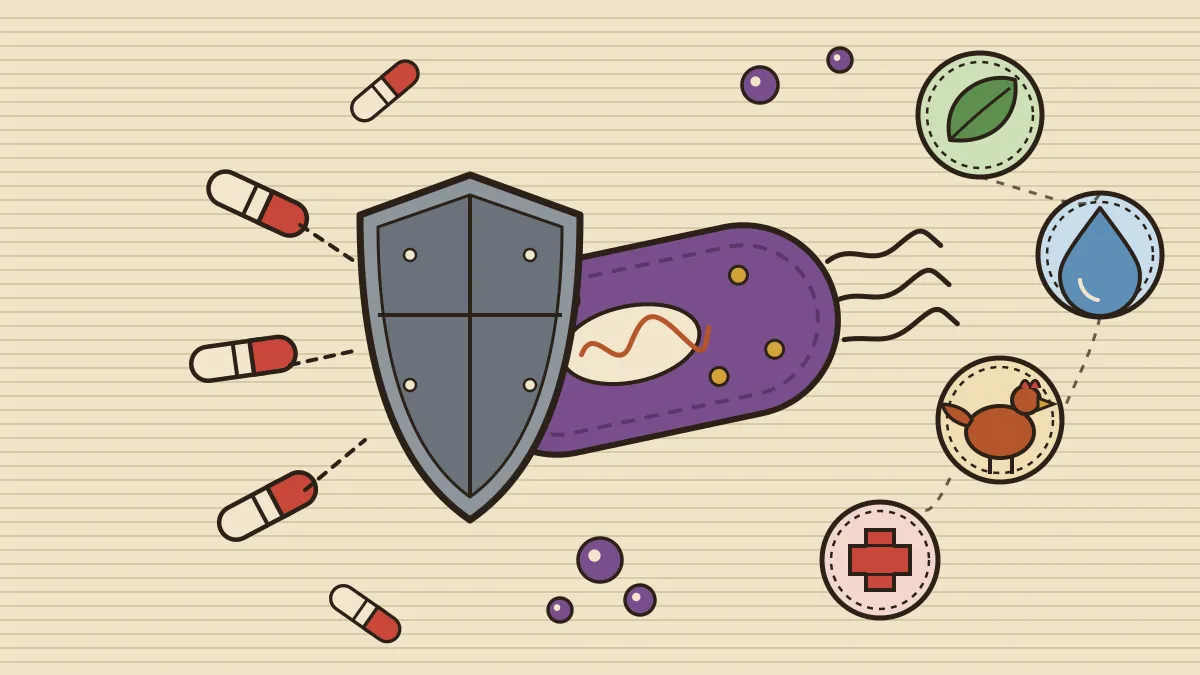
On 18 November 2026 the Union Ministry of Health and Family Welfare opened the national observance of World Antimicrobial Resistance (AMR) Awareness Week at Kartavya Bhawan, New Delhi. The week runs 18 to 24 November every year. This year's theme is "One Health, One Action: Prevent AMR Now".
The Union Health Secretary, Smt. Punya Salila Srivastava, addressed the meeting virtually. She described AMR as one of the most serious public-health challenges of our time and warned that, if left unchecked, it could "undermine decades of medical progress". The meeting also recorded two numbers that sum up India's problem. More than half of antimicrobial sales in India happen without a prescription, and nearly half of outpatient antibiotic prescriptions are inappropriate.
This article explains the science behind resistance, the architecture India has built to contain it, and the "One Health" idea that holds the policy together.
What antimicrobial resistance is
Antimicrobials are medicines that kill or stop the growth of microorganisms. They include antibiotics (against bacteria), antivirals, antifungals and antiparasitic drugs. Antimicrobial resistance occurs when bacteria, viruses, fungi or parasites change over time so that the medicines no longer work on them. The infection then lasts longer, spreads further and may become untreatable.
Two points of definition are often tested.
- Resistance is a property of the microbe, not of the patient. The body does not "get used to" an antibiotic; the bacteria that survive it multiply.
- Antibiotics act on bacteria only. They do nothing against viruses. The Health Secretary reminded citizens on 18 November that antibiotics are not effective against viral infections such as the common cold and influenza.
How resistance arises
Any large population of bacteria contains a few individuals with random genetic changes (mutations) that let them survive a particular drug. When the drug is used, the sensitive bacteria die and the resistant ones are left to multiply. This is natural selection, speeded up by the drug itself.
Bacteria can also share resistance genes. They pass small rings of DNA called plasmids to one another, sometimes across species, in a process called horizontal gene transfer. A resistance gene that arises in one microbe can therefore spread widely.
The more antibiotics are used, and especially the more they are used wrongly, the stronger the selection. Wrong use includes taking them for viral illnesses, stopping the course early, sharing leftover tablets, and giving them routinely to healthy animals. Resistance is a natural process, but human behaviour speeds it up.
Memory line: The drug does not create resistance; it selects it. Misuse gives the resistant microbes the field to themselves.
Why it matters
Two familiar examples show the stakes (the basics of bacterial and viral disease are in our note on diseases caused by bacteria and viruses). MRSA (methicillin-resistant Staphylococcus aureus) is a hospital-acquired bacterium resistant to many penicillin-type drugs. Multidrug-resistant tuberculosis is TB that no longer responds to the two main first-line drugs, isoniazid and rifampicin. In each case, treatment becomes longer, costlier and more toxic.
AMR also threatens modern medicine in general. Surgery, cancer chemotherapy and organ transplants depend on antibiotics to prevent and treat infection. When PIB described the problem in 2024, it cited an estimate of around 6 lakh lives lost in India each year because of resistant infections; this is a PIB-quoted estimate, not a census figure. The first antibiotic, penicillin, was discovered by Alexander Fleming in 1928; the whole antibiotic age is less than a century old, and resistance has followed every new class.
The One Health approach
The theme of the week rests on a single idea. One Health recognises that the health of people, animals, plants and food systems, and the environment is linked. Antibiotics given to poultry or fish can leave residues in food and shed resistant bacteria into soil and water, from which resistant microbes can return to people. A single sector cannot contain the problem alone.
This is why the Union Health Secretary linked the plan to the vision of the Prime Minister and stressed coordinated action across sectors. The ministries involved in India's national plan show the breadth: Health, Animal Husbandry and Dairying, Fisheries, Agriculture, Environment, Science and Technology, Chemicals and Fertilisers, AYUSH, Jal Shakti, Information and Broadcasting, and Education.
For a student, the link with other CDS topics is direct. The same logic of residue limits and veterinary use appeared when India sought to stay on the European Union's list for seafood exports, as explained in our article on AMR and seafood trade.
India's policy timeline
| Year | Step |
|---|---|
| 2010 | National Task Force on AMR Containment constituted |
| 2011 | National Policy on AMR Containment developed |
| 2013 | ICMR sets up the AMR Research and Surveillance Network (AMRSN) |
| April 2017 | First National Action Plan on AMR (NAP-AMR), 2017-2021, aligned with the global action plan |
| 2022 | Work begins on the second plan through stakeholder consultations |
| 18 Nov 2025 | NAP-AMR 2.0 (2025-29) launched by the Union Health Minister, J.P. Nadda |
| 18 Nov 2026 | National observance of the Awareness Week opened; Health Secretary calls for collective action |
NAP-AMR 2.0: what is new
The second plan was launched on the first day of the World AMR Awareness Week in 2025. The Union Health Minister said it addresses gaps found in the first plan. The main changes were stated in the launch release:
- Ownership. Each stakeholder ministry or department prepared its own action plan with goals, timelines and a budget. The Minister said the plan was designed to raise ownership, one of the gaps found in the first.
- Coordination. Defined mechanisms for working within and across sectors, backed by high-level meetings at NITI Aayog with participants from more than 20 ministries and departments.
- Private-sector engagement. The plan puts stronger emphasis on involving industry, professional groups, cooperatives and technical institutions.
- Priority areas. Awareness, education and training; stronger laboratory capacity; and infection prevention and control in healthcare facilities.
The Principal Scientific Adviser, Dr A.K. Sood, noted at the launch that Kerala and Gujarat were the first states to ban over-the-counter sales of antibiotics, and that some antimicrobials and pesticides had been banned for use in crops. He also mentioned the India AMR Innovation Hub, set up with national and international partners to build a new technology platform.
The machinery on the ground
India's response has several working parts. Each has a name that CDS-style questions can use.
Coordinating body. The National Programme on AMR Containment is run by the Ministry of Health and coordinated by the National Centre for Disease Control (NCDC). It builds laboratory capacity for AMR surveillance, infection control, antibiotic stewardship and public awareness.
Surveillance in humans. The NCDC runs the National AMR Surveillance Network (NARS-Net), which tracks nine priority pathogens in clinical samples. Separately, ICMR's AMRSN, set up in 2013, collects evidence from tertiary-care hospitals.
Surveillance in animals. ICMR's counterpart on the farm side is the Indian Council of Agricultural Research (ICAR). Its Indian Network for Fisheries and Animal Antimicrobial Resistance (INFAAR) has 20 centres, and the All India Network Programme on AMR (AINP-AMR) has 31 centres.
Law on sale. Antibiotics fall under Schedule H and Schedule H1 of the Drugs Rules, 1945. They have to carry caution labels and may be sold only on the prescription of a registered medical practitioner. The Red Line campaign asks the public not to use any medicine marked with a red vertical line, including antibiotics, without a doctor's prescription. The meeting of 18 November identified one measure to scale up: displaying legal warnings at drug shops against sale without a prescription.
Law on animals. On the recommendation of the Department of Animal Husbandry and Dairying, colistin and its formulations are prohibited for manufacture, sale and distribution for food-producing animals, poultry, aquaculture and animal feed supplements. The reason is that colistin is a drug of last resort in human medicine. The rules for laying hens notified in 2023 also bar antimicrobial growth promoters.
Hospitals. National Treatment Guidelines for judicious use, infection prevention and control guidelines, an Antimicrobial Stewardship Programme adapted for resource-limited hospitals, and a nationwide surveillance of healthcare-associated infections.
New drugs. In November 2024 India launched Nafithromycin, marketed as Miqnaf, described by PIB as the country's first indigenous macrolide antibiotic. It was developed by Wockhardt with support from the Biotechnology Industry Research Assistance Council (BIRAC) and targets community-acquired bacterial pneumonia caused by drug-resistant bacteria, with a three-day course.
The global frame
AMR is a global-governance subject. The World Health Organization runs the awareness week and a global action plan, to which India's first plan was aligned. In September 2024 the UN General Assembly held a High-Level Meeting on AMR at its 79th session, which adopted a political declaration; India reaffirmed its commitment there, and its Minister of State pointed to the budgeted sector-wise plans of NAP-AMR 2.0 as India's answer.
What to watch
- Prescription compliance. The gap highlighted on 18 November, that over half of antimicrobials are sold without a prescription, is a matter of enforcement at the chemist's counter, not of new law.
- State action plans. NAP-AMR 2.0 expects each ministry to develop its implementation roadmap; the speed of state-level plans will show how far the One Health idea has travelled.
- Veterinary use. Meeting participants called for appropriate antibiotic use in food-producing animals, which links directly to trade rules on residues.
- New antibiotics. A new drug class is rare, and any further indigenous approval would be a significant development.
🔑 Revision block
The event. Union Health Ministry opened World AMR Awareness Week on 18 November 2026 at Kartavya Bhawan; week = 18-24 November; theme "One Health, One Action: Prevent AMR Now"; Health Secretary Punya Salila Srivastava.
Gaps flagged. Over half of antimicrobial sales without prescription; nearly half of outpatient antibiotic prescriptions inappropriate.
Science. AMR = microbes no longer respond to medicines; resistance arises by mutation + selection and plasmid-based horizontal gene transfer; antibiotics act on bacteria, not viruses; examples MRSA, MDR-TB.
Policy timeline. Task force 2010; policy 2011; ICMR AMRSN 2013; NAP-AMR April 2017 (2017-21); NAP-AMR 2.0 (2025-29) launched 18 Nov 2025.
Machinery. NCDC coordinates the National Programme; NARS-Net (9 priority pathogens); INFAAR (20 centres), AINP-AMR (31 centres); Schedule H/H1, Drugs Rules 1945; Red Line campaign; colistin banned for food animals; Nafithromycin (Wockhardt, BIRAC, Nov 2024).
States. Kerala and Gujarat first to ban over-the-counter antibiotic sales.
🎯 Practice MCQs
Q1. Antimicrobial resistance (AMR) occurs when:
(a) The body's immune system stops recognising a pathogen
(b) Microorganisms no longer respond to medicines that once killed or stopped them
(c) Antibiotics destroy only the beneficial gut bacteria
(d) A vaccine fails to produce antibodies
→ (b)
Resistance is a property of the microbe: the pathogen changes so that the drug no longer works.
Q2. World AMR Awareness Week is observed every year from:
(a) 1 to 7 December
(b) 18 to 24 October
(c) 11 to 17 November
(d) 18 to 24 November
→ (d)
It runs from 18 to 24 November; India's NAP-AMR 2.0 was launched on its first day in 2025.
Q3. The period covered by India's National Action Plan on AMR 2.0 is:
(a) 2025-2029
(b) 2025-2030
(c) 2026-2030
(d) 2027-2031
→ (a)
The first plan covered 2017-2021; the second runs for 2025-29.
Q4. The National Programme on AMR Containment is coordinated by:
(a) The Indian Council of Medical Research
(b) The Central Drugs Standard Control Organisation
(c) The National Centre for Disease Control
(d) The National Health Systems Resource Centre
→ (c)
The NCDC coordinates the programme and runs the NARS-Net surveillance network. ICMR runs a separate research and surveillance network.
Q5. On the recommendation of the Department of Animal Husbandry and Dairying, which antibiotic is prohibited for food-producing animals, poultry and aquaculture?
(a) Penicillin
(b) Tetracycline
(c) Colistin
(d) Streptomycin
→ (c)
Colistin is reserved as a last-resort drug in human medicine, so its use in animals is prohibited.
Q6. Which two states were the first to ban over-the-counter sales of antibiotics?
(a) Kerala and Gujarat
(b) Tamil Nadu and Karnataka
(c) Maharashtra and Delhi
(d) Punjab and Haryana
→ (a)
The Principal Scientific Adviser named Kerala and Gujarat at the launch of NAP-AMR 2.0.
Q7. Consider the following statements:
1. Antibiotics are effective against viral infections such as the common cold.
2. The One Health approach excludes the environment and deals only with human and animal health.
Which of the statements given above is/are correct?
(a) 1 only
(b) 2 only
(c) Both 1 and 2
(d) Neither 1 nor 2
→ (d)
Antibiotics act only on bacteria. One Health covers humans, animals, plants and food systems, and the environment.
Q8. Consider the following statements about India's action on AMR:
1. The first National Action Plan on AMR was launched in 2010.
2. NAP-AMR 2.0 includes action plans of individual ministries with timelines and budgets.
Which of the statements given above is/are correct?
(a) 1 only
(b) 2 only
(c) Both 1 and 2
(d) Neither 1 nor 2
→ (b)
The National Task Force was formed in 2010 and the first plan launched in April 2017. The second plan includes budgeted, time-bound plans for each stakeholder.
📋 How this gets asked (PYQ pattern)
Health and biology questions on resistance come up in three patterns.
The first is the concept check: what resistance is, how it arises, and what antibiotics can and cannot treat. Options typically include a plausible misconception, such as the patient "becoming resistant" or antibiotics working on viruses, as in Q1 and Q7.
The second is the institutional match: which body coordinates, surveils or regulates. NCDC, ICMR, CDSCO and ICAR each have a distinct role, and the examiner mixes them (Q4).
The third is the dates and firsts pattern: the year of the first plan, the span of the second, the states that acted first, and the week's dates. This cycle's fresh hook is the 2025-29 plan and the "One Health, One Action" theme.
Preparing for CDS? Make a three-line note: what AMR is, how it spreads, and the five Indian instruments (NAP, NARS-Net, Schedule H1, Red Line, colistin ban). Revise the biology with our notes on bacterial and viral diseases and microbes in human welfare. Follow the daily CDS current affairs, and learn with experienced faculty in the upcoming Cavalier courses in Delhi.
Source: PIB / Ministry of Health and Family Welfare, "Union Health Ministry Observes World Antimicrobial Resistance Awareness Week 2026", 18 November 2026. Background: PIB, "Union Health Minister Shri J P Nadda Launches National Action Plan on Antimicrobial Resistance 2.0", 18 November 2025; "Steps taken by the Government to increase surveillance and awareness of AMR", 28 March 2025; Ministry of Fisheries, Animal Husbandry & Dairying, "Use of Antibiotics in Poultry", 2 April 2025; "Nafithromycin: Country's First Indigenous Antibiotic", 6 December 2024; Ministry of Health, UNGA High-Level Meeting on AMR, 27 September 2024.
✍️ Written by Col D.N. Sharma — Science & general-studies faculty at The Cavalier. Reviewed by the Cavalier Faculty Desk.