On 18 November 2026 the Union Health Ministry opened the national observance of World Antimicrobial Resistance (AMR) Awareness Week, held every year from 18 to 24 November, under the theme "One Health, One Action: Prevent AMR Now". The meeting noted that more than half of antimicrobial sales in India happen without a prescription and that nearly half of outpatient antibiotic prescriptions are inappropriate. On 20 November India's first indigenous H5N1 bird-flu vaccine for chickens, from ICAR-NIHSAD, Bhopal, is due to be dedicated to the nation. The two are linked: fewer infections mean fewer drugs, and fewer drugs mean slower resistance. UPSC has asked about penicillin's target in CDS 2020-II and again in CDS 2026-I, and about antibiotics versus viruses in CDS 2021-I and NDA 2020-I.
From Mould to Medicine: The Antibiotic Story
By Akanksha Kumari · Science faculty, The Cavalier · B.Tech, 15 years teaching Science
Before the 1930s a septic scratch or a case of pneumonia could kill a healthy adult. The names to know, in order:
| Year | Who | What |
|---|---|---|
| 1909 | Paul Ehrlich | Salvarsan, an arsenic compound against syphilis: the first synthetic "magic bullet" aimed at a microbe |
| 1928 | Alexander Fleming, London | Notices that Staphylococcus bacteria will not grow near a mould, Penicillium notatum, that had contaminated a culture plate. He names the chemical penicillin and publishes in 1929 |
| 1940s | Howard Florey and Ernst Chain | Purify penicillin and prove it works; mass production rescues wounded soldiers in the Second World War. Fleming, Florey and Chain share the Nobel Prize, 1945 |
| 1943 | Selman Waksman | Streptomycin from the soil bacterium Streptomyces griseus, the first effective drug against tuberculosis. Nobel Prize, 1952 |
| 1954-55 | Hindustan Antibiotics Ltd, Pimpri (Pune) | India's first antibiotic factory begins making penicillin |
Two definitions the exam likes. An antibiotic is a chemical made by one microbe that kills or stops the growth of another, and the word is used today for drugs that act on bacteria. Antimicrobial is the wider word: antibiotics, plus antivirals (for viruses), antifungals and antiparasitic drugs such as those used for malaria. That is why the global problem is called antimicrobial resistance, not "antibiotic resistance" alone.
Fleming discovered penicillin by chance. Florey and Chain turned it into a medicine. Waksman searched soil on purpose, which opened the golden age of antibiotics.
How an Antibiotic Kills: Targets That Humans Lack
A good antibiotic must harm the bacterium and spare the patient. This is selective toxicity, and it works because bacteria (prokaryotes) differ from human cells in a few places. Each class of drug aims at one of those differences.
| Target | Why humans are safe | Examples |
|---|---|---|
| Cell wall (peptidoglycan) construction | Human cells have no cell wall at all | Penicillins, cephalosporins, vancomycin. These are bactericidal: the weakened wall bursts as water rushes in |
| Protein synthesis at the 70S ribosome | Human cytoplasmic ribosomes are 80S | Tetracycline, streptomycin, erythromycin, chloramphenicol. Most only halt growth (bacteriostatic) |
| DNA copying (the enzyme DNA gyrase) | The human enzyme is different in shape | Ciprofloxacin and other fluoroquinolones |
| RNA synthesis (bacterial RNA polymerase) | Human polymerase is not blocked | Rifampicin, a key drug in tuberculosis |
| Folic acid production | Bacteria must make folate; humans get it from food | Sulpha drugs, trimethoprim |
| Outer membrane | Acts on the bacterial membrane's lipids | Polymyxins such as colistin, kept as a last resort |
Notice what is missing from the table: viruses. A virus has no cell wall, no ribosomes and no metabolism of its own. It is a packet of genetic material that takes over a host cell and uses the host's machinery. There is no bacterial pathway for the drug to block, so a course of antibiotics does nothing to a cold, influenza, dengue or COVID-19. Viruses are met by vaccines, which prime the immune system (see immunity and vaccination), and by specific antivirals.
Spectrum is a second axis. Narrow-spectrum antibiotics work on a few kinds of bacteria; broad-spectrum drugs, such as tetracycline and chloramphenicol, work on many. Broad drugs also wipe out helpful gut bacteria, which is why a course can upset the stomach. Gram-negative bacteria, which have an extra outer membrane that blocks many drugs, are generally the harder ones to treat. For the wider list of bacterial, viral and protozoal illnesses, see our page on viral and bacterial diseases.
How Resistance Is Born: Selection, Mutation and Plasmids
The most common mistake is to say that antibiotics "create" resistant bacteria or that the body "gets used to" the drug. Neither is true. The patient does not become resistant; the bacterial population changes, by natural selection, in months and not in millions of years.
- Variation. A billion bacteria in an infection are not identical. Copying errors (mutations) mean a few cells, by chance, carry a change that lets them survive a particular drug.
- Selection. The antibiotic kills the sensitive majority. The rare resistant cells survive: the drug did not cause the change, it only removed the competition.
- Multiplication. Bacteria can divide every 20 minutes or so, so survivors refill the space quickly.
This is a textbook case of evolution by anthropogenic (human-caused) action, like pesticide-resistant insects. No bacterium "decides" to become resistant.
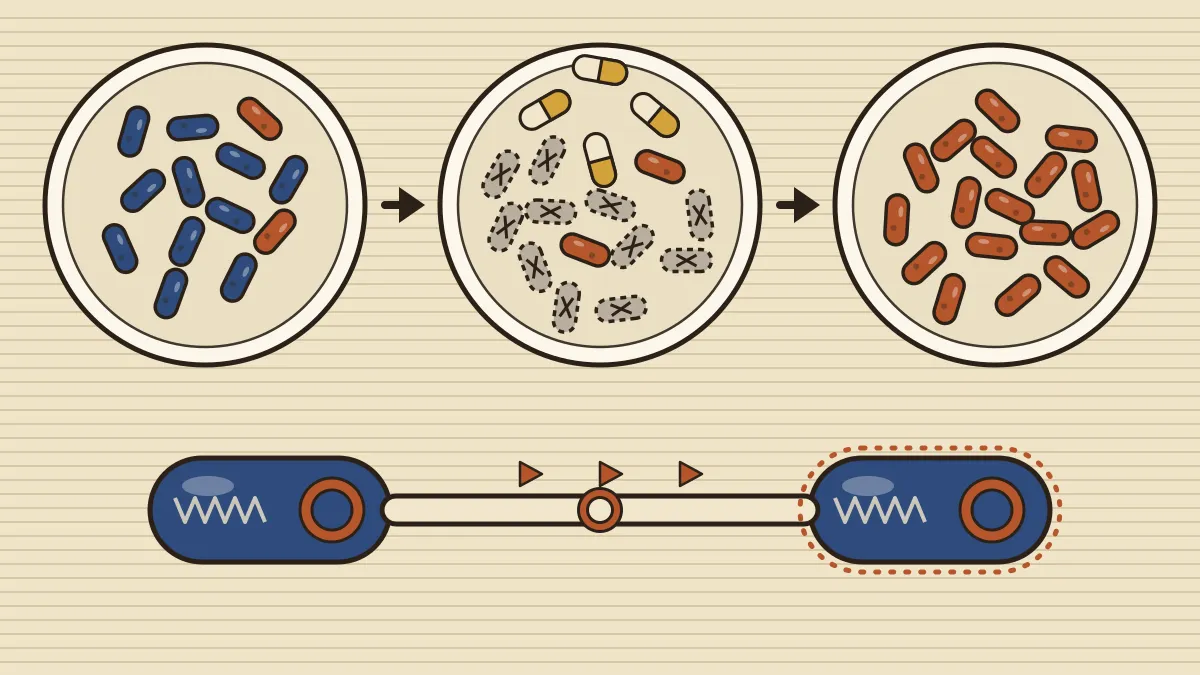
Mutation is only half the story. Bacteria can also borrow resistance from each other, even across species, which is why it spreads so fast.
| Route | How it works |
|---|---|
| Conjugation | Two bacteria touch through a hollow thread, the pilus, and a copy of a plasmid passes across. This is the usual route for resistance genes. The plasmid that allows it is the F (fertility) factor, which makes a cell the "male" donor |
| Transformation | A bacterium picks up loose DNA from its surroundings, left behind by dead cells |
| Transduction | A bacteriophage (a virus that infects bacteria) accidentally carries bacterial DNA from one cell into another |
A plasmid is a small circular ring of DNA that copies itself separately from the chromosome and often carries several resistance genes, so one transfer can make a bacterium resistant to many drugs at once. Genetic engineers use the same tool on purpose, as on our page on recombinant DNA technology.
Bacteria have a short list of ways to defeat a drug:
- Destroy it. The enzyme β-lactamase cuts the ring-shaped core of penicillin-type drugs.
- Change the target. MRSA makes an altered wall-building protein (PBP2a) that penicillin-type drugs cannot grip.
- Pump it out. Efflux pumps in the membrane throw the drug out of the cell faster than it arrives.
- Shut the door. Narrower channels (porins) let less drug in.
The Superbugs Worth Knowing
A superbug is a microbe resistant to several drugs. The word is informal, and the exam usually names the organism or the enzyme.
| Name | What it is | Why it matters |
|---|---|---|
| MRSA | Methicillin-resistant Staphylococcus aureus | A common hospital-acquired wound and bloodstream infection; resists penicillin-type drugs through the altered target protein |
| MDR-TB | Mycobacterium tuberculosis resistant to at least isoniazid and rifampicin, the two core first-line drugs | Needs a longer, costlier course. XDR-TB is MDR plus resistance to further key drugs. TB is a bacterial disease, caused by Mycobacterium |
| NDM-1 | An enzyme (New Delhi metallo-β-lactamase-1), described in 2009, found on a plasmid that can sit in many Gram-negative bacteria | Breaks down even carbapenems, which are reserve antibiotics. Named after the city where the first patient's infection was traced, a name that has been disputed in India |
| mcr-1 | A plasmid gene that makes bacteria resistant to colistin | Threatens the "last-resort" drug. India banned colistin for food-producing animals in July 2019 |
The burden is large. The Lancet study of 2022 estimated that in 2019 about 1.27 million deaths were directly caused by drug-resistant bacterial infections and about 4.95 million were associated with them. WHO ranks AMR among the top global public-health threats. A UN General Assembly political declaration of September 2024 set a global target of cutting deaths associated with bacterial AMR by 10% by 2030, measured against the 2019 figure.
Resistance is not limited to bacteria. Plasmodium resists chloroquine, which is why malaria is treated with drug combinations (see the malaria life cycle), and HIV is treated with combination therapy for the same reason.
One Health and India's Action Plan
Resistance is driven by use, and use happens in more than hospitals. The One Health approach, the theme of the 2026 awareness week, treats the health of people, animals, plants and food systems, and the environment as one linked system. Antibiotics given to farm animals, drug waste in rivers and misuse by people all feed one pool of resistance genes. Our June 2026 article on AMR and seafood trade shows how this reaches export markets.
That is where the bird-flu vaccine fits. Avian influenza (H5N1) is a viral disease of poultry, so antibiotics are useless against it. The ICAR-NIHSAD vaccine is meant to prevent the disease itself, and fewer outbreaks mean fewer sick flocks and less reason to reach for drugs on the farm; that last link is the logic of the One Health idea, not a figure from PIB. PIB notes that outbreaks can kill nearly all infected birds and that India has had more than 500 H5N1 and H5N8 outbreaks since 2006.
| Step | What India did |
|---|---|
| 2013 | Antibiotics placed in Schedule H1 of the Drugs Rules, so they cannot be sold without a prescription and the sale must be recorded |
| 2016 | The "red line" campaign: antibiotic strips carry a red vertical line meaning "do not take without a doctor's advice" |
| 2017 | National Action Plan on AMR (NAP-AMR) 2017-2021, the first, built on the One Health idea |
| 2019 | Colistin banned for food-producing animals, poultry and aquaculture |
| Nov 2025 | NAP-AMR 2.0 (2025-2029) launched by the Union Health Minister during AMR Awareness Week |
NAP-AMR 2.0 rests on surveillance, infection prevention, responsible use, research and joint action across sectors. The National Programme on AMR Containment is coordinated by the National Centre for Disease Control (NCDC), and ICMR runs a surveillance network of laboratories.
Use antibiotics only for bacterial infections, on prescription, at the right dose, for the full course. Stopping early leaves the toughest survivors; taking them for a cold selects resistance without any benefit. Wash hands, vaccinate (vaccines such as those for typhoid and pneumococcus prevent infections that would need antibiotics), keep water and food safe, and avoid unnecessary use in animals.
How UPSC Has Asked It: Past Papers Solved
These are actual CDS and NDA questions. The pattern is plain: what does the drug target, why does it not work on viruses, and how does resistance arise.
Antibiotic such as penicillin blocks
(a) cell wall formation in bacteria (b) RNA synthesis in bacteria (c) DNA synthesis in bacteria (d) division in bacteria
Answer: (a). Penicillin stops the building of peptidoglycan, so the wall weakens and the cell bursts. Option (b) is rifampicin's target and (c) the quinolones'.
The antibiotic penicillin can kill invading bacteria without harming human cells because it targets bacterial:
(a) Cell wall (b) Plasma membrane (c) Ribosome (d) Chromosome
Answer: (a). The same fact as 2020, phrased as selective toxicity: human cells have no wall to attack. Ribosomes are a target of other antibiotics, not penicillin.
Consider the following statements regarding cell wall composition: 1. Bacterial cell wall is made of peptidoglycan. 2. Fungal cell wall is made of cellulose. 3. Animals lack cell wall and have extracellular matrix made up of sugar and proteins.
(a) 2 only (b) 1 and 2 only (c) 1 and 3 only (d) 2 and 3 only
Answer: (c). Statement 2 is wrong: fungal walls are mainly chitin; cellulose is the plant wall.
Which one of the following statements regarding Penicillin is correct?
(a) Penicillin-resistant bacteria can store this antibiotic in vacuole (b) Penicillin-resistant bacteria can degrade this antibiotic by an enzyme called β-lactamase (c) Penicillin-resistant bacteria can degrade this antibiotic by an enzyme called lactic acid dehydrogenase (d) Penicillin is not absorbed by bacteria; so most bacteria are resistant
Answer: (b). β-lactamase splits the β-lactam ring that gives penicillin its action. Bacteria have no vacuoles, so (a) fails.
Which one of the following statements is correct about effects of antibiotics on viruses?
(a) Viruses are "non-living" entities but it can interact with antibiotics (b) Taking antibiotics cures viral infections (c) Viruses do not possess metabolic pathways on which antibiotics can function, whereas bacteria have such pathways (d) Viruses are resistant to all antibiotics
Answer: (c). Option (d) is wrong in kind: a virus is not "resistant", it simply offers no target.
An antibiotic is not useful against a virus whereas a vaccine is. Which one of the following is the most appropriate reason for this?
(a) An antibiotic can break RNA only, whereas virus has DNA. (b) An antibiotic is a carbohydrate in its chemical nature, whereas a vaccine is a protein which works well to kill a virus. (c) Only a vaccine can break the genetic material of a virus. (d) A virus does not use biochemical pathways which can be blocked by an antibiotic. But a vaccine can boost an immune system to fight the virus.
Answer: (d). A vaccine does not kill or cut anything: it trains the immune system.
Three families repeat. (1) Target: penicillin means cell wall; humans lack a cell wall, hence safe. (2) Virus: no metabolism of its own, so antibiotics fail and vaccines work. (3) Resistance: selection of chance variants, spread by plasmids, defeated by enzymes like β-lactamase. Watch the wall trap: bacteria peptidoglycan, fungi chitin, plants cellulose.
Practice MCQs (with answers)
- Resistance genes on a plasmid pass directly from one bacterium to another through a pilus. This process is called
- transformation
- transduction
- conjugation
- binary fission
- MRSA resists methicillin mainly because it
- has no cell wall at all
- makes an altered wall-building protein that the drug cannot bind
- stores the drug in a vacuole
- is a virus
- Rifampicin, a key drug in tuberculosis, acts by blocking
- cell wall synthesis
- the 70S ribosome
- folic acid production
- bacterial RNA polymerase
- Which statement best explains how a resistant population arises during treatment?
- The drug kills sensitive cells and leaves rare pre-existing resistant cells to multiply
- The patient's body becomes resistant to the drug
- The drug changes every bacterium's genes on purpose
- Resistant bacteria are produced by the pharmacy
- World AMR Awareness Week is observed every year during
- 18 to 24 November
- 1 to 7 August
- 7 to 14 April
- 1 to 7 December
- Which habit most directly encourages antibiotic resistance?
- Completing the doctor's full course
- Washing hands with soap
- Taking vaccines on schedule
- Taking leftover antibiotics for a common cold
- Multidrug-resistant tuberculosis (MDR-TB) is resistant to at least
- streptomycin and ethambutol
- isoniazid and rifampicin
- pyrazinamide only
- every known drug
- A broad-spectrum antibiotic is one that
- kills only a single species
- can be made only in a laboratory
- acts on a wide range of bacteria
- works on both bacteria and viruses
1-c, 2-b, 3-d, 4-a, 5-a, 6-d, 7-b, 8-c. Q1: transformation takes up free DNA; transduction uses a bacteriophage. Q2: MRSA still has a cell wall; it changes the target protein. Q3: the ribosome is hit by tetracycline, folate by sulpha drugs. Q4: option (b) is the common misconception; the population changes, not the patient. Q6: a cold is viral, so the antibiotic gives no benefit and still selects resistant gut bacteria. Q7: XDR-TB adds more drugs to this list.
Quick Revision
- Fleming 1928 (published 1929), Penicillium notatum; Florey and Chain made it usable; Nobel 1945 to all three. Waksman: streptomycin (TB).
- Antibiotic acts on bacteria; antimicrobial = antibiotics + antivirals + antifungals + antiparasitics. Viruses have no metabolism of their own, so antibiotics fail; vaccines prime immunity.
- Targets: cell wall (penicillin, cephalosporins, vancomycin); 70S ribosome (tetracycline, streptomycin, erythromycin, chloramphenicol); DNA gyrase (ciprofloxacin); RNA polymerase (rifampicin); folate (sulpha drugs); membrane (colistin).
- Resistance = selection of chance mutants, not the body "getting used to" a drug. Spread by plasmids: conjugation (pilus), transformation (free DNA), transduction (phage).
- Superbugs: MRSA, MDR-TB (isoniazid + rifampicin), NDM-1 (2009), mcr-1 (colistin). Lancet 2019: 1.27 million direct deaths, 4.95 million associated. UN 2024 target: 10% cut in global bacterial-AMR deaths by 2030 (2019 baseline).
- India: Schedule H1 (2013), red line (2016), NAP-AMR 2017-21, colistin ban (2019), NAP-AMR 2.0 (2025-29), NCDC coordinates. Week: 18-24 Nov; 2026 theme "One Health, One Action: Prevent AMR Now". More than half of antimicrobial sales are without a prescription (PIB).
Frequently asked questions
Why do antibiotics not work on viral infections like colds and flu?
Antibiotics attack features that only bacteria have, such as the cell wall, the 70S ribosome and the folate pathway. A virus has none of these and uses the host cell's machinery to multiply, so an antibiotic has nothing to block. Colds, influenza, dengue and COVID-19 are viral and are prevented by vaccines or treated with specific antivirals.
What is antimicrobial resistance (AMR)?
AMR is the ability of microbes such as bacteria, viruses, fungi and parasites to survive a drug that once killed or stopped them. It is caused mainly by the misuse and overuse of antimicrobials in humans, animals and agriculture. It makes common infections harder to treat and surgeries and cancer care riskier.
How do bacteria become resistant to antibiotics?
A few bacteria in any population carry chance mutations that help them survive a drug. When the drug kills the sensitive cells, these survivors multiply and take over. Bacteria can also pass resistance genes on plasmids to other bacteria, even of another species, through conjugation, transformation or transduction.
What does One Health mean in AMR control?
One Health treats the health of people, animals, plants and food systems, and the environment as connected. Antibiotics used on farms, drug residues in water and misuse by patients all add to the same pool of resistance genes. So control needs all these sectors to act together, the idea behind India's NAP-AMR 2.0 (2025-2029).
Why should an antibiotic course be completed?
The full course at the prescribed dose clears the infection and leaves fewer survivors that could carry resistance. Stopping early can leave the toughest bacteria alive. Antibiotics should also be taken only on a doctor's prescription for a bacterial infection, never for viral illness.
Related CDS / OTA Science topics
Biology questions reward clear mechanisms, not memorised lists
Cavalier's CDS/OTA and NDA batches teach biology from first principles, with diagrams, mechanism drills and weekly PYQ tests.