India has a new set of home-built AI models. On 26 November 2026, Shri S. Krishnan, Secretary of the Ministry of Electronics and Information Technology (MeitY), inaugurated the launch of the Chariot-1 Foundation Models at Bharat Mandapam, New Delhi. The models were developed by Chariot Artificial Intelligence Pvt. Ltd. under the IndiaAI Mission.
The suite has two parts: Chariot-1 LLM, a large language model, and Chariot-1 TTS, a text-to-speech model. Both were pre-trained from scratch in India. That phrase matters. It means the models were not built by taking a foreign model and adjusting it. They were trained from the first step on the developer's own design and data.
Behind the launch are three research ideas, and they are more instructive for a student than the product itself. This article explains each idea in plain terms, then places Chariot-1 inside the IndiaAI Mission, whose numbers appear in competitive exams again and again. A note on the figures: the performance numbers below are reported by the developer in the PIB release and have not been independently verified, so read them as claims, not as established results.
First, a few words you must know
Foundation model. A very large AI model trained on a vast amount of data, which can then be adapted to many tasks: answering questions, translating, summarising, speaking. The word "foundation" is used because applications are built on top of it.
Large language model (LLM). A foundation model that works with text. It learns the patterns of a language from huge amounts of writing and predicts what comes next.
Parameters. The adjustable numbers inside the model, learned during training. A model with more parameters can usually capture more, but it also costs more to train and to run. "11 billion parameters" means eleven thousand million such numbers.
Token. The small unit of text a model reads and writes. A token may be a whole short word, a part of a longer word, or even a single letter. A tokeniser is the component that chops text into tokens. The cost of running a model rises with the number of tokens, so a model that needs fewer tokens for the same sentence is cheaper and faster for that sentence.
Text-to-speech (TTS). A model that turns written text into spoken audio.
Sovereign AI. AI built within a country, on its own data and infrastructure, so that it does not depend wholly on foreign systems. The government's framing of the IndiaAI Mission is built around this idea, and the PIB release says the aim is to reduce dependence on externally developed technologies.
The Chariot-1 suite in numbers
The figures here are from the 26 November 2026 release.
| Item | Detail |
|---|---|
| Chariot-1 LLM | Mixture-of-experts model; about 11 billion parameters in all, 4 billion active per token |
| Sizes | Three: 10.7 billion, 1.7 billion, 745 million parameters |
| Chariot-1 TTS | Speech in English and 10 Indian languages: Hindi, Bengali, Marathi, Tamil, Telugu, Kannada, Malayalam, Gujarati, Punjabi and Odia |
| TTS accuracy (reported) | Over 97% verbalisation accuracy on the Async TTS Pronunciation Benchmark (1,029 real-world sentences, 2,251 instances of non-standard text, 42 categories) |
| TTS error rates (reported) | Hindi character error rate 7.60%; average 6.47% across nine other Indian languages, the lowest among the systems evaluated in the reported tests |
The release rounds the largest model to 11 billion parameters and lists its size as 10.7 billion. Treat them as the same model, rounded in the first case.
Idea one: a shared alphabet for Indian scripts (IndicShift)
India writes its languages in many scripts. A model that treats each script as a separate world wastes effort, because most Indian scripts, from Devanagari and Bengali to Kannada and Telugu, trace back to a common ancestor, Brahmi, and their letters largely line up with the same sounds.
IndicShift, an open-source innovation, introduces a shared alphabet for Indian scripts. According to the release:
- It covers 1,012 characters across 12 Indian scripts, through 350 letters.
- It lets the model use similarities across languages instead of learning each script independently.
- It needs up to 2.5 times fewer tokens on Indian text than OpenAI's GPT tokeniser.
- It reports a 5% to 8% improvement on Indian-language performance for the same compute, with no loss in English and code.
Why does the token count matter so much? Most widely used tokenisers were designed around English. Text in an Indian script often gets broken into many tiny pieces, so a Hindi sentence can often cost more tokens than the same sentence in English. That makes it slower, more expensive and able to fit less in the model's working memory. A tokeniser built for Indian scripts removes that penalty. This is the core of the "Indian languages" argument for sovereign models, and it is a fair exam point.
Idea two: three models from one training run (Nested Training)
Companies usually need several sizes of the same model: a big one for data centres, a small one for a laptop or a phone. Normally each size is trained separately, which multiplies the cost.
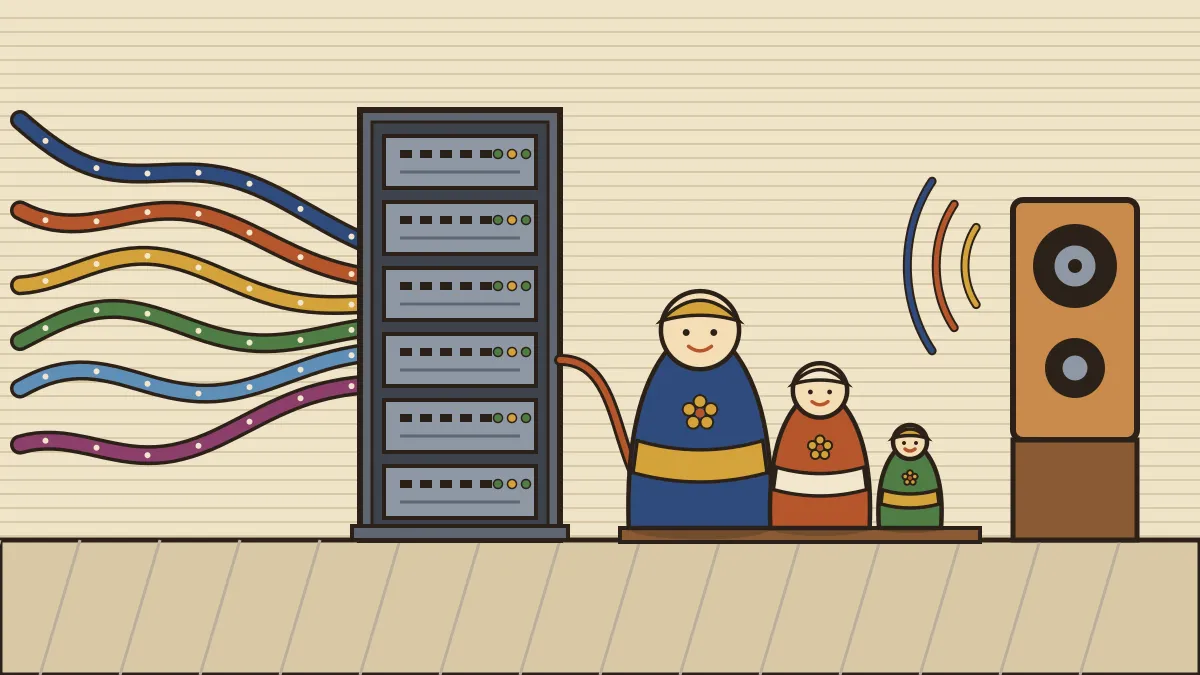
Nested Training trains three complete model sizes at the same time, in a single run, with one set of weights. The smaller models live inside the larger one, which is the picture of nested dolls. The release says this allows deployment across data centres, laptops, smartphones and edge devices, and reports a 62% improvement in training speed compared with training the three sizes separately.
"Edge" here means running the AI on the device itself, close to the user, instead of in a distant data centre. It matters for privacy, for cost and for places with poor internet.
Idea three: scoring only the relevant part of the vocabulary (Mixture of Vocabularies)
When a language model writes a word, it must in effect score every word-piece in its vocabulary and pick one. With a large vocabulary that is a heavy calculation, repeated for every token.
Mixture of Vocabularies divides the vocabulary into 11 groups and scores only the relevant group at a time. The release reports:
- 5.7 times fewer vocabulary entries scored per word.
- A 38% improvement in training speed on the same GPUs.
- Negligible change in model loss, which is the measure of how wrong the model's predictions are during training.
Note the similar spirit across all three ideas. They are about doing the same job with less computing power. For a country that has to ration its GPUs, efficiency is not a side issue.
Mixture-of-experts: what "4 billion active" means
The Chariot-1 LLM is a mixture-of-experts (MoE) model. Instead of one giant network in which every parameter works on every word, an MoE model contains many smaller specialist sub-networks, called experts, and a router that sends each token to a few of them.
Here the model has about 11 billion parameters in total but uses only about 4 billion for any one token. Think of a hospital with many specialists: each patient sees only the two or three relevant doctors, though the whole staff is on the payroll. The result is a model that has the knowledge capacity of a big network but the running cost of a much smaller one.
The speech model: why "verbalisation" is hard
Chariot-1 TTS is designed to understand context and decide how numbers, dates, currencies, units, URLs and abbreviations should be spoken. The text "₹2,500 on 12/11" can be read in several ways, and the right reading depends on the language and the context. Reading it out correctly is called verbalisation or text normalisation, and it is the step where many speech systems sound robotic or make embarrassing mistakes.
The reported verbalisation accuracy above 97% was measured on the Async TTS Pronunciation Benchmark, which has 1,029 real-world sentences with 2,251 non-standard items in 42 categories. The reported character error rate is a measure where lower is better: 7.60% for Hindi and 6.47% on average across nine other Indian languages. The release says these were the lowest among the systems evaluated in the reported tests. Because the comparison systems are not named in the release, a careful reader keeps this as a developer claim.
Where Chariot-1 sits in the IndiaAI Mission
The IndiaAI Mission was approved by the Government on 7 March 2024 with an outlay of about ₹10,372 crore (₹10,371.92 crore over five years). It is built on seven pillars: compute capacity, the innovation centre for foundation models, the datasets platform (AIKosh), application development, FutureSkills, startup financing, and safe and trusted AI. IndiaAI, an Independent Business Division under the Digital India Corporation of MeitY, runs the Mission.
Compute. In March 2026 the government told Parliament that 38,231 GPUs had been onboarded from 14 empanelled service providers, offered to Indian startups and academia at subsidised rates, at an average of about ₹65 per GPU-hour (except for some high-end GPUs). The figure was 34,333 in May 2025, and PIB's Digital India release of June 2026 put the shared compute facility at over 45,000 GPUs.
Foundation models. On 25 March 2026 the government told the Lok Sabha that twelve organisations and consortia were supported to build indigenous models, including Sarvam AI, Soket AI, Gnani AI, Gan AI, Avataar AI, the IIT Bombay consortium (BharatGen), GenLoop, Zenteiq, Intellihealth, Shodh AI, Fractal Analytics and Tech Mahindra's Maker's Lab. Financial assistance is given in a calibrated manner to cover compute usage costs, along with support for ancillary research expenses. By August 2026 PIB reported that, after a Call for Proposals issued on 30 January 2025 drew 506 applications, 20 indigenous model proposals (12 large multimodal models and 8 small language models) had been identified for support. The count keeps growing, so always quote the date with the number.
Models already launched. Sovereign models of Sarvam AI, BharatGen and Gnani were launched at the IndiaAI Impact Summit 2026. The Sarvam and BharatGen models are available on AIKosh, the Mission's platform for datasets and models. The first selection came on 26 April 2025, when Sarvam AI was picked to build a sovereign LLM ecosystem. Soket AI, Gnani AI and Gan AI followed in the first phase.
Safe and trusted AI. The Mission's thirteen responsible-AI projects cover bias mitigation, machine unlearning and privacy-preserving tools, and the India AI Governance Guidelines are anchored in seven principles ("sutras") including trust, fairness, accountability and safety. The Digital Personal Data Protection Act, 2023 sits alongside them as the privacy law.
The Mission's earlier steps are covered in our explainers on Digital India at 11 and on AI translation for tribal languages (Adi Vaani). The hardware side, from transistor to GPU, is in the note on semiconductors, diodes and transistors.
What to watch
- Independent testing. The headline numbers are the developer's. The test of a foundation model is how it performs when others evaluate it on the same benchmarks.
- Availability. IndicShift is open source. Whether the Chariot-1 weights will be shared through AIKosh has not yet been announced.
- Use cases. Speech in ten Indian languages could serve call centres, education, accessibility tools and public-service helplines, where India's language diversity is the main challenge.
- Compute and talent. Every model in the Mission depends on subsidised GPUs. The pace of the programme depends on keeping that supply growing.
🔑 Revision block
The launch. 26 November 2026, Bharat Mandapam, New Delhi; inaugurated by S. Krishnan, Secretary, MeitY; developer Chariot Artificial Intelligence Pvt. Ltd., under the IndiaAI Mission.
The suite. Chariot-1 LLM (mixture-of-experts, ~11 B total, 4 B active; sizes 10.7 B / 1.7 B / 745 M) and Chariot-1 TTS (English + 10 Indian languages). Both pre-trained from scratch in India.
Three ideas. IndicShift (open source; 1,012 characters, 12 scripts, 350 letters; up to 2.5× fewer tokens). Nested Training (three sizes, one run, 62% faster). Mixture of Vocabularies (11 groups, 5.7× fewer entries scored, 38% faster).
Reported TTS results. 97%+ verbalisation accuracy; Hindi CER 7.60%; average 6.47% for nine other languages. Developer-reported.
IndiaAI Mission. Approved 7 March 2024; ₹10,372 crore; 7 pillars; implementation agency IndiaAI (under MeitY); 38,231 GPUs, 14 providers, about ₹65 per GPU-hour (March 2026; over 45,000 by June 2026); 12 organisations backed for foundation models (March 2026), 20 proposals identified by August 2026; AIKosh for datasets and models.
🎯 Practice MCQs
Q1. The IndiaAI Mission was approved by the Government of India on:
(a) 7 March 2023
(b) 7 September 2023
(c) 7 March 2024
(d) 7 September 2024
→ (c)
The Mission was approved on 7 March 2024 with an outlay of about ₹10,372 crore and seven pillars.
Q2. Which body is the implementation agency of the IndiaAI Mission?
(a) IndiaAI, an Independent Business Division under the Digital India Corporation of MeitY
(b) The Atal Innovation Mission of NITI Aayog
(c) The Centre for Development of Advanced Computing
(d) The National Remote Sensing Centre
→ (a)
IndiaAI works under the Ministry of Electronics and Information Technology and implements the Mission across its pillars.
Q3. Which of the following is NOT one of the seven pillars of the IndiaAI Mission?
(a) Compute capacity
(b) Datasets
(c) Startup financing
(d) Spectrum auctions for 6G
→ (d)
The pillars are compute capacity, the innovation centre for foundation models, the datasets platform (AIKosh), application development, FutureSkills, startup financing, and safe and trusted AI.
Q4. In a mixture-of-experts language model, the phrase "active parameters" refers to:
(a) The parameters that have been released as open source
(b) The subset of parameters used to process each token
(c) The parameters trained only on Indian languages
(d) The parameters stored on the user's device
→ (b)
A router sends each token to a few experts, so only part of the network works at a time. Chariot-1 LLM has about 11 billion parameters in all and about 4 billion active per token.
Q5. In the context of language models, a tokeniser is a component that:
(a) Splits text into the units that the model reads and writes
(b) Converts spoken audio into written text
(c) Encrypts the data used for training
(d) Allocates GPU time among users
→ (a)
A tokeniser that suits a script well needs fewer tokens for the same sentence, which makes the model cheaper and faster for that language. IndicShift is aimed at exactly this.
Q6. Chariot-1 TTS is designed to produce speech in English and ten Indian languages. Which of the following is NOT among them?
(a) Odia
(b) Punjabi
(c) Gujarati
(d) Assamese
→ (d)
The ten are Hindi, Bengali, Marathi, Tamil, Telugu, Kannada, Malayalam, Gujarati, Punjabi and Odia.
Q7. Consider the following statements about the research innovations presented at the Chariot-1 launch:
1. IndicShift is an open-source approach that uses a shared alphabet across several Indian scripts.
2. Nested Training trains three model sizes together in one run with one set of weights.
Which of the statements given above is/are correct?
(a) 1 only
(b) 2 only
(c) Both 1 and 2
(d) Neither 1 nor 2
→ (c)
Both descriptions match the PIB release. The efficiency figures attached to them are reported by the developer.
Q8. As of March 2026, about how many GPUs had been onboarded under the IndiaAI compute capacity framework from 14 empanelled providers?
(a) 10,000
(b) 38,231
(c) 58,000
(d) 100,000
→ (b)
The figure given to Parliament in March 2026 was 38,231, offered to startups and academia at subsidised rates averaging about ₹65 per GPU-hour. It had been 34,333 in May 2025 and was reported as over 45,000 by June 2026.
📋 How this gets asked (PYQ pattern)
Technology questions in CDS usually reward clear concepts more than company names, and this topic can be asked in three ways.
The first is definitions: what a parameter, a token, a foundation model or text-to-speech is. The examiner builds options that are each close to the truth, as in Q4 and Q5, so a precise understanding beats a vague one.
The second is government schemes in technology: the Mission's launch date, its outlay, the number of pillars, the implementing body and the GPU count. These facts are easy to test and easy to learn, as in Q1, Q2 and Q8.
The third is applications and policy: how AI helps language access, why "sovereign" matters, and the safeguards (governance guidelines, the Digital Personal Data Protection Act, 2023). The fresh hooks this cycle are Chariot-1, the 38,231 GPUs, and the models launched at the IndiaAI Impact Summit 2026.
Preparing for CDS? Keep a one-page "IndiaAI Mission card": date, outlay, seven pillars, implementing agency and GPU count. Revise the hardware basics in our note on semiconductors and transistors. Follow the daily CDS current affairs, and learn with experienced faculty in the upcoming Cavalier courses in Delhi.
Source: PIB / Ministry of Electronics & IT, "India AI Mission-supported Chariot-1 Foundation Models Launched, Strengthening India's Indigenous AI Capabilities", 26 November 2026; MeitY releases of 25 March 2026 (Lok Sabha reply on foundation models, GPUs and Impact Summit launches), 1 April 2026 (Mission approval date and pillars), 3 November 2026 (IndiaAI pillars, EKA-1 and Dhīr), 6 August 2026 (20 proposals, 506 applications), 27 June 2026 (Digital India at 11) and 2025 releases on Sarvam AI's selection and the GPU count. Performance figures are as reported by the developer in the PIB release. Explanations of tokens, parameters and mixture-of-experts are The Cavalier's own.
✍️ Written by Col D.N. Sharma — Science & general-studies faculty at The Cavalier. Reviewed by the Cavalier Faculty Desk.