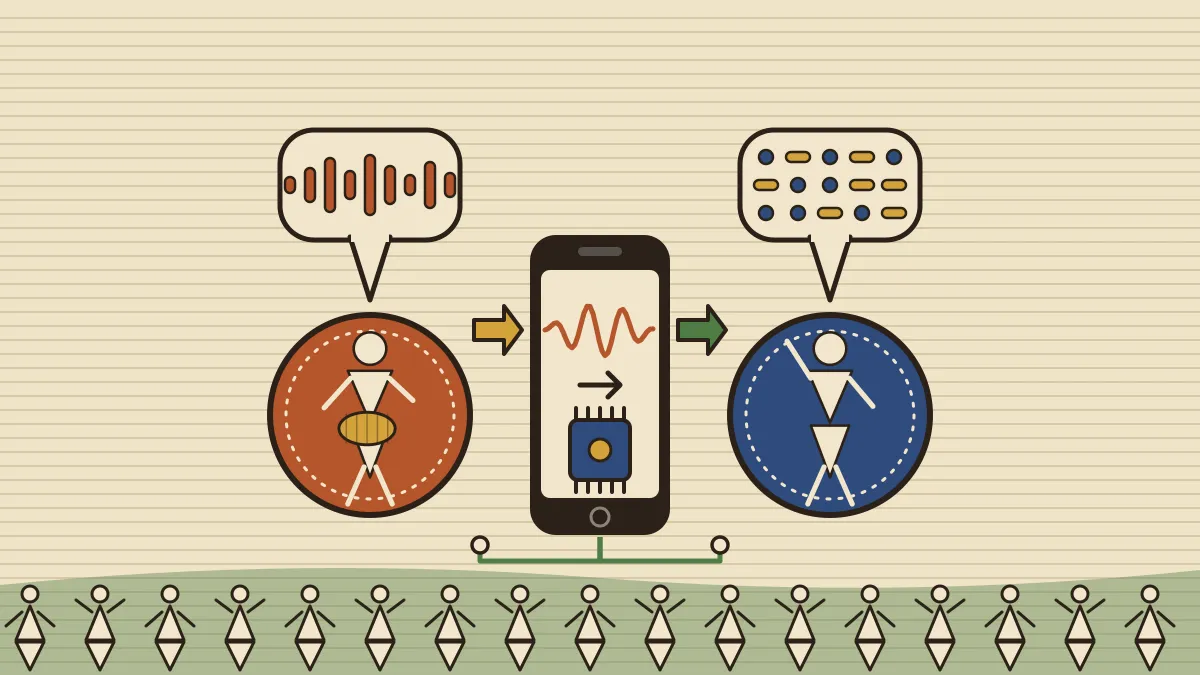
Most of the world's translation software works because it has read an enormous amount of text. A language with millions of written pages is easy for a computer to learn. A language that has been passed down by voice, in songs and stories, with few books and almost nothing on the internet, is a different problem. Computer scientists call these low-resource languages, and many of India's tribal languages are among them.
On 15 November 2026, the day India marks Janjatiya Gaurav Diwas, PIB published a Backgrounder on Adi Vaani, the Ministry of Tribal Affairs' AI-powered platform for translating and documenting tribal languages. As of 15 October 2026 it supports text translation in nine tribal languages, and State Tribal Research Institutes have contributed about 13.9 lakh sentences and around 300 hours of speech to train its models.
This article explains what is distinctive about the platform, how a system like this is trained, and what the numbers do and do not tell us. (The policy side, the Eighth Schedule and the constitutional safeguards for languages, is covered in our explainer on the Mysuru conclave on tribal languages, so we concentrate here on the technology.)
What Adi Vaani is
Adi Vaani is described as an AI-powered translation and language platform "built with tribal communities, for tribal communities". The key facts:
- It was launched by the Ministry of Tribal Affairs on 1 September 2025.
- It was developed by a national consortium led by IIT Delhi, along with BITS Pilani, IIIT Hyderabad, IIIT Nava Raipur and the Tribal Research Institutes (TRIs) of Jharkhand, Odisha, Madhya Pradesh, Chhattisgarh and Meghalaya. Other State TRIs joined later.
- It began with four languages, Santali, Bhili, Mundari and Gondi, and by 15 October 2026 offered text translation in nine.
- It recorded over 35,000 Android downloads and about 6,500 monthly users.
Its stated vision is a digitally inclusive India where no citizen is left behind because of a language barrier. Its features go beyond a simple translator:
| Feature | What it does |
|---|---|
| Text-to-text translation | Translates between supported tribal languages and languages such as Hindi and English |
| Speech-to-text | Converts spoken words to text, helping document oral languages |
| Speech-to-speech translation | Links speech recognition, translation and speech synthesis |
| Optical Character Recognition (OCR) | Extracts text from images and scanned documents for translation |
| Video subtitling | Translates video content and public information into tribal languages |
| Dictionaries and primers | More than 300 language primers and 24 dictionaries |
Why tribal languages are hard for AI
To see why a ministry needs a consortium of IITs and research institutes, it helps to know how a modern translation system learns.
Machine translation is trained on a parallel corpus: large numbers of sentences in one language, each paired with its translation in another. The system finds patterns across millions of such pairs. If the pairs do not exist, it cannot learn.
Speech recognition needs recorded audio matched with a written transcript, ideally from many different speakers. Speech synthesis, the reverse step, needs clean recordings of a voice. OCR needs examples of a script in print and handwriting.
For a major language, these resources already exist online. For a low-resource language they do not, and several practical difficulties follow.
- Oral traditions. The Backgrounder notes that many tribal languages have been passed on largely through oral traditions, with limited written records and very little digital text or speech data.
- Scripts. Some languages have their own script, others borrow one. The Backgrounder's table shows Santali written in Ol Chiki, Garo, Kokborok, Thadou Kuki and Tangkhul in the Latin script, and others in Devanagari, Odia, Kannada, Telugu or Gujarati. A system has to handle all of them.
- Dialects and spread. Some languages are spoken in several States beyond the one named on the portal, so a single "standard" form does not exist.
The consequence is that data, not computing power, is the bottleneck. Collecting trustworthy data has to be done with the speakers themselves.
How the data is gathered
The Backgrounder describes a community-based approach, and it is the part of the design that deserves attention.
- Contribution. Native speakers contribute words, sentences and voice recordings through the Tribal Research Institutes and AdiKosh.
- Verification. Language experts check the material, and speech recorded through AdiKosh is validated by the TRIs before it is used.
- Training. Verified data trains the AI models. Each language passes through five phases, from data collection to integration on the platform.
- Retraining. As the community contributes more data, the models are retrained and accuracy improves.
Tribal Research Institutes are State-level bodies established under the Ministry of Tribal Affairs. They act as knowledge centres and think tanks, preserving cultural heritage and giving research inputs for planning. The Ministry provides financial assistance to 29 TRIs.
AdiKosh is the platform's word bank: dictionary entries and spoken sentences recorded by verified speakers and reviewed by the language team.
The target is about 1,00,000 sentence pairs and 100 hours of speech recordings per language.
Reading the corpus table
The Backgrounder lists 13 tribal languages the platform works with, with the State named on the portal and the corpus size reported by the State TRIs.
| Language | State on portal | Corpus size | Script |
|---|---|---|---|
| Mundari | Jharkhand | 3,39,394 | Devanagari |
| Bhili | Madhya Pradesh | 2,53,634 | Devanagari |
| Santali | Odisha | 2,19,063 | Ol Chiki |
| Gondi | Chhattisgarh | 1,49,133 | Devanagari |
| Garo (A'chik) | Meghalaya | 1,33,747 | Latin |
| Kui | Odisha | 95,478 | Odia |
| Kokborok | Tripura | 63,556 | Latin |
| Katkari | Maharashtra | 59,160 | Devanagari |
| Koya | Andhra Pradesh | 45,940 | Telugu |
| Betta Kuruba | Karnataka | 33,635 | Kannada |
| Thadou Kuki, Tangkhul (Manipur), Chodri (Gujarat) | not reported | Latin, Latin, Gujarati |
Several useful conclusions come from adding the table up. These are calculated by us from the published figures.
- The ten languages with a reported corpus add up to about 13.9 lakh, which matches the Backgrounder's figure of 13.9 lakh text sentences across ten languages.
- The aggregate is above the target of one lakh per language for ten languages, but the spread is uneven. Five languages (Mundari, Bhili, Santali, Gondi, Garo) are above one lakh, and five are below it.
- The thinnest is Betta Kuruba at about 33,600, only a tenth of Mundari's.
- Speech lags text. About 300 hours against a target of 100 hours per language is roughly 30% of a ten-language target of 1,000 hours, if the same ten-language scope applies.
A caution is needed. The Backgrounder describes the target as sentence pairs and the table as corpus size. The two may not be the same unit, so the comparison shows direction, not a precise completion percentage.
Also note how the counts differ across the document, because the examiner can use each: 13 languages the platform works with, 10 with data, 9 with text translation. The nine are the four from the start plus five added at the upgrade announced in Mysuru on 24 August 2026, which also brought an iOS application.
What the platform is meant to change
The Backgrounder links Adi Vaani to five practical areas.
Mother-tongue education. The National Education Policy 2020 recommends the home language or mother tongue as the medium of instruction wherever possible, at least until Grade 5 and preferably until Grade 8 and beyond. Adi Vaani provides the 300-plus primers and 24 dictionaries prepared by TRIs. The National Education Society for Tribal Students has pointed to their possible use across more than 525 Eklavya Model Residential Schools, serving over 1.7 lakh students.
Healthcare communication. Translated awareness material on Sickle Cell Disease is on the platform. The National Sickle Cell Anaemia Elimination Mission, launched on 1 July 2023, aims to eliminate the disease as a public health problem by 2047, and had conducted more than 7.24 crore screenings in tribal-dominated areas by 16 July 2026.
Economic access. As of 13 August 2026, 4,712 Van Dhan Vikas Kendras had been sanctioned in 28 States and UTs, covering 12.94 lakh beneficiaries. About 6,000 tribal products were on the Tribes India e-commerce platform and 1,339 had been onboarded onto the Open Network for Digital Commerce (ONDC) as of 18 March 2026. Translation helps producers read market information and scheme terms.
Public services. The Ministry launched Jago, its official AI conversational assistant, on 24 August 2026, to make information on tribal welfare schemes easier to find. On the same Janjatiya Gaurav Diwas, the Ministry also launched two national digital initiatives, the Jan-HIT Portal and the National FRA Digital Platform. Our note on the Forest Rights Act explains why the second of these matters, and our explainer on PM-JANMAN covers the welfare programme for the most vulnerable groups.
Cultural preservation. The platform brings together folk songs, stories and oral traditions recorded by speakers, elders and linguists, reviewed by experts for accuracy.
From a translator to a repository
The Ministry now wants Adi Vaani to be more than a translator. On 15 October 2026 it convened the first meeting of the Working Group on Tribal Languages, chaired by Smt. Ranjana Chopra, Secretary, Ministry of Tribal Affairs. Members include the Central Institute of Indian Languages (CIIL), IITs, universities, language organisations and experts on endangered languages.
The meeting discussed positioning Adi Vaani as the National Tribal Language Repository, a single home for corpora, primers, dictionaries and community stories. The proposals before the group include:
- a national baseline of tribal languages and available resources;
- digital archives and multilingual educational material;
- district-level community resource groups involving trained tribal youth;
- stronger cooperation among TRIs, academic institutions and language experts;
- a two-year action plan with quarterly reviews.
This builds on the National Conclave on Tribal Languages and Museums at Mysuru on 24 August 2026, where the Ministry signed an MoU with CIIL on language documentation and corpus development, and where Karnataka released Class 1 primers in Jenukuruba.
A student's checklist of limits
Honest reading of the Backgrounder suggests a few things to keep in mind.
- Scale of use. About 35,000 downloads and 6,500 monthly users are small against a Scheduled Tribe population of about 10.45 crore (Census 2011), so the platform is at an early stage of adoption.
- Unequal coverage. Three listed languages report no corpus at all, and five of ten reported corpora are below the one-lakh target.
- Quality is not measured in the release. The document describes accuracy as improving with data but gives no accuracy score, so the claim cannot be tested from PIB alone.
- Speech is harder than text. The gap between 300 hours and the target shows why speech features arrive later.
These points do not diminish the project. They tell an examiner where a "Discuss" question would expect balance.
🔑 Revision block
The release. PIB Backgrounder "Adi Vaani: Bringing India's Tribal Languages into the Digital Age", 15 November 2026; Ministry of Tribal Affairs.
Platform. AI translation platform launched 1 September 2025; consortium led by IIT Delhi with BITS Pilani, IIIT Hyderabad, IIIT Nava Raipur and TRIs of Jharkhand, Odisha, MP, Chhattisgarh and Meghalaya. Started with Santali, Bhili, Mundari, Gondi.
Numbers (15 October 2026). Text translation in 9 languages; works with 13; 13.9 lakh sentences across 10 languages; about 300 hours of speech; 35,000+ Android downloads; about 6,500 monthly users; 300+ primers; 24 dictionaries. Target: 1 lakh sentence pairs and 100 hours per language. 29 TRIs funded.
Features. Text, speech-to-text, speech-to-speech, OCR, video subtitling, dictionaries; AdiKosh = word bank, validated by TRIs.
Next. Working Group on Tribal Languages met 15 October 2026 (chair: Secretary Ranjana Chopra): National Tribal Language Repository; two-year plan with quarterly reviews. Upgrade at Mysuru 24 August 2026: iOS app, 5 new languages, MoU with CIIL. Jago AI assistant launched 24 August 2026.
Linked facts. NEP 2020: mother tongue at least to Grade 5, preferably Grade 8. 525+ EMRS, 1.7 lakh students. Sickle Cell Mission: 1 July 2023, goal 2047, 7.24 crore screenings.
🎯 Practice MCQs
Q1. Adi Vaani, the AI-powered platform for tribal languages, was launched by the Ministry of Tribal Affairs on:
(a) 1 September 2025
(b) 15 October 2025
(c) 24 August 2026
(d) 15 November 2026
→ (a)
The platform launched on 1 September 2025. 24 August 2026 was the date of the Mysuru upgrade, and 15 October 2026 was the first meeting of the Working Group.
Q2. The national consortium that developed Adi Vaani is led by:
(a) ISRO
(b) IISc Bengaluru
(c) IIT Delhi
(d) The Central Institute of Indian Languages
→ (c)
IIT Delhi leads, with BITS Pilani, IIIT Hyderabad, IIIT Nava Raipur and several Tribal Research Institutes. CIIL has since signed an MoU with the Ministry for corpus development.
Q3. Adi Vaani began with which four languages?
(a) Santali, Garo, Kui and Koya
(b) Bhili, Kokborok, Koya and Mundari
(c) Gondi, Garo, Santali and Katkari
(d) Santali, Bhili, Mundari and Gondi
→ (d)
The platform started with Santali, Bhili, Mundari and Gondi, and had grown to nine languages for text translation by 15 October 2026.
Q4. In the Adi Vaani system, "AdiKosh" is:
(a) A payment app for tribal products
(b) The platform's word bank of dictionary entries and spoken sentences recorded by verified speakers
(c) A national museum of tribal freedom fighters
(d) The Ministry's AI conversational assistant
→ (b)
AdiKosh is the word bank. Speech recorded through it is validated by the Tribal Research Institutes before use. The AI assistant is called Jago.
Q5. Consider the following statements about Adi Vaani:
1. It offers Optical Character Recognition and video subtitling.
2. As on 15 October 2026 it offered text translation in all 13 languages it works with.
Which of the statements given above is/are correct?
(a) 1 only
(b) 2 only
(c) Both 1 and 2
(d) Neither 1 nor 2
→ (a)
OCR and subtitling are listed features. Text translation was available in nine languages, not all 13.
Q6. The Working Group on Tribal Languages, which first met on 15 October 2026, discussed positioning Adi Vaani as the:
(a) Eighth Schedule Language Commission
(b) National Translation Mission
(c) National Tribal Language Repository
(d) Official Language Board of India
→ (c)
The proposal is to bring corpora, primers, dictionaries and community stories into a single national repository.
Q7. The National Education Policy 2020 recommends the home language or mother tongue as the medium of instruction wherever possible, at least until:
(a) Grade 3
(b) Grade 5
(c) Grade 8
(d) Grade 10
→ (b)
The policy says at least until Grade 5 and preferably until Grade 8 and beyond.
Q8. "Jago", launched by the Ministry of Tribal Affairs on 24 August 2026, is:
(a) A tribal e-commerce platform
(b) A sickle cell screening application
(c) A digital archive of tribal museums
(d) The Ministry's official AI conversational assistant
→ (d)
Jago helps users find information on tribal welfare schemes and programmes. The e-commerce platform is Tribes India.
📋 How this gets asked (PYQ pattern)
Science and technology in CDS general knowledge increasingly asks about applications of AI to governance, not the technology in the abstract.
The first pattern is matching a platform to its purpose and ministry: Adi Vaani with tribal languages and the Ministry of Tribal Affairs, AdiKosh with the word bank, Jago with the AI assistant. The options are usually names that sound alike.
The second is terminology: OCR, speech-to-text, parallel corpus and low-resource language. A one-line definition of each is enough for most questions.
The third is number and date items: launch date, number of languages, the two target figures and the dates of the Working Group and the Mysuru conclave. This cycle the fresh hooks are nine languages, 13.9 lakh sentences, 300 hours and the National Tribal Language Repository.
Preparing for CDS? Keep a one-page note on how AI is being used in governance: the platform, the ministry, the date and one number. Revise the background in our note on Digital India and AI, follow the daily CDS current affairs, and learn with experienced faculty in the upcoming Cavalier courses in Delhi.
Source: PIB Backgrounder, "Adi Vaani: Bringing India's Tribal Languages into the Digital Age", Ministry of Tribal Affairs, 15 November 2026 (Release ID 2336424). Corpus totals, shares and the speech-target comparison were calculated by The Cavalier from the published table. Explanations of machine translation and speech technology are general background.
✍️ Written by Col D.N. Sharma — Science & general-studies faculty at The Cavalier. Reviewed by the Cavalier Faculty Desk.