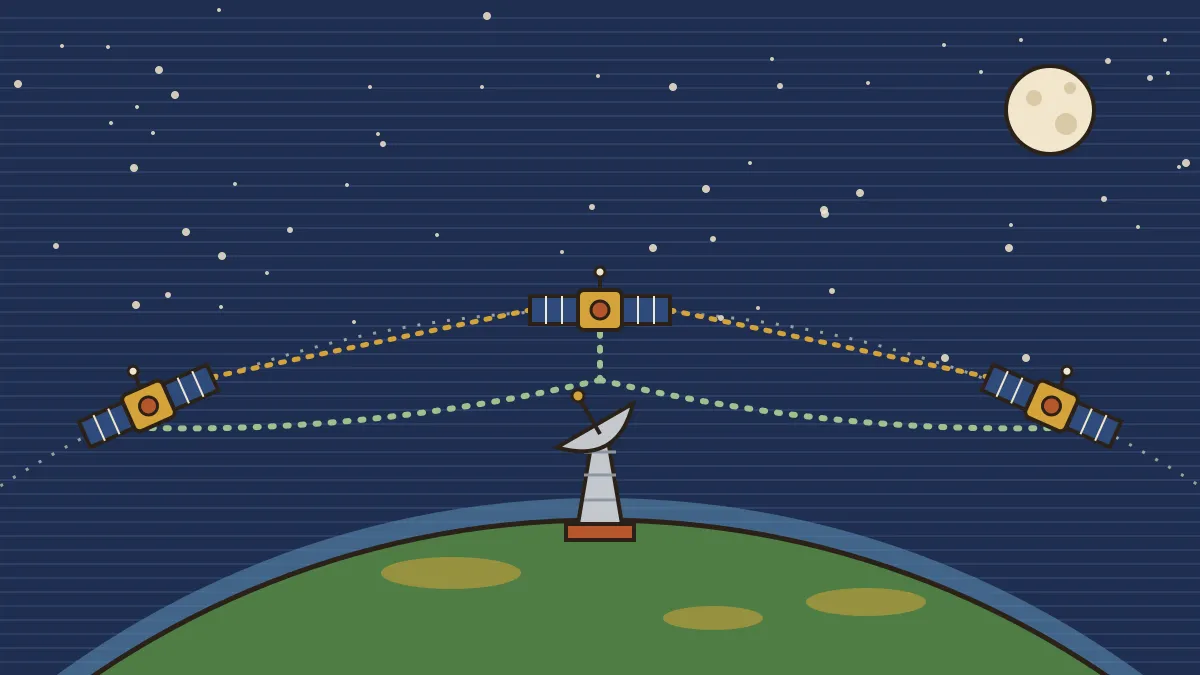
Every radar, from an airport weather set to a warship's fire-control system, announces itself to anyone who listens. The pulses it sends out carry a pattern, and the pattern reveals what kind of radar it is and where it sits. Collecting and studying those signals is called electronic intelligence, or ELINT, and it has long been done from aircraft, ships and ground stations. A Bengaluru company is now being backed to do it from space.
On 12 November 2026 the Technology Development Board (TDB) of the Department of Science and Technology (DST) signed an agreement with Astrome Technologies Pvt Ltd, Bengaluru. It will provide ₹64.05 crore from the Research, Development and Innovation (RDI) Fund towards a project costing ₹128.11 crore in total. The aim is a sovereign space-based AI-enabled ELINT (AI-ELINT) constellation for national security applications.
This article explains the technology and the money behind it. The first half is about ELINT and constellations; the second half is about how India is paying for deep technology.
The agreement in numbers
| Item | What the release says |
|---|---|
| Supporting body | Technology Development Board, DST |
| Company | Astrome Technologies Pvt Ltd, Bengaluru, Karnataka |
| Funding source | Research, Development and Innovation (RDI) Fund |
| Support from TDB | ₹64.05 crore |
| Total project cost | ₹128.11 crore |
| Form of support | Optionally Convertible Debt (OCD) |
| Technology goal | From TRL-4 to TRL-9 |
| Sector | Deep Technology, sub-sector Space Technology |
The two money figures are worth a second look. ₹64.05 crore is almost exactly half of ₹128.11 crore (about 50%), which matches the rule stated when the first TDB call under the RDI Fund opened in February 2026: support of up to 50% of project cost, with the company bringing the rest.
Optionally Convertible Debt is a financing instrument: a loan that may, under conditions agreed in the contract, be converted into equity. It sits between a plain loan and an equity stake, and it suits a technology company whose value is not yet proven. If the project succeeds, the lender can share in the upside; if it fails, the lender has a claim as a creditor.
What is being built
The project has three technology components:
- An ELINT payload, the receiving equipment, designed to detect and analyse signals across a broad frequency range.
- AI-based ground processing software, which sorts and interprets what the satellites collect.
- Inter-satellite communication links, so that satellites in the constellation can exchange information and work as one network.
The release says the system will use microsatellites in the 50 kg class, flying in low Earth orbit (LEO) as a constellation, with the number of satellites growing progressively to widen coverage and shorten the time between visits to the same area. It describes the purpose as "persistent surveillance" of identified areas of interest.
The release gives no launch date, no satellite count and no launch vehicle. It describes a development programme, so nobody should read it as a deployed system.
ELINT, COMINT and SIGINT: the three terms
Examiners like this family of acronyms, so sort them out first.
| Term | Full form | What it covers |
|---|---|---|
| SIGINT | Signals intelligence | The umbrella term for intelligence from intercepted signals |
| COMINT | Communications intelligence | The content of communications: speech, text, messages |
| ELINT | Electronic intelligence | Non-communication emissions, mainly radar, plus beacons and similar |
In ELINT the analyst usually does not care what a message says, because radar carries no message. The questions are of another kind: what type of radar is this, what is it for, where is it, and how often does it switch on? Typical features studied are the frequency, the pulse width, the pulse repetition interval and the way the beam scans. Together they act like a fingerprint for a particular radar. A change in that fingerprint can warn that a system has moved or been upgraded.
This ties directly to physics you already know. A radar emits electromagnetic waves, and our note on the electromagnetic spectrum lists the bands used, from radio waves to microwaves.
Why from space, and why a constellation
An aircraft can listen to a radar only while it is flying near it, and some regions are too dangerous or too remote to patrol. A satellite sees a very wide area as it passes and does not need anyone's permission to fly over. A satellite in low Earth orbit is close to the ground, so it can pick up weaker signals than one far away, and it is cheaper to launch.
The catch is speed. A satellite about 500 km up completes one orbit in roughly 95 minutes and travels at about 7.6 km a second. It crosses the whole sky quickly, so a single satellite sees a given patch of ground for only a few minutes at a time, and may return to it only a handful of times a day.
That is the reason for a constellation. Many satellites in different orbital positions mean:
- shorter revisit time, because some satellite is nearly always overhead;
- wider coverage of a large region such as a long border or a sea area; and
- resilience, since the loss of one satellite does not end the system.
Linking them with inter-satellite communication matters too. Without it, each satellite must wait to be over an Indian ground station before it can pass on what it heard. With links, data can be relayed through the constellation and delivered sooner. Our study note on satellite orbits explains LEO, MEO and GEO and why each is used.
The role of artificial intelligence
A listening satellite hears a flood of signals, and most are not interesting. The "AI" in AI-ELINT refers to the ground software that sorts those signals, groups them by emitter, and flags the unusual ones. The release says this software is meant to make processing and analysis "efficient". How the artificial intelligence works is not described, and it should not be assumed that the satellites do the thinking on board.
Where this fits in defence
India's armed forces already treat space as a theatre of operations. The Defence Space Agency, a tri-service body under Headquarters Integrated Defence Staff, was set up in 2019 and is headquartered in Bengaluru. In November 2024 it ran its first space exercise, Antariksha Abhyas, a table-top exercise held from 11 to 13 November 2024 to improve tri-service readiness in space.
ELINT also has a ground counterpart. In October 2025 the Defence Acquisition Council gave Acceptance of Necessity for a Ground Based Mobile ELINT System (GBMES) for the Army, to provide round-the-clock electronic intelligence on enemy emitters. Space-based collection would be the high-altitude partner to such ground systems. For how the three Services work together, see our Defence GK page on the tri-services.
The project also follows the opening of the sector. India's space reforms let private firms build and operate satellites; our explainer on India's space economy crossing 400 start-ups covers IN-SPACe and the policy changes.
The money: what the RDI scheme is
The support comes from the RDI Fund, so the funding story deserves as much attention as the satellites.
- The scheme. The Union Cabinet approved the Research Development and Innovation (RDI) Scheme on 1 July 2025, with a corpus of ₹1 lakh crore. The Prime Minister launched it on 3 November 2025.
- The aim. To give the private sector long-term financing at low or nil interest for research in sunrise and strategic areas, to finance transformative projects at higher technology readiness levels, to support acquisition of critical technologies, and to set up a Deep-Tech Fund of Funds.
- The structure. It is two-tiered. A Special Purpose Fund within the Anusandhan National Research Foundation (ANRF) holds the money. It is passed to second-level fund managers, which include the TDB, which lend to projects. DST is the nodal department.
- The terms of the first TDB call (opened 4 February 2026): loans at about 2 to 4%, tenure up to 15 years, no collateral, for projects at TRL-4 or above, with up to 50% of project cost supported. Nearly 191 proposals came in.
Astrome's agreement shows the scheme moving from announcement to signed contracts.
Technology readiness levels
The words "TRL-4 to TRL-9" are the heart of the release. Technology Readiness Levels form a nine-step ladder that measures how mature a technology is.
| TRL | Stage |
|---|---|
| 1 to 3 | Proof of concept |
| 4 to 6 | Prototype development |
| 7 to 9 | Operational deployment |
Moving from TRL-4 to TRL-9 therefore means taking a technology tested in a laboratory all the way to a proven, working system. In December 2025 the Principal Scientific Adviser released a National Technology Readiness Assessment Framework (NTRAF) to standardise how projects are rated. He spoke of a "Valley of Death" between TRL-4 and TRL-7, where funding often dries up because the risk is high and the product is not yet ready to sell. The RDI Fund is designed to cover exactly that stretch.
What to watch
- Milestones. Whether the company announces launch partners, an orbital demonstration and a satellite count.
- Other RDI contracts. Whether more TDB agreements follow in defence-relevant fields.
- Data rules. Who may receive satellite-collected intelligence, and how it is shared with the Services.
- Spectrum and debris. More small satellites in low orbit raise questions of crowded orbits and shared radio spectrum.
🔑 Revision block
The news. 12 November 2026: TDB (DST) signed an agreement with Astrome Technologies, Bengaluru; ₹64.05 crore from the RDI Fund; project cost ₹128.11 crore (about 50%); Optionally Convertible Debt; TRL-4 to TRL-9.
The system. AI-ELINT constellation: ELINT payload, AI ground processing, inter-satellite links; 50 kg-class microsatellites in LEO. No launch date or satellite count given.
Terms. SIGINT (umbrella); COMINT (communications content); ELINT (non-communication emissions, mainly radar). LEO at about 500 km: about 95 minutes per orbit.
RDI scheme. Cabinet 1 July 2025; corpus ₹1 lakh crore; launched 3 November 2025; Special Purpose Fund in ANRF, second-level fund managers (TDB first); DST nodal. First TDB call 4 February 2026: 2 to 4%, up to 15 years, TRL-4+, up to 50% of cost.
TRL scale. 1 to 3 proof of concept; 4 to 6 prototype; 7 to 9 deployment. NTRAF released December 2025.
Defence. Defence Space Agency (tri-service, 2019); Antariksha Abhyas (11 to 13 November 2024); GBMES (AoN, October 2025).
🎯 Practice MCQs
Q1. Electronic intelligence (ELINT) is gathered mainly from:
(a) Intercepted calls, texts and messages
(b) Non-communication electronic emissions such as radar signals
(c) Optical photographs taken from satellites
(d) Human sources and informants
→ (b)
ELINT studies emissions that carry no message, with radar the classic target. Option (a) describes communications intelligence (COMINT).
Q2. The Technology Development Board, which signed the agreement with Astrome, functions under the:
(a) Department of Space
(b) Ministry of Defence
(c) Ministry of Electronics and Information Technology
(d) Department of Science and Technology
→ (d)
The TDB is a body of the Department of Science and Technology, which is also the nodal department for the RDI scheme.
Q3. The support to Astrome is being provided as Optionally Convertible Debt. This is best described as:
(a) A loan that may be converted into equity under agreed conditions
(b) A grant that never has to be repaid
(c) A purchase of shares at the time of the agreement
(d) A guarantee on a bank loan
→ (a)
It is a debt instrument with a conversion option. It lies between a plain loan and an equity stake.
Q4. The corpus of the Research, Development and Innovation (RDI) scheme approved by the Union Cabinet in July 2025 is:
(a) ₹10,000 crore
(b) ₹50,000 crore
(c) ₹1 lakh crore
(d) ₹2 lakh crore
→ (c)
The Cabinet approved a corpus of ₹1 lakh crore on 1 July 2025, held in a Special Purpose Fund within the ANRF.
Q5. On the nine-step Technology Readiness Level scale, levels 7 to 9 correspond to:
(a) Proof of concept
(b) Operational deployment
(c) Prototype development
(d) Basic scientific research
→ (b)
TRL 1 to 3 is proof of concept, TRL 4 to 6 prototype development and TRL 7 to 9 operational deployment.
Q6. Consider the following statements about the Astrome project:
1. It combines an ELINT payload, AI-based ground processing software and inter-satellite communication links.
2. The satellites are planned to operate in geostationary orbit.
Which of the statements given above is/are correct?
(a) 1 only
(b) 2 only
(c) Both 1 and 2
(d) Neither 1 nor 2
→ (a)
The release describes a constellation of 50 kg-class satellites in low Earth orbit, not geostationary orbit.
Q7. The Defence Space Agency of the Indian armed forces is headquartered at:
(a) New Delhi
(b) Hyderabad
(c) Pune
(d) Bengaluru
→ (d)
The tri-service agency, set up in 2019 under Headquarters Integrated Defence Staff, is based in Bengaluru.
Q8. The main advantage of a constellation of many small low-orbit satellites over a single satellite for surveillance is:
(a) A fixed position over one spot on the equator
(b) No need for any ground processing
(c) Shorter revisit time and wider coverage
(d) Complete immunity to jamming
→ (c)
A single low-orbit satellite passes over a place only briefly and rarely. Many satellites keep some satellite overhead more often and cover larger areas.
📋 How this gets asked (PYQ pattern)
Science-and-technology questions that grow out of defence and space news usually arrive in three forms.
The first is terminology: SIGINT, COMINT and ELINT, or LEO, MEO and GEO. Options are usually the neighbouring terms, so a one-line definition of each is the best preparation (see Q1).
The second is how a system works: why a constellation, what an inter-satellite link does, what radar emits. Examiners prefer reasoning to recall, so the "why" behind each design choice is worth knowing.
The third is institutions and funds: which body sits under which ministry, what a scheme's corpus is and who launched it. This cycle's fresh hooks are ₹64.05 crore, ₹1 lakh crore, TRL-4 to TRL-9 and the Technology Development Board.
Preparing for CDS? Make a one-page sheet of the acronyms in this article, and add the physics behind each. Revise the base from the CDS/OTA study material, follow the daily CDS current affairs, and learn with experienced faculty in the upcoming Cavalier courses in Delhi.
Source: PIB / Ministry of Science & Technology, "TDB-DST signs agreement with Astrome for ₹64.05 crore RDI support to develop sovereign space-based AI-ELINT constellation", 12 November 2026; PIB releases on the RDI Scheme (Cabinet, 1 July 2025; first TDB RDI call, 4 February 2026), the National Technology Readiness Assessment Framework (29 December 2025), the Defence Space Agency's Antariksha Abhyas (13 November 2024) and the Defence Acquisition Council (23 October 2025). Defence Space Agency headquarters and ELINT definitions from open reference sources. Orbital period and speed calculated by The Cavalier for a 500 km circular orbit.
✍️ Written by Col D.N. Sharma — Science & general-studies faculty at The Cavalier. Reviewed by the Cavalier Faculty Desk.