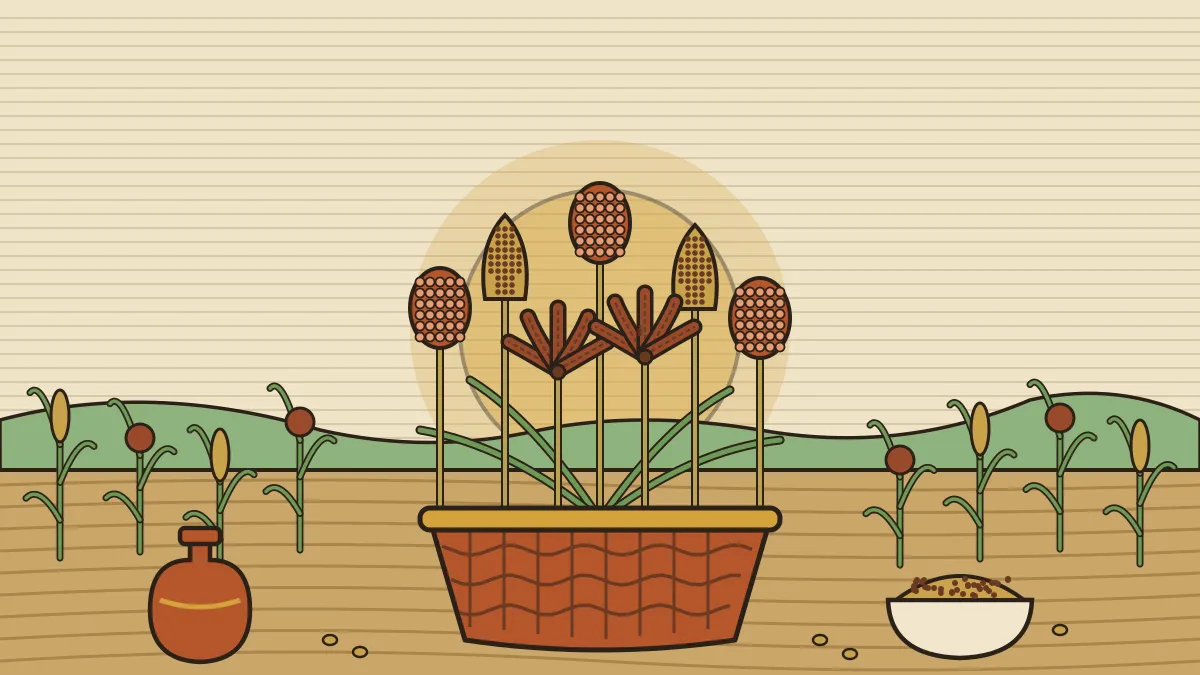
Odisha's hills were once covered in mandia, the local name for ragi, long before millets became a global talking point. On 10 November 2026, a two-day national event on agro-biodiversity conservation, climate-resilient agriculture and sustainable food systems began in Bhubaneswar. The Governor of Odisha, the state's Minister for Agriculture and Farmers' Empowerment and Dr. Mangi Lal Jat, who is Secretary of the Department of Agricultural Research and Education (DARE) and Director General of the Indian Council of Agricultural Research (ICAR), and Dr. Soumya Swaminathan, chairperson of the M.S. Swaminathan Research Foundation, were present.
In his address, Dr Jat described the Odisha Shree Anna Abhiyan as a possible national model for millet-led agricultural change. He asked for the state's area under millets to grow from 1.79 lakh hectares to 5 lakh hectares by 2047, with a production target of 8 lakh tonnes. The Press Information Bureau headlined it as Odisha charting "a National Roadmap for Millet led Agricultural Transformation".
This article explains what millets are, where they grow, why governments want more of them, and the schemes behind the push. For NDA, it is a Geography, Agriculture, Biology and current-affairs topic in one.
What was said in Bhubaneswar
The PIB release of 10 November 2026 records these points:
- Opportunity crops. Dr Jat urged greater use of Odisha's rich agro-biodiversity, with a focus on "opportunity crops" such as millets, to meet the challenges of climate change, soil health and nutrition, and to promote local food systems under the One Health approach.
- Area and output. Millet area to rise from 1.79 lakh ha to 5 lakh ha by 2047, with production of 8 lakh metric tonnes.
- Ragi procurement. Odisha procured 7.5 lakh quintals of ragi in Kharif Marketing Season (KMS) 2024-25 and has set a target of 8 lakh quintals for 2025-26.
- Local varieties. The state has 163 documented finger millet landraces. Traditional varieties named in the release are Kalia, Bati, Mami and Bharathi.
- Minor millets. Scaling up scientific cultivation of suan (little millet) and kangu (foxtail millet), along with affordable processing machinery, stronger Farmer Producer Organisations (FPOs) and women's self-help groups, and more millet enterprises and markets through ICAR-IIMR, Hyderabad.
- Research. A proposal for a Centre of Excellence on Millets at the Odisha University of Agriculture and Technology (OUAT), in partnership with ICAR-IIMR.
A simple calculation shows how ambitious the area target is. The 2047 goal of 8 lakh tonnes from 5 lakh hectares implies about 1.6 tonnes per hectare. That is above the national average yield of about 1,239 kg per hectare, quoted by the Agriculture Ministry in 2022. So the plan depends on both more land and better yields. (The calculation is ours; the release gives only the area and production targets.)
What are millets?
Millets are a group of small-seeded grasses grown for grain, mostly in dry regions. In India they are also called Shree Anna (the "mother of grains", a name given in the Union Budget of 2023-24) and nutri-cereals, a label the government gave them in April 2018 because of their health value.
| Group | Crops | Notes |
|---|---|---|
| Major millets | Bajra (pearl millet), Jowar (sorghum), Ragi (finger millet; mandua) | About 61%, 27% and 10% of India's millet production |
| Small or minor millets | Foxtail (kangni/kangu), barnyard, kodo, proso, little millet (kutki/suan) | Grow on poor soils and steep land, often in tribal areas |
| Pseudo-millets | Buckwheat, amaranth | Not true grasses, but counted with millets in PIB lists |
India is the world's largest producer of millets, with about 20% of global production and about 80% of Asia's, according to the Agriculture Ministry. PIB also reported that India was the 7th largest exporter as of 2021. In 2022-23, India produced 17.32 million tonnes of millets.
Where they grow
Millets are mostly Kharif crops, sown with the southwest monsoon in June–July and harvested in autumn. They suit semi-arid land with poor soils and low rainfall, where rice and wheat struggle.
- Bajra is concentrated in the drier west and north: Rajasthan, Uttar Pradesh, Haryana, Gujarat and Maharashtra.
- Jowar is strongest on the black soils of the Deccan, in Maharashtra and Karnataka, with large areas also in Madhya Pradesh and Telangana.
- Ragi is the speciality of the south and the hills: Karnataka (the largest producer), Tamil Nadu, Uttarakhand, Andhra Pradesh and Odisha's southern highlands.
- Small millets are typical of tribal belts, including Odisha's Koraput, Kandhamal and Malkangiri areas.
For maps and cropping seasons, revise Indian agriculture alongside the black and red soils, which suit millets best.
Why governments want more millets
Nutrition. Millets supply protein, dietary fibre, iron, calcium and phosphorus, and have a low glycaemic index, which helps people with diabetes. They are gluten-free. Ragi is especially rich in calcium, which is why it is a traditional food for children and growing adolescents. Our note on vitamins and nutrition explains the deficiency diseases that such grains help prevent, such as anaemia.
Climate. Millets need far less water than rice, are drought-tolerant, mature in a short time and resist pests better. Most are C4 plants, a type of photosynthesis that works well in heat and uses water efficiently. As rainfall becomes more erratic, millets are a built-in insurance for rain-fed farmers. Our explainer on soil health and degradation shows why crops that do well on poor soil matter.
Livelihoods. Millets are grown mainly by small, tribal and women farmers, which is why the Odisha plan puts FPOs and women's SHGs at its centre.
Defence link. In May 2023 the Ministry of Home Affairs decided to introduce 30% millets in the meals of personnel of the Central Armed Police Forces and the National Disaster Response Force, calling millets good for "a soldier's diet".
Odisha's mission: a model for the country
The state began its Odisha Millets Mission (OMM) in 2017, starting small, in a few tribal-dominated blocks of a handful of districts, and has grown to cover many more. It has since been renamed the Shree Anna Abhiyan. Its approach combines several parts:
- Reviving production in tribal areas, with seed support and better farming methods.
- Procurement at the Minimum Support Price (MSP), so that farmers have a guaranteed buyer. This is the part the Union Agriculture Minister praised at the Mandia Dibasa (Millet Day) event in Bhubaneswar on 10 November 2025, when he called for millets in mid-day meals.
- Processing and enterprise, through FPOs and women's groups.
- Demand, by bringing millets into public food schemes, with the aim of connecting farmers to a steady market.
The 2026 event adds a long-term target date, 2047, in line with the Viksit Bharat goal.
The national picture: from IYM 2023 to MSP
International Year of Millets (IYM) 2023. India proposed the idea to the United Nations, and its resolution was backed by 72 countries. The UN General Assembly adopted it in March 2021 and declared 2023 the International Year of Millets. The Food and Agriculture Organization (FAO) opened the year at its Rome headquarters in December 2022. The action plan rested on seven themes ("sutras"): production, nutrition, value addition, entrepreneurship, awareness, international outreach and policy support.
Shree Anna and IIMR. The Union Budget 2023-24 announced support for the Indian Institute of Millets Research (IIMR), Hyderabad as a Centre of Excellence for sharing best practices, research and technology, to make India a global hub for Shree Anna. IIMR is an institute of ICAR, which is under DARE in the Ministry of Agriculture and Farmers Welfare.
Production schemes. The Sub-Mission on Nutri-Cereals under the National Food Security Mission (NFSM) has run since 2018-19 to raise area, output and yield. By December 2023 it covered all districts of 28 States and 2 Union Territories.
Processing. A Production Linked Incentive Scheme for Millet-based Products with an outlay of ₹800 crore runs from 2022-23 to 2026-27, within the larger PLI scheme for the food-processing industry.
MSP. The government has fixed MSP at at least 1.5 times the all-India weighted average cost of production since the Budget of 2018-19. The MSPs for millets for the 2025-26 Kharif season, compared with 2015-16 (₹ per quintal), show how much the support has risen:
| Crop | 2015-16 | 2025-26 | Rise |
|---|---|---|---|
| Jowar (hybrid) | 1,570 | 3,699 | About 136% |
| Jowar (Maldandi) | 1,590 | 3,749 | About 136% |
| Bajra | 1,275 | 2,775 | About 118% |
| Ragi | 1,650 | 4,886 | About 196% |
Ragi has the highest MSP of the three major millets, which explains why it has been the centre of Odisha's procurement. For the 2026-27 season, PIB said the expected margin over cost is 56% for bajra, among the highest of all Kharif crops. MSP itself is recommended by the Commission for Agricultural Costs and Prices (CACP) and approved by the Cabinet Committee on Economic Affairs; you can revise the wider scheme in our notes on government schemes.
What to watch
- Whether the yield gap closes. The 2047 plan needs about 1.6 tonnes per hectare against a national average of about 1.2.
- Whether demand follows supply. Procurement without steady buyers piles up stock. Public food schemes, processing units and branded products are the answer.
- Seed and variety work. Conserving the 163 ragi landraces and the minor millets is a job for gene banks and farmers together.
- Centre of Excellence at OUAT. It was proposed, not approved, at the event.
🔑 Revision block
The event. Two-day national event on agro-biodiversity and climate-resilient agriculture, Bhubaneswar, from 10 November 2026; Dr M.L. Jat, DG ICAR and Secretary DARE.
Targets. Millet area 1.79 lakh ha to 5 lakh ha by 2047; production 8 lakh tonnes. Ragi procurement 7.5 lakh quintals (KMS 2024-25); target 8 lakh quintals (2025-26). 163 finger millet landraces; Kalia, Bati, Mami, Bharathi; minor millets suan, kangu. Proposed CoE on Millets at OUAT.
Millets. Major: bajra 61%, jowar 27%, ragi 10%. India: largest producer, about 20% of world output; 17.32 million tonnes (2022-23). Kharif crops; C4; low GI; gluten-free; iron and calcium.
Policy timeline. Nutri-cereals notified April 2018; NFSM sub-mission 2018-19; Odisha mission 2017; UNGA declares 2023 IYM in March 2021 (72 countries); Budget 2023-24: IIMR Hyderabad as CoE for Shree Anna; millet PLI ₹800 crore (2022-23 to 2026-27).
MSP 2025-26. Ragi ₹4,886, jowar (hybrid) ₹3,699, bajra ₹2,775 per quintal; MSP at least 1.5 times cost; CACP recommends.
🎯 Practice MCQs
Q1. Which of the following is the correct order of India's major millets by share of production, from highest to lowest?
(a) Jowar, bajra, ragi
(b) Bajra, jowar, ragi
(c) Bajra, ragi, jowar
(d) Ragi, bajra, jowar
→ (b)
PIB gives bajra about 61%, jowar about 27% and ragi about 10%.
Q2. The Indian Institute of Millets Research, designated a Centre of Excellence for Shree Anna, is located at:
(a) Bhubaneswar
(b) Bengaluru
(c) Ludhiana
(d) Hyderabad
→ (d)
ICAR-IIMR is in Hyderabad. The release also mentions a proposed Centre of Excellence on Millets at the Odisha University of Agriculture and Technology, Bhubaneswar, which is a separate proposal.
Q3. Millets were notified as "nutri-cereals" by the Government of India in:
(a) 2014
(b) 2016
(c) 2018
(d) 2023
→ (c)
The notification came in April 2018, the same year the NFSM Nutri-Cereals sub-mission began (2018-19). 2023 was the International Year of Millets.
Q4. Consider the following statements:
1. Millets are mostly Kharif crops suited to semi-arid regions.
2. Ragi is grown mainly in the north-western plains.
Which of the statements given above is/are correct?
(a) 1 only
(b) 2 only
(c) Both 1 and 2
(d) Neither 1 nor 2
→ (a)
Millets are sown with the monsoon and suit dry land. Ragi is a southern and hill crop (Karnataka, Tamil Nadu, Uttarakhand, Odisha), while bajra dominates the north-west.
Q5. The United Nations declared 2023 as the International Year of Millets on a proposal from India. How many countries supported India's resolution, according to PIB?
(a) 22
(b) 42
(c) 72
(d) 102
→ (c)
The resolution was supported by 72 countries and adopted by the UN General Assembly in March 2021.
Q6. Which crop has the highest Minimum Support Price among the major millets for the 2025-26 Kharif Marketing Season?
(a) Jowar (hybrid)
(b) Bajra
(c) Maize
(d) Ragi
→ (d)
Ragi is at ₹4,886 per quintal, against ₹3,699 for hybrid jowar, ₹2,775 for bajra and ₹2,400 for maize.
Q7. Consider the following statements about the Minimum Support Price (MSP):
1. Since the Budget of 2018-19, MSP has been set at least 1.5 times the all-India weighted average cost of production.
2. MSP is recommended by the Reserve Bank of India.
Which of the statements given above is/are correct?
(a) 1 only
(b) 2 only
(c) Both 1 and 2
(d) Neither 1 nor 2
→ (a)
MSP is recommended by the Commission for Agricultural Costs and Prices (CACP) and approved by the Cabinet Committee on Economic Affairs.
Q8. Local ragi landraces such as Kalia, Bati and Mami are associated with which state?
(a) Karnataka
(b) Odisha
(c) Tamil Nadu
(d) Uttarakhand
→ (b)
These are traditional finger millet varieties named in the PIB release on Odisha's 163 documented landraces.
📋 How this gets asked (PYQ pattern)
Agriculture questions in NDA General Knowledge follow a stable pattern, and millets fit three of its forms.
The first is crop-to-region and crop-to-season matching: which crop is Kharif or Rabi, which state leads in bajra, jowar or ragi, and which soils suit them. Options usually mix the north-west and the south on purpose.
The second is scheme and institution matching: NFSM, the PLI scheme, the Centre of Excellence at IIMR Hyderabad, and the roles of ICAR, DARE and CACP. A common trap is giving the RBI or NITI Aayog as the body that recommends MSP.
The third is international and year-based facts: the International Year of Millets (2023), the notification year (2018) and the number of supporting countries. The fresh hook this cycle is the Bhubaneswar event, the 5 lakh hectare target for 2047 and ragi's MSP of ₹4,886. We show the pattern, not any exact past question.
Preparing for NDA? Agriculture, food security and nutrition link Geography, Economics and Biology, and millets suit all three. Revise them with our notes on Indian agriculture and vitamins and nutrition, then follow the daily NDA current affairs and learn with experienced faculty in the upcoming Cavalier courses in Delhi.
Source: PIB / Ministry of Agriculture & Farmers Welfare, "Odisha charts a National Roadmap for Millet led Agricultural Transformation", 10 November 2026. Background from PIB releases: "Promotion of Millets" (29 March 2022), "Funds for Shree Anna" (21 March 2023), "Promoting Millets Consumption" (14 March 2023), "Promoting the Production of Millets" (5 December 2023), the MHA release on millets in CAPF meals (3 May 2023), "Increase in the Minimum Support Prices" (9 December 2025) and the Mandia Dibasa release (10 November 2025). The 1.6 tonnes per hectare yield is calculated by The Cavalier from the release's area and production targets.
✍️ Written by Aditya Tiwari — Economy & current-affairs faculty at The Cavalier. Reviewed by the Cavalier Faculty Desk. The Cavalier, founded by ex-Army officers, has trained NDA/CDS/SSB aspirants since 2001 (Facebook · YouTube).