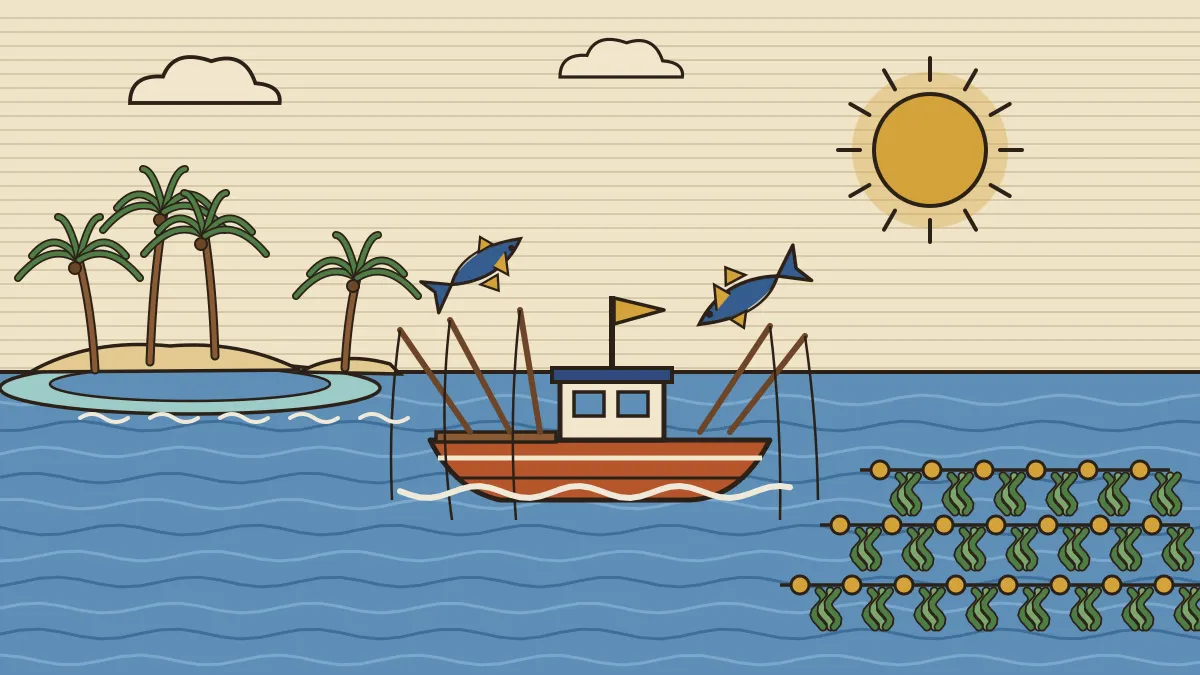
India's seas are far larger than its land, and the two island groups that sit furthest out in them are now being asked to do the heaviest lifting. On 10 November 2026, the Ministry of Fisheries, Animal Husbandry & Dairying released a note titled "Island fisheries at the centre of India's Blue Economy push". It says that Lakshadweep and the Andaman & Nicobar Islands will anchor growth in tuna, seaweed and ornamental fisheries, backed by cold chains, landing centres and export links.
The idea is simple. Most Indian fishing boats stay within 40–50 nautical miles of the coast, while India's Exclusive Economic Zone (EEZ) stretches out to 200. The fish that live in that unused middle, above all tuna, are valuable. The islands are the stepping stones that put boats, ice plants and processing sheds close to those fish. This article covers the geography, the law and the schemes behind that plan, because an NDA paper can ask about any one of them.
The release in numbers
All figures below are from the PIB release of 10 November 2026 unless a different source is named.
| Item | Figure |
|---|---|
| Coastline | About 11,099 km |
| Exclusive Economic Zone | Nearly 24 lakh sq km |
| Marine fisheries potential in the EEZ | 58.6 lakh MT |
| People dependent on fishing | Nearly 50 lakh fishers |
| Seafood exports, FY 2025-26 | About ₹73,890 crore |
| Public investment committed since 2015 | ₹39,272 crore through key schemes |
| PMMSY investment envisaged: Andaman & Nicobar | ₹218 crore |
| PMMSY investment envisaged: Lakshadweep | ₹175 crore |
| Share of India's EEZ held by the two island groups | "Nearly 40%" |
| Lakshadweep tuna plan | Double output to 50,000 tonnes in five years |
| Lakshadweep ornamental species | Over 300 reef-associated species |
Two cautions about these numbers. First, official releases have not always used the same figure for the EEZ: a February 2025 Budget note said about 20 lakh sq km and the present release says nearly 24 lakh. Second, the islands' share has been stated as "nearly 40%" today, while a February 2026 release put it at 49%. Neither is a mistake you need to resolve; for the exam, remember that the two groups together hold a very large share, roughly two-fifths or more, of the EEZ, and that Andaman & Nicobar's zone (about 6.6 lakh sq km, or one-third of the EEZ, in the Budget 2025-26 note) is larger than Lakshadweep's (about 4 lakh sq km).
Maritime zones: the law behind the map
The word "EEZ" comes from the United Nations Convention on the Law of the Sea (UNCLOS), adopted in 1982 and in force since 1994. India ratified it in 1995. Distances are measured outward from the baseline, roughly the low-water line along the coast. A nautical mile is 1,852 metres.
| Zone | Extent from baseline | What the coastal state may do |
|---|---|---|
| Territorial sea | Up to 12 nm | Full sovereignty, subject to the right of innocent passage |
| Contiguous zone | Up to 24 nm | Enforce customs, fiscal, immigration and sanitary laws |
| Exclusive Economic Zone | Up to 200 nm | Sovereign rights over living and non-living resources; others keep freedom of navigation and overflight |
| Continental shelf | At least 200 nm, up to 350 nm in defined cases | Rights over seabed minerals and sedentary species |
| High seas | Beyond national jurisdiction | Open to all, under international rules |
India's own law on this is the Territorial Waters, Continental Shelf, Exclusive Economic Zone and Other Maritime Zones Act, 1976. Note the order of the title and the year, which comes before UNCLOS itself. Fishing in the EEZ is now governed by rules made under this Act, which we return to below.
The practical point is that the EEZ is a zone of rights, not of ownership. India decides who may fish there and how much, but ships of other countries can still sail through it.
Why islands carry such weight
A small land area can control a huge sea area, because the EEZ is measured from every inhabited island as well as from the mainland. That is why the two island groups hold such a large part of India's zone.
Lakshadweep is a union territory of coral atolls in the Arabian Sea, about 200–440 km off the Kerala coast. Its land area is only about 32 sq km, but its lagoons run to more than 4,200 sq km and its EEZ to about 4 lakh sq km. The islands are separated from the Maldives by the Eight Degree Channel (Minicoy side) and Minicoy is separated from the rest of the group by the Nine Degree Channel.
The Andaman & Nicobar Islands are a long arc of hilly, forested islands in the Bay of Bengal, separated into the Andaman and Nicobar groups by the Ten Degree Channel. They lie close to the Strait of Malacca and Southeast Asia, which is why the release speaks of their "proximity to Southeast Asian maritime routes". They are also home to India's only tri-service theatre command, covered in our explainer on the Andaman & Nicobar Command. The fisheries plan therefore overlaps with strategy: boats, harbours and cold stores on remote islands add to India's presence on the sea.
Both groups also sit on the migration routes of tuna, which is why they are the centre of the plan. For the physical geography of coral atolls and island arcs, revise ocean relief and islands.
Tuna: the centrepiece
The release calls tuna the "centrepiece" of the roadmap for high-value marine fisheries. Three species matter:
- Yellowfin tuna, the main export species, with yellow fins and finlets.
- Skipjack tuna, smaller and the mainstay of the traditional island catch.
- Bigeye tuna, a deep-dwelling species that is prized for sashimi.
The government's approach rests on a few moves:
- Modern deep-sea vessels and mother vessels that collect and carry the catch from smaller boats.
- Selective fishing, such as hook-and-line and pole-and-line, instead of nets that take everything.
- Better onboard handling and chilling, then cold storage, processing and canning on shore.
- Export links, through the Marine Products Export Development Authority (MPEDA).
Pole-and-line fishing is the traditional Lakshadweep method. Fishers stand at the boat's edge, throw live bait to bring a school up to the surface, and then catch the fish one at a time on barbless hooks fixed to bamboo poles. It takes very few unwanted fish ("bycatch"), which is why the method is called ecologically sound and why it suits eco-labels such as that of the Marine Stewardship Council. A December 2025 PIB note on investment in Lakshadweep said that production of about 15,000 tonnes was a small fraction of an estimated potential of around one lakh tonnes. The five-year plan to reach 50,000 tonnes is therefore a target of roughly a threefold rise from that base.
In the Andaman & Nicobar Islands, a Tuna Cluster was notified under PMMSY on 29 October 2024. Its work covers new vessels, upgraded fleets and more cold storage. In a December 2024 reply, the Ministry put the estimated tuna yield at about 64,500 tonnes and said the current harvest was far below it. It also approved proposals worth ₹58.91 crore for seven deep-sea vessels, upgrades to ten existing vessels and 29 cold-storage and ice-plant units. MPEDA has opened a desk office in the islands to help direct exports. Until now, catch from the islands often had to be sent to the mainland before it could be sold abroad.
Seaweed and ornamental fish: beyond capture fishing
The release treats seaweed and ornamental fisheries as "complementary pillars". That matters, because it moves the plan from catching wild fish to farming and value addition.
Seaweed. Lakshadweep has been notified as a Seaweed Cluster. The plan includes large-scale cultivation, seed banks and hatcheries and training. The Department of Fisheries has approved a seaweed seed bank and a hatchery for the islands. Seaweed is grown on ropes and rafts in sheltered lagoons, which is the scene in our illustration. The main farmed species in India are Kappaphycus alvarezii and Gracilaria edulis, used for carrageenan and agar, which thicken foods and are used in pharmaceuticals and cosmetics. The Central Marine Fisheries Research Institute (CMFRI) reported India's seaweed output at 72,385 tonnes (wet weight) in 2023, and its Mandapam Regional Centre is the designated Centre of Excellence for seaweed. Seaweed also takes up carbon and needs no fresh water, land or fertiliser, which is why it is often called a climate-friendly crop.
Ornamental fisheries. Lakshadweep hosts over 300 reef-associated ornamental species. The plan focuses on medium-scale rearing units, regulated, conservation-based collection and better access to markets for sustainably sourced aquarium species. The concern is coral reefs: collecting from the wild can damage the reef, so breeding in captivity is the safer path.
Infrastructure. To support all this, the release lists fish landing centres, ice plants, cold-chain networks, onboard preservation systems, fish aggregating devices (floating structures that gather fish and make them easier to catch), boat-building yards, value-addition units and export facilitation. The aim is to cut post-harvest losses, which are high where fish must travel far without ice.
The policy frame: from Blue Revolution to the EEZ Rules
The island plan is the newest step in a longer story:
- Blue Revolution (2015-16). A scheme, also called the Neel Kranti Mission, that merged earlier fisheries programmes with a focus on production and productivity.
- Fisheries as a separate ministry (2019). The Ministry of Fisheries, Animal Husbandry and Dairying was formed, with a Department of Fisheries inside it.
- Pradhan Mantri Matsya Sampada Yojana (PMMSY), 2020. The flagship scheme, with a planned outlay of ₹20,050 crore, aimed at raising production, exports, cold chains and fisher incomes. The island allocations (₹218 crore and ₹175 crore) are part of it.
- Union Budget 2025-26. It promised a framework for harnessing fisheries in the EEZ and high seas, with special attention to Lakshadweep and the Andaman & Nicobar Islands. The same year's note estimated about 2.5 lakh tonnes of untapped potential in the two groups.
- EEZ Rules, 2025. The Sustainable Harnessing of Fisheries in the Exclusive Economic Zone Rules, 2025 were notified on 4 November 2025 under the 1976 Act, giving the first national legal framework for fishing in the EEZ.
- Access Pass (February 2026). A pass issued free through an online portal, launched at Veraval in Gujarat on 20 February 2026, to let fishers, mainly through cooperatives and Fish Farmer Producer Organisations, fish in the EEZ.
Seen together, the pattern is clear: first schemes and money, then a legal framework, then a permit system, and now a place-based plan for the islands.
Why it matters, and what could go wrong
For the economy. Seafood exports of about ₹73,890 crore in 2025-26 show that the sector already earns well. Moving from low-value, nearshore catch to sashimi-grade tuna, canned products and seaweed extracts raises the earning per tonne. Island communities also gain jobs closer to home.
For security. More boats at sea mean more eyes on the sea, but also more need for monitoring. Fishers in deep waters must be tracked for safety and to prevent illegal fishing, a task for the Indian Coast Guard and the Navy; see our note on the Indian Coast Guard. For science and deeper exploration of the same waters, see our explainer on the Deep Ocean Mission.
Risks. The release itself says success depends on balancing growth with ecological safeguards. Four risks stand out:
- Overfishing. Tuna are highly migratory and are shared with other countries; stocks are managed jointly through bodies such as the Indian Ocean Tuna Commission.
- Coral damage from reef collection, boat anchors and warming seas.
- Fragile islands. Lakshadweep is only a few metres above sea level, so sea-level rise and cyclones threaten its infrastructure.
- Local participation. Plans that bring in outside investors must still leave the island fishers with a real share of the income.
🔑 Revision block
The release. PIB, Ministry of Fisheries, Animal Husbandry & Dairying, 10 November 2026: Lakshadweep and A&N Islands to anchor growth in tuna, seaweed and ornamental fisheries.
Numbers. Coastline 11,099 km; EEZ nearly 24 lakh sq km; potential 58.6 lakh MT; 50 lakh fishers; exports ₹73,890 crore (2025-26); ₹39,272 crore committed since 2015. PMMSY: A&N ₹218 crore, Lakshadweep ₹175 crore. Islands' EEZ share "nearly 40%" (A&N about 6.6 lakh sq km, Lakshadweep about 4 lakh).
Clusters. Tuna Cluster, A&N (notified 29 Oct 2024); Seaweed Cluster, Lakshadweep. Lakshadweep tuna target 50,000 tonnes; ornamental species 300+. Species: yellowfin, skipjack, bigeye.
UNCLOS zones. Territorial sea 12 nm; contiguous 24 nm; EEZ 200 nm; shelf up to 350 nm. Indian law: 1976 Act; EEZ Rules notified 4 Nov 2025; Access Pass launched 20 Feb 2026.
Geography. Ten Degree Channel: Andaman | Nicobar. Eight Degree: Minicoy | Maldives. Nine Degree: Minicoy | rest of Lakshadweep. Seaweed species: Kappaphycus, Gracilaria; CoE: CMFRI Mandapam.
🎯 Practice MCQs
Q1. Under the UN Convention on the Law of the Sea, the contiguous zone of a coastal state extends up to:
(a) 12 nautical miles
(b) 24 nautical miles
(c) 200 nautical miles
(d) 350 nautical miles
→ (b)
The contiguous zone is the band from 12 to 24 nautical miles, where the state may enforce customs, fiscal, immigration and sanitary laws. 12 is the territorial sea, 200 the EEZ and 350 the outer limit of the continental shelf.
Q2. The Ten Degree Channel separates:
(a) Minicoy from the Maldives
(b) Lakshadweep from the mainland
(c) Great Nicobar from Sumatra
(d) The Andaman Islands from the Nicobar Islands
→ (d)
The Ten Degree Channel lies between Little Andaman and Car Nicobar. Minicoy and the Maldives are divided by the Eight Degree Channel, and Great Nicobar is separated from Sumatra by the Six Degree Channel.
Q3. Consider the following statements:
1. Yellowfin, skipjack and bigeye are the tuna species identified for the island fisheries roadmap.
2. A Tuna Cluster has been notified for Lakshadweep.
Which of the statements given above is/are correct?
(a) 1 only
(b) 2 only
(c) Both 1 and 2
(d) Neither 1 nor 2
→ (a)
Statement 1 is correct. The Tuna Cluster is for the Andaman & Nicobar Islands; Lakshadweep is the notified Seaweed Cluster.
Q4. The pole-and-line method of tuna fishing is best described as:
(a) Towing a large net along the sea floor
(b) Encircling a whole school with a purse seine
(c) Catching fish one at a time on hooks fixed to poles, using live bait to draw the school up
(d) Setting a very long line with thousands of baited hooks
→ (c)
It is a selective method with very little bycatch, which is why it is called ecologically sound and is the traditional Lakshadweep practice.
Q5. Which Union Territory has been notified as a dedicated Seaweed Cluster under PMMSY?
(a) Puducherry
(b) Andaman & Nicobar Islands
(c) Daman & Diu
(d) Lakshadweep
→ (d)
Lakshadweep's clean lagoons make it the Seaweed Cluster, with a seed bank and a hatchery under PMMSY. The Andaman & Nicobar Islands have the Tuna Cluster.
Q6. Consider the following statements about the Pradhan Mantri Matsya Sampada Yojana (PMMSY):
1. It is the flagship fisheries scheme launched in 2020 with a planned outlay of ₹20,050 crore.
2. It is implemented by the Ministry of Earth Sciences.
Which of the statements given above is/are correct?
(a) 1 only
(b) 2 only
(c) Both 1 and 2
(d) Neither 1 nor 2
→ (a)
PMMSY is run by the Department of Fisheries under the Ministry of Fisheries, Animal Husbandry & Dairying. The Ministry of Earth Sciences runs the Deep Ocean Mission.
Q7. The Sustainable Harnessing of Fisheries in the Exclusive Economic Zone Rules, 2025 were framed under which law?
(a) The Environment (Protection) Act, 1986
(b) The Merchant Shipping Act, 1958
(c) The Territorial Waters, Continental Shelf, Exclusive Economic Zone and Other Maritime Zones Act, 1976
(d) The Wild Life (Protection) Act, 1972
→ (c)
The 1976 Act is India's main law on its maritime zones, and the EEZ fishing rules were notified under it on 4 November 2025.
Q8. The Andaman & Nicobar Command, India's only tri-service theatre command, is headquartered at:
(a) Kochi
(b) Port Blair
(c) Visakhapatnam
(d) Kavaratti
→ (b)
It is based at Port Blair. Kochi hosts the Southern Naval Command, Visakhapatnam the Eastern Naval Command and Kavaratti is the capital of Lakshadweep.
📋 How this gets asked (PYQ pattern)
Marine and island geography appears in NDA papers in three recurring ways.
The first is zones and definitions: the width of the territorial sea, contiguous zone and EEZ, and which rights a state holds in each. Options are usually the numbers 12, 24, 200 and 350 shuffled, so learn the pairs, not just the list.
The second is map and place facts: the channels between island groups, the position of Lakshadweep and the Andaman & Nicobar Islands, and the capital or headquarters of each. The Ten, Nine, Eight and Six Degree channels are a standard trap.
The third is scheme-to-purpose matching: PMMSY, Blue Revolution and the Deep Ocean Mission, and which ministry runs which. The fresh hook this cycle is the tuna and seaweed clusters, the EEZ Rules of November 2025 and the Access Pass.
Preparing for NDA? Island geography, maritime law and the economy of the oceans cross over between Geography, Economics and current affairs. Revise them with our notes on Indian agriculture and allied sectors and sectors of the economy, then follow the daily NDA current affairs and learn with experienced faculty in the upcoming Cavalier courses in Delhi.
Source: PIB / Ministry of Fisheries, Animal Husbandry & Dairying, "Island fisheries at the centre of India's Blue Economy push", 10 November 2026. Supporting PIB releases: Budget 2025-26 fisheries note (1 February 2025), "Export of Tuna Fish" (13 December 2024), "Seaweed Production" (18 March 2025), "Investment Opportunities in Lakshadweep" (14 December 2025) and the Access Pass launch note (21 February 2026). UNCLOS zone limits from the text of the Convention.
✍️ Written by Aditya Tiwari — Economy & current-affairs faculty at The Cavalier. Reviewed by the Cavalier Faculty Desk. The Cavalier, founded by ex-Army officers, has trained NDA/CDS/SSB aspirants since 2001 (Facebook · YouTube).