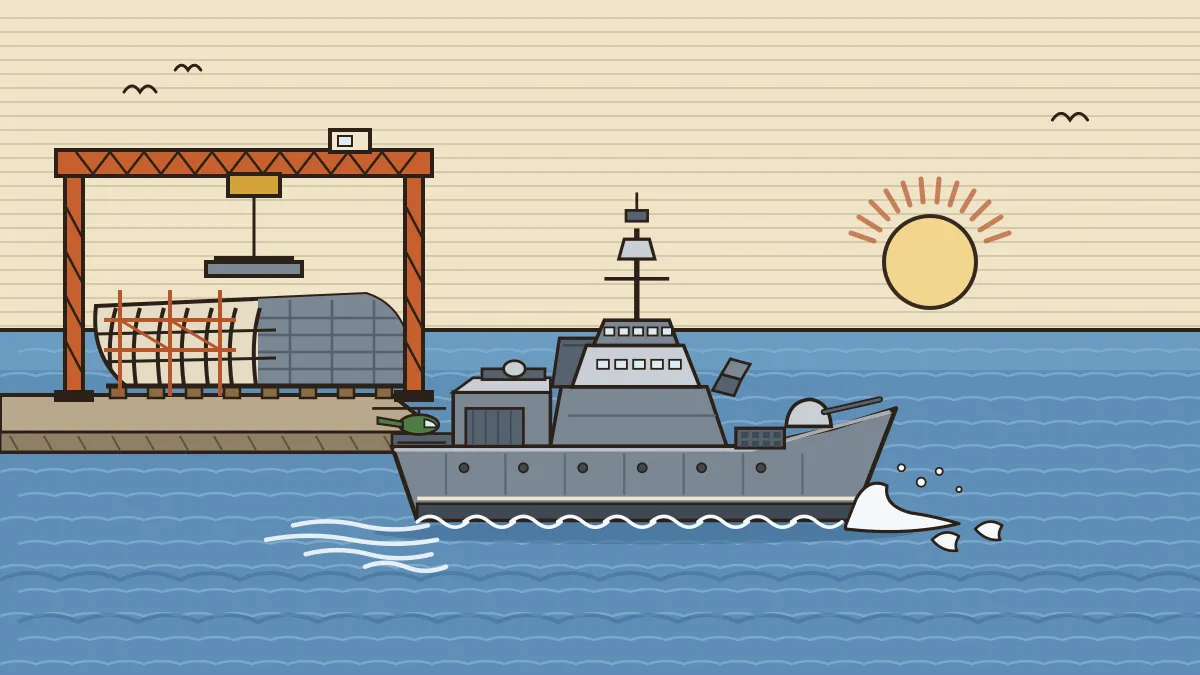
On 2 November 2026, the Ministry of Defence signed contracts worth ₹53,866.50 crore with 2 defence shipyards, Garden Reach Shipbuilders & Engineers Limited (GRSE), Kolkata and Goa Shipyard Limited (GSL), Vasco da Gama, to build 8 Next Generation Corvettes (NGCs) for the Indian Navy. The contracts were signed at Kartavya Bhawan-2, New Delhi, in the presence of Defence Secretary Shri Rajesh Kumar Singh.
This order is about who did the thinking as much as who builds. The release calls it the first project in which the ships are indigenously designed by the Indian Navy and built by Defence Public Sector Undertakings (DPSUs) chosen through a competitive process. That sentence, more than the rupee figure, is what an aspirant should be able to repeat.
The deal in brief:
- Signed: 2 November 2026, Kartavya Bhawan-2, New Delhi.
- Value: ₹53,866.50 crore, in contracts with 2 yards, for 8 NGCs.
- Split: GRSE (Kolkata) builds 5; GSL (Goa) builds 3.
- Claim: Navy-designed, DPSU-built, competitively selected.
This article covers what the release says and what it leaves out, how a corvette differs from a frigate, a destroyer and an offshore patrol vessel, the two yards, and where the order sits in the Navy's shipbuilding pipeline.
What the release says, and what it leaves out
| Detail | What the PIB release says |
|---|---|
| Buyer | Indian Navy |
| Contracts | ₹53,866.50 crore in total, with GRSE and GSL |
| Quantity and split | 8 NGCs: 5 at GRSE, 3 at GSL |
| Design | Indigenously designed by the Indian Navy |
| Builders | DPSUs selected through a competitive process |
| Fit | "Advanced missiles, weapons and sensor suites" for air, surface and sub-surface missions |
| Roles | Protecting maritime trade routes, anti-surface and anti-submarine warfare, coastal defence, littoral combat, maritime presence and surveillance |
| Jobs | About 72 lakh person-days in the shipyards and 460 lakh person-days in ancillary industries and MSMEs over the next 10 years |
Just as useful is what the release does not give: a delivery schedule, the ship's size and dimensions, a percentage of indigenous content, the names of the weapons and sensors, or the acquisition category under which the ships are bought. Anything you read on those points elsewhere is not from the release.
Reported around the signing, not in the release. News reports said the Cabinet Committee on Security cleared the project in the last week of October 2026, that GRSE had emerged as the lowest bidder for 5 ships in 2025, and that the first ship is expected by about 2030. Reported displacement figures start at about 2,000 tonnes but differ between outlets. Treat all of this as provisional, and do not memorise a tonnage for the NGC.
Reading the numbers
The average price. ₹53,866.50 crore divided by 8 is about ₹6,733 crore per ship. It is only an average: the release does not split the money between the two contracts.
The jobs figure. 72 lakh + 460 lakh = 532 lakh person-days, or about 5.32 crore. Spread over 10 years at 300 working days a year, that is roughly 17,700 people working full-time. The telling part is the ratio: 460 ÷ 72 is about 6.4. For every day of work inside the shipyards, the release expects about 6 days outside them, in firms making cables, castings, pumps, electronics and fittings. That multiplier is the economic argument for building warships at home.
Three meanings of "indigenous". Students blur these, and examiners do not.
- Indigenous design. The drawings come from the Navy's own design organisation. The release credits the NGC design to the Navy. The Project 17A frigates were designed in-house by the Navy's Warship Design Bureau, as our article on INS Mahendragiri explains.
- Indigenous build. The hull, outfitting and integration happen in Indian yards, here GRSE and GSL.
- Indigenous content. The share of the ship's value that is made in India, including engines, sonars, radars and missiles. The release promises "Made-in-India materials and equipment" but gives no percentage. For comparison, Mahendragiri was reported at over 75%, and the shallow-water craft Mangrol at over 80%. Engines and sensors are usually the hardest items to localise.
A DPSU is a government-owned company under the Department of Defence Production. There are 16: the 9 older ones (HAL, BEL, BEML, BDL, MIDHANI, MDL, GRSE, GSL and HSL) and 7 formed from the Ordnance Factory Board in 2021, the story told in our piece on ordnance factory corporatisation.
Corvette, frigate, destroyer or patrol vessel?
No treaty defines these classes. Navies use them by role first, size second, and the tonnage ranges overlap. The word "corvette" became famous in the Second World War, when Britain built hundreds of small, cheap escorts of the Flower class to guard Atlantic convoys. Today it means the smallest ocean-going warship that still carries serious weapons.
| Type | Rough displacement | Main job | Usual fit | Indian example |
|---|---|---|---|---|
| Corvette | 1,000 to 3,500 t | Coastal and littoral combat, escort, anti-ship and anti-submarine work close to home | Medium gun, anti-ship missiles, short-range air defence, ASW weapons; at most 1 helicopter | Kamorta class (Project 28), about 3,300 t, built by GRSE |
| Frigate | 3,000 to 6,500+ t | Multi-role escort for carriers and convoys; strong anti-submarine capability | Vertical-launch missiles, gun, torpedoes, 1 to 2 helicopters | Nilgiri class (Project 17A), about 6,700 t |
| Destroyer | 6,500 to 10,000+ t | Fleet air defence and long-range strike; leads a task group | Large missile magazines, 2 helicopters, advanced radars | Visakhapatnam class (Project 15B), about 7,400 t |
| Offshore patrol vessel (OPV) | 1,500 to 2,500 t | Patrolling the EEZ, anti-piracy, search and rescue, protecting offshore assets | Light gun, helicopter deck; built for policing, not fleet battle | Saryu class (built by GSL), 2,230 t, 105 m long |
The overlap catches students out. The 2,230-tonne Saryu is an OPV, while the 3,300-tonne Kamorta is a corvette: what separates them is the weapons and sensors fitted and the job intended, not the number on the scale.
That number is displacement, the mass of water a floating ship pushes aside. By Archimedes' principle (see our page on properties of matter) a floating ship displaces water equal to its own mass, so displacement tonnage is simply the ship's mass. Standard displacement excludes fuel and stores; full-load includes everything. Always check which figure a question quotes.
Where the NGC fits. The roles in the release (trade-route protection, anti-surface and anti-submarine warfare, coastal defence, littoral combat, presence and surveillance) are classic corvette work. "Across the air, surface and sub-surface domains" makes it a multi-role ship. That is a shift from the Navy's earlier corvettes: the Veer class are missile boats, while the Abhay and Kamorta classes are anti-submarine specialists. The older missile corvettes, the Veer and Khukri classes, began entering service in the late 1980s, so the oldest are close to 40 years old.
Two yards, two histories
GRSE, Kolkata. The yard began in 1884 as a small workshop on the Hooghly repairing river craft. It was renamed Garden Reach Workshop in 1916, incorporated as a company in 1934, and taken over by the Government of India in 1960. It became Garden Reach Shipbuilders & Engineers in 1977. It was made a Miniratna Category-I company in 2006, listed on the stock exchanges in October 2018, and granted Navratna status in June 2026. On 30 March 2019 it became the first Indian shipyard to deliver 100 warships, with the landing craft LCU L-56.
GSL, Vasco da Gama. The yard was set up in 1957 as Estaleiros Navais de Goa, a Portuguese-era yard building barges for Goa's mining trade. After Goa joined India in December 1961 the Government took it over. Mazagon Dock ran it on lease from 14 April 1962 to 30 September 1967, and it has been Goa Shipyard Limited since 29 September 1967. It is a Central Public Sector Enterprise under the Ministry of Defence.
| GRSE | GSL | |
|---|---|---|
| Place | Garden Reach, Kolkata (West Bengal) | Vasco da Gama (Goa) |
| NGC share | 5 ships | 3 ships |
| Corvettes built before | Kamorta class (4 ships, Project 28), plus Kora- and Khukri-class ships | Veer class (4 ships, 1993 to 2002) |
| Other Navy work | Project 17A frigates (3 of 7), Arnala-class shallow-water craft (8), NGOPVs (4) | NGOPV lead yard (7), Saryu-class OPVs (4), 2 Talwar-class frigates (Triput, Tavasya) |
| Other notable work | Survey vessels (Sandhayak class), landing craft such as LCU L-56 | Sail-training ships Tarangini and Sudarshini; the 11-ship Samarth-class Coast Guard OPVs |
Both yards have therefore built corvettes before. GRSE's Kamorta class also used indigenous DMR-249A steel, covered in our article on SAIL's naval steel.
Where the order sits in the pipeline
| Programme | Ships | Yard(s) | Where it stands |
|---|---|---|---|
| Project 17A (Nilgiri class) frigates | 7 | MDL 4, GRSE 3 | 6 commissioned by July 2026; GRSE's Vindhyagiri is the 7th |
| Project 15B (Visakhapatnam class) destroyers | 4 | MDL | All commissioned, November 2021 to January 2025 |
| Project 75 (Kalvari class) submarines | 6 | MDL | All commissioned; Vagsheer, the last, in January 2025 |
| Anti-submarine shallow-water craft | 16 | GRSE 8, CSL 8 | Replacing the Abhay class; see our Mangrol article |
| Next Generation Offshore Patrol Vessels | 11 | GSL 7, GRSE 4 | Contracted March 2023; Shruti was launched at GRSE on 11 August 2026 |
| Next Generation Missile Vessels | 6 | CSL | Under construction at Kochi |
| Next Generation Corvettes | 8 | GRSE 5, GSL 3 | Contracts signed 2 November 2026 |
Two patterns run through the table. Design stays with the Navy, and the build is shared between yards, often 4 : 3 or 7 : 4. Mazagon Dock carries the destroyers and submarines, while GRSE and GSL carry the smaller combatants and patrol vessels. The Navy's stated goal is a fleet of about 175 ships by 2035.
What the signing does not settle
Schedule. The release gives no dates. India's recent record warns against optimism: the Cochin Shipyard contract for the Mahe class carried a first-ship timeline of about 42 months, yet the lead ship was delivered about 6.5 years after the 2019 signing, a delay open reporting links largely to engines and sonars.
Crowded slipways. GRSE must fit 5 NGCs around its last Project 17A frigate and 4 NGOPVs; GSL leads on 7 NGOPVs and also has 2 Talwar-class frigates. Building a new design while finishing other classes is a capacity test.
🔑 Revision block
The event. 2 November 2026, Kartavya Bhawan-2, New Delhi; Defence Secretary Rajesh Kumar Singh present; ₹53,866.50 crore contracts for 8 Next Generation Corvettes.
The split. GRSE, Kolkata: 5 ships; GSL, Vasco da Gama (Goa): 3 ships. Average about ₹6,733 crore per ship.
The claim. First project with ships indigenously designed by the Navy and built by DPSUs selected through a competitive process.
Numbers to carry. 72 lakh person-days in shipyards + 460 lakh in ancillary industries and MSMEs over 10 years (about 6.4 : 1).
Not in the release. Delivery dates, tonnage, indigenous-content percentage, weapon names, acquisition category.
Types. Corvette (Kamorta, about 3,300 t) < frigate (Nilgiri, about 6,700 t) < destroyer (Visakhapatnam, about 7,400 t); OPV = patrol role (Saryu, 2,230 t). Role first, tonnage second.
Yards. GRSE: 1884, Government 1960, listed 2018, Navratna June 2026, first to deliver 100 warships (30 March 2019, LCU L-56). GSL: 1957 (Estaleiros Navais de Goa), Mazagon Dock lease 1962 to 1967, GSL since 29 September 1967.
🎯 Practice MCQs
Q1. Under the contracts of 2 November 2026 for 8 Next Generation Corvettes, how are the ships divided?
(a) GRSE 3, GSL 5
(b) GRSE 4, GSL 4
(c) GRSE 5, GSL 3
(d) GRSE 6, GSL 2
→ (c)
GRSE (Kolkata) builds 5 and Goa Shipyard Limited builds the remaining 3.
Q2. According to the Ministry of Defence, the Next Generation Corvette project is the first in which the ships are:
(a) designed by a foreign shipyard and built under licence in India
(b) indigenously designed by the Indian Navy and built by DPSUs selected through a competitive process
(c) built by private shipyards under the Strategic Partnership model
(d) fitted entirely with imported weapons and sensors
→ (b)
The release credits the design to the Navy and the construction to competitively selected DPSUs. The others are not in the release.
Q3. Consider the following statements about the NGC release:
1. The ships are being designed jointly by GRSE and Goa Shipyard Limited.
2. The release states the delivery date of the first ship.
Which of the statements given above is/are correct?
(a) 1 only
(b) 2 only
(c) Both 1 and 2
(d) Neither 1 nor 2
→ (d)
The design is the Navy's, and the release gives no delivery schedule.
Q4. Which Indian shipyard became the first to deliver 100 warships, a milestone reached on 30 March 2019 with LCU L-56?
(a) Garden Reach Shipbuilders & Engineers
(b) Mazagon Dock Shipbuilders
(c) Cochin Shipyard
(d) Goa Shipyard
→ (a)
GRSE reached 100 warships with the landing craft LCU L-56.
Q5. Which of the following is NOT a class built at Garden Reach Shipbuilders & Engineers?
(a) Saryu-class offshore patrol vessels
(b) Kamorta-class corvettes
(c) Arnala-class shallow-water craft
(d) Project 17A frigates
→ (a)
Saryu-class OPVs were built by Goa Shipyard. GRSE builds Kamorta corvettes, Arnala-class craft and three of the 7 Project 17A frigates.
Q6. The release expects about 72 lakh person-days of work in the shipyards and 460 lakh person-days in ancillary industries and MSMEs. Roughly how many days of ancillary work accompany each day of shipyard work?
(a) 2
(b) 4
(c) 6
(d) 10
→ (c)
460 ÷ 72 is about 6.4.
Q7. The displacement of a floating warship is equal to the:
(a) volume of its hull above the waterline
(b) weight of the cargo it can carry
(c) length multiplied by beam and draught
(d) mass of water it displaces, which equals the ship's own mass
→ (d)
By Archimedes' principle, a floating body displaces water equal to its own mass. Standard displacement leaves out fuel and stores; full-load includes them.
Q8. Which status was granted to GRSE in June 2026?
(a) Maharatna
(b) Navratna
(c) Miniratna Category-I
(d) Miniratna Category-II
→ (b)
GRSE was a Miniratna Category-I company from 2006 and was elevated to Navratna in June 2026.
📋 How this gets asked (PYQ pattern)
Defence-industry questions in the NDA general ability paper arrive in a few reliable shapes. Matching: which shipyard is in which city (GRSE in Kolkata, GSL in Goa, MDL in Mumbai, CSL in Kochi, HSL in Visakhapatnam) and which class it built. The type ladder: the trap is treating corvette, frigate and destroyer as loose synonyms. Aatmanirbhar Bharat vocabulary: DPSU, indigenous design versus indigenous content, and what a "first" actually claims. The news fact: a number, place or date from the latest release.
The fresh hooks this cycle are the ₹53,866.50 crore figure, the 5 : 3 split, 2 November 2026, and Navy design plus competitive DPSU selection. An option that invents a delivery date or an indigenous-content percentage is usually the wrong one, because the release gives neither.
Preparing for NDA? Keep one page of the Navy's classes with yard, role and an example ship, and add each new order to it. Our NDA study material builds the science and general-knowledge base, the daily NDA current affairs keeps the list current, and the upcoming Cavalier courses in Delhi prepare you for the written paper and the SSB.
Source: PIB (Ministry of Defence), "Aatmanirbhar Bharat: MoD inks Rs 53,866.50 crore contracts with GRSE & GSL for 8 Next Generation Corvettes for Indian Navy", 2 November 2026 (Release ID 2331418). Shipyard histories cross-checked with GRSE and GSL company material, the Department of Public Enterprises announcement on GRSE's Navratna status (19 June 2026) and open naval reporting; class data from open sources; reports of the Cabinet Committee on Security clearance and schedule are from news coverage and are marked as such.
✍️ Written by Maj Sunil Chopra — Co-founder and defence studies faculty at The Cavalier. Reviewed by the Cavalier Faculty Desk.