By Col Manoj Batra (Retd) · SSB faculty, The Cavalier · Senior GTO (retd), 20 SSB
A division is three to four brigades under one Major General, with its own artillery, engineers, signals and supply. It is the first rung on the Army's ladder built to fight a whole engagement by itself, so "know your Army" questions often stop here. The Major General is called the GOC, the General Officer Commanding.
This page is the division chapter of our Indian Army hierarchy section, under the Indian Army hub. It gives the types in one table, why the division count is not a number to quote, the divisions with nicknames, and the Integrated Battle Group, the formation being rolled out since 2026. The full ladder from section to command is on the hierarchy page.
What a Division Is, and How It Differs From a Brigade and a Corps
The NIOS military studies text says three to four brigades make a division, headed by a Major General termed the GOC. Around the brigades sit the divisional troops: artillery, engineers, signals, a reconnaissance and support element, and the supply and medical backing that let the division live and move on its own. A Tribune report on RAPID divisions lists the same, and the Army publishes no fuller table.
| Formation | Commander | Made up of | Rough strength (press, not official) |
|---|---|---|---|
| Brigade | Brigadier | 3 battalions (NIOS) plus supporting arms | about 3,000 to 3,500 (ThePrint, 1 Jul 2026) |
| Integrated Battle Group | Major General (reported) | A self-contained mix of infantry, armour, artillery, engineers and support | about 5,000 (reported, ThePrint, 1 Jul 2026) |
| Division | Major General (GOC) | 3 to 4 brigades plus divisional troops (NIOS) | about 10,000 to 12,000 (ThePrint, 1 Jul 2026) |
| Corps | Lieutenant General (GOC) | 3 to 4 divisions plus corps troops (NIOS) | not published; tens of thousands |
The Army publishes no strength table. These headcounts are ThePrint's figures from its 1 July 2026 report on the battle-group rollout, which gives a brigade at 3,000 to 3,500 and a division at 10,000 to 12,000. Our hierarchy page gives wider rule-of-thumb ranges (a brigade up to 5,000, a division up to 15,000), and books differ again; none is an Army figure. Learn the ratio and the commander's rank, not the headcount.
A corps sits above the division; our Army corps page names each. Below it, the brigades and battalions page shows how a brigade is built from units of different regiments. A division is a formation, a mix of arms, not a regiment or an arm such as the Corps of Signals.
Division Types in One Table
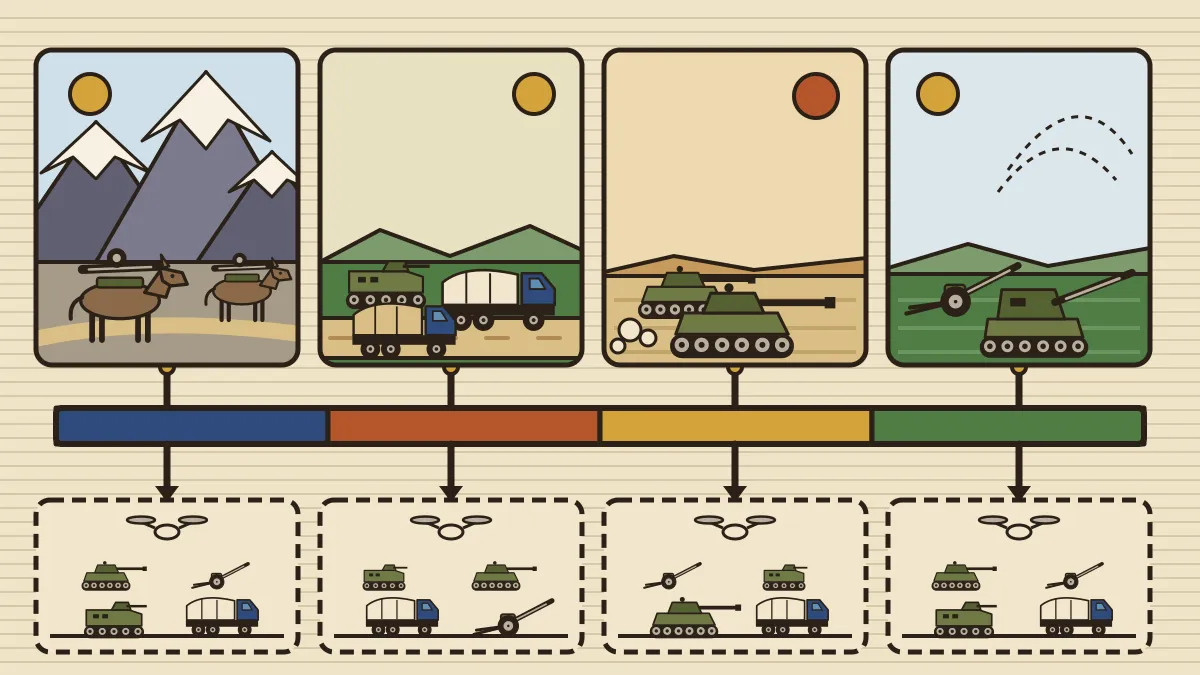
The NIOS text lists five types: Infantry, Mountain, Armoured, Artillery and Re-organised Army Plains Infantry Division (RAPID). Each is the same skeleton, a Major General with brigades and divisional troops, fitted out for a different job. The picture shows four of them, with the bar below showing a division drawing on all four to form combined-arms battle groups.
| Type | Role | What it is built around | Where official sources place such divisions |
|---|---|---|---|
| Infantry division | The all-round formation: hold ground, attack, counter-insurgency | Infantry battalions in 3 to 4 brigades, with divisional troops | PIB career notes mention an infantry division on the Line of Control |
| Mountain division | Fight and live on high ground, where roads are few | Mountain-trained brigades; mix and size not published | PIB mentions a mountain division in the high-altitude area of Western Ladakh, and 17, 20, 27 and 57 Mountain Divisions by number |
| Armoured division | Break through and exploit in open country | Tank regiments with mechanised infantry (a 2023 Tribune report shows T-90 tanks and BMP-2 vehicles with 1 Armoured Division) | PIB mentions an armoured division in the Western Sector |
| RAPID (Re-organised Army Plains Infantry Division) | Fast, hard-hitting action in the plains | A 2017 Tribune report: two tank regiments (about 100 tanks), two mechanised regiments (about 100 BMPs), two infantry brigades, artillery, engineers and signals | First raised in the late 1980s under Western Command; 10 Infantry Division at Akhnoor became a RAPID, the first under Northern Command (Tribune, Sep 2017) |
| Artillery division | Massed long-range fire for a theatre or to support strike corps | Artillery brigades; the Army has not published an artillery division's make-up | PIB mentions "41 Artillery Division" (Jan 2026) and an artillery division in the Western Theatre (2021) |
A mechanised division is not a separate type in the NIOS list: the mechanised element, infantry riding tracked vehicles beside tanks, lives inside armoured and RAPID divisions and in mechanised brigades. The combat arms page covers the Armoured Corps, Mechanised Infantry and Artillery, and the main battle tanks and artillery guns pages cover the machines.
NIOS spells it "Re-organised"; press reports spell it "Reorganised". Both mean the same plains division that mixes armour, mechanised infantry and infantry. RAPID is a division type, not a "rapid reaction force". We found no official list of which divisions are RAPID today, and some have been reorganised since, so learn the type, not a roll call.
How Many Divisions? Why the Number Moves
The Army does not publish a division count, by type or in total. The one figure in our approved textbook list is the NIOS text, which says the Army has 37 divisions of the five types above. The module carries no date, and other books and websites give totals from the mid-30s to 40, because divisions are raised and converted and books count artillery and RAPID divisions differently.
The 37 is a textbook figure, not an official release; we found no dated official total or split by type. UPSC follows official figures, so a question needing one will give it. Learn the five types, three to four brigades per division and Major General as commander, and treat any "N armoured divisions" in a coaching sheet as unverified.
Divisions With Names
Many divisions carry a nickname. These are used in press and unit profiles, not in an official list, so we give only those we could check in named press reports.
| Division | Nickname | What to remember | Source |
|---|---|---|---|
| 8 Mountain Division | "Forever in Operations" | Fought in the 1999 Kargil War; its then commander, Lt Gen (retd) Mohinder Puri, said on the 25th anniversary that it captured very dominating heights in inhospitable terrain. See the Kargil War | PTI, 27 Jul 2024; the "Forever in Operations" nickname is as press profiles give it (StratNews Global) |
| 1 Armoured Division | "Black Elephant" | Called the oldest decorated division of the Indian Army; shown with T-90 tanks, BMP-2 vehicles and a bridging system at Patiala | The Tribune, 6 Oct 2023 |
| 31 Armoured Division | "White Tiger" | Under the Sudarshan Chakra Corps; pioneered the Shaurya Squadrons, drone units of 20 to 25 personnel added to armoured regiments, reported in March 2026 | The Week, 25 Mar 2026 |
| 41 Artillery Division | none checked | PIB's gallantry list (Jan 2026) names its Provost Unit, so the formation exists in official records | PIB, 25 Jan 2026 |
Lists also give "Red Eagle" for 4 Infantry Division; we could not confirm it in a named press report, so we leave it out. The 1971 war page covers the other big conventional campaign.
Integrated Battle Groups
An Integrated Battle Group (IBG) is a self-contained, combined-arms force of infantry, armour, artillery, engineers and logistics under one commander. It is larger than a brigade and smaller than a division, and reported to be commanded by a Major General. The Army has published no establishment table, so that description is from press; The Tribune (Jul 2025) adds that its composition and role are largely similar to the Rudra all-arms brigades. A division stays arms-specific; an IBG mixes the arms in one grouping.
How the idea developed. The Raksha Mantri spoke of IBGs under consideration, for quicker decisions, at the Defence Services Staff College (PIB, 29 Aug 2021). ThePrint (Oct 2021) calls Exercise HimVijay in Arunachal Pradesh, October 2019, a test bed for them, with government in-principle approval for IBGs in 17 Corps and 9 Corps. PIB's "Forging One Force" note (18 May 2025) lists IBGs, with Integrated Theatre Commands, among the restructuring under way; our theatre commands page covers that joint reform.
Where it stands. On 9 April 2026 the Army chief said the Army had operationalised IBGs, and on 30 June 2026 PIB listed IBGs among reforms progressed under his tenure. Yudh Abhyas 2026 with the US aimed at employing IBGs in mountain and semi-mountain terrain (PIB, 15 Sep 2026), and at Jabalpur on 27 Aug 2026 the Raksha Mantri used the IBG as his example of tanks, infantry, artillery, drones and air power working as one system (PIB).
The details are press-reported. ThePrint and The Week (1 and 2 July 2026) say the first IBGs were set up in 17 Mountain Strike Corps from 1 July 2026, under a sanction letter of that date. The first two come from 23 Division, with 57 Division to follow, each of about 5,000 personnel, and the change is likely to finish around mid-2027 (unnamed sources). Reports differ on how many there are, so learn the concept, not the count.
- 13 Nov 2025: a Rudra Brigade takes part in land operations in Exercise Akhand Prahaar, validating Konark Corps (PIB).
- Mar 2026: 31 Armoured Division shows Shaurya Squadrons at a 13-day exercise (press).
- 9 Apr 2026: the Army chief says IBGs have been operationalised (PIB).
- 1 Jul 2026: first IBGs reported set up in 17 Mountain Strike Corps (ThePrint, The Week; not an Army release).
- 15 Sep 2026: Yudh Abhyas 2026 trains for IBG employment in mountain terrain (PIB).
PIB confirms the Army has operationalised IBGs but gives no count, strength or division. The ~5,000 troops, the Major General and the 17 Corps location are press-reported, and a question will follow PIB's wording. Our notes on Yudh Abhyas 2026 and the Jabalpur tank overhaul cover two of the PIB items.
Rudra, Bhairav and the Divisions
The 2025 formations, Rudra all-arms brigades, Bhairav light commando battalions, Shaktibaan artillery regiments and Divyastra batteries, were announced by the Army chief on 26 July 2025 (PIB) and are set out on the hierarchy page. Each fits a rung already in a division: a Rudra is a brigade (PIB shows one working inside Konark Corps in November 2025) and a Bhairav a battalion. The Army has not said how many divisions will be reshaped, so these are reorganisations of rungs, not a new tier. Our Mountain Guardian note follows a Bhairav Battalion on an exercise.
- Who commands what. A Major General commands a division; a Brigadier commands a brigade; a Lieutenant General commands a corps.
- RAPID is not a rapid-reaction force. It is Re-organised Army Plains Infantry Division, a plains formation with armour, not a unit for quick deployment.
- Mountain divisions face the northern borders. PIB places them in Western Ladakh and mentions the 17 Mountain Division at an event in Sikkim, so tie them to the northern borders, not to a single command.
To place the divisions inside the seven commands, see Indian Army commands; for the weapons they carry, Army weapon systems; and for the exercises where IBGs and divisions are tried, military exercises.
Exam pins
- A division is 3 to 4 brigades (NIOS), commanded by a Major General, the GOC.
- Division sits between a brigade (Brigadier) and a corps (Lieutenant General).
- Five types in the NIOS text: Infantry, Mountain, Armoured, Artillery and RAPID.
- RAPID = Re-organised Army Plains Infantry Division: armour, mechanised infantry and infantry for the plains. The first came up in the late 1980s under Western Command (Tribune).
- Divisional troops include artillery, engineers, signals and a reconnaissance and support element.
- The NIOS text says 37 divisions; the Army has published no official total.
- Integrated Battle Group (IBG) = combined-arms group, larger than a brigade and smaller than a division; PIB says the Army operationalised IBGs by 9 April 2026.
- HimVijay, October 2019 (Arunachal Pradesh, 17 Mountain Strike Corps) is reported as the test bed for IBGs.
- 8 Mountain Division fought in Kargil, 1999; 1 Armoured Division is "Black Elephant"; 31 Armoured Division is "White Tiger".
- Rudra is a brigade, Bhairav a battalion: not divisions.
Asked in past papers
No past paper we hold asks about division types directly. These three are the nearest: they test placing a unit on the right rung, and the Army-reform theme the new formations belong to.
Which one of the following is the 'Theme of the Year 2026' of Indian Army?
(a) Anchored in Tradition, Sailing into Self-Reliance and Innovation (b) Year of Networking and Data Centricity (c) Achook, Abhedya va Sateek (d) Samarth Bharat, Saksham Sena
Answer: (b). PIB records that the Army designated 2026 the year of "Networking and Data Centricity" (17 Apr 2026); the others are not the theme PIB reports. It follows the Defence Ministry's 2025 "Year of Reforms", the year the Rudra and Bhairav formations were announced.
The Battle of Rezang La, an epic battle in hostile conditions, was fought by the Indian Army in:
(a) 1948 (b) 1956 (c) 1962 (d) 1972
Answer: (c). PIB gives 18 November 1962, when Charlie Company of 13 KUMAON defended Rezang La in Eastern Ladakh. The question is about high-altitude fighting, the job a mountain division is built for. The other years are not China-border wars.
Jammu and Kashmir Light Infantry is
(a) A Central Paramilitary Force (b) A force maintained by the state of Jammu and Kashmir (c) A regiment of the Indian Army (d) None of the above
Answer: (c). It is an infantry regiment, a parent family that raises battalions; each battalion then serves in a brigade. The name tempts a candidate towards a state or paramilitary force.
Questions on this branch of the Army ask "which rung?" and "what is new?". Learn each formation with its commander (Brigadier, Major General, Lieutenant General) and each new name with its rung (Rudra brigade, Bhairav battalion, IBG between brigade and division). Then try the NDA and CDS past-paper pages.
Practice MCQs (with answers)
- Which officer commands an Indian Army division?
- A Brigadier
- A Major General
- A Lieutenant General
- A Colonel
- In the NIOS text, what does "RAPID" stand for?
- Rapid Action Paratroop Infantry Division
- Regional Armoured Plains Infantry Division
- Reserve Army Plains Infantry Division
- Re-organised Army Plains Infantry Division
- Which description of an Integrated Battle Group matches press and PIB accounts?
- A combined-arms group larger than a brigade and smaller than a division
- An all-infantry battalion of commandos
- A formation of two or more corps
- A purely artillery regiment
- Which of these is NOT a division type listed in the NIOS military studies text?
- Mountain
- Armoured
- Commando
- Artillery
- The first Integrated Battle Groups were reported in July 2026 to be set up within which corps?
- 14 Corps
- 15 Corps
- 9 Corps
- 17 Mountain Strike Corps
- Which exercise in October 2019 is reported to have been a test bed for the IBG concept?
- HimVijay, in Arunachal Pradesh
- Yudh Abhyas, in Alaska
- Garuda Shakti, in Indonesia
- Khaan Quest, in Mongolia
1-b, 2-d, 3-a, 4-c, 5-d, 6-a. Q1: a Brigadier commands a brigade, a Lieutenant General a corps. Q2: the "R" is "Re-organised", and the division is for the plains; (a) and (c) are the traps. Q3: the IBG mixes arms between brigade and division; (b) describes a Bhairav-type battalion and (d) a Shaktibaan-type regiment. Q4: the NIOS list is Infantry, Mountain, Armoured, Artillery and RAPID; there is no commando division. Q5: press-reported (ThePrint, The Week), not an Army release. Q6: HimVijay, 2019; Yudh Abhyas is the India-US exercise, and Garuda Shakti and Khaan Quest are other drills.
Where to Go Next
Go next to the Army corps page for the rung above and brigades and battalions for the rung below. The career in the Indian Army page shows where an officer's command ladder leads, and SSB boards ask about the formations an officer will serve in, so read our SSB interview tips with this page open. Revise the structure in the NDA study material and the CDS/OTA study material, and our CDS/OTA coaching batches cover the Army's formations, with PYQ drills and weekly tests.
Frequently asked questions
Who commands an Indian Army division?
A division is commanded by a Major General, who is called the General Officer Commanding or GOC. Under him are three to four brigades, each under a Brigadier, plus divisional troops such as artillery, engineers and signals. Above the division is a corps, under a Lieutenant General.
How many divisions does the Indian Army have?
The Army does not publish a division count. The NIOS military studies text says the Army has 37 divisions, including infantry, mountain, armoured, artillery and RAPID divisions, but the module is undated and other books give different totals. For an exam, learn the five types and the Major General's command, and use a number only if the question gives it.
What is a RAPID division in the Indian Army?
RAPID stands for Re-organised Army Plains Infantry Division. It adds tanks and mechanised infantry to infantry brigades for fast, hard-hitting action in the plains. The first RAPID divisions came up in the late 1980s under Western Command, according to The Tribune. It is a division type, not a rapid-reaction force.
What is an Integrated Battle Group in the Indian Army?
An Integrated Battle Group is a self-contained, combined-arms force of infantry, armour, artillery, engineers and logistics, larger than a brigade and smaller than a division. PIB reports that the Army chief said on 9 April 2026 that IBGs had been operationalised. Press reports say the first were set up in 17 Mountain Strike Corps from 1 July 2026, each of about 5,000 troops under a Major General; these details are not from an Army release.
What is the difference between a division, a brigade and a corps?
A brigade is three battalions under a Brigadier. A division is three to four brigades plus its own artillery, engineers, signals and supply, under a Major General. A corps is three to four divisions under a Lieutenant General. Each step up holds the one below it, so the rank of the commander rises by one step.
More in Army Hierarchy
← Back to Army Hierarchy · Defence GK home
Sources: pib.gov.in/PressReleasePage.aspx?PRID=2250618 · pib.gov.in/PressReleasePage.aspx?PRID=2310476 · pib.gov.in/PressReleasePage.aspx?PRID=2129453 · digital.nios.ac.in/content/374en/4.pdf
Preparing for CDS or OTA?
Cavalier's CDS/OTA batches teach the whole GK paper, defence awareness included, with PYQ drills, weekly tests and SSB training.