By Col Vijayant Thakur (Retd) · Defence faculty, The Cavalier
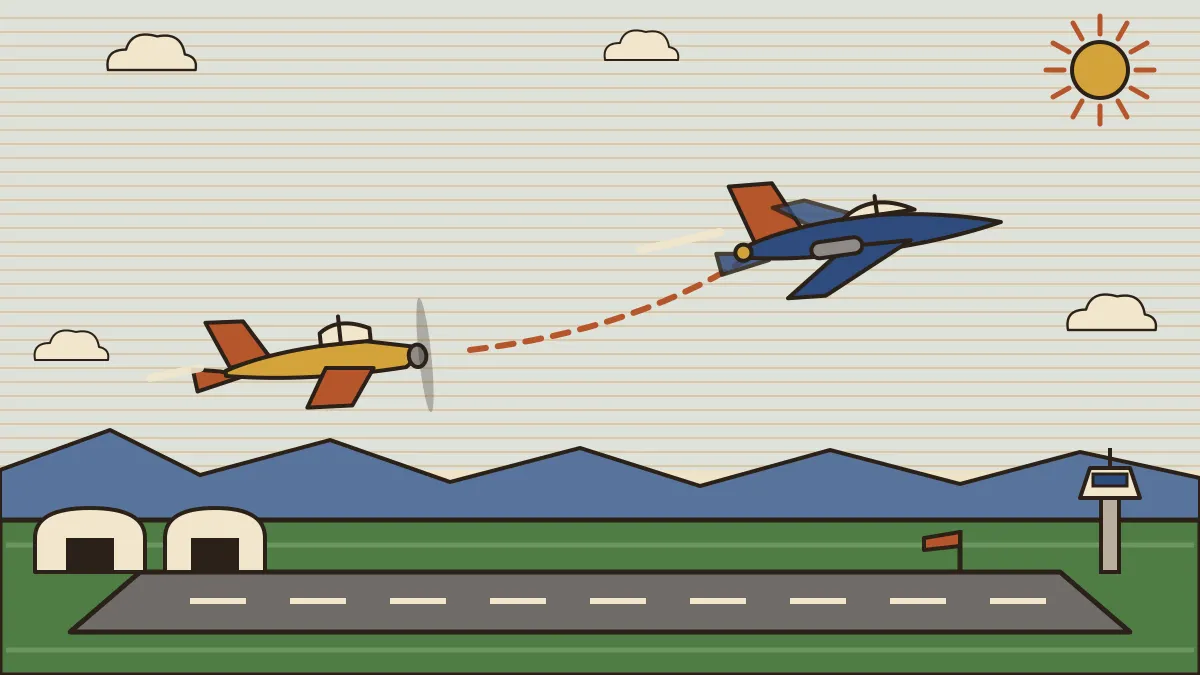
No Air Force pilot flies a fighter on the first day. The Indian Air Force trains its pilots on a ladder of aircraft: a slow, forgiving propeller trainer to learn the basics of flying, a jet to learn speed and formation, and then the Hawk, a trainer that handles like a small fighter. Only after that does a young officer join a squadron. The exams ask the names, the makers and the order of the rungs.
This page sits under Indian Air Force flying squadrons, next to fighter jets. It follows what the Air Force and PIB have published. Where the training route has changed or the sources are silent, the text says so, and it gives no fleet totals because the Air Force does not release them.
The Three Stages of Pilot Training
Pilot training for the Air Force begins at the Air Force Academy (AFA), Dundigal, near Hyderabad, where flying cadets spend about six months in joint training with every branch before their flying begins. The route below is the Air Force's own account of Training Command, summarised on our page on the Training and Maintenance Commands. It is the Air Force's own published account (indianairforce.nic.in) and carries no date, so treat places and aircraft as a guide to the order of the stages, and read the "Changed recently" box for what PIB has shown since.
| Stage | What it teaches | Trainer (fighter stream) | Where (Air Force account) |
|---|---|---|---|
| Stage I: basic | First solo, aerobatics, instrument flying | Pilatus PC-7 Mk II (turboprop) | Air Force Academy, Dundigal |
| Stage II: intermediate | Jet handling, formation. Trainees are split by stream; wings are awarded on completing this stage | HJT-16 Kiran (jet); Chetak for helicopter trainees | Hakimpet, Hyderabad |
| Stage III: advanced (lead-in to fighters) | Fighter-type flying and weapon work | BAE Hawk Mk132, called the advanced jet trainer (AJT) | Air Force Station Bidar, Karnataka, then Kalaikunda, West Bengal |
Transport trainees leave the fighter route after Stage I and train on the Dornier Do-228 and An-32 at Yelahanka, Bengaluru; helicopter trainees fly the Chetak at Hakimpet. After Stage III, the fighter pilot goes to an operational squadron. The rest of this page takes the rungs one at a time.
Basic Stage: Pilatus PC-7 Mk II and HAL HTT-40
The Pilatus PC-7 Mk II is a Swiss turboprop trainer and the Air Force's basic trainer. The Air Force's own history says it was inducted for Stage I in July 2013, after the HPT-32 fleet was grounded, and that the 194 Pilot's Course was the first to train on it. It is imported, so the next aircraft in the table below matters a great deal for the self-reliance questions the exams ask.
The HAL HTT-40 (Hindustan Turbo Trainer-40) is the indigenous answer. PIB describes it as an indigenously designed and developed basic trainer meant for the primary training needs of the Defence Forces, a turboprop with good low-speed handling, a modern cockpit and avionics.
| HTT-40 fact | Detail (PIB) |
|---|---|
| Order | 70 aircraft for the Air Force from HAL, worth ₹6,828.36 crore |
| Approval and contract | Cabinet approval 1 March 2023; contract signed 7 March 2023 |
| Supply period | Over six years, with simulators and training aids included |
| Type | Fully aerobatic, tandem-seat turboprop; air-conditioned cockpit; zero-zero ejection seats |
| Indigenous content | About 56%, to rise above 60% as parts are indigenised |
| Second production line | Opened at HAL Nashik on 17 October 2025 |
| First handover | Three trainers handed to the Air Force on 18 September 2026, in Bengaluru |
As of 18 September 2026, those three are the deliveries PIB has reported. The Air Force has not published a later count or the date the HTT-40 starts basic courses, so we state neither. The Raksha Mantri used the handover to say that India had long relied on imported aircraft for basic training, and that HAL now builds the HTT-40 for the Air Force. Our explainer Trainers, Not Fighters covers that day.
Do not mix the numbers. 70 is the HTT-40 order and 3 is how many had been handed over on 18 September 2026. UPSC follows official figures, and the Air Force's own figures are the PIB ones above.
Intermediate and Advanced Stages: Kiran, Hawk and the Tejas Trainer
The HJT-16 Kiran is HAL's own jet trainer, the intermediate rung. No retirement date has been announced in any release we used, and the Kiran is still in use: PIB shows it in the flypast at the Academy's graduation parades in December 2025 and June 2026, and the Chief of the Air Staff flew in a Kiran at Dundigal on 20 October 2026. The HJT-36 Sitara, the intermediate jet trainer HAL was developing, does not appear in PIB or Air Force pages we could use, so we state no status for it. If a question gives one, check it against a current source.
The BAE Hawk Mk132 is the advanced jet trainer. It is British-designed and licence-manufactured in India by HAL, in PIB's words of September 2026. Flying training at Bidar is done on the Hawk, and the Hawk is also the aircraft of the Suryakiran Aerobatic Team. PIB says the team was formed at Bidar in 1996, flies the Hawk Mk-132 in red and white, has given over 800 displays and marked its 30th anniversary at Bidar on 26 May 2026. Displays are covered on the display teams page, and our explainer Nine Hawks over Meerut describes a recent show.
The Hawk is not an Air Force exclusive. In July 2025 PIB reported the Navy's Second Basic Hawk Conversion Course at INS Dega, Visakhapatnam, in which Sub Lieutenant Aastha Poonia became the first woman streamed into the fighter stream of Naval Aviation. Navy, Coast Guard and even Vietnamese trainees also get wings at the Academy: at the June 2026 parade, nine Navy officers, three Coast Guard officers and two from Vietnam received them (PIB).
The last step on the indigenous ladder is the Tejas twin-seater trainer. When HAL handed two Tejas FOC twin-seaters to the Air Force on 18 September 2026, PIB said they would give pilots an indigenous training continuum into frontline fighter operations, on an aircraft that keeps the core systems of the fighter. The Tejas itself belongs on the fighter jets page.
- Dec 2025 and Jun 2026: the Academy's graduation flypasts (216 and 217 Courses) feature the PC-7 Mk II, Hawk, Kiran and Chetak (PIB).
- 26 May 2026: the Suryakiran team marks 30 years at Bidar (PIB).
- 13 Jun 2026: 231 flight cadets, including 37 women and the first batch of NDA women, are commissioned at Dundigal (PIB).
- 18 Sep 2026: HAL hands over three HTT-40 and two Tejas twin-seater trainers (PIB).
- 20 Oct 2026: the Chief of the Air Staff flies a Kiran sortie with an NCC Air Wing cadet at Dundigal (PIB).
Helicopter and Transport Trainees
Not every cadet goes to the Hawk. After the basic stage, the Air Force's account says trainees are split by stream: fighter trainees to Hakimpet, transport trainees to Yelahanka for the Dornier Do-228 and An-32, and helicopter trainees to the Helicopter Training School at Hakimpet for the Chetak, with the Mi-17 at the next stage. The Chetak, a helicopter that PIB lists among HAL's products, is still flown in the Academy flypast, which is why it appears with the trainers. The transport types are on transport aircraft and the helicopters on helicopter units. Each school is described on training establishments.
Women in the Fighter Stream
The Air Force opened combat roles to women on an experimental basis in 2015; PIB says the scheme was made permanent in 2022, with the fighter stream open on equal footing. PIB names Squadron Leader Avani Chaturvedi, the first Air Force woman fighter pilot to take part in an aerial wargame abroad, and Squadron Leader Bhawana Kanth, the first woman fighter pilot to qualify for day-time combat missions and the first to fly in the Republic Day Parade, in 2021. Both went through the same ladder of trainers as the men. Since 2017, NCC Special Entry vacancies for women in the flying branch have also been open, and in June 2026 the first NDA women passed out at Dundigal. For routes into the flying branch, see careers in the Indian Air Force; the NDA entry is covered by NDA coaching, and the first NDA women are in our CGP 217 explainer.
Exam pins
- PC-7 Mk II = basic (Stage I) trainer, Swiss, inducted at the Academy in July 2013.
- Hawk Mk132 = advanced jet trainer (AJT), British-designed, licence-built by HAL, flown at Bidar.
- HTT-40 = indigenous basic trainer by HAL; 70 ordered; contract 7 Mar 2023; ₹6,828.36 crore.
- HTT-40 indigenous content: about 56%, to exceed 60%.
- Kiran = HAL's jet trainer, the intermediate rung; still flying as of Oct 2026.
- Suryakiran team: Hawk Mk132, formed 1996 at Bidar, nine-aircraft display team.
- Air Force Academy is at Dundigal, Hyderabad; the NDA is at Khadakwasla.
- Three stages: basic, intermediate, advanced; wings are awarded on completing the intermediate stage.
- Tejas twin-seater trainers: first two handed over 18 Sep 2026.
- Women entered the fighter stream in 2015 (experimental); permanent from 2022.
Asked in past papers
No past paper has asked about a trainer aircraft by name. The questions below are the closest ones, and the first is a real trap for anyone who read this page.
Surya Kiran is a joint military exercise between India and:
(a) Bangladesh (b) Bhutan (c) Singapore (d) Nepal
Answer: (d). Surya Kiran with two words is the India-Nepal army exercise. The tempting mistake is to link it with the Air Force's Suryakiran aerobatic team, which flies the Hawk and is not an exercise at all.
'Cheetah' and 'Chetak' are the names of
(a) Fighter aircrafts (b) Helicopters (c) Armoured vehicles (d) Infantry regiments
Answer: (b). Both are light helicopters that HAL has built, and the Chetak is also flown to train helicopter pilots. The tempting wrong option is (a), because aircraft names often sound like animals.
'Tejas' is the name of which one of the following?
(a) Main battle tank (b) Nuclear submarine (c) Light combat aircraft (d) Aircraft carrier
Answer: (c). Tejas is the indigenous light combat aircraft, and it now also has twin-seater trainer versions. The tempting wrong option is (d), since the first indigenous carrier is called Vikrant.
Defence questions go by name, maker and role. Learn each trainer as three words, for example "HTT-40: HAL, basic, indigenous". Then test yourself on the AFCAT and NDA past-paper pages, and revise with our AFCAT defence awareness notes.
Practice MCQs (with answers)
- The Air Force uses the Pilatus PC-7 Mk II as its
- advanced jet trainer
- basic Stage-I trainer
- transport aircraft
- airborne early warning aircraft
- The Suryakiran Aerobatic Team, flying the Hawk Mk132, was formed in 1996 at
- Hakimpet
- Dundigal
- Kalaikunda
- Bidar
- The HTT-40 is
- a turboprop basic trainer designed and developed by HAL
- a Swiss jet trainer
- a British advanced jet trainer
- an Air Force helicopter
- How many HTT-40 trainers did the Ministry of Defence order from HAL in March 2023?
- 40
- 56
- 70
- 156
- The Air Force Academy, where Stage I flying is done, is at
- Dundigal
- Khadakwasla
- Yelahanka
- Kalaikunda
- Which of the following is NOT a trainer designed and built in India?
- HTT-40
- Kiran
- Tejas twin-seater
- Pilatus PC-7 Mk II
1-b, 2-d, 3-a, 4-c, 5-a, 6-d. Q1: the PC-7 is the first rung; the advanced jet trainer is the Hawk. Q2: Bidar is both the Hawk training base and the Suryakiran home. Q4: 70 is the order; 56 is the percentage of indigenous content, a number that appears in the same release. Q5: the NDA is at Khadakwasla; Yelahanka is the transport training base. Q6: the PC-7 Mk II is Swiss. The Tejas trainer is a twin-seat version of the indigenous fighter.
Where to Go Next
A first-time Air Force aspirant should read this page after the squadrons overview, then ready the interview: the SSB interview tips page lists the questions boards usually ask about a candidate's chosen service. Cavalier's AFCAT coaching takes you through general awareness, reasoning, numerical ability and English for the Air Force Selection Board.
Frequently asked questions
Which trainer aircraft does the Indian Air Force use?
The Air Force's published trainer ladder is the Pilatus PC-7 Mk II for basic training, the HJT-16 Kiran for the intermediate stage and the BAE Hawk Mk132 for advanced training. The indigenous HTT-40 is replacing imported basic trainers: 70 are on order and three were handed over on 18 September 2026, per PIB.
What is the HTT-40 trainer aircraft?
The HTT-40 (Hindustan Turbo Trainer-40) is a basic trainer designed and developed by HAL. It is a fully aerobatic, tandem-seat turboprop with zero-zero ejection seats. The Ministry of Defence signed a contract for 70 on 7 March 2023, at ₹6,828.36 crore, according to PIB.
Which aircraft does the Suryakiran team fly?
The Suryakiran Aerobatic Team flies the Hawk Mk132 in a red-and-white livery. PIB says the team was formed in 1996 at Bidar, where it marked 30 years on 26 May 2026, and that it has performed over 800 displays.
Where do IAF pilots train?
Pilot cadets start at the Air Force Academy at Dundigal, near Hyderabad. The Air Force's account of Training Command then places the intermediate stage at Hakimpet and the advanced stage on the Hawk at Bidar, with transport pilots at Yelahanka. Fighter pilots later complete lead-in work before joining a squadron.
Is the Kiran trainer still in service?
Yes, as far as PIB shows. The Kiran appeared in the Academy's graduation flypasts in December 2025 and June 2026, and the Chief of the Air Staff flew in one at Dundigal on 20 October 2026. No retirement date has been announced in the sources we used.
More in Flying Squadrons
← Back to Flying Squadrons · Defence GK home
Sources: pib.gov.in/PressReleasePage.aspx?PRID=2312215 · pib.gov.in/PressReleasePage.aspx?PRID=1904828 · pib.gov.in/PressReleasePage.aspx?PRID=2272390 · pib.gov.in/PressReleasePage.aspx?PRID=2266121
Aiming for the Air Force?
Cavalier's AFCAT batches cover general awareness, military aptitude, numerical ability and English, then prepare you for the AFSB.