On 26 November 2026, PIB published a backgrounder titled The Return of the Spotted Sprint. It reports that India's cheetah population has reached 62, of which 43 were born in India, after two litters of cubs at Kuno National Park in October and November (five cubs on 5 October and four on 20 November). A species that vanished from India in 1952 is now breeding in the wild. The news opens a topic UPSC likes: the Wild Life (Protection) Act, 1972, the protected areas it creates and the flagship projects run under it. The exam asks two things: which area is which and which project is where.
Why the Cheetah Vanished, and Why the Law Came Late
By Akanksha Kumari · Science faculty, The Cavalier · B.Tech, 15 years teaching Science
The cheetah once ranged from Punjab in the north to Tirunelveli in the south. Its English name comes from the Sanskrit chitraka, meaning spotted. The last three wild cheetahs in India were shot in the sal forests of present-day Koriya district, Chhattisgarh, in 1947, and the species was officially declared extinct in 1952. Biology textbooks name four causes of species loss, the "evil quartet": habitat loss and fragmentation, over-exploitation, alien species invasions and co-extinctions. The cheetah fell mainly to the first two:
- Habitat loss: the grasslands and open forests it needs were ploughed up.
- Over-exploitation: sport hunting, and the capture of cheetahs for coursing (hunting blackbuck with a tamed cat).
- Prey decline and a low breeding rate: once numbers fell, the narrow gene pool and slow reproduction made recovery unlikely.
India's first law to protect wild animals nationwide came only in 1972, twenty-five years too late for the cheetah. The Constitution as framed in 1950 left forests and wildlife to the states. The Wild Life (Protection) Act was passed by Parliament under Article 252, which lets Parliament legislate for states that pass a resolution asking it to do so, and was then adopted by the states (Jammu and Kashmir had its own law at the time). The 42nd Amendment (1976) moved "forests" and "protection of wild animals and birds" from the State List to the Concurrent List (Entries 17A and 17B), and added Article 48A (the State must protect forests and wildlife) and Article 51A(g) (a citizen's duty to protect the environment and have compassion for living creatures). See our pages on Union, State and Concurrent Lists and Fundamental Duties.
Inside the Wild Life (Protection) Act, 1972
The Act does four jobs: it bans hunting of wild animals (Section 9), it grades species into schedules, it lets governments declare protected areas, and it regulates trade in wild animals and their parts. Several bodies carry it out.
| Body or officer | Role |
|---|---|
| National Board for Wild Life (NBWL) | Advises the Government on policy and clears projects in and around protected areas. Chaired by the Prime Minister. It replaced the Indian Board for Wildlife in 2002. See our article on the NBWL and India's conservation bodies |
| State Board for Wild Life | The state-level counterpart, chaired by the Chief Minister |
| Chief Wild Life Warden | The state's wildlife authority: controls sanctuaries, grants permits, and may allow the hunting of an animal that has become dangerous to human life or is diseased beyond recovery |
| National Tiger Conservation Authority (NTCA) | Made statutory by the 2006 amendment; chaired by the Union Environment Minister; runs Project Tiger and, today, Project Cheetah |
The schedules. Until 2022 the Act had six schedules: four for animals, one for plants and one for "vermin". The Wild Life (Protection) Amendment Act, 2022 cut them to four. The four are now: Schedule I (animals with the highest protection and the heaviest penalties: the tiger, elephant, Asiatic lion, snow leopard, one-horned rhinoceros and Gangetic dolphin are examples), Schedule II (other protected animals), Schedule III (specified plants, which cannot be cultivated or traded without a licence) and Schedule IV (specimens listed in the CITES appendices, a new addition). The vermin schedule was removed.
- Added a chapter implementing CITES, the international convention on trade in endangered species, with a Management Authority (issues export and import permits) and a Scientific Authority (advises on the effect of trade on a species).
- Let the Centre regulate invasive alien species, and let people surrender captive animals to the Chief Wild Life Warden without compensation.
- Raised the penalties: the general fine up to ₹1 lakh (from ₹25,000), and the minimum fine for offences involving specially protected animals to ₹25,000 (from ₹10,000). Offences involving Schedule I animals still carry imprisonment of 3 to 7 years.
A schedule is a legal category in India: it decides the penalty. A Red List category is a scientific judgement by the International Union for Conservation of Nature (IUCN): Extinct, Extinct in the Wild, Critically Endangered, Endangered, Vulnerable, Near Threatened, Least Concern, Data Deficient. IUCN lists the tiger, the Asian elephant and the Asiatic lion as Endangered, and the African cheetah as Vulnerable. Red sanders was moved from Endangered to Near Threatened in 2021, which is a CDS-style question in itself.
Five Kinds of Protected Area, Compared
The Act creates four kinds of protected area. A fifth, the tiger reserve, comes from the 2006 amendment. A sixth look-alike, the biosphere reserve, is not created by the Act at all.
| Area | Declared on | Human activity | Key point |
|---|---|---|---|
| Wildlife Sanctuary | Forest or other land, by the State Government | Some activity (such as grazing or collecting minor forest produce) can be allowed by the Chief Wild Life Warden | Less strict. Boundary changes need the National Board's recommendation. Example: Gandhi Sagar |
| National Park | An area of special ecological, faunal or geomorphological value | No grazing of livestock | Stricter than a sanctuary: grazing is barred. Examples: Kuno, Kaziranga |
| Conservation Reserve | Government-owned land, often next to a park or sanctuary | Managed with local communities | Added in the 2002 amendment; links protected areas |
| Community Reserve | Private or community land, with the owners' consent | Owners keep the land and run it with a committee | Added in 2002; the only category on privately owned land |
| Tiger Reserve | Notified by the State on the advice of the NTCA | A core (critical tiger habitat) kept inviolate; a buffer with regulated use | Project Tiger's unit of management |
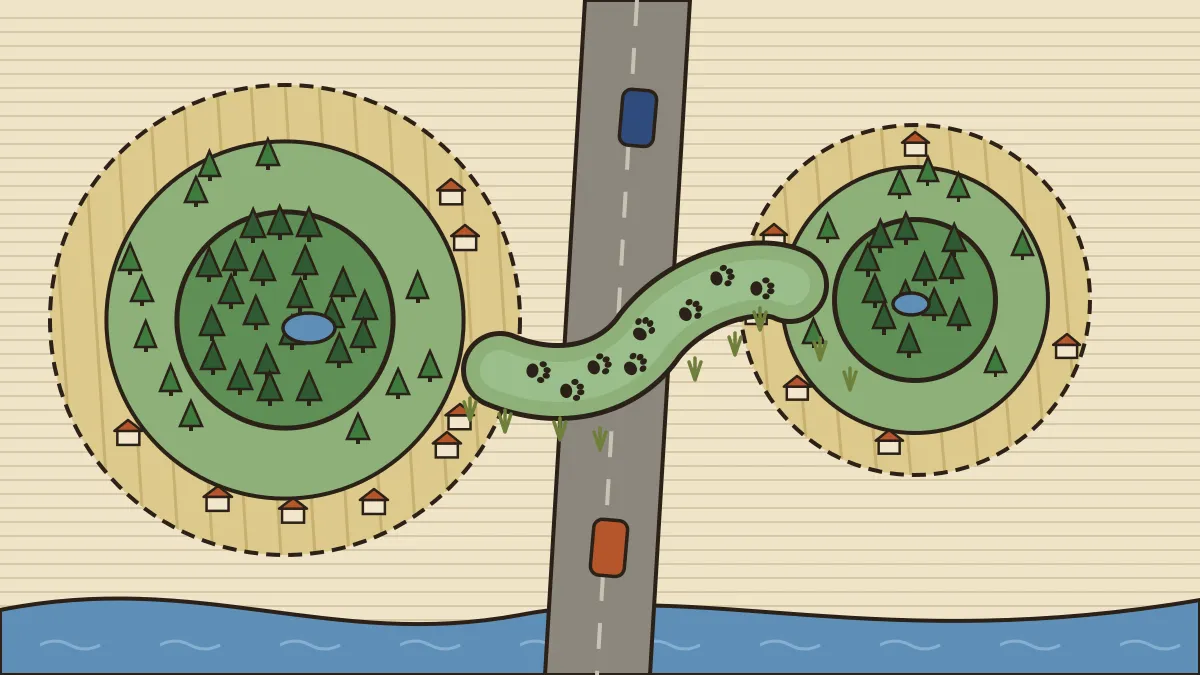
The ring of land outside a protected area is the Eco-Sensitive Zone (ESZ). In June 2022 the Supreme Court ordered a minimum 1 km ESZ around every national park and sanctuary. In April 2023 it relaxed that blanket rule, though mining inside a protected area stays barred. Villages inside these zones are why the Forest Rights Act matters to conservation.
A biosphere reserve is a UNESCO Man and the Biosphere programme idea. Its zones are core, buffer and transition, and the Indian Government notifies it. India has 18 notified biosphere reserves, and not every one is on UNESCO's world network. Nilgiri (Tamil Nadu, Kerala, Karnataka) was the first, in 1986, and the only one spread over three states. Panna (Madhya Pradesh) entered the UNESCO list in 2020. Our geography page on India's conservation network lists sites state by state.
Flagship Projects and Their Numbers
| Project | Started | What it is | Latest figure |
|---|---|---|---|
| Project Tiger | 1 April 1973 | Began with 9 reserves, the first being Jim Corbett (Uttarakhand); the tiger is the national animal | 3,682 tigers (average estimate) in the All India Tiger Estimation 2022, with a camera-trapped minimum of 3,167 and an upper limit of 3,925; over 70% of the world's wild tigers; 58 tiger reserves |
| Project Elephant | 1992 | Protects elephants and their corridors; the elephant is the National Heritage Animal (2010); 33 elephant reserves | 22,446 wild elephants in the first DNA-based Synchronous All India Elephant Estimation (SAIEE 2021-25), which sets a new baseline for later counts; nearly 60% of the world's wild Asian elephants; 150 identified corridors |
| Asiatic lion (Gir) | — | The only wild home of the Asiatic lion is Gujarat's Gir landscape | 891 lions in 2025, up from 523 in 2015 (and 674 in 2020) |
| Project Cheetah | 17 September 2022 | First intercontinental translocation of a large wild carnivore; run by the Environment Ministry through the NTCA | 62 cheetahs (November 2026), 43 born in India |
The tiger count runs on a four-year cycle. Tigers are protected by the Act, but they are also a "flagship" and "umbrella" species: saving a tiger reserve saves its whole forest and everything living in it. India's International Big Cat Alliance (2023) extends the idea to all seven big cats.
Project Cheetah: How a Species Is Brought Back
The Action Plan for Introduction of Cheetah in India was drawn up by the Wildlife Institute of India, the NTCA and the Madhya Pradesh Forest Department, following IUCN guidelines on conservation translocations. The cheetah that came to India is the African cheetah. The Asiatic cheetah survives only in Iran. The release sequence shows the method:
| Date | Event |
|---|---|
| 17 Sep 2022 | Eight cheetahs from Namibia released into quarantine enclosures at Kuno National Park, Sheopur district, Madhya Pradesh |
| Feb 2023 | Twelve more from South Africa, completing a founder stock of twenty |
| Apr 2025 | First animals moved to Gandhi Sagar Wildlife Sanctuary, the second site |
| 28 Feb 2026 | Nine cheetahs from Botswana, to add genetic variety |
| Oct 2026 | Two cheetahs released in Veerangana Durgavati Tiger Reserve (Sagar), the third site in the State |
Animals are first kept in Closed Natural Areas, large fenced enclosures, and released into the open landscape in stages (a soft release), so each animal can adjust to terrain, prey and climate. Before the cheetahs arrived, 24 villages were relocated from Kuno, freeing about 6,258 hectares. Chital is the main prey, making up about three-quarters of recorded kills. Over 450 Cheetah Mitras in 80 villages act as local ambassadors, and the villages share 5 per cent of eco-tourism revenue.
PIB reports 62 cheetahs, 43 born in India. How many imported animals are alive, and what share of the population is India-born?
The Action Plan sets milestones, not just numbers. Breeding by the first India-born generation (F1) was one, achieved when Mukhi, the first India-born cheetah, gave birth to cubs in November 2025. A birth in the wild (outside the enclosures) was another, recorded again in November 2026. The next test is cub survival beyond one year. The long-term goal is a self-sustaining population of 60 to 70 cheetahs by 2032, across about 17,000 sq km in the Kuno and Gandhi Sagar landscape. The 62 already reaches the lower end of that range, but, as PIB notes, it includes very young cubs whose survival is not yet certain. Our daily note on the first Botswana female to give birth covers the latest litter.
How UPSC Has Asked It: Past Papers Solved
These are actual CDS and NDA questions since 2018. UPSC tests where (which park, which state) and which category, and since 2023 it has also asked about the cheetah itself.
Cheetahs, brought from Namibia, were introduced in India to which one of the following National Parks?
(a) Kaziranga National Park (b) Keoladeo Ghana National Park (c) Keibul Lamjao National Park (d) Kuno National Park
Answer: (d). Kuno, in Madhya Pradesh. Kaziranga is the rhino's home, and Keibul Lamjao in Manipur is the floating park of the sangai deer.
Cheetahs were recently re-introduced to India from Africa. From which language is the name 'Cheetah' derived?
(a) Swahili (b) Afrikaans (c) Somali (d) Sanskrit
Answer: (d). From the Sanskrit chitraka, "spotted". The African languages are tempting because the animal came from Africa.
Which one among the following is the largest tiger reserve of India in terms of area of the core/critical tiger habitat?
(a) Manas (b) Pakke (c) Nagarjunasagar Srisailam (d) Periyar
Answer: (c). Nagarjunsagar-Srisailam (Andhra Pradesh and Telangana) is the largest.
In a recent judgement, the Supreme Court of India directed that every protected forest, national park and wildlife sanctuary across the country should have a mandatory eco-sensitive zone (ESZ) of a minimum of
(a) 1 km starting from their demarcated boundaries (b) 2 km starting from their demarcated boundaries (c) 3 km starting from their demarcated boundaries (d) 5 km starting from their demarcated boundaries
Answer: (a). The June 2022 order set a minimum of 1 km, which the Court eased in April 2023.
The International Union for Conservation of Nature (IUCN) has recently categorized the Red Sanders (Red Sandalwood) into
(a) deficient category (b) endangered category (c) near-threatened category (d) critically endangered category
Answer: (c). It was moved from Endangered to Near Threatened. The word "recently" tempts students to pick a more alarming category.
Which one of the following biosphere reserves is spread over three States in India?
(a) Nilgiri (b) Achanakmar-Amarkantak (c) Seshachalam (d) Agasthyamalai
Answer: (a). Nilgiri spans Tamil Nadu, Kerala and Karnataka; Agasthyamalai covers Kerala and Tamil Nadu.
In the year 2020 which one of the following tiger reserves of India was declared by UNESCO as a Biosphere Reserve?
(a) Panna Tiger Reserve (b) Namdapha Tiger Reserve (c) Dudhwa Tiger Reserve (d) Pench Tiger Reserve
Answer: (a). Panna entered UNESCO's world network of biosphere reserves in 2020. A tiger reserve and a biosphere reserve are different labels, which can sit on the same forest.
Static questions ask for site, state and category; current ones ask about the latest species or project. Pair each species with its park (cheetah: Kuno; lion: Gir; rhino: Kaziranga; sangai: Keibul Lamjao) and learn the label as a separate fact.
Practice MCQs (with answers)
- The cheetah was declared extinct in India in
- 1947
- 1952
- 1972
- 2022
- Project Cheetah is run by the Environment Ministry through the
- National Tiger Conservation Authority
- Central Zoo Authority
- National Biodiversity Authority
- Forest Survey of India
- Which of the following is NOT a category created by the Wild Life (Protection) Act, 1972?
- National park
- Conservation reserve
- Community reserve
- Biosphere reserve
- The National Board for Wild Life is chaired by
- the President
- the Union Environment Minister
- the Prime Minister
- the Chief Justice of India
- The only protected-area category that can be created on private or community land is the
- national park
- wildlife sanctuary
- community reserve
- core zone of a tiger reserve
- Project Tiger, launched in 1973, began with which as the first reserve?
- Ranthambore
- Kaziranga
- Bandipur
- Jim Corbett
- The first batch of cheetahs released in India in September 2022 came from
- South Africa
- Namibia
- Botswana
- Kenya
- The 2022 amendment reduced the schedules of the Wild Life (Protection) Act to
- four
- five
- three
- six
1-b, 2-a, 3-d, 4-c, 5-c, 6-d, 7-b, 8-a. Q3: biosphere reserves are a UNESCO programme, not part of the Act. Q6: Project Tiger began with nine reserves, and Jim Corbett (Uttarakhand) was the first; Ranthambore and Bandipur were in the nine but were not the first. Q7: Namibia first (8 animals), then South Africa (12) in 2023, then Botswana (9) in 2026. Q8: six to four.
Quick Revision
- Cheetah: last three shot 1947 (Koriya, Chhattisgarh); extinct 1952; name from Sanskrit chitraka. Project Cheetah: 17 Sep 2022, Kuno; Namibia 8, South Africa 12 (Feb 2023), Botswana 9 (Feb 2026); 62 cheetahs, 43 India-born (Nov 2026); target 60–70 by 2032.
- Wild Life (Protection) Act, 1972: passed under Article 252; hunting ban (Section 9); 42nd Amendment put wildlife in the Concurrent List (17B), added 48A and 51A(g).
- 2022 amendment: schedules six to four; vermin schedule removed; CITES chapter; invasive alien species; surrender of captive animals; higher fines.
- NBWL chaired by the PM; State Board by the CM; NTCA statutory since 2006.
- Sanctuary (some use allowed with permission) vs National Park (no grazing; stricter); conservation and community reserves added in 2002; community reserve = private land.
- Biosphere reserve = UNESCO MAB, not under the Act; Nilgiri (first, 1986, three states); Panna (UNESCO list, 2020).
- Project Tiger 1973, Corbett, 9 reserves; 3,682 tigers (2022, average estimate); 58 reserves. Project Elephant 1992; 33 reserves; 22,446 elephants (SAIEE 2021-25, DNA-based, new baseline). Gir lions 891 (2025).
- IUCN is not a schedule: tiger Endangered, African cheetah Vulnerable, red sanders Near Threatened.
Frequently asked questions
What is the Wild Life (Protection) Act, 1972?
It is India's main law for protecting wild animals, birds and plants. It bans hunting, divides species into schedules with different levels of protection, allows sanctuaries, national parks, conservation reserves and community reserves to be declared, and regulates trade in wildlife. It has been amended several times, including in 2002, 2006 and 2022.
What changed in the Wild Life (Protection) Amendment Act, 2022?
It cut the schedules from six to four, removed the vermin schedule and added a schedule for specimens covered by the CITES convention. It also created a framework to regulate invasive alien species, allowed captive animals to be surrendered and raised the fines.
What is the difference between a national park and a wildlife sanctuary?
A national park has stricter protection and no grazing of livestock. A sanctuary allows some regulated human activity, such as grazing or collecting minor forest produce, with the permission of the Chief Wild Life Warden.
Why was the cheetah brought back to India?
The cheetah went extinct in India in 1952, and Project Cheetah aims to restore it as a flagship species of open forests and grasslands. Restoring it needs grassland and prey recovery, which also helps soil, water retention and carbon storage across the landscape.
How many cheetahs are there in India now?
According to PIB, India had 62 cheetahs in November 2026, of which 43 were born in India. The count includes nine cubs born in October and November 2026 at Kuno National Park. The long-term goal is 60 to 70 cheetahs by 2032.
Related CDS / OTA Science topics
Environment and ecology reward steady revision
Cavalier's CDS/OTA batches cover biology, environment and current affairs together, so a news item like Project Cheetah is linked to the law behind it.