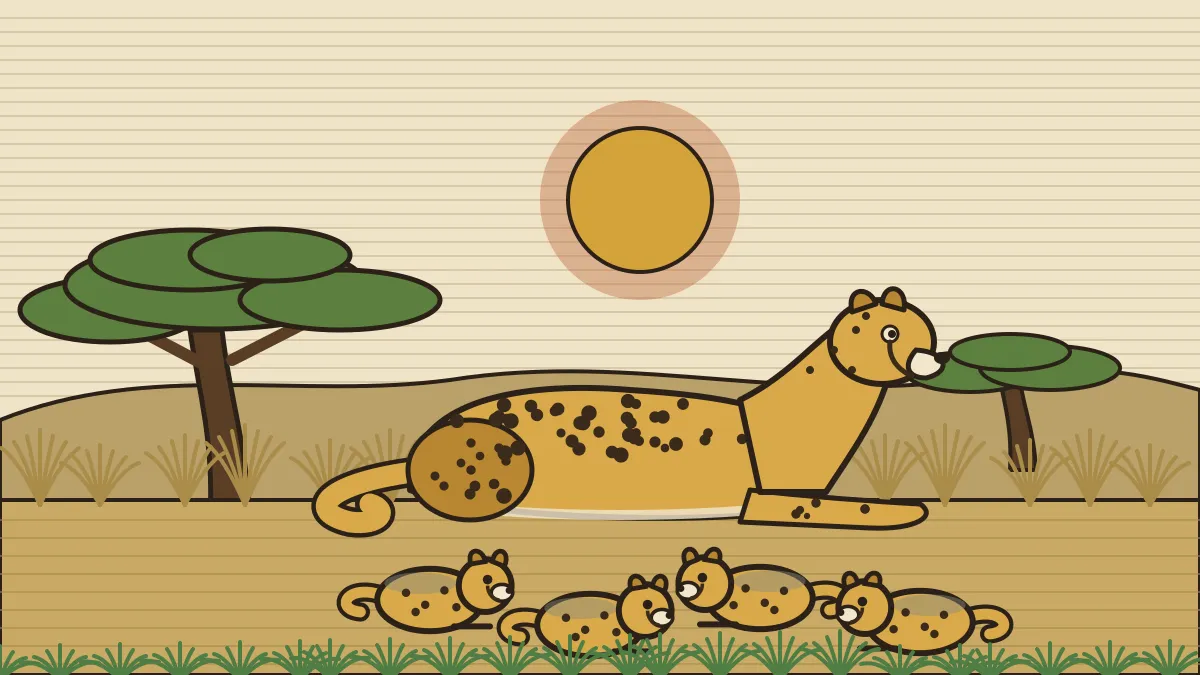
On 20 November 2026, Union Environment Minister Bhupender Yadav announced that a Botswana-born female cheetah, tagged KOMG 3, had given birth to four healthy cubs in the wild. She is two and a half years old and had spent more than four months in the wild before the birth. With the new arrivals, India's cheetah population has risen to 62, of whom 43 were born in India.
For a species that India lost almost seventy-five years ago, each such birth is a measure of whether the reintroduction is working. This article places the news within the full story of Project Cheetah: where it started, how the animals have arrived, what the numbers show, and which facts an examiner is likely to pick.
The news in four points
According to the PIB release of 20 November 2026:
- KOMG 3, a two-and-a-half-year-old female from Botswana, gave birth to four cubs in the wild.
- She is the first female cheetah from Botswana to give birth in India.
- This is the second recorded birth in the wild since the reintroduction programme began in 2022.
- The population is now 62, including 43 Indian-born individuals.
The Minister thanked the managers, veterinarians and frontline forest staff, and said conservation is "a journey of patience, perseverance and collective effort". The release does not name the site of the birth.
Two words need care. A "birth in the wild" means a litter born to a cheetah living free in the landscape, not inside a quarantine or acclimatisation enclosure (a boma). Most cubs so far have been born in enclosures, where the mothers can be watched and protected. A wild birth shows that the mother has settled, found prey and chosen a den for herself.
Why India lost its cheetah
The cheetah (Acinonyx jubatus) is the world's fastest land animal and the only large carnivore declared extinct in independent India. The PIB's Backgrounder on the project gives the key dates:
- 1947: the last confirmed sighting, when three animals were shot in the sal forests of Koriya district, in present-day Chhattisgarh.
- 1952: the species was officially declared extinct in India.
The causes were hunting, the use of cheetahs for coursing (trained cheetahs were used to hunt blackbuck), loss of grassland to agriculture, the fall in prey numbers and the cheetah's own low reproductive rate and narrow gene pool. The cheetah was a creature of open habitats: dry grasslands, savanna and scrub. Those are among the most under-protected habitats in India, often classed as "wasteland" even though they hold their own wildlife. Our note on Indian vegetation types explains the savanna and scrub belts.
How the project began
| Date | Milestone |
|---|---|
| Before 2022 | The 2013 Action Plan and Supreme Court directives, as the PIB Backgrounder puts it, laid the ground for the project |
| July 2022 | India signs an MoU with Namibia on wildlife conservation |
| 17 September 2022 | Eight cheetahs from Namibia (five females, three males) released into quarantine enclosures at Kuno National Park, Madhya Pradesh |
| January 2023 | Inter-governmental agreement with South Africa concluded |
| February 2023 | Twelve cheetahs arrive from South Africa |
| November 2025 | Botswana hands over eight cheetahs at Mokolodi Nature Reserve |
| 28 February 2026 | Nine cheetahs from Botswana (six females, three males) released into quarantine at Kuno |
Project Cheetah is run by the Ministry of Environment, Forest and Climate Change, with the National Tiger Conservation Authority (NTCA) as the lead agency. It was launched on 17 September 2022, and the PIB describes it as the world's first inter-continental translocation of a large carnivore.
One scientific point is worth knowing. The cheetah that once lived in India was the Asiatic cheetah, a subspecies now confined to a tiny population in Iran. The animals brought to India are African cheetahs, so the project is an experiment in establishing the species, not a return of the exact original animal.
Why Kuno? The site was chosen after an expert committee review. It is in Sheopur district of Madhya Pradesh. The Backgrounder records that 24 villages (1,545 families) were relocated voluntarily to leave about 6,258 hectares of undisturbed grassland. For the conservation framework, see our note on conservation in India.
The Botswana chapter
The Botswana sourcing shows how a modern translocation is arranged. According to the PIB release of 28 February 2026:
- In December 2024 India began formal talks with Botswana's government.
- An Indian delegation visited Botswana in September 2025 to map out transport and clearances.
- Eight cheetahs were identified and captured from the Ghanzi region and moved about 700 km by road to Gaborone under veterinary supervision.
- On 13 November 2025, President Droupadi Murmu, visiting Botswana, witnessed their symbolic release into quarantine at Mokolodi Nature Reserve.
- On 28 February 2026, nine cheetahs from Botswana were released into quarantine enclosures at Kuno.
The PIB gives eight in the November 2025 handover and nine at Kuno in February 2026. The release does not explain the difference, so quote both numbers with their dates.
Botswana matters for genetics. The first two batches came from only two countries, so the founders were few. A small population drawn from few animals risks inbreeding and a loss of genetic variety over time. Adding a third source widens the gene pool. The Backgrounder says India's plan relies on continued sourcing from African countries to maintain genetic diversity. That is why a Botswana-born mother producing cubs with a new bloodline is more than a headline.
Counting the cheetahs
The PIB has reported the national total several times this year. The comparison is the most useful table in this article.
| PIB release | Total cheetahs | Indian-born |
|---|---|---|
| 28 February 2026 | 48 | 28 |
| 9 March 2026 | 53 | 33 |
| 19 May 2026 | 53 | 33 |
| 5 October 2026 | 60 | 41 |
| 20 November 2026 | 62 | 43 |
From these figures, 19 of the 62 animals today (62 minus 43) were born outside India. Put the other way, more than two in three cheetahs in India were born on Indian soil. That is the number which most directly supports the claim of a population that is becoming self-sustaining.
The first recorded birth in the wild came on 11 April 2026, when an Indian-born female (KGP12, from the first litter of Gamini) gave birth to four cubs at Kuno. The PIB called it a historic first, and the first such case involving an Indian-born female. The release does not report what happened to those cubs later, so this article does not claim anything about their fate.
Cubs in the wild face real risks from predators and disease, which is why survival matters as much as births. The May 2026 PIB review said the survival rates of released animals and cubs were "in line with, and in certain cases better than, global benchmarks". The population is the proof, and the cubs' survival over the coming months will be the test.
The October 2026 figures also carry a genetic point. On 5 October 2026 KJP21, a 32-month-old Indian-born female, gave birth to five cubs at Kuno, taking the population to 60 (41 Indian-born). The PIB noted that the father is a Botswana male, so these cubs began the Botswana lineage in India.
The plan beyond Kuno
A single park cannot hold a viable cheetah population, because cheetahs range widely. The government's design is a metapopulation: several linked sub-populations across a landscape, between which animals can move and mix. The PIB sets out the landscape plan:
- Kuno National Park is the primary site for establishing the population.
- Gandhisagar Wildlife Sanctuary, also in Madhya Pradesh, has been prepared as an additional habitat.
- Nauradehi Wildlife Sanctuary, Madhya Pradesh, is a new site under development.
- The Banni grasslands in Gujarat are being prepared, and the PIB says habitat readiness and prey augmentation there are satisfactory.
The PIB Backgrounder gives the target: a self-sustaining metapopulation of 60 to 70 cheetahs across about 17,000 sq km by 2032. Today's 62 has already reached the lower end of that range, though the key word in the target is "self-sustaining", which depends on survival and breeding, not just a count.
The review meeting of 19 May 2026 was held weeks before the first International Big Cat Alliance Summit 2026, a reminder that the cheetah project sits within India's wider big-cat diplomacy.
People and economy around Kuno
Conservation of this kind works only if people nearby gain. The Backgrounder reports more than 450 Cheetah Mitras (local volunteers who watch for animals and prevent conflict), about 380 direct jobs and a 5% share of eco-tourism revenue for local communities. Our earlier note on the President's visit to Kuno covers the park's wider wildlife set-up.
Key terms to keep straight
- Translocation: moving animals from one place to another for conservation.
- Reintroduction: releasing a species into a part of its former range where it has disappeared.
- Boma / soft release: an acclimatisation enclosure from which animals are released in stages.
- Metapopulation: a group of separated populations linked by occasional movement.
- Founder population: the initial animals from which a new population grows.
🔑 Revision block
The news. On 20 November 2026, KOMG 3, a two-and-a-half-year-old Botswana-born female, gave birth to four cubs in the wild: the first Botswana female to give birth in India and the second recorded birth in the wild since 2022. Population 62, 43 Indian-born.
The project. Project Cheetah, launched 17 September 2022 at Kuno National Park (Sheopur, Madhya Pradesh) with eight cheetahs from Namibia; 12 from South Africa in February 2023; nine from Botswana at Kuno on 28 February 2026. Lead agency: NTCA under the MoEFCC.
History. Last confirmed sighting 1947 (Koriya, now Chhattisgarh); declared extinct 1952. India's cheetah was the Asiatic subspecies (now only in Iran); the animals brought in are African.
Numbers. 48 (28 Indian-born) on 28 Feb 2026; 53 (33) in March and May; 60 (41) on 5 Oct 2026; 62 (43) on 20 Nov 2026. First wild birth: 11 April 2026 (KGP12, four cubs). Target: 60-70 cheetahs over about 17,000 sq km by 2032.
Sites. Kuno; Gandhisagar Wildlife Sanctuary; Nauradehi Wildlife Sanctuary (new); Banni grasslands, Gujarat.
🎯 Practice MCQs
Q1. Project Cheetah was launched on 17 September 2022 with the release of cheetahs brought from:
(a) South Africa
(b) Botswana
(c) Namibia
(d) Kenya
→ (c)
Eight cheetahs from Namibia were released first. South Africa followed in February 2023, and Botswana in 2025-26.
Q2. The primary site for the establishment of the cheetah population in India is:
(a) Kuno National Park
(b) Ranthambhore National Park
(c) Bandipur National Park
(d) Kaziranga National Park
→ (a)
Kuno National Park in Sheopur district, Madhya Pradesh, is the primary site, with Gandhisagar as an additional habitat.
Q3. According to the Union Environment Minister on 20 November 2026, India's cheetah population stood at:
(a) 48
(b) 53
(c) 60
(d) 62
→ (d)
The four cubs took the total to 62, including 43 Indian-born cheetahs.
Q4. The cheetah was officially declared extinct in India in:
(a) 1947
(b) 1952
(c) 1960
(d) 1972
→ (b)
The last confirmed sighting was in 1947 in Koriya, in present-day Chhattisgarh; extinction was declared in 1952.
Q5. Which body is the lead agency for Project Cheetah under the Ministry of Environment, Forest and Climate Change?
(a) National Tiger Conservation Authority
(b) Wildlife Institute of India
(c) Zoological Survey of India
(d) Central Zoo Authority
→ (a)
The NTCA spearheads the project. The Wildlife Institute of India provides scientific support, but it is not the lead agency.
Q6. Which of the following has been prepared as an additional habitat for cheetahs beyond Kuno?
(a) Ranthambhore Tiger Reserve
(b) Sariska Tiger Reserve
(c) Gandhisagar Wildlife Sanctuary
(d) Panna Tiger Reserve
→ (c)
Gandhisagar Wildlife Sanctuary in Madhya Pradesh is the next site, with Nauradehi and the Banni grasslands under preparation.
Q7. Consider the following statements:
1. The cheetahs brought to India are of the same subspecies as the cheetah that became extinct in India.
2. KOMG 3 is the first Botswana-born cheetah to give birth in India.
Which of the statements given above is/are correct?
(a) 1 only
(b) 2 only
(c) Both 1 and 2
(d) Neither 1 nor 2
→ (b)
India's original cheetah was the Asiatic subspecies, found today only in Iran; the animals brought in are African. Statement 2 matches the PIB release.
Q8. Consider the following statements:
1. Most of the cheetahs now in India were born outside the country.
2. The first recorded birth in the wild under Project Cheetah took place in November 2026.
Which of the statements given above is/are correct?
(a) 1 only
(b) 2 only
(c) Both 1 and 2
(d) Neither 1 nor 2
→ (d)
43 of the 62 cheetahs are Indian-born, and the first recorded wild birth was in April 2026; November's was the second.
📋 How this gets asked (PYQ pattern)
Environment questions in the CDS paper lean on species, protected areas and policy hooks, and a conservation story like this one is a natural source.
The first pattern is "what is where": which park hosts which species or project. Kuno, Gandhisagar, Banni and the other big-cat and elephant projects are pairings an examiner can build options from. Expect a wrong option that places the cheetah in a tiger reserve.
The second is institutions and agencies: the National Tiger Conservation Authority, the Wildlife Institute of India, the Zoological Survey of India and the Central Zoo Authority all sound alike, and options often differ by a single body.
The third is dates and firsts: the launch date, the countries of origin in order and the year of extinction. Questions about "the first inter-continental translocation of a large carnivore" are a typical way to test whether you read the headline carefully.
Preparing for CDS? Make a one-page map of India's flagship species projects and the parks that host them. Revise the geography behind them in our notes on conservation and the geography section, and follow the daily CDS current affairs. Learn with experienced faculty in the upcoming Cavalier courses in Delhi.
Source: PIB / Ministry of Environment, Forest and Climate Change, "Botswana-born Cheetah gives Birth to Four Cubs in the Wild; India's Cheetah Population Rises to 62", 20 November 2026; PIB, "Union Environment Minister Shri Bhupender Yadav welcomes 9 Cheetahs from Botswana, at Kuno National Park", 28 February 2026; PIB, "Cheetah numbers in India reach 53, as Jwala gives birth to five cubs at Kuno National Park", 9 March 2026; PIB, "Indian-born Female Cheetah at Kuno National Park gives Birth to Four Cubs in the Wild", 11 April 2026; PIB, "Project Cheetah: India's Landmark Wildlife Restoration Initiative Shows Strong Progress and Promising Future", 19 May 2026; PIB Backgrounder, "A Sprinting Revival: The Return of the Cheetah", 12 December 2025; PIB, President's Secretariat, 13 November 2025.; PIB, "Indian-born Cheetah gives birth to 5 Healthy Cubs at Kuno National Park; India's Cheetah Population reaches 60", 5 October 2026.
✍️ Written by Col D.N. Sharma — Science & general-studies faculty at The Cavalier. Reviewed by the Cavalier Faculty Desk.