On 13 November 2026 the Prime Minister inaugurated the COSMOS Planetarium in Mysuru, described in the PIB release as India's first LED-dome planetarium. It was built with the Indian Institute of Astrophysics and the University of Mysore. In the same speech he noted that five Indian students at the International Olympiad on Astronomy and Astrophysics in Vietnam this year won four gold medals and one silver, and he recalled Chandrayaan-3, the first landing near the Moon's south pole, and Aditya-L1, India's first solar observatory in space. All of them point to one syllabus topic: the solar system. It appears in the CDS GK paper almost every year, in the form of a "which planet" fact. Most questions come from a short list of records, a handful of definitions and the small bodies beyond Mars. This article covers all of them.
What Counts as a Planet? The IAU Test and the Fall of Pluto
By Abhishek Thakur · Science faculty, The Cavalier · 15 years teaching NDA and CDS Science
Our solar system is made up of the Sun, eight planets, their moons, and countless smaller bodies. The Sun alone holds more than 99 per cent of the system's mass. The planets and the Sun formed about 4.6 billion years ago from a rotating cloud of gas and dust. Gravity pulled the material into small lumps (planetesimals), and these joined to form the planets. If you want to see how a star like the Sun itself is born, our page on the life cycle of stars tells that story.
Until 2006, the number of planets was nine. In August 2006, at its General Assembly in Prague, the International Astronomical Union (IAU) agreed a formal definition. A body is a planet only if it passes all three tests.
| Test | Planet | Dwarf planet |
|---|---|---|
| 1. Orbits the Sun (and is not a moon) | Yes | Yes |
| 2. Massive enough for its own gravity to make it nearly round | Yes | Yes |
| 3. Has cleared the neighbourhood around its orbit | Yes | No |
Pluto, discovered by Clyde Tombaugh in 1930, fails the third test. It shares its region with many other icy bodies. It was therefore reclassified as a dwarf planet, and the number of planets fell to eight. Five dwarf planets are officially recognised today.
| Dwarf planet | Where | Note |
|---|---|---|
| Ceres | Asteroid belt, between Mars and Jupiter | The only dwarf planet in the inner solar system; found by Giuseppe Piazzi in 1801 |
| Pluto | Kuiper belt | Visited by NASA's New Horizons probe in 2015 |
| Haumea, Makemake | Kuiper belt | Recognised in 2008 |
| Eris | Scattered disc beyond the Kuiper belt | Found in 2005 (first called 2003 UB313); a little smaller than Pluto across but more massive. Its discovery forced the IAU to settle the definition |
A dwarf planet is not a small planet and not an asteroid. It is round (test 2) but has not cleared its orbit (test 3).
The Eight Planets and Their Record Facts
The planets in order from the Sun are Mercury, Venus, Earth, Mars, Jupiter, Saturn, Uranus and Neptune. The first four are the inner or terrestrial planets (earth-like): small, rocky, dense. They lie between the Sun and the asteroid belt. The other four are the outer or Jovian planets (Jupiter-like): huge, with thick atmospheres of hydrogen and helium. Uranus and Neptune are also called ice giants. Distances are measured in astronomical units (1 AU is the mean Earth-Sun distance, about 150 million km, which light covers in roughly 8 minutes 20 seconds).
| Planet | Distance (AU) | Density (g/cm³) | Year | Remember |
|---|---|---|---|---|
| Mercury | 0.39 | 5.4 | 88 days | Nearest the Sun, smallest and lightest planet; almost no atmosphere, so huge day-night swings |
| Venus | 0.72 | 5.2 | 225 days | Hottest (about 465 °C); carbon-dioxide atmosphere, clouds of sulphuric acid; brightest planet in our sky |
| Earth | 1.00 | 5.5 | 365.25 days | Densest planet; only one with liquid surface water |
| Mars | 1.52 | 3.9 | 687 days | Red from iron oxide; two moons (Phobos, Deimos); Olympus Mons is the tallest volcano known in the solar system |
| Jupiter | 5.2 | 1.3 | about 12 years | Largest; shortest day (about 10 hours); Great Red Spot storm; four big moons found by Galileo |
| Saturn | 9.5 | 0.7 | about 29.5 years | Least dense, lighter than water; ring system; the planet with the most known moons |
| Uranus | 19.2 | 1.3 | 84 years | Found by William Herschel in 1781; spins on its side |
| Neptune | 30.1 | 1.6 | 165 years | Farthest planet; located by mathematical prediction in 1846 |
The year lengths and distances follow a rule from Kepler's third law: the farther a planet is from the Sun, the longer its year, and the square of the period is proportional to the cube of the average orbital distance. The derivation and the numericals are on our page on satellite orbits, and the force that holds all of these bodies in orbit is covered on our page on gravity. In one line each: planets move in ellipses with the Sun at one focus; a planet moves faster when nearer the Sun; and a farther planet takes a longer year.
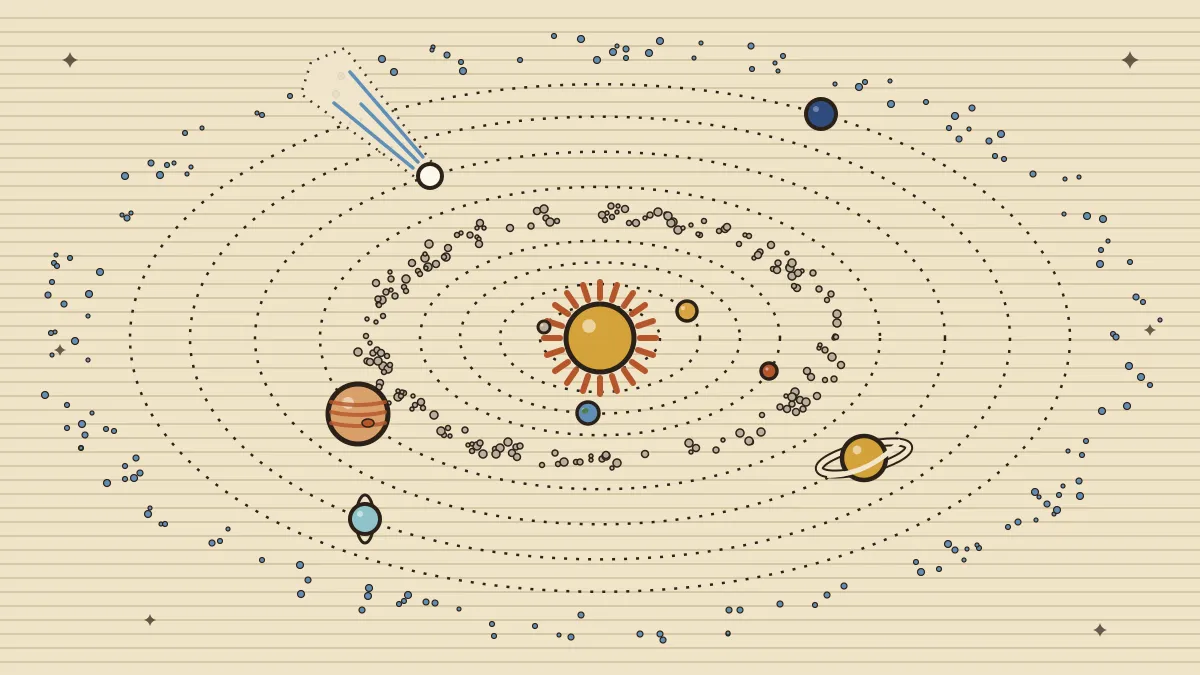
Largest: Jupiter. Smallest, nearest the Sun and least massive: Mercury. Hottest: Venus (not Mercury, because of its greenhouse atmosphere). Densest: Earth. Least dense: Saturn. Most known moons: Saturn. Fastest spin: Jupiter. Longest day: Venus (243 Earth days, longer than its 225-day year). Farthest: Neptune.
Moons. Mercury and Venus have none, Earth has one, and Mars has two. Jupiter, Saturn, Uranus and Neptune have dozens each. Counts rise as new moons are found, so examiners ask "which has the most". Saturn leads with well over 250 known moons, Jupiter has more than 90, Uranus about 28 or 29 and Neptune about 16.
Why are the inner planets rocky and the outer ones gaseous? The inner planets formed near the Sun, where it was too warm for gases to condense and where the strong solar wind blew away much of the gas and dust. Their low gravity could not hold on to what escaped. The outer planets formed farther out, in cooler regions, where the solar wind was too weak to strip them, and they kept their huge gas envelopes.
Odd Spinners: Venus, Uranus and the Direction of Rotation
Most planets rotate in the same sense as Earth, from west to east, and also orbit the Sun in that sense. Two do not. Venus rotates backwards (retrograde), so the Sun would rise in the west there. Its rotation is so slow, 243 Earth days, that its day is longer than its year. Uranus is tipped over on its axis by about 98 degrees, so it rolls around its orbit almost on its side, and each pole sees roughly 42 years of sunlight followed by 42 years of dark.
Compare these with Earth's tilt of 23.5 degrees, which produces our seasons. That story is covered on our page on Earth's rotation and revolution. The point for the exam is that axial tilt, not distance from the Sun, causes seasons.
Mercury is closest to the Sun, but Venus is hotter, because its thick carbon-dioxide atmosphere traps heat (a runaway greenhouse effect). Neptune is farthest, but Uranus has recorded the coldest temperatures.
Asteroids, the Kuiper Belt, the Oort Cloud, Comets and Meteors
| Region | Location | What is there |
|---|---|---|
| Asteroid belt | Between Mars and Jupiter (about 2 to 3.5 AU) | Rocky and metallic fragments, left over from a planet that never formed because of Jupiter's gravity. Their combined mass is far less than the Moon's. Ceres is the largest |
| Kuiper belt | Beyond Neptune (about 30 to 50 AU) | Icy bodies including Pluto, Haumea and Makemake; the source of most short-period comets |
| Oort cloud | A distant, hypothetical shell, thousands of AU out and reaching perhaps a light year or more | Trillions of icy bodies; the source of long-period comets. It has never been observed directly |
Some asteroids also sit at the stable Lagrange points in front of and behind Jupiter, called the Trojan asteroids. NASA's solar-powered Lucy probe, launched in 2021, was sent to study them. UPSC asked this in CDS 2022-I (see below). The same "Lagrange" idea is what keeps India's Aditya-L1 in place near the Sun, and it is covered on our satellite orbits page.
Comets are "dirty snowballs" of ice, dust and rock. When one nears the Sun, the ice turns to gas and forms a glowing head (the coma) and tails. A comet's tail always points away from the Sun, pushed by the solar wind and radiation, whichever way the comet is moving. Halley's comet returns about every 76 years. It was last seen in 1986 and is expected again in 2061.
| Term | Meaning |
|---|---|
| Meteoroid | A small rock or dust grain moving through space |
| Meteor ("shooting star") | The streak of light when a meteoroid burns up in Earth's atmosphere |
| Meteorite | A piece that survives the fall and reaches the ground |
Meteor showers occur when Earth passes through a comet's dusty trail. The Leonids peak in mid-November (around the 17th and 18th), the Perseids in August. India's best-known meteorite-impact feature is Lonar Lake in Maharashtra, a crater lake in basalt rock.
India and the Solar System: Chandrayaan, Mangalyaan, Aditya-L1
| Mission | Target | What to remember |
|---|---|---|
| Chandrayaan-1 (2008) | Moon | India's first lunar mission; an orbiter that helped confirm water molecules on the Moon |
| Chandrayaan-2 (2019) | Moon | Orbiter worked; the lander Vikram and the six-wheeled rover Pragyan were lost in the landing |
| Chandrayaan-3 (landing 23 August 2023) | Moon | Landed near the south pole, the first country to do so; 23 August is National Space Day |
| Mangalyaan (Mars Orbiter Mission, launched 2013) | Mars | Entered Mars orbit on 24 September 2014: India the first Asian country to reach Mars orbit, and the first to do it on the first attempt |
| Aditya-L1 (launched 2 September 2023) | Sun | India's first solar observatory in space; in a halo orbit around the Sun-Earth L1 point, about 1.5 million km from Earth, reached in January 2024 |
The Venus Orbiter Mission, approved by the Government in 2024, would add a mission to the planet discussed above. For the story of these missions and the private space sector, see our article on India's space odyssey from Mangalyaan to a space station. For what Aditya-L1 studies, see the article on space weather and solar storms.
How UPSC Has Asked It: Past Papers Solved
UPSC asks this topic as record facts, planet groups and the odd numerical on Kepler's law. All seven questions below are CDS or NDA papers.
Consider the following statements about some planets in the solar system: 1. Mercury has no atmosphere. 2. Venus has two moons. 3. There is no land on Jupiter. 4. Rings of Saturn are composed of lumps of ice and dust. Which of the statements given above are correct?
(a) 1 and 2 only (b) 3 and 4 only (c) 1, 2 and 3 (d) 1, 3 and 4
Answer: (d). Statement 2 is false: Venus has no moon at all. Mercury has only a trace of gas, treated as "no atmosphere" at this level. Jupiter is a gas giant with no solid surface, and Saturn's rings are lumps of ice and dust.
Which one among the following planets has the largest number of known satellites?
(a) Mars (b) Neptune (c) Jupiter (d) Saturn
Answer: (d). Saturn overtook Jupiter in the count of known moons. The tempting answer, Jupiter, was correct only a few years ago, so older notes may mislead.
Which one of the following is the correct sequence of arrangement of the given planets in descending order of their density (in gm/cm³)?
(a) Earth > Jupiter > Venus > Saturn (b) Jupiter > Earth > Saturn > Venus (c) Earth > Venus > Jupiter > Saturn (d) Earth > Venus > Saturn > Jupiter
Answer: (c). Earth (5.5) is the densest, then Venus (5.2), then Jupiter (1.3), and Saturn (0.7) is the least dense. The terrestrial planets come before the gas giants. Option (d) swaps the last two.
The four planets closest to the Sun are called
(a) terrestrial planets (b) giant planets (c) dwarf planets (d) gas planets
Answer: (a). Mercury, Venus, Earth and Mars are rocky and earth-like. The giant or gas planets are the outer four.
Two planets orbit the Sun in circular orbits, with their radius of orbit as R₁ = R and R₂ = 4R. Ratio of their periods (T₁ / T₂) around the Sun will be
(a) 1/16 (b) 1/8 (c) 1/4 (d) 1/2
Answer: (b). By Kepler's third law T² ∝ R³. So T₁/T₂ = (R₁/R₂)^(3/2) = (1/4)^(3/2) = 1/8. The tempting answer (a) uses T ∝ R². Square the period and cube the radius.
To study which one of the following was a spacecraft launched that would be farthest from the Sun and would run exclusively on solar power?
(a) Jupiter's Trojan asteroids (b) Saturn's rings and moons (c) Mars' atmosphere (d) Kuiper Belt and Oort Cloud
Answer: (a). This is NASA's Lucy mission (2021), which goes to the Trojan asteroids that share Jupiter's orbit. It is solar-powered even at that distance. The Kuiper belt and Oort cloud are farther still, and probes sent that far, such as New Horizons, carried nuclear power sources.
Which of the following are the major missions of Indian Space Research Organization in 2023? 1. Chandrayaan-3 2. Solar Mission Aditya-L1 3. Liquid fuel powered rockets 4. Solar powered rockets
(a) 1 and 2 only (b) 1, 2 and 3 (c) 3 and 4 only (d) 1, 2, 3 and 4
Answer: (a). Chandrayaan-3 and Aditya-L1 were the two major missions of 2023. Liquid-fuel rockets and "solar-powered rockets" are not missions at all.
Most wrong options are the near-miss record: the second-densest planet, Mercury as the hottest, Jupiter as the planet with the most moons. For each superlative, learn both the winner and the planet that people wrongly pick.
Practice MCQs (with answers)
- Which of the following separates a planet from a dwarf planet under the IAU definition?
- The number of moons
- Being nearly round
- Having cleared the neighbourhood of its orbit
- Being larger than Pluto
- The only dwarf planet found in the asteroid belt is
- Ceres
- Eris
- Haumea
- Makemake
- The hottest planet in the solar system is
- Mercury
- Mars
- Earth
- Venus
- The planet with the lowest density, less than that of water, is
- Neptune
- Saturn
- Uranus
- Mercury
- Most short-period comets come from the
- Kuiper belt
- Oort cloud
- asteroid belt
- rings of Saturn
- A piece of space rock that survives its passage through the atmosphere and lands on Earth is a
- meteor
- meteoroid
- meteorite
- comet
- Which planet rotates on its side, with an axial tilt of about 98 degrees?
- Neptune
- Saturn
- Venus
- Uranus
- India's Aditya-L1 observatory is placed near
- the Moon's south pole
- the Sun-Earth L1 point
- Mars's orbit
- Earth's geostationary orbit
1-c, 2-a, 3-d, 4-b, 5-a, 6-c, 7-d, 8-b. Q3: Venus beats Mercury because of its greenhouse atmosphere. Q5: Oort-cloud comets are mostly long-period ones. Q7: Venus spins backwards, but Uranus is the one tipped on its side.
Quick Revision
- 13 Nov 2026: PM inaugurates the COSMOS Planetarium, Mysuru, India's first LED-dome planetarium (IIA and University of Mysore).
- IAU 2006 (Prague): a planet orbits the Sun, is nearly round and has cleared its orbit. Pluto fails the third test. Eight planets, five dwarf planets (Ceres, Pluto, Haumea, Makemake, Eris).
- Inner = terrestrial (Mercury, Venus, Earth, Mars). Outer = Jovian (Jupiter, Saturn, Uranus, Neptune); Uranus and Neptune are ice giants.
- Records: Jupiter largest; Mercury smallest and nearest; Venus hottest; Earth densest; Saturn least dense and most moons; Venus' day is longer than its year; Venus and Uranus spin unusually.
- Asteroid belt between Mars and Jupiter; Kuiper belt beyond Neptune (short-period comets); Oort cloud (long-period comets). Comet tails point away from the Sun. Halley: 76 years, next 2061.
- Meteoroid, meteor, meteorite. Lonar Lake is a meteor-impact crater.
- Kepler: ellipses; equal areas in equal times; T² ∝ a³.
- India: Chandrayaan-3 near the south pole (23 Aug 2023); Mangalyaan in Mars orbit on 24 Sep 2014; Aditya-L1 at Sun-Earth L1 (2024).
Frequently asked questions
Why is Pluto no longer a planet?
In 2006 the International Astronomical Union defined a planet as a body that orbits the Sun, is nearly round and has cleared the neighbourhood around its orbit. Pluto meets the first two tests but shares its region with many other icy bodies, so it was reclassified as a dwarf planet. The solar system now has eight planets.
Which planet is the hottest, and why is it not Mercury?
Venus is the hottest planet, with a surface temperature of about 465 degrees Celsius. Its thick carbon-dioxide atmosphere traps heat in a runaway greenhouse effect. Mercury is nearer the Sun but has almost no atmosphere, so it loses its heat at night.
What is the difference between an asteroid, a comet and a meteor?
Asteroids are rocky or metallic bodies, most of them in the belt between Mars and Jupiter. Comets are icy and develop a glowing head and tails near the Sun. A meteor is the streak of light made when a small body burns up in Earth's atmosphere, and a meteorite is a piece that reaches the ground.
What are the Kuiper belt and the Oort cloud?
The Kuiper belt is a ring of icy bodies beyond Neptune, home to Pluto and the source of short-period comets. The Oort cloud is a hypothetical, distant shell of icy bodies that is thought to supply long-period comets. It has never been observed directly.
What are the main Indian missions to study the solar system?
Chandrayaan-1, 2 and 3 went to the Moon, and Chandrayaan-3 landed near the south pole in August 2023. Mangalyaan, the Mars Orbiter Mission, entered Mars orbit in September 2014. Aditya-L1, launched in September 2023, studies the Sun from the Sun-Earth L1 point.
Related CDS / OTA Science topics
Science is a third of the CDS GS paper
Cavalier's CDS/OTA batches teach physics, chemistry and biology from first principles, with numericals and weekly PYQ tests.