At 8:25 pm on 6 April 2026, the 500 MWe Prototype Fast Breeder Reactor (PFBR) at Kalpakkam in Tamil Nadu reached first criticality. The Department of Atomic Energy announced it the next day, and a PIB backgrounder of 28 August 2026 called it the beginning of the second stage of India's three-stage programme. The same backgrounder gives the position today: 24 operating power reactors with 8.78 GW, nine more under construction (7.5 GW), and a target of 100 GW by 2047. In March 2026 Canada's Cameco also agreed to supply about 22 million pounds of uranium concentrate between 2027 and 2035, a reminder that India imports uranium. Our radioactivity page covers fission and reactor parts. This article goes narrower: Bhabha's plan, the three reactor types and the fuel that moves between them. UPSC has tested pieces of it in most years since 2018.
Why Three Stages: Poor Uranium, Rich Thorium
By Abhishek Thakur · Science faculty, The Cavalier · 15 years teaching NDA and CDS Science
Everything follows from the fuel. Natural uranium is 99.3% uranium-238 and only about 0.7% uranium-235. Only U-235 splits readily with slow neutrons. India's uranium ore is low-grade and has to be topped up by imports. What India does have is thorium-232, found in the monazite sands of the coast: Kerala, Tamil Nadu, Andhra Pradesh, Odisha, West Bengal and Jharkhand.
Thorium cannot run a reactor by itself. It is fertile, not fissile.
| Fissile (sustains the chain) | Fertile (must be converted first) | |
|---|---|---|
| Natural source | Uranium-235 (0.7% of natural uranium) | Uranium-238 (99.3%), thorium-232 |
| Made in a reactor | Plutonium-239 (from U-238), uranium-233 (from Th-232) | None: these are the products |
The conversions are two short chains of neutron capture and beta decay. Remember that each beta decay raises the atomic number by one.
The plan to exploit this was proposed by Homi Jehangir Bhabha in 1954. He is the physicist behind the Tata Institute of Fundamental Research and the atomic energy establishment at Trombay, later renamed after him. Our article on Bhabha's legacy covers his institutions. The logic was practical. After India's 1974 test, nuclear exports to India were restricted, and PIB says the strategy was shaped by fuel embargoes. A programme that began on natural uranium and then grew its own fuel needed nobody's permission. The 2008 Nuclear Suppliers Group waiver reopened imports, but the design still stands.
The Chain at a Glance: What Each Stage Hands to the Next
| Stage | Reactor | Fuel in | Moderator, coolant | What it hands on |
|---|---|---|---|---|
| I | Pressurised Heavy Water Reactor (PHWR) | Natural uranium | Heavy water (D₂O), both | Electricity, and plutonium-239 in the spent fuel |
| II | Fast Breeder Reactor (FBR) | Plutonium-239 (mixed oxide); U-238 blanket, later thorium | No moderator; liquid sodium coolant | Electricity, more plutonium than it burns, and uranium-233 from thorium |
| III | Thorium-based reactors (for example the AHWR design) | Uranium-233 with thorium-232 | Heavy water, light-water coolant | Electricity, with U-233 bred from the thorium itself |
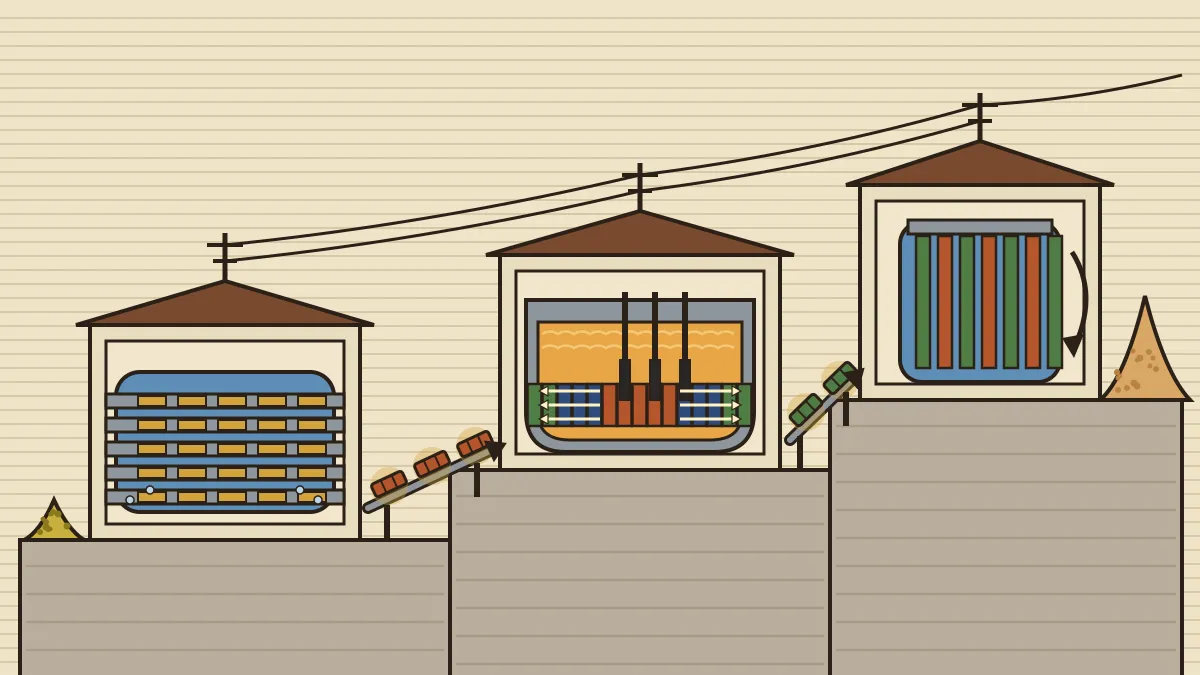
India follows a closed fuel cycle: spent fuel is reprocessed to recover plutonium and unused uranium, and only the remaining high-level waste is locked into glass by vitrification. The open (once-through) cycle, used by the United States, treats spent fuel as waste. Stage II needs reprocessing, because plutonium must be separated from spent Stage I fuel first.
Stage I: Heavy Water and Natural Uranium
Fission neutrons are born fast, with an average energy near 2 MeV. U-235 captures slow (thermal) neutrons far more readily, so thermal reactors surround the fuel with a moderator that slows the neutrons by collisions. The moderator must slow neutrons without swallowing them. Ordinary water slows them well but absorbs enough that a chain reaction cannot hold on natural uranium. Heavy water absorbs very few, which is why India's first-stage reactors need no enriched uranium.
| Feature | PHWR (India's workhorse) | Light-water reactor (most of the world) |
|---|---|---|
| Fuel | Natural uranium | Uranium enriched to a few per cent U-235 |
| Moderator | Heavy water | Ordinary water |
| Coolant | Heavy water, under pressure, in many horizontal tubes | Ordinary water (PWR or BWR types) |
| Needs enrichment plant? | No | Yes |
| Indian examples | Rawatbhata, Kakrapar, Kaiga, Narora, Tarapur 3 and 4 | Tarapur 1 and 2 (boiling water, 1969); Kudankulam (Russian pressurised-water units) |
Indian PHWR designs have grown from 220 MWe to 540 MWe and then to the 700 MWe unit built at Kakrapar. The Government has approved 10 indigenous PHWRs in fleet mode, meaning one repeated design built in series to cut cost and time. Two more 500 MW breeders are in pre-project stage. For deuterium itself, see our page on hydrogen isotopes.
Inside a running PHWR some U-238 atoms catch neutrons and follow the first chain above, so the spent bundles hold plutonium-239. Beyond power, that is Stage I's job: it makes the fuel for Stage II.
In a PHWR, heavy water is both moderator and coolant (in separate circuits). Kudankulam is not a PHWR: its Russian units are light-water reactors that run on enriched uranium. Tarapur 1 and 2 were India's first power reactors in 1969 and are boiling-water reactors, not heavy-water ones. In 2026 they received a ten-year life extension; see our Tarapur article.
Stage II: The Breeder at Kalpakkam
A breeder produces more fissile material than it consumes. The neutron accounting explains how. Each fission of plutonium-239 releases close to three neutrons. One is needed to keep the chain going. A second can convert one atom of fertile U-238 into new plutonium. If the third is not lost to leakage or capture, the reactor ends up with more fuel than it started with. In a fast spectrum that surplus is real; in a slowed spectrum too many neutrons are absorbed without fission. So a breeder must keep the neutrons fast, which means no moderator, and a coolant that does not slow them.
That coolant is liquid sodium. Sodium atoms are heavy (23 u), so they slow neutrons very little. The metal melts at about 98 °C and boils near 883 °C, so it stays liquid at high temperature without high pressure, and it carries heat away very well. The price is safety: sodium burns in air and reacts violently with water. The design therefore places an intermediate sodium loop between the radioactive primary sodium and the steam generators.
| Date | Milestone at Kalpakkam |
|---|---|
| October 1985 | Fast Breeder Test Reactor (FBTR), 40 MWt, reaches first criticality; it burns a plutonium–uranium carbide fuel developed in India |
| 1996 | KAMINI, a small research reactor fuelled with uranium-233, first goes critical (29 October) |
| 2004 | Construction of the 500 MWe PFBR begins; criticality was then planned for 2010 |
| March 2024 | Fuel loading starts at the PFBR |
| 6 April 2026 | PFBR attains first criticality (8:25 pm); announced 7 April |
The PFBR was designed by the Indira Gandhi Centre for Atomic Research (IGCAR) and built and commissioned by BHAVINI (Bharatiya Nabhikiya Vidyut Nigam Limited), a DAE public-sector company. PIB says nearly 90 per cent of its equipment was made in India. Its core burns mixed oxide (MOX), a blend of plutonium and uranium oxides. Around the core sits a blanket of U-238 that fast neutrons turn into plutonium-239, and the blanket is meant to carry thorium-232 later. The honest footnote: a parliamentary committee put the cost at ₹8,181 crore against an original ₹3,492 crore, and criticality came about sixteen years after the first target. Our DAE sodium-cell article has more on the sodium systems.
Criticality means the chain reaction has become self-sustaining, which the PFBR did at very low power. Power raising in steps up to 500 MWe, synchronisation with the grid and the measured breeding of new fuel all come later, under the Atomic Energy Regulatory Board. An answer that says the PFBR "now supplies 500 MW" is wrong.
Stage III: Thorium and Uranium-233
Stage III is the destination. Uranium-233 bred from thorium has a useful property: it yields enough neutrons per absorption that breeding is possible even in a slowed (thermal) reactor, not only a fast one. That opens the door to the Advanced Heavy Water Reactor (AHWR), a 300 MWe design from the Bhabha Atomic Research Centre. It is heavy-water moderated with boiling light-water coolant in vertical tubes, and it is built to burn thorium. It is still a design, so any claim that India "runs on thorium" is premature.
Stage III is slow for three reasons. Thorium needs a fissile starter, so the breeders must come first. Protactinium-233 decays with a half-life of about 27 days, so thorium converts far more slowly than U-238. And U-233 carries traces of U-232, whose decay products emit hard gamma rays, so the fuel is handled behind shielding. The monazite is processed by IREL (India Rare Earths Limited), which also recovers rare earths from the same sands.
| Body | Role in the programme |
|---|---|
| DAE and the Atomic Energy Commission | Apex department and policy body (Bhabha was the Commission's first chairman) |
| BARC, Trombay | Reactor design, fuel cycle, AHWR |
| IGCAR, Kalpakkam | Fast reactor science; designed the PFBR |
| NPCIL and BHAVINI | NPCIL runs the power reactors; BHAVINI builds the fast breeders |
| UCIL and IREL | Uranium mining (Jaduguda in Jharkhand, Tummalapalle in Andhra Pradesh) and monazite processing |
The SHANTI Act, 2025 opens atomic power to Indian private companies (see our SHANTI Act article), and the Union Budget 2025-26 set aside ₹20,000 crore for indigenous small modular reactors, at least five by 2033. None of this changes the fuel logic above.
How UPSC Has Asked It: Past Papers Solved
Six questions, from NDA and CDS papers 2018 to 2026.
Which one of the following metals is alloyed with sodium to transfer heat in a nuclear reactor?
(a) Potassium (b) Calcium (c) Magnesium (d) Strontium
Answer: (a). Sodium–potassium alloy (NaK) is liquid at ordinary temperatures and is used as a liquid-metal coolant. Calcium, magnesium and strontium do not form such a coolant alloy with sodium. The PFBR itself uses pure sodium.
Which one of the following minerals is used as a fuel in nuclear power stations?
(a) Bauxite (b) Quartz (c) Feldspar (d) Pitchblende
Answer: (d). Pitchblende is the chief ore of uranium. Bauxite is the ore of aluminium, and quartz and feldspar are silica-based minerals. For thorium the ore to remember is monazite.
Of the following, which does not belong to a nuclear reactor?
(a) A turbine (b) A heat exchanger (c) A mechanism to reduce CO₂ emission (d) A reaction chamber
Answer: (c). A nuclear plant has a reactor core, heat exchangers and steam generators, and a turbine. Fission releases no CO₂, so there is nothing to capture. The tempting (b) is wrong: a heat exchanger carries the core's heat to the steam circuit.
Which of the following statements about 'fission' is correct? 1. It is related with the creation of new individuals by means of cell division in unicellular organism. 2. It is related with the transformation of heavier nuclei into smaller nuclei. 3. It is related with the creation of a heavier nuclei by means of combining two higher nuclei.
(a) 1 only (b) 2 only (c) 1 and 2 only (d) 1 and 3 only
Answer: (c). Binary fission in an amoeba and nuclear fission in uranium both split one body into two. Statement 3 describes fusion. The tempting (b) forgets the biological meaning of the word.
Which one of the following issues was included in the Indo-US Nuclear Agreement of 2007?
(a) India has advance right to reprocess US-origin safeguarded spent fuel. (b) India did not have the right to build a strategic fuel reserve with the help of the other supplier countries. (c) India should not test a nuclear device. (d) The Agreement will impede the growth of India's nuclear weapons programme.
Answer: (a). Reprocessing links Stage I to Stage II, which is why India wanted it. The agreement also let India build a fuel reserve, so (b) is the opposite of the truth. Options (c) and (d) are criticisms of the deal, not its terms.
Which two countries signed a US$2·6 billion uranium supply agreement in March 2026 ?
(a) India and Russia (b) India and Canada (c) India and Australia (d) Australia and Canada
Answer: (b). Cameco of Canada agreed to supply India's Department of Atomic Energy with nearly 22 million pounds of uranium concentrate between 2027 and 2035, during the visit of Canada's Prime Minister to India in early March 2026. Releases quote the value as about C$2.6 billion, so the dollar sign is loose, but the country pair decides the answer.
Questions are mostly plain definitions (fission, ores, reactor parts); the rest tie a reactor fact to an agreement or event. Learn the stage table, the fissile and fertile lists and the 2026 milestones.
Practice MCQs (with answers)
- When thorium-232 absorbs a neutron and then undergoes two beta decays, the fissile nucleus formed is
- uranium-235
- uranium-233
- plutonium-239
- protactinium-233
- A PHWR can run on natural uranium mainly because its heavy-water moderator
- absorbs only a few neutrons
- absorbs most neutrons
- turns U-238 into U-235
- is cheaper than graphite
- A fast breeder reactor has no moderator because
- moderated neutrons would be absorbed without enough fission to breed
- moderators are radioactive
- sodium cannot carry heat
- plutonium cannot be placed near water
- Which statement about liquid sodium as a breeder coolant is correct?
- It slows neutrons strongly
- It stays liquid over a wide range without high pressure
- It does not react with water
- It is used only in Stage I reactors
- The fissile isotope that accumulates in spent PHWR fuel is
- thorium-232
- uranium-238
- uranium-233
- plutonium-239
- On 6 April 2026 the PFBR at Kalpakkam
- attained first criticality
- was connected to the grid at 500 MW
- began burning thorium fuel
- started breeding uranium-233 at full power
- Which of these is a fertile, not fissile, material?
- Uranium-235
- Thorium-232
- Uranium-233
- Plutonium-239
- India's closed fuel cycle means that
- spent fuel is never reprocessed
- spent fuel is reprocessed to recover plutonium and uranium
- all reactors run on enriched uranium
- no waste is produced
1-b, 2-a, 3-a, 4-b, 5-d, 6-a, 7-b, 8-b. Q1: Th-232 → Th-233 → Pa-233 → U-233; protactinium-233 is the intermediate, so (d) is the trap. Q3: in a slowed spectrum too many neutrons are captured without fission, so the surplus needed for breeding is lost. Q6: criticality is only the start; grid connection and breeding come later. Q8: closed means recycled, not waste-free.
Quick Revision
- Natural uranium: 99.3% U-238, 0.7% U-235. Fissile: U-235, Pu-239, U-233. Fertile: U-238, Th-232. Thorium ore: monazite; uranium ore: pitchblende.
- Bhabha proposed the three stages in 1954. Stage I: PHWR, natural uranium, heavy water, gives Pu-239. Stage II: FBR, Pu-239, no moderator, liquid sodium, breeds Pu-239 and U-233. Stage III: thorium–U-233 reactors (AHWR design).
- PFBR: 500 MWe, Kalpakkam, IGCAR design, BHAVINI builder, MOX fuel, first criticality 6 April 2026. FBTR 1985 (40 MWt); KAMINI 1996 (U-233).
- Criticality is not breeding or grid power. India uses a closed fuel cycle with vitrification of waste.
- Today: 24 reactors, 8.78 GW; nine under construction (7.5 GW); 10 PHWRs approved in fleet mode; target 100 GW by 2047; SHANTI Act 2025; Cameco deal 2027-2035.
Frequently asked questions
Why does India follow a three-stage nuclear programme?
India has little good uranium but large thorium reserves in coastal monazite sands. Thorium cannot sustain a chain reaction on its own, so Bhabha's 1954 plan first builds fuel from uranium and plutonium, then converts thorium into uranium-233.
What is the difference between fissile and fertile material?
Fissile material such as uranium-235, plutonium-239 and uranium-233 can sustain a chain reaction directly. Fertile material such as uranium-238 and thorium-232 cannot, but it turns into fissile material after absorbing a neutron and undergoing two beta decays.
Why do Indian PHWRs use heavy water?
Heavy water slows fission neutrons while absorbing very few of them. That lets a reactor sustain a chain reaction on natural uranium without enrichment. Ordinary water absorbs more neutrons and needs enriched fuel.
What happened at Kalpakkam on 6 April 2026?
The 500 MWe Prototype Fast Breeder Reactor attained first criticality, meaning a self-sustaining chain reaction began. IGCAR designed it and BHAVINI built it. Raising power, grid connection and net breeding come later.
Is India already running reactors on thorium?
No. Thorium is a planned blanket material, and the Advanced Heavy Water Reactor meant to burn it is still a design. Thorium needs uranium-233 or plutonium to start, which is why the breeder stage comes first.
Related CDS / OTA Science topics
Science is a third of the CDS GS paper
Cavalier's CDS/OTA batches teach physics, chemistry and biology from first principles, with numericals and weekly PYQ tests.