India observes National Cancer Awareness Day on 7 November, a date the Union Health Ministry has marked since 2014 and which is widely linked to the birth anniversary of Marie Curie. This year it comes with a policy story. On 6 November the PIB released a backgrounder on the 30% cap on trade margins that the National Pharmaceutical Pricing Authority (NPPA) placed on 137 anti-cancer medicines by its order of 17 October 2026, effective 9 November. The story starts with one cell that stops obeying the rules of division. UPSC asked about cancer in the latest CDS sitting (CDS 2026-II). The questions are always some mix of how a cell turns malignant, how it spreads, what causes it, how it is found and how it is treated.
The Rules Normal Cells Obey
By Akanksha Kumari · Science faculty, The Cavalier · B.Tech, 15 years teaching Science
Every cell in your body descends from one fertilised egg, and every one is on a leash. The sequence in which a cell duplicates its genome, makes what it needs and divides into two daughter cells is the cell cycle. A typical human cell completes it in about 24 hours, yet division itself takes only about an hour. More than 95% of the cycle is interphase, the "resting" phase of growth and preparation.
| Phase | What happens | Cancer link |
|---|---|---|
| G1 (gap 1) | The cell grows; DNA is not copied | The main "go or stop" decision |
| S (synthesis) | DNA is replicated: 2C to 4C, chromosome number stays 2n | Copying errors become mutations |
| G2 (gap 2) | Proteins for division are made | A checkpoint inspects the new DNA |
| M phase | Mitosis: prophase, metaphase, anaphase, telophase, then cytokinesis | A spindle checkpoint confirms every chromosome is attached |
| G0 (quiescent) | The cell leaves the cycle but stays alive (heart cells) | Cancer cells refuse to stay here |
Mitosis is equational division: the daughters get the same chromosome number as the parent. Meiosis, which halves the number, is for gametes only (CDS 2026-II tested this contrast).
Checkpoints act like inspectors on an assembly line. At each one, proteins check whether the DNA is intact and whether the cell has the signals to divide. A faulty cell is repaired or told to die by apoptosis, programmed cell death. Normal cells also show contact inhibition: a dividing cell that touches its neighbours stops. Cancer is what happens when these controls fail together. The cell ignores the brakes and the order to die, and its daughters inherit the fault.
Cancer is the uncontrolled, unwanted growth of cells, caused by a breakdown of the mechanisms that regulate growth and differentiation. It is non-infectious: you cannot catch cancer from a patient, though some viruses and one bacterium that raise the risk can be caught.
Benign, Malignant and the Spread
Cells that keep dividing form a lump called a tumour (neoplasm). Not every tumour is cancer.
| Feature | Benign tumour | Malignant tumour (cancer) |
|---|---|---|
| Growth | Slow | Rapid |
| Boundary | Stays confined to the original site | Invades the surrounding normal tissue |
| Spread | Does not spread to other parts | Metastasis: cells travel to distant organs |
| Danger | Usually little | Serious; can be fatal if untreated |
| Examples | Wart, fibroid | Lung, breast, oral, cervical cancers |
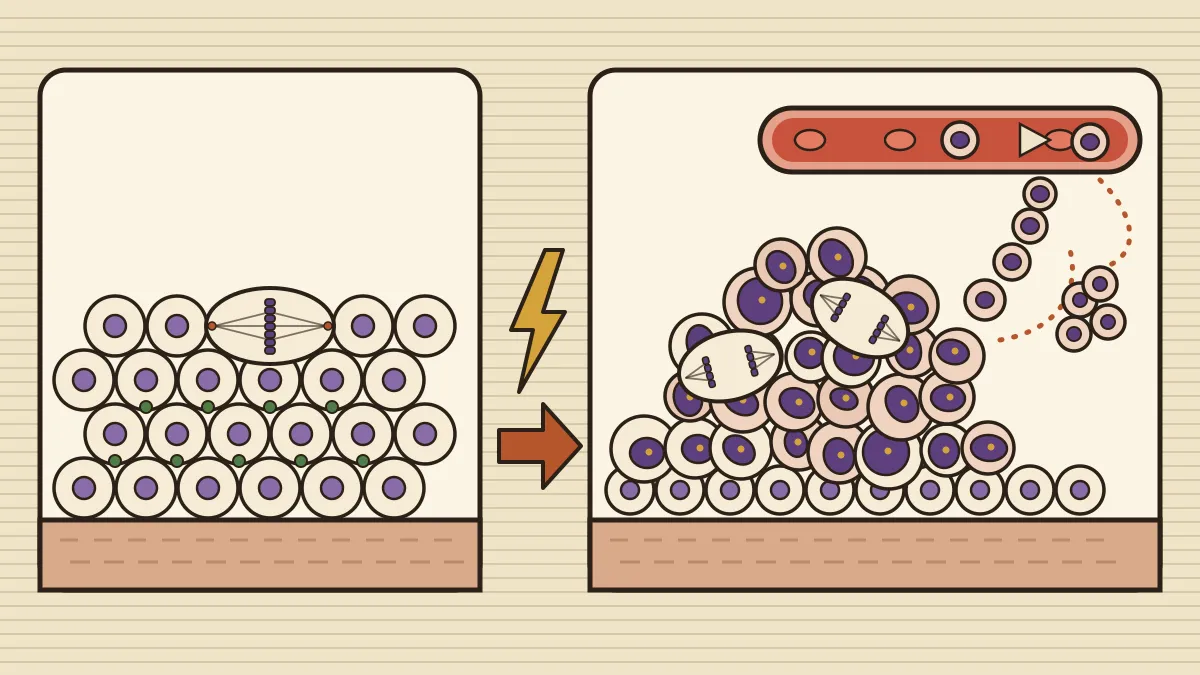
A malignant tumour invades healthy tissue and starves normal cells by competing for nutrients; it also recruits its own blood vessels (angiogenesis). Most dangerous of all, shed cells reach distant sites through blood and lymph and start new tumours wherever they lodge. This is metastasis, the most feared property of cancer and the reason early detection saves lives.
Doctors name cancers by the tissue they begin in:
| Type | Arises in | Examples |
|---|---|---|
| Carcinoma | Epithelial tissue (skin, linings of lung, gut, breast, cervix) | The commonest group: lung, breast, oral, cervical |
| Sarcoma | Connective tissue: bone, cartilage, muscle | Osteosarcoma (bone) |
| Leukaemia | Blood-forming bone marrow | No solid lump; abnormal white cells crowd the blood |
| Lymphoma | Lymph nodes | Hodgkin and non-Hodgkin lymphoma |
Malignant malaria (Plasmodium falciparum) has nothing to do with cancer; there "malignant" only means dangerous. Our viral and bacterial diseases page covers the infectious side, so keep cancer in the non-infectious column.
What Triggers It: Carcinogens and Cancer Genes
Any agent that can turn a normal cell into a cancer cell is a carcinogen. The common thread is damage to DNA: most carcinogens are also mutagens.
| Kind | Examples | What to remember |
|---|---|---|
| Physical | X-rays and gamma rays (ionising); ultraviolet light (non-ionising) | Both damage DNA. UV causes skin cancer |
| Chemical | Tobacco smoke, smokeless tobacco, asbestos, aflatoxin (mould on stored groundnuts) | Tobacco smoke: lung cancer. Chewing tobacco (gutkha): oral cancer, common in India |
| Biological | Human papillomavirus (HPV), hepatitis B and C viruses, Epstein-Barr virus, Helicobacter pylori (a bacterium) | HPV: cervical cancer. Hepatitis B and C: liver cancer. H. pylori: stomach cancer |
Peyton Rous first showed in 1911 that a virus could cause a sarcoma in chickens (Nobel Prize, 1966). Harald zur Hausen shared the 2008 Nobel Prize in Physiology or Medicine for showing that HPV causes cervical cancer, which led to the vaccine.
The real story is in the genes. Two families of genes control division:
- Proto-oncogenes are the accelerator. They are normal genes that push cells to divide when needed. A mutation or virus can switch one permanently "on", making it an oncogene; one faulty copy is enough. Examples: RAS, HER2 (breast cancer) and BCR-ABL (chronic myeloid leukaemia). Bishop and Varmus won the 1989 Nobel Prize for showing that viral oncogenes are hijacked normal genes.
- Tumour suppressor genes are the brakes. They halt the cycle or order a damaged cell to die, and cause cancer when lost (usually both copies must fail). The best known is TP53, the "guardian of the genome", damaged in about half of all human cancers. Others: RB1 (retinoblastoma, a childhood eye cancer) and BRCA1 and BRCA2 (inherited breast and ovarian cancer risk).
One mutation is rarely enough. Several hits accumulate over years, which is why risk climbs with age and why cervical cancer appears ten to twenty years after HPV infection.
Oncogene = stuck accelerator (gain of function). Tumour suppressor = failed brakes (loss of function).
Finding Cancer: Biopsy, Scans and Markers
Early detection is the biggest lever in cancer survival. The standard methods:
- Biopsy and histopathology. A piece of suspected tissue is cut into thin sections, stained and examined under a microscope: the gold standard, since only a biopsy confirms that a lump is malignant. Leukaemia is found by blood and bone-marrow tests.
- Imaging. X-ray and mammography; CT (X-rays building a three-dimensional image); MRI (strong magnetic fields, non-ionising, good for soft tissue); PET (a radioactive sugar tracer that tumours absorb greedily). The Pap smear screens the cervix.
- Tumour markers. Blood proteins such as PSA (prostate), CA-125 (ovary) and AFP (liver) help to track a cancer, but never prove it alone.
Over 1.86 lakh Ayushman Arogya Mandirs screen people above 30 for oral, breast and cervical cancer.
Treatment: From the Scalpel to CAR-T
Most patients get a combination of three classical treatments: surgery, radiation therapy and chemotherapy. Newer ones target the cancer's own biology or turn the patient's immune system against it.
| Treatment | How it works | Points that get examined |
|---|---|---|
| Surgery | Cuts out the tumour and nearby tissue | Works best before metastasis |
| Radiotherapy | Ionising radiation damages tumour DNA; the beam is aimed to spare healthy tissue | Cobalt-60 gamma rays; sealed iridium-192 placed inside the body; iodine-131 for thyroid cancer |
| Chemotherapy | Drugs that kill rapidly dividing cells | Also hits healthy fast-dividing cells: hair loss, anaemia, nausea |
| Hormone and targeted therapy | Block a protein a particular cancer depends on | Imatinib blocks BCR-ABL in leukaemia; trastuzumab targets HER2 in breast cancer |
| Immunotherapy | Wakes the immune system, which tumours learn to evade | Interferon; checkpoint inhibitors (nivolumab, pembrolizumab); CAR-T cells |
Radiotherapy works because ionising radiation breaks DNA; our radioactivity and nuclear energy page covers the isotopes.
Checkpoint inhibitors earned James Allison and Tasuku Honjo the 2018 Nobel Prize in Physiology or Medicine. T cells carry "off switches" such as PD-1, which some tumours press to hide. These antibody drugs release the brake. Nivolumab and pembrolizumab are on the list of 137 medicines under the margin cap.
CAR-T therapy goes further. Doctors collect the patient's T cells, engineer them in the laboratory to carry a chimeric antigen receptor that recognises a protein on the cancer cell (CD19, in B-cell leukaemias and lymphomas), multiply them and return them as a "living drug". In October 2023 the CDSCO approved NexCAR19, India's first indigenous CAR-T therapy, developed by ImmunoACT, a company incubated at IIT Bombay, with clinical work at Tata Memorial, for relapsed or resistant B-cell leukaemia and lymphoma.
Chemotherapy hits all fast-dividing cells (hence hair loss). A vaccine prevents; it does not treat a cancer already begun.
Prevention and Cost: HPV Vaccine and the Margin Cap
The best cancer is the one that never starts, and two cancers have a vaccine against their cause: the hepatitis B vaccine (liver cancer) and the HPV vaccine (cervical cancer). HPV types 16 and 18 cause about 70% of cervical cancers. India's National HPV Vaccination Campaign, launched on 28 February 2026, gives free single-dose vaccination to about 1.15 crore girls aged 14, and over 80 lakh doses had been given by 11 September. The vaccine is preventive and does nothing for an existing cancer. See our campaign explainer and the immunity and vaccination page.
The third lever is cost. The gap between a manufacturer's price to the distributor and the MRP a patient pays is the trade margin. From the PIB backgrounder:
| Item | Fact |
|---|---|
| Order | NPPA, 17 October 2026; 137 non-scheduled anti-cancer medicines, patented ones included |
| Cap | Trade margin at most 30% of MRP, from the March 2026 distributor price; GST is added on top |
| Effective | 9 November 2026; a medicine already cheaper cannot be made dearer |
| Legal power | Paragraph 19 of the Drugs (Prices Control) Order, 2013, under the Essential Commodities Act. A 2019 pilot covered 42 drugs |
| Result by 4 November | Average cuts 20% to 70%, highest 96.45%; savings ₹3,357.49 crore |
Know the difference between the two kinds of drug. A scheduled drug, on the National List of Essential Medicines (NLEM 2022: 384 medicines), has a government-fixed ceiling price. A non-scheduled drug is only monitored, and its MRP may rise by no more than 10% in twelve months. The margin cap is a third tool that trims the margin without fixing the price. Our earlier explainer covers the legal route. Ayushman Bharat PM-JAY adds cashless cover of ₹5 lakh per family per year, including oncology.
How UPSC Has Asked It: Past Papers Solved
Cancer questions are seldom stand-alone: UPSC tests the idea inside questions on mitosis, radiation and X-rays, and the latest paper combined a gene, a virus and spread.
Which of the following statements associated with cancer is/are correct? 1. Oncogenes expression and some viral infections can cause cancer 2. In metastasis, the cancer cells spread through the blood and lymphatic system
(a) 1 only (b) 2 only (c) Both 1 and 2 (d) Neither 1 nor 2
Answer: (c). Oncogenes and oncogenic viruses cause cancer, and metastasis is spread through blood and lymph. Both statements are textbook.
Which one of the following is NOT true of mitotic cell division?
(a) The nuclei of the two daughter cells in mitosis have same number of chromosomes (b) Replacement of cell and tissue repairing is possible through mitosis (c) Asexual reproduction in eukaryotes is done by mitosis (d) The cells become haploid as a result of mitosis
Answer: (d). Mitosis keeps the chromosome number the same; haploid cells arise only through meiosis. Mitosis does replace and repair tissue, so (b) is true.
Consider the following statements: 1. DNA replication takes place when chromatin is opened up. 2. Chromatin organises itself into rod-shaped chromosomes before cell division. 3. Both prokaryotes and eukaryotes have the same process for cell division. Which of the statements given above is/are correct?
(a) 1 only (b) 1 and 2 only (c) 1, 2 and 3 (d) 3 only
Answer: (b). DNA must be unwound to be copied, and chromatin condenses into chromosomes before division. Statement 3 is wrong: prokaryotes divide by binary fission, not mitosis.
Which one of the following element's isotope is used in the treatment of cancer?
(a) Uranium (b) Cobalt (c) Sodium (d) Iodine
Answer: (b). Cobalt-60 is the gamma-ray source in radiotherapy. Iodine-131 treats thyroid cancer, so (d) tempts, but the key here and in NDA 2021-II, which repeated the question, was cobalt.
Which one of the following statements about X-rays is not true?
(a) They have wavelengths of about 1 Å. (b) These can be generated by bombarding a metal target by high energy electrons. (c) Due to their wavelengths being shorter, these can be used for radar systems. (d) These are also used for the treatment of certain forms of cancer.
Answer: (c). Radar uses microwaves and radio waves. X-rays are made when fast electrons strike a metal target, and are used in cancer diagnosis and treatment.
Expect a statement question pairing a cause (virus, oncogene, radiation) with a feature (metastasis). Know the neighbours: mitosis versus meiosis, X-ray uses, and which isotope treats which disease.
Practice MCQs (with answers)
- In which phase of the cell cycle is DNA replicated?
- G1 phase
- S phase
- G2 phase
- M phase
- Normal cells stop dividing when they touch their neighbours. This property, which cancer cells lose, is called
- metastasis
- angiogenesis
- contact inhibition
- apoptosis
- A cancer that begins in bone or muscle is called a
- sarcoma
- carcinoma
- lymphoma
- leukaemia
- Which of the following is a bacterium linked to stomach cancer?
- Vibrio cholerae
- Salmonella typhi
- Mycobacterium tuberculosis
- Helicobacter pylori
- A gene that normally halts the cell cycle or orders a damaged cell to die, and whose loss promotes cancer, is a
- tumour suppressor gene
- proto-oncogene
- viral oncogene
- mitochondrial gene
- Which of these is NOT a feature of a malignant tumour?
- Rapid growth
- Invasion of neighbouring tissue
- Staying confined to the original site
- Spread to distant organs
- In CAR-T therapy, the cells taken from the patient and genetically modified are
- red blood cells
- platelets
- bone cells
- T cells
- Chemotherapy causes hair loss mainly because
- it destroys all the cells of the body equally
- it damages rapidly dividing cells, including those of hair follicles
- it releases radiation
- it changes the colour of hair pigment
1-b, 2-c, 3-a, 4-d, 5-a, 6-c, 7-d, 8-b. Q4: Vibrio causes cholera, Salmonella typhoid and Mycobacterium tuberculosis. Q6: only a benign tumour stays confined. Q8: chemotherapy hits fast-dividing cells, so hair follicles, bone marrow and the gut lining suffer too.
Quick Revision
- Cell cycle: G1, S, G2, M; interphase is over 95% of the cycle; DNA doubles in S (2C to 4C); mitosis is equational.
- Cancer = uncontrolled growth; cells lose contact inhibition and escape apoptosis; non-infectious.
- Benign: confined, slow. Malignant: invasive, rapid, metastasis via blood and lymph.
- Types: carcinoma (epithelium, commonest), sarcoma (bone, muscle), leukaemia (blood), lymphoma (lymph nodes).
- Carcinogens: physical (X-ray, gamma, UV), chemical (tobacco, asbestos, aflatoxin), biological (HPV 16/18, hepatitis B/C, H. pylori). zur Hausen 2008 (HPV).
- Oncogene = stuck accelerator (RAS, HER2, BCR-ABL); tumour suppressor = failed brakes (TP53, RB1, BRCA1/2).
- Detection: biopsy is the gold standard; X-ray, CT, MRI, PET, Pap smear, markers.
- Treatment: surgery, radiotherapy (cobalt-60), chemotherapy, immunotherapy (Nobel 2018), CAR-T. NexCAR19: first indigenous CAR-T, October 2023.
- HPV vaccine: preventive, single dose, 28 February 2026. NPPA: 30% margin cap on 137 drugs from 9 November 2026. Cancer Awareness Day: 7 November.
Frequently asked questions
What is the difference between a benign and a malignant tumour?
A benign tumour grows slowly, stays where it began and does little harm. A malignant tumour grows quickly, invades nearby tissue and sheds cells that travel through blood and lymph to start new tumours. That spread is called metastasis.
What are oncogenes and tumour suppressor genes?
Proto-oncogenes are normal genes that push cells to divide. When a mutation or virus switches one permanently on, it becomes an oncogene, like a stuck accelerator. Tumour suppressor genes such as TP53 are the brakes, and cancer develops when they are lost.
What causes cancer?
Damage to the genes that control cell division. It can come from physical agents such as X-rays and ultraviolet light, chemicals such as tobacco smoke, or microbes such as HPV, hepatitis B and Helicobacter pylori. Several changes usually accumulate over years.
How is cancer treated?
Most patients receive a mix of surgery, radiotherapy and chemotherapy. Targeted drugs, immunotherapy and CAR-T cell therapy are newer options. India approved its first indigenous CAR-T therapy, NexCAR19, in October 2023.
Why is the HPV vaccine given to 14-year-old girls?
The vaccine is preventive, so it works best before any exposure to the virus. HPV types 16 and 18 cause about 70 percent of cervical cancers, which appear ten to twenty years after infection. India's campaign, launched on 28 February 2026, uses a single dose.
Related CDS / OTA Science topics
Biology is a steady scorer in GS
Cavalier's CDS/OTA batches teach life science from the cell upwards, with diagrams, mnemonics and weekly PYQ tests.