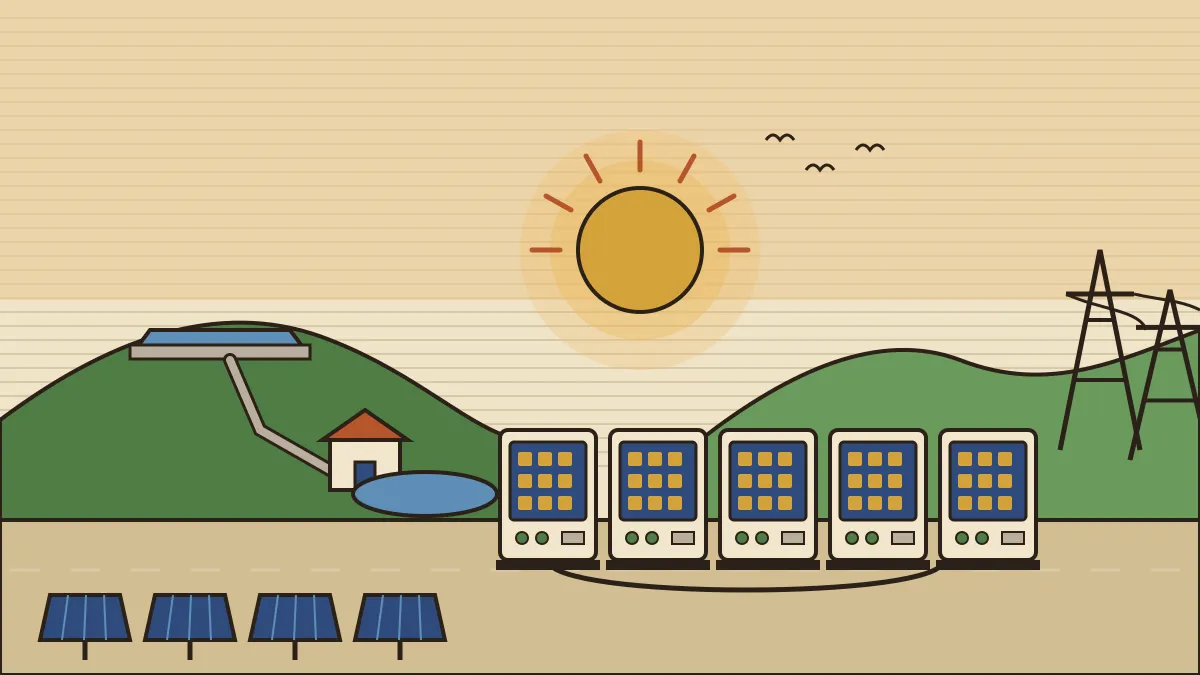
India's electricity system has a timing problem. Solar panels deliver their best output around noon, but the country's demand peaks after sunset, when the panels have gone quiet. Wind is stronger in some seasons and some hours than others. The cheapest way to bridge the gap is not another power plant but a way of holding electricity until it is needed.
On 4 November 2026, the Union Cabinet, chaired by the Prime Minister, approved a scheme built around exactly that idea: the Viability Gap Funding (VGF) Scheme for Development of Grid-Scale Energy Storage Systems. It offers ₹14,500 crore of support over FY 2026-27 to FY 2030-31 to bring 92 GWh of storage that is yet to be commissioned into operation. This article explains what the money is, what it buys, and how the numbers fit together.
The scheme in one table
Every figure below is from the PIB release of 4 November 2026 unless marked as calculated.
| Item | Detail |
|---|---|
| Support | ₹14,500 crore of Viability Gap Funding |
| Period | FY 2026-27 to FY 2030-31 (five years) |
| Capacity supported | 92 GWh, not yet commissioned |
| Pumped storage (hydro PSP) | 60 GWh |
| Battery energy storage (BESS) | 30 GWh |
| Alternative storage technologies | 2 GWh |
| Estimated total investment | ₹97,600 crore |
| Domestic content | Minimum 40% for BESS projects |
| How capacity is awarded | Tariff-based competitive bidding |
| Who can receive VGF | Public and private distribution companies (discoms) for BESS and PSP; public and private entities for alternative technologies |
PIB adds two comparisons. The new capacity equals about 170% of the grid-scale storage India has today, and it will help meet a required grid-scale storage capacity of 411 GWh by 2031-32.
What "viability gap" means
A project can be worth building for the country and still be unattractive to a lender. A storage plant costs a great deal up front, and its income comes slowly, over many years, from selling the difference between cheap and expensive hours. When the expected return falls short of what investors need, there is a viability gap. Viability Gap Funding is a government capital grant that covers part of the project cost so that the remainder can be financed commercially.
Three features make VGF different from a loan or a subsidy on every unit sold:
- It is paid against capital cost, usually in tranches linked to progress, so the government pays for a plant that actually gets built.
- It is awarded through competitive bidding, so the developer who needs the least support wins and the grant shrinks as costs fall.
- It is meant to be temporary: it kick-starts a market that should later stand without help.
India has used the tool in several sectors. The offshore wind VGF of June 2024 provided ₹7,453 crore for the first 1 GW off Gujarat and Tamil Nadu (₹6,853 crore for the projects and ₹600 crore for two ports). The Modified UDAN scheme approved in March 2026 carries a VGF for airlines on regional routes. The storage scheme applies the same logic to a third area. Compare how it is used for aviation in our explainer on Viksit UDAN.
Why storage, and why now
India aims for 500 GW of non-fossil capacity by 2030. Installed non-fossil capacity was 308.027 GW in September 2026, according to the PIB backgrounder summarised in our piece on Bharat RE 2026. Most of the additions are solar and wind, which are variable: their output follows the sun and the weather, not the demand curve.
Storage solves three separate problems:
- Time-shifting. Surplus noon solar is stored and released in the evening peak. Without it, solar plants are switched off at midday while thermal stations ramp up at night.
- Grid stability. Batteries can respond in fractions of a second, supporting frequency and voltage. A larger share of variable power makes the grid more delicate, and storage steadies it.
- Round-the-clock supply. A solar-plus-storage plant can offer power at a committed hour, which is what discoms need and what plain solar cannot promise.
The Central Electricity Authority's planning figures show the size of the task. The National Electricity Plan 2023 projects a need for 208 GWh of BESS by 2030 and, in a PIB reply of April 2025, 236 GWh by 2031-32. The present scheme's 411 GWh is a wider figure for all grid-scale storage, including pumped hydro. Against these targets, a Rajya Sabha reply of 30 March 2026 reported only 798 MWh of installed battery storage above 1 MWh, though 35.8 GWh was under construction.
Reading GW and GWh
Examiners love this distinction, and it is the easiest way to lose a mark on an energy question.
- GW (gigawatt) measures power: how fast energy can be delivered at an instant.
- GWh (gigawatt-hour) measures energy: how much can be delivered over time.
A storage system rated 250 MW that can discharge for four hours holds 1 GWh. The scheme is quoted in GWh because the hours of supply matter as much as the instantaneous power. A pumped storage plant with eight hours of storage and a battery with two hours may have the same GW rating and very different GWh.
Why 60 GWh of it is pumped storage
The largest share of the scheme, 60 of 92 GWh (about 65%), goes to pumped storage projects. A PSP uses two reservoirs at different heights. Surplus power pumps water uphill; when power is needed, the water runs down through turbines. Its strengths are long duration (many hours), long life (decades) and large size. Its weaknesses are the need for suitable terrain, long construction times and heavy up-front cost.
Battery energy storage systems are the opposite: quick to build (months), flexible in location, and fast in response, but with shorter duration and a shorter life. That is why the scheme funds both. As the NDA explainer on pumped storage hydropower sets out, they are complements rather than competitors. India's operational pumped storage was 7.43 GW in 10 projects, with 15.87 GW under construction.
The remaining 2 GWh is for alternative technologies. PIB does not name them. Typical candidates the industry discusses include flow batteries, sodium-ion cells and compressed air, but treat these as examples rather than the scheme's list.
From ₹94 lakh to ₹18 lakh per MWh: the falling cost of batteries
This is not India's first storage VGF. The earlier two give a useful time-line:
| Scheme | Capacity | Support | Notes |
|---|---|---|---|
| Sept 2023 (Cabinet, 6 September 2023) | 4,000 MWh originally, later 13,200 MWh | ₹3,760 crore budget support | Implied support about ₹94 lakh per MWh (₹3,760 crore ÷ 4,000 MWh, calculated); at least 85% of capacity to be offered to discoms |
| June 2025 | 30 GWh of BESS | ₹5,400 crore from the Power System Development Fund | ₹18 lakh per MWh |
| Nov 2026 (this scheme) | 92 GWh (30 BESS + 60 PSP + 2 other) | ₹14,500 crore | 40% domestic content for BESS |
Because battery prices fell sharply, the same budget bought more storage: the 2023 scheme's capacity was raised from 4,000 MWh to 13,200 MWh without increasing the ₹3,760 crore. The cost of stored electricity tells the same story. The tariff discovered in competitive bidding in 2022-23 was about ₹10.18 per kWh (storage used twice a day). Recent bids have come down to about ₹2.1 per kWh without VGF, a fall of roughly four-fifths, against solar power at about ₹2.5 per kWh.
PIB's release does not say how the 30 GWh BESS component of this new scheme relates to the 30 GWh scheme of June 2025, so do not assume they are the same or that they add up. Treat each as a separate Cabinet-approved or Ministry-approved scheme, as the release does.
Doing the sums
These are the calculations The Cavalier made from the release; they are not PIB statements.
- VGF share of investment: 14,500 ÷ 97,600 ≈ 14.9%. The government is paying about one rupee in seven; developers and lenders fund the rest, about ₹83,000 crore.
- Average support: ₹14,500 crore ÷ 92,000 MWh ≈ ₹15.8 lakh per MWh, though the real rate will differ between PSP and BESS.
- Implied present capacity: if 92 GWh is 170% of today's capacity, today's figure is about 92 ÷ 1.7 ≈ 54 GWh. Adding the scheme gives about 146 GWh, or roughly 36% of the 411 GWh needed by 2031-32.
- Mix of the 92 GWh: PSP 65%, BESS 33%, alternatives 2%.
The last point shows that the sum, large as it looks, covers only about a third of the stated need. The rest must come from other schemes, state procurement and merchant projects.
Made in India: the 40% rule
The scheme's second goal is industrial. The release's concern is import dependence for storage components. A Domestic Content Requirement (DCR) of at least 40% for BESS projects ties the grant to Indian manufacturing, so that demand-side support (money to those who buy storage) complements supply-side support (money to those who make batteries).
The supply-side partner already exists. The Production Linked Incentive scheme for Advanced Chemistry Cell (ACC) batteries, approved in May 2021, has an outlay of ₹18,100 crore for 50 GWh of manufacturing capacity, of which 10 GWh is earmarked for grid-scale storage. Our NDA explainer on Advanced Chemistry Cell batteries covers the technology. Other enablers include a 100% waiver of inter-state transmission charges for pumped storage awarded by 30 June 2028, and for co-located BESS commissioned by the same date.
Note that the DCR applies only to BESS. The release does not extend a content requirement to pumped storage.
Who gets the money
The money does not go to the Ministry, to a state, or to a battery maker. It goes to projects, and the winners are chosen by tariff-based competitive bidding. Under such bidding, bidders compete on the price at which they will sell storage services, and the lowest tariff wins. Distribution companies, public and private, are the eligible recipients for BESS and PSP; for alternative technologies, public and private entities can implement projects directly.
The choice of discoms matters. Discoms are the end buyers of storage: they need cheap evening power. Giving them access to VGF reduces the price they pay and passes the saving to consumers, which is the same logic as the 2023 scheme's rule that at least 85% of capacity be offered to discoms first.
What to watch
- Bidding results. The discovered tariff will show how much VGF each project really needs, and whether the average support is closer to ₹16 lakh or ₹18 lakh per MWh.
- Pumped storage pace. Large PSPs take years to build, so the 60 GWh target depends on land, forest and environment clearances.
- Battery safety and standards. Draft CEA safety and technical-standard regulations for BESS were issued in 2025.
- Cell supply. Whether Indian cell factories can meet a 40% domestic content rule at a competitive price.
🔑 Revision block
The decision. Union Cabinet, 4 November 2026: VGF Scheme for Development of Grid-Scale Energy Storage Systems; ₹14,500 crore, FY 2026-27 to 2030-31.
Capacity. 92 GWh = 60 GWh pumped storage + 30 GWh BESS + 2 GWh alternative technologies; investment about ₹97,600 crore; equals 170% of present grid-scale storage; national need 411 GWh by 2031-32.
Conditions. 40% minimum Domestic Content Requirement for BESS; tariff-based competitive bidding; discoms (public and private) eligible for BESS and PSP VGF.
Earlier schemes. Cabinet VGF for BESS, 6 September 2023: 4,000 MWh, later 13,200 MWh, ₹3,760 crore. June 2025: 30 GWh, ₹5,400 crore from the Power System Development Fund, ₹18 lakh per MWh. Offshore wind VGF, June 2024: ₹7,453 crore, 1 GW.
Costs. Storage tariff ₹10.18/kWh (2022-23) to about ₹2.1/kWh without VGF.
Supporting policy. ACC PLI: ₹18,100 crore, 50 GWh, 10 GWh for grid storage (May 2021). ISTS waiver for PSP and co-located BESS up to 30 June 2028.
Units. GW = power; GWh = energy. 250 MW for 4 hours = 1 GWh.
🎯 Practice MCQs
Q1. Viability Gap Funding is best described as:
(a) A concessional loan repaid out of project profits
(b) A grant covering part of the capital cost of a project that is useful but not yet commercially viable
(c) A tax holiday for infrastructure developers
(d) A guarantee against default by a state electricity board
→ (b)
VGF is a capital grant that closes the gap between what a project earns and what investors need. It is not a loan, a tax relief or a guarantee.
Q2. Under the scheme approved on 4 November 2026, battery energy storage projects must meet a minimum Domestic Content Requirement of:
(a) 20%
(b) 30%
(c) 40%
(d) 50%
→ (c)
PIB states a minimum DCR of 40% for BESS projects, to promote indigenous manufacturing and reduce import dependence.
Q3. Who is eligible to receive VGF for battery and pumped storage projects under the scheme?
(a) Public and private electricity distribution companies
(b) Only central public sector undertakings
(c) Only state generation companies
(d) Only the Solar Energy Corporation of India
→ (a)
Public and private discoms qualify for BESS and Hydro PSP support, while alternative technologies are implemented by public and private entities.
Q4. The scheme says India needs grid-scale energy storage capacity of about how much by 2031-32?
(a) 92 GWh
(b) 208 GWh
(c) 236 GWh
(d) 411 GWh
→ (d)
The release cites 411 GWh by 2031-32. The 92 GWh is the new capacity to be supported, and 208 GWh and 236 GWh are earlier battery-only projections.
Q5. Storage capacity under the scheme will be allocated through:
(a) Nomination by the Ministry of Power
(b) First-come, first-served registration
(c) Tariff-based competitive bidding
(d) A lottery among eligible applicants
→ (c)
Competitive bidding lets the developer needing the least support win, which keeps the grant efficient.
Q6. Taking the ₹14,500 crore VGF against the estimated investment of ₹97,600 crore, the VGF is about what share of the total?
(a) 15%
(b) 25%
(c) 40%
(d) 60%
→ (a)
14,500 ÷ 97,600 is about 14.9%. The remaining investment is to be raised commercially.
Q7. Consider the following statements about the scheme:
1. Projects based on alternative storage technologies can be implemented only by distribution companies.
2. The 40% domestic content requirement applies to pumped storage projects.
Which of the statements given above is/are correct?
(a) 1 only
(b) 2 only
(c) Both 1 and 2
(d) Neither 1 nor 2
→ (d)
Alternative technologies can be implemented by public and private entities, and the 40% rule applies to BESS.
Q8. Consider the following statements:
1. GWh is a measure of how fast storage can deliver power.
2. A storage system of 250 MW that can discharge for four hours holds 1 GWh.
Which of the statements given above is/are correct?
(a) 1 only
(b) 2 only
(c) Both 1 and 2
(d) Neither 1 nor 2
→ (b)
GWh measures energy, not the rate of delivery. 250 MW over four hours is 1,000 MWh, or 1 GWh.
📋 How this gets asked (PYQ pattern)
Energy and economy questions on schemes tend to follow three patterns.
The first is scheme mechanics: what a term like Viability Gap Funding, Production Linked Incentive or Domestic Content Requirement means, and which ministry runs which scheme. The examiner usually offers one correct definition and three that describe loans, taxes or guarantees.
The second is units and arithmetic: power versus energy, GW versus GWh, percentage shares and capacity targets. Expect a ratio or a percentage that you can calculate in half a minute.
The third is targets and dates: 500 GW of non-fossil capacity by 2030, the year a scheme was approved, outlay figures. The fresh hooks this cycle are ₹14,500 crore, 92 GWh, 60 + 30 + 2 GWh, 40% DCR and 411 GWh by 2031-32.
Preparing for CDS? Revise how the grid, power sector and energy mix fit together in our notes on energy resources and geography and industry and services. Follow the daily CDS current affairs, and learn with experienced faculty in the upcoming Cavalier courses in Delhi.
Source: PIB / Union Cabinet, "Cabinet approves Rs.14,500 crore Viability Gap Funding Scheme for development of 92 GWh Grid-Scale Energy Storage Systems", 4 November 2026. Background from PIB: Cabinet BESS VGF release (6 September 2023); Lok Sabha reply on VGF for BESS (3 April 2025); Ministry of Power replies of 15 December 2025 and 30 March 2026; MNRE reply of 3 February 2026; offshore wind VGF release (19 June 2024). Derived percentages and implied present capacity calculated by The Cavalier.
✍️ Written by Aditya Tiwari — Economy & current-affairs faculty at The Cavalier. Reviewed by the Cavalier Faculty Desk.