17 November is the death anniversary of Lala Lajpat Rai, the "Lion of Punjab" (Punjab Kesari). He died in Lahore in 1928, a little over two weeks after policemen beat him while he led a silent march against the Simon Commission. Those eighteen days link three things the exam loves to mix up: a commission that no Indian was allowed to join, a constitution that Indians drafted on their own in reply, and the Congress resolution at Lahore that made Purna Swaraj its goal. Our Gandhian phase page covers the whole sweep from 1915 to 1942. This article stays inside the two years 1927 to 1929 and gives you the dates, the names and the clauses that UPSC turns into questions.
Why an All-White Commission Was an Insult
By Narendra Singh · GS faculty, The Cavalier · 15 years teaching GS
The Government of India Act 1919 said that a commission would review the working of the reforms after ten years, so the review was due in 1929. The Conservative government in London, with Lord Birkenhead as Secretary of State for India, brought it forward by two years. It feared that a Labour government, expected to win the next British election, would be kinder to Indian demands. In November 1927 it named the Indian Statutory Commission, which everyone calls the Simon Commission after its chairman, Sir John Simon.
It had seven members, all of them British MPs and peers, and not one Indian. Among them was Clement Attlee of the Labour Party, who as Prime Minister in 1947 would oversee the transfer of power. The anger in India was not about the people. It was about the principle. Foreigners were going to sit in judgment on whether Indians were fit for self-government, and Indians were not even to be in the room. Indians saw it as a violation of the principle of self-determination and a deliberate insult to their self-respect.
| Date | Event |
|---|---|
| Nov 1927 | Simon Commission announced; no Indian member |
| Dec 1927 | Congress session at Madras (president M.A. Ansari) resolves to boycott the commission "at every stage and in every form" |
| 3 Feb 1928 | Commission lands at Bombay; all-India hartal, black flags and the cry "Simon Go Back" |
| Aug 1928 | Nehru Report adopted by the All Parties Conference |
| 30 Oct / 17 Nov 1928 | Lathi charge on Lajpat Rai at Lahore; he dies on 17 November |
| Dec 1928 | Congress session and All Parties Convention at Calcutta; the one-year ultimatum |
| Mar 1929 | Jinnah presents his Fourteen Points |
| Dec 1929 | Congress at Lahore (president Jawaharlal Nehru) declares Purna Swaraj |
| 1930 | Simon Report published; first Round Table Conference opens in London in November |
The Congress led the boycott, the Hindu Mahasabha and the Jinnah group of the Muslim League joined it, and for a short time the commission united Hindu and Muslim politicians against one British act. A few groups cooperated, including the Justice Party in Madras, the Unionists of Punjab and a faction of the League led by Muhammad Shafi.
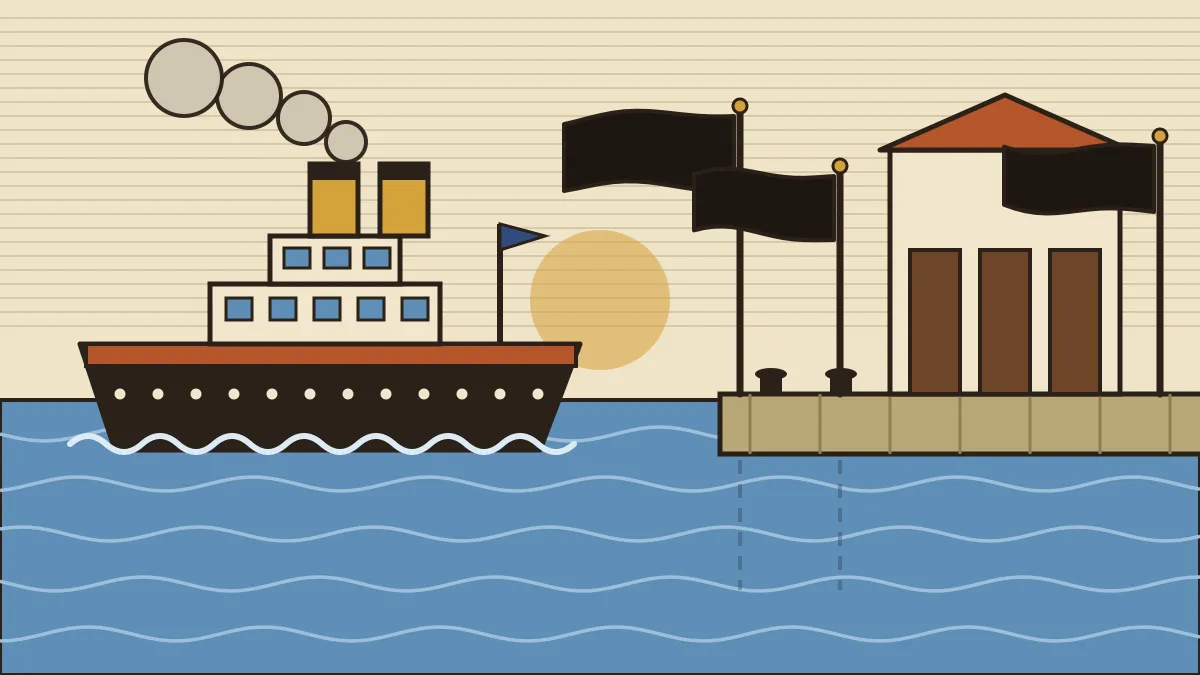
The protests spread with the commission. Wherever it went it met black flags and empty streets. Police used batons freely. The slogan "Simon Go Back" is credited to the Bombay socialist Yusuf Meherally.
Lahore, 30 October 1928: The Death of Lajpat Rai
The commission came to Lahore on 30 October 1928. Lajpat Rai, then in his sixties and the best-known leader of Punjab, led a silent, peaceful march to the railway station with black flags. The police superintendent, James A. Scott, ordered a lathi charge and, by most accounts, struck Rai himself. That evening Rai told a crowd at Mochi Gate: "the blows struck at me today will be the last nails in the coffin of British rule in India." He died on 17 November 1928.
Lajpat Rai's death had a second life. Young revolutionaries of the Hindustan Socialist Republican Association (HSRA), founded in 1928 under Chandra Shekhar Azad as the new name of the old Hindustan Republican Association, saw it as a national insult that required an answer. On 17 December 1928, Bhagat Singh and Rajguru shot J.P. Saunders, an assistant superintendent, outside the Lahore police headquarters. They had mistaken him for Scott. The story continues in our page on the Kakori conspiracy and the HRA/HSRA.
Lajpat Rai's lathi charge (October 1928) belongs to the anti-Simon protests. The Purna Swaraj resolution at Lahore came a year later, in December 1929. The Lahore Resolution that asked for Pakistan is a third event, from 1940. Examiners put all three in one question.
Birkenhead's Challenge and the Nehru Report
Lord Birkenhead had a favourite taunt. Indians, he said, were always criticising British proposals, so why did they not produce a constitution of their own that commanded agreement among all communities? In 1927 and 1928, Indian leaders took him at his word. The Madras Congress called for an All Parties Conference, which met in several cities during 1928, and it appointed a committee under Motilal Nehru. Members included Sir Ali Imam, Tej Bahadur Sapru and Subhas Chandra Bose. Its report, the Nehru Report of August 1928, was the first attempt by Indians to write a full constitution for India.
| Subject | What the Nehru Report recommended |
|---|---|
| Status | Dominion status within the British Commonwealth as the "next immediate step" |
| Structure | A federation built on linguistic provinces, with residuary powers kept with the Centre; an executive responsible to the legislature |
| Franchise | Adult suffrage; men and women equal citizens |
| Electorates | No separate electorates; joint electorates throughout |
| Minorities | Seats reserved, in proportion to population, for a minority of at least 10 per cent in a province, for a period of ten years; no weightage |
| Rights | A list of nineteen fundamental rights, no state religion, and a Supreme Court |
| Regions | Sind to be separated from Bombay (on conditions); the North-West Frontier Province to get full provincial status |
The bill of rights, the secular state and the Supreme Court all reappear in the Constitution of 1950, which is why Constituent Assembly notes trace fundamental rights back to 1928. The British acts these proposals answered are covered on our constitutional development page.
The Nehru Report is the work of Motilal Nehru, the Congress president for 1928, not of his son Jawaharlal. Jawaharlal presided over the next year's session at Lahore. NDA 2020-I asked exactly this (see below).
Where the Consensus Broke: Jinnah's Fourteen Points
In Delhi in March 1927 a group of Muslim leaders, including Jinnah, had offered to give up separate electorates in return for one-third of the seats in the central legislature, a separate province of Sind and reforms in the North-West Frontier Province. The Nehru Report granted Sind and the Frontier but refused one-third Muslim representation at the Centre.
At the All Parties Convention in Calcutta (December 1928), Jinnah moved amendments asking for one-third of central seats, reserved seats for Muslims in Punjab and Bengal in proportion to population, and residuary powers for the provinces. They were voted down, and some Hindu Mahasabha and Sikh League leaders objected to other parts of the report as well. In March 1929 he put his terms in the form of the Fourteen Points, which became the League's standard programme for years.
| Question | Nehru Report (1928) | Jinnah's Fourteen Points (1929) |
|---|---|---|
| Electorates | Joint; seats reserved only for minorities | Separate electorates for Muslims to continue |
| Muslims at the Centre | No special share | One-third of central legislature seats |
| Punjab and Bengal | No reservation for a community in a province where it is the majority | Muslim majority in Punjab, Bengal and the Frontier not to be reduced |
| Residuary powers | With the Centre | With the provinces |
| Sind and the Frontier | Sind separated on conditions; NWFP made a full province | Sind separated at once; reforms for NWFP and Baluchistan |
Many historians think the gap on purely constitutional questions was narrow, and that what failed was trust: the majority did not fully grasp the minority's fears. After 1928 the unity the Simon boycott had created was gone. The question of separate electorates returned to dominate the Round Table Conferences and the Poona Pact.
Separate electorates for Muslims were first introduced by the Morley-Minto Reforms (1909), not by the Communal Award of 1932, which extended the principle to depressed classes and others. CDS 2022-I tested the 1909 date.
Calcutta 1928 to Lahore 1929: The Ultimatum That Ran Out
The convention's failure left the Congress with a report no one could enforce, and young leaders were impatient with the word "dominion". Jawaharlal Nehru and Subhas Bose wanted a clear goal of complete independence. Motilal Nehru presided at the Calcutta session (December 1928), and Gandhi returned to active politics to hold the party together. His resolution said that the Congress would accept the Nehru Report's dominion constitution if the British conceded it, but that otherwise it would fight for independence by civil disobedience. Gandhi first wanted to give the British two years. Under pressure from the younger leaders he agreed to one year, ending on 31 December 1929.
The British did not accept the report. On 31 October 1929 the Viceroy, Lord Irwin, announced that the natural result of India's constitutional progress was dominion status and that a conference would be held in London. The Congress wanted a firm assurance that the conference would draft a dominion constitution. When Gandhi and other leaders met Irwin on 23 December 1929, he could not give it.
The Lahore session met in the last days of December 1929 on the bank of the river Ravi, with Jawaharlal Nehru as president. It passed the Purna Swaraj resolution declaring complete independence the Congress goal, and said that the Nehru Report's dominion constitution had lapsed. At midnight on 31 December 1929 Nehru hoisted the tricolour of the Congress on the Ravi bank. The Congress also decided that 26 January 1930 would be observed as Independence Day, with flag-hoisting and a pledge in villages and towns at the same hour, as Gandhi advised. That date is why the Constitution came into force on 26 January 1950.
The Simon Report and the Road to the Round Table
The commission itself kept working. After a second tour starting in October 1928, it published its report in 1930. It did not mention dominion status. It proposed ending dyarchy in the provinces and setting up representative government there, with the governors keeping large reserve powers, and it looked to a future federation that would include the princely states. It also proposed the separation of Burma from India. By then the Congress had launched the Civil Disobedience Movement with the Dandi March (March 1930).
The British Government then called the Round Table Conferences in London to discuss the report. The first opened in November 1930 and the Congress stayed away. A line often quoted at the time said that a conference on India without the Congress was like staging the Ramlila without Rama. The Gandhi-Irwin Pact of March 1931 brought the Congress to the Second Round Table Conference (September to December 1931), which ended without agreement, and a third conference met in 1932. Provincial autonomy and federation were finally written into the Government of India Act 1935.
How UPSC Has Asked It: Past Papers Solved
The questions below come from NDA and CDS papers between 2020 and 2026. Notice the pattern: UPSC asks for who headed it, where and when, and which came first.
In the year 1928, a committee of Congress leaders drafted a Constitution for India. The Committee was headed by
(a) Mahatma Gandhi (b) T. B. Sapru (c) Motilal Nehru (d) Jawaharlal Nehru
Answer: (c). The Nehru Report was drafted by a committee under Motilal Nehru, then Congress president. Sapru was a member, and Jawaharlal Nehru, the tempting option, was the president of the next year.
When and where was the demand for 'Purna Swaraj' or complete independence made by the Indian National Congress?
(a) Bombay, 1885 (b) Lahore, 1929 (c) Kheda, 1917 (d) Bombay, 1942
Answer: (b). The Lahore session of December 1929 adopted the Purna Swaraj resolution. Bombay 1942 is the Quit India resolution, and 1885 is the founding of the Congress.
Consider the following statements with regard to the Lahore Session : I. The Congress decided to observe Independence Day on 26 January 1930. II. It was decided to hoist the National Flag and sing patriotic songs at different venues. III. Gandhiji suggested that the event be held synchronously in all the places. Which of the statements given above are correct ?
(a) I and II only (b) II and III only (c) I and III only (d) I, II and III
Answer: (d). All three are correct. The Independence Day pledge was to be taken at the same hour everywhere, on Gandhi's advice, with flag-hoisting and patriotic songs at every venue.
The provision for separate electorate for Muslims was given in:
(a) Morley-Minto Reforms, 1909 (b) Montagu-Chelmsford Reforms, 1919 (c) Communal Award, 1932 (d) Government of India Act, 1935
Answer: (a). The Morley-Minto Reforms introduced separate electorates for Muslims. The Communal Award later extended them to other groups, which is why option (c) tempts. The Nehru Report of 1928 tried to undo the system.
Chronologically arrange the following political events related to Indian National Movement beginning from the earliest: 1. Formation of Swaraj Party 2. Communal Award 3. Lucknow Pact 4. Simla Conference
(a) 3, 1, 2, 4 (b) 1, 3, 2, 4 (c) 2, 1, 4, 3 (d) 1, 2, 3, 4
Answer: (a). Lucknow Pact 1916, Swaraj Party 1923, Communal Award 1932, Simla Conference 1945. The Simon Commission and the Nehru Report fall between the Swaraj Party and the Communal Award.
Each year gives one question from the 1927-1932 block, usually as a chronology, a name-match or a "which session" item. If you know the chain Madras, Nehru Report, Calcutta, Lahore, Dandi and the three Round Tables, you can solve all three formats.
Practice MCQs (with answers)
- The Simon Commission was officially called the
- Indian Statutory Commission
- Indian Education Commission
- Indian Famine Commission
- Indian Hunter Commission
- Which of these was NOT a recommendation of the Nehru Report?
- Dominion status as the immediate goal
- Linguistic provinces
- Separate electorates for Muslims
- A list of fundamental rights
- Lala Lajpat Rai died on
- 30 October 1928
- 17 November 1928
- 17 December 1928
- 3 February 1928
- The Simon Commission first landed in India at
- Madras
- Calcutta
- Lahore
- Bombay
- The Calcutta Congress of 1928 gave the British time to accept dominion status up to
- 31 December 1928
- 31 December 1929
- 31 December 1930
- 26 January 1930
- How many members did the Simon Commission have, and how many of them were Indian?
- Seven, none
- Seven, two
- Five, one
- Nine, three
- Jinnah put forward his Fourteen Points in
- 1927
- 1928
- 1929
- 1931
- The Congress presidents at the Calcutta session (1928) and the Lahore session (1929) were, respectively,
- M.A. Ansari and Motilal Nehru
- Jawaharlal Nehru and Mahatma Gandhi
- Motilal Nehru and Mahatma Gandhi
- Motilal Nehru and Jawaharlal Nehru
1-a, 2-c, 3-b, 4-d, 5-b, 6-a, 7-c, 8-d. Q2: the report rejected separate electorates and offered reserved seats within joint electorates. Q5: the one-year ultimatum was set at Calcutta, and the Lahore session in December 1929 declared Purna Swaraj when it ran out. Q7: the Fourteen Points date from March 1929, a reaction to the failure of the Calcutta convention. Q8: Ansari presided at Madras (1927), which decided the boycott.
Quick Revision
- Simon Commission = Indian Statutory Commission; Nov 1927; 7 British members, no Indian; Attlee a member. Madras Congress (Dec 1927, Ansari) boycotts; lands at Bombay, 3 Feb 1928.
- Lajpat Rai: lathi charge 30 Oct 1928 (Scott); died 17 Nov 1928. Saunders shot 17 Dec 1928 (Bhagat Singh, Rajguru).
- Nehru Report (Aug 1928, Motilal): dominion status, joint electorates, ten-year minority reservation, linguistic provinces, nineteen rights, residuary powers with the Centre.
- Calcutta (Dec 1928, Motilal): Jinnah's amendments rejected; ultimatum to 31 Dec 1929. Fourteen Points: Mar 1929.
- Lahore (Dec 1929, Jawaharlal): Purna Swaraj; flag 31 Dec; Independence Day 26 Jan 1930.
- Simon Report 1930: no dominion status, end of dyarchy, federation, Burma separated. Round Tables: 1930 (no Congress), 1931 (Gandhi), 1932. Separate electorates: 1909.
Frequently asked questions
What was the Simon Commission?
The Simon Commission, officially the Indian Statutory Commission, was appointed in November 1927 to review the working of the 1919 reforms. It was chaired by Sir John Simon and had seven British members and no Indian.
Why was the Simon Commission boycotted?
The Congress decided at Madras in December 1927 to boycott it at every stage because every member was British. The Jinnah group of the Muslim League and the Hindu Mahasabha also supported the boycott. At Bombay on 3 February 1928 it met a hartal and black flags under the slogan Simon Go Back.
What was the Nehru Report?
The Nehru Report of August 1928 was the first constitution for India drafted by Indians, by a committee headed by Motilal Nehru. It asked for dominion status, linguistic provinces, joint electorates with reserved seats for minorities and nineteen fundamental rights.
What were Jinnah's Fourteen Points?
They were demands put forward by Mohammad Ali Jinnah in March 1929, after the Nehru Report. They included separate electorates, one-third of central seats for Muslims, residuary powers for the provinces and the separation of Sind.
How did the Nehru Report lead to Purna Swaraj?
At Calcutta in December 1928 the Congress gave the British until 31 December 1929 to accept the Nehru Report's dominion constitution. They gave no such assurance, so the Lahore session of December 1929 declared Purna Swaraj the goal.
Related CDS / OTA History topics
Modern History is the most predictable part of CDS GS
Cavalier's CDS/OTA batches teach the freedom struggle as a connected timeline, with dates, traps and weekly PYQ tests.