India marks Constitution Day on 26 November. The date recalls the day in 1949 when the Constituent Assembly adopted the Constitution, so 2026 is the 77th anniversary. The government began observing the day in 2015, the 125th birth anniversary year of B.R. Ambedkar; before that it was known as Law Day. Do not confuse it with 26 January, the day the Constitution came into force. UPSC keeps asking about the Assembly: CDS 2026-II tested how it was elected, and earlier papers asked who chaired what, who moved which resolution and which party accepted which plan. This article gives the whole machinery in one place, from the existing overview on constitutional history to the committee-by-committee detail that page leaves out.
From Demand to Assembly: 1934 to 1946
| When | Step |
|---|---|
| 1934 | M.N. Roy first suggests a Constituent Assembly for India. |
| 1935 | The Congress officially demands one. |
| 8 August 1940 | The August Offer: the British concede, for the first time, that Indians will frame their own constitution after the war. |
| March 1942 | The Cripps Proposals add the method: an elected body after the war, with provinces free to stay out. |
| 16 May 1946 | The Cabinet Mission Plan (Pethick-Lawrence, Stafford Cripps, A.V. Alexander) creates the Assembly. The Muslim League accepts the plan on 6 June. |
| July–August 1946 | Elections to the 296 seats of British India. |
| 9 December 1946 | First sitting. |
The Assembly had 389 seats: 292 from the provinces, 4 from the chief commissioners' provinces (Delhi, Ajmer-Merwara, Coorg and British Baluchistan) and 93 from the princely states. It was not elected by adult franchise. Provincial members were chosen by the provincial legislative assemblies by proportional representation (single transferable vote), community by community, at roughly one member per ten lakh people. The Congress won 208 of the 296 seats and the Muslim League 73, and the League then boycotted the Assembly. After Partition, the strength fell to 299. From 15 August 1947 the Assembly was fully sovereign, and it also served as the Dominion's legislature, with G.V. Mavalankar presiding over those sittings.
On 9 December 1946 the Assembly met in the Constitution Hall, now the Central Hall of Parliament, with 207 members present. Sachchidananda Sinha, the oldest member, presided temporarily. On 11 December Rajendra Prasad was elected President, with H.C. Mookerjee as Vice-President. B.N. Rau, a civil servant, was Constitutional Adviser, and S.N. Mukherjee was Chief Draftsman. On 13 December Nehru moved the Objectives Resolution, adopted unanimously on 22 January 1947. It became the seed of the Preamble (see the Preamble and basic structure).
Who Chaired What: The Committee Table
The Assembly worked through committees. Eight are usually called major. The table lists them with the common minor ones.
| Committee | Chairman |
|---|---|
| Union Powers Committee; Union Constitution Committee; States Committee (negotiating with the princely states) | Jawaharlal Nehru |
| Provincial Constitution Committee | Vallabhbhai Patel |
| Advisory Committee on Fundamental Rights, Minorities and Tribal and Excluded Areas | Vallabhbhai Patel |
| Sub-committee on Fundamental Rights | J.B. Kripalani |
| Sub-committee on Minorities | H.C. Mookerjee |
| Sub-committee on North-East Frontier Tribal Areas and Assam Excluded and Partially Excluded Areas | Gopinath Bordoloi |
| Sub-committee on Excluded and Partially Excluded Areas (other than Assam) | A.V. Thakkar |
| Drafting Committee | B.R. Ambedkar |
| Rules of Procedure Committee; Steering Committee; Finance and Staff Committee; Ad hoc Committee on the National Flag | Rajendra Prasad |
| Credentials Committee | Alladi Krishnaswami Ayyar |
| House Committee; Committee on Chief Commissioners' Provinces | B. Pattabhi Sitaramayya |
| Order of Business Committee | K.M. Munshi |
| Committee on the Functions of the Constituent Assembly | G.V. Mavalankar |
| Ad hoc Committee on the Supreme Court | S. Varadachariar |
| Expert Committee on Financial Provisions | Nalini Ranjan Sarkar |
| Linguistic Provinces Commission (1948) | S.K. Dar |
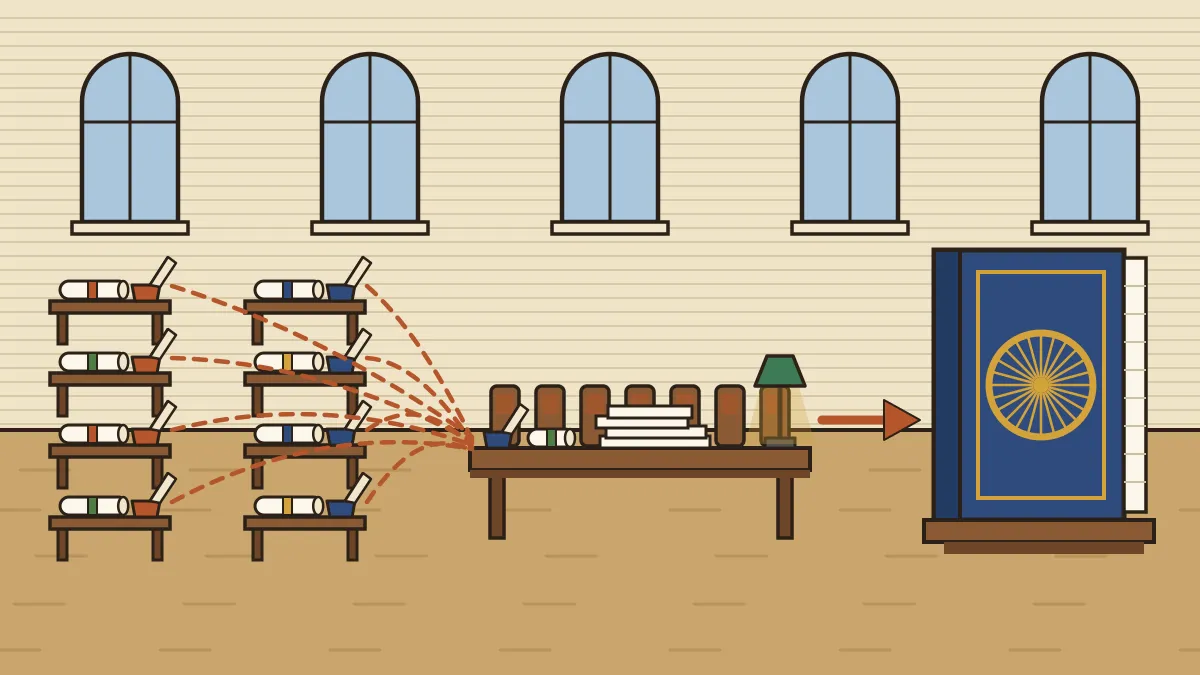
The major committees did real work. The Union Powers Committee gave the Centre the residuary powers, and the Union Constitution Committee chose a parliamentary executive for the Union. The Provincial Constitution Committee recommended a parliamentary system for the provinces. The Fundamental Rights Sub-Committee divided rights into those a court can enforce and those it cannot, a split that became Part III and the Directive Principles. On minorities, the Assembly finally gave up separate electorates. The States Committee handled talks with the princely states, and the flag committee kept the Congress tricolour but replaced the spinning wheel with the Ashoka chakra.
Three people chaired most of the heavy committees. Match the initial to the job.
Ambedkar chaired only the Drafting Committee. Fundamental rights were prepared under Kripalani, and Patel, not Ambedkar, chaired the Advisory Committee. Nehru chaired three committees on federal structure, Rajendra Prasad those on procedure, and B.N. Rau was an adviser, not a member. The Linguistic Provinces Commission is covered in our article on reorganisation of states.
The Drafting Committee and the Three Readings
The Assembly set up the Drafting Committee on 29 August 1947, with seven members: Ambedkar (chairman), N. Gopalaswami Ayyangar, Alladi Krishnaswami Ayyar, K.M. Munshi, Syed Mohammad Saadulla, B.L. Mitter (later replaced by N. Madhava Rao) and D.P. Khaitan (replaced by T.T. Krishnamachari after his death). Ambedkar said the committee sat for 141 days, and T.T. Krishnamachari told the House in November 1948 that illness, absence and other duties had left the main burden of drafting on Ambedkar. Ambedkar himself credited Rau's rough draft as the starting point.
| Stage | Date | What happened |
|---|---|---|
| Rau's draft | October 1947 | 243 articles and 13 schedules, prepared by the Constitutional Adviser. |
| Committee's draft | 21 February 1948 | Submitted to the President of the Assembly; the public got about eight months to comment. It had 315 articles and 8 schedules, and Article 1 read "India shall be a Union of States". |
| First reading | 4–9 November 1948 | Ambedkar introduced the draft on 4 November. |
| Second reading | 15 November 1948 to 17 October 1949 | Clause by clause. About 7,635 amendments were tabled and 2,473 moved and decided. The Preamble was taken up last. |
| Third reading | 14–26 November 1949 | The Constitution was passed on 26 November. |
The original Constitution had 395 articles, 22 parts and 8 schedules. The whole exercise took 2 years, 11 months and 18 days and cost about ₹64 lakh.
Sessions, Symbols and the Last Act
| Session | Dates | Key business |
|---|---|---|
| 1 | 9–23 December 1946 | Rajendra Prasad elected; Objectives Resolution moved (13 December) |
| 2 | 20–25 January 1947 | Objectives Resolution adopted (22 January) |
| 3 | 28 April–2 May 1947 | Reports of the Advisory Committee taken up |
| 4 | 14–31 July 1947 | National flag adopted (22 July) |
| 5 | 14–30 August 1947 | Met at midnight on 14 August as a sovereign body |
| 6 | 27 January 1948 | One-day sitting |
| 7 | 4 November 1948–8 January 1949 | Draft Constitution introduced |
| 8 | 16 May–16 June 1949 | Clause-by-clause debate continues |
| 9 | 30 July–18 September 1949 | Hindi adopted as official language (14 September) |
| 10 | 6–17 October 1949 | Second reading ends |
| 11 | 14–26 November 1949 | Third reading; Constitution adopted (26 November) |
| Last sitting | 24 January 1950 | Members sign; first President elected |
Four decisions are worth knowing in detail. On 22 July 1947 Nehru moved the flag resolution: a horizontal tricolour of saffron, white and dark green in equal proportion, with a wheel in navy blue at the centre. On 14 September 1949 the Assembly adopted Hindi in the Devanagari script as the official language of the Union, with English continuing for fifteen years. On 25 November 1949 Ambedkar warned that on 26 January 1950 India would "enter a life of contradictions": equality in politics, inequality in social and economic life. On 26 November 1949 the Constitution was adopted and the provisions on citizenship, elections and the provisional Parliament took effect at once.
On 24 January 1950 the members signed the Hindi and English copies, 284 of them. The English text was handwritten by Prem Behari Narain Raizada and decorated by Shantiniketan artists led by Nandalal Bose. The Assembly then elected Rajendra Prasad the first President, accepted Jana Gana Mana as the national anthem and gave Vande Mataram equal honour. The rest of the Constitution took effect on 26 January 1950, chosen because it was Purna Swaraj Day of 1930.
How UPSC Has Asked It: Past Papers Solved
These are actual CDS and NDA questions since 2018. They test the process (Cabinet Mission to composition), the officers and a few famous speeches.
The principle that the framing of the new Constitution for independent India should be primarily (though not solely) the responsibility of Indians themselves, was for the first time conceded in the
(a) Government of India Act, 1935 (b) August Offer of Viceroy Linlithgow (c) Cripps Proposals (d) Cabinet Mission
Answer: (b). Linlithgow's August Offer of 8 August 1940 first accepted that Indians would frame their own constitution after the war. The Cripps Proposals of 1942 then described how the body would be elected, which is why (c) tempts, and the Cabinet Mission of 1946 finally created it.
Which political party formally accepted the Cabinet Mission Plan on 6th June, 1946, which had rejected the demand for a sovereign Pakistan?
(a) The Hindu Mahasabha (b) The Congress (c) The Muslim League (d) The Unionist Party
Answer: (c). The League accepted the plan on 6 June 1946, hoping its grouping scheme could lead to Pakistan later. The Congress accepted only the long-term proposals, and later, with reservations.
Which of the following statements related to the Constituent Assembly of India is/are correct? 1. Its members were chosen by indirect election by the members of the Provincial Legislative Assemblies 2. Indian Princely States were given representation in the Constituent Assembly
(a) 1 only (b) 2 only (c) Both 1 and 2 (d) Neither 1 nor 2
Answer: (c). Provincial members were elected by the provincial assemblies, not by voters, and 93 seats went to the princely states.
Who among the following introduced the 'Objective Resolution' in the Constituent Assembly on 13th December, 1946?
(a) Jawaharlal Nehru (b) Rajendra Prasad (c) B. R. Ambedkar (d) Alladi Krishnaswami Aiyar
Answer: (a). Nehru moved it, and it was adopted on 22 January 1947. Prasad was the President of the Assembly and Ambedkar chaired the Drafting Committee.
Who among the following are the two civil servants who assisted the Constituent Assembly in framing the Constitution of India?
(a) B.N. Rau and K.M. Munshi (b) S.N. Mukherjee and Alladi Krishnaswamy Aiyer (c) B.N. Rau and S.N. Mukherjee (d) K.M. Munshi and Alladi Krishnaswamy Aiyer
Answer: (c). Rau was Constitutional Adviser and Mukherjee Chief Draftsman, both civil servants. Munshi and Alladi were lawyers and members of the Drafting Committee.
Which member of the Constituent Assembly proposed the resolution that the National Flag of India be a "horizontal tricolour of saffron, white and dark green in equal proportion", with a wheel in navy blue at the centre?
(a) Jawaharlal Nehru (b) B.R. Ambedkar (c) Rajendra Prasad (d) Sardar Vallabhbhai Patel
Answer: (a). Nehru moved the flag resolution on 22 July 1947. Prasad chaired the ad hoc committee on the flag, which is the tempting wrong answer.
Who among the following stated in the Constituent Assembly that on 26th January, 1950, India was going to enter a life of contradictions?
(a) Dr. B. R. Ambedkar (b) Jawaharlal Nehru (c) Mahatma Gandhi (d) S. P. Mukherjee
Answer: (a). Ambedkar said it on 25 November 1949: political equality, but inequality in social and economic life. Gandhi was never a member of the Assembly.
Four question types recur: who chaired or moved what, how the Assembly was elected, which plan or offer conceded which principle, and who said what in the debates. Pair each person with one act: Nehru (Objectives Resolution, flag), Prasad (President, procedure committees), Ambedkar (Drafting Committee, "contradictions"), Rau (adviser).
Practice MCQs (with answers)
- The Provincial Constitution Committee and the Advisory Committee on Fundamental Rights were both chaired by
- Vallabhbhai Patel
- Jawaharlal Nehru
- Rajendra Prasad
- B.R. Ambedkar
- The Fundamental Rights Sub-Committee was chaired by
- H.C. Mookerjee
- Gopinath Bordoloi
- A.V. Thakkar
- J.B. Kripalani
- Which of these was NOT a member of the Drafting Committee?
- K.M. Munshi
- Vallabhbhai Patel
- Alladi Krishnaswami Ayyar
- N. Gopalaswami Ayyangar
- The members of the Assembly signed the Constitution on
- 26 November 1949
- 15 August 1947
- 24 January 1950
- 26 January 1950
- How many of the Assembly's 389 seats were allotted to the princely states?
- 93
- 70
- 99
- 292
- The resolution moved on 13 December 1946 and adopted on 22 January 1947 was the
- flag resolution
- language resolution
- Objectives Resolution
- resolution on the Union of States
- Hindi in Devanagari was adopted as the Union's official language on
- 26 November 1949
- 22 July 1947
- 9 December 1946
- 14 September 1949
- Who prepared the first draft of the Constitution in October 1947 for the Drafting Committee?
- S.N. Mukherjee
- B.N. Rau
- K.M. Munshi
- G.V. Mavalankar
1-a, 2-d, 3-b, 4-c, 5-a, 6-c, 7-d, 8-b. Q3: Patel chaired two committees but was not among the seven drafters. Q4: 26 November 1949 was adoption, 24 January 1950 the signing and 26 January 1950 the commencement. Q5: 93 is the princely states' share of the original 389; after Partition the whole Assembly fell to 299.
Quick Revision
- Road: Roy 1934 → Congress demand 1935 → August Offer 1940 → Cripps 1942 → Cabinet Mission 16 May 1946 (League accepts 6 June).
- Composition: 389 = 292 + 4 + 93; indirect, by provincial assemblies; Congress 208, League 73; 299 after Partition. Not elected by adult franchise.
- Officers: Sinha (temporary, 9 December 1946), Prasad (President, 11 December), Mookerjee (Vice-President), Rau (Adviser), S.N. Mukherjee (Chief Draftsman).
- Committees: Nehru: Union Powers, Union Constitution, States. Patel: Provincial Constitution, Advisory. Kripalani: Fundamental Rights. Prasad: Rules, Steering, Finance and Staff, Flag. Ambedkar: Drafting.
- Dates: Objectives Resolution 13 December 1946 / 22 January 1947; flag 22 July 1947; Drafting Committee 29 August 1947; draft 21 February 1948; introduced 4 November 1948; Hindi 14 September 1949; adopted 26 November 1949; signed and President elected 24 January 1950; in force 26 January 1950.
- Totals: 11 sessions, 2 years 11 months 18 days, 395 articles, 22 parts, 8 schedules, about ₹64 lakh.
Frequently asked questions
Why is Constitution Day observed on 26 November?
Constitution Day marks 26 November 1949, when the Constituent Assembly adopted the Constitution. The government began observing it in 2015, the 125th birth anniversary year of B.R. Ambedkar, replacing the older Law Day. The Constitution itself came into force on 26 January 1950, which is Republic Day.
Who were the members of the Drafting Committee?
The Drafting Committee was set up on 29 August 1947 with B.R. Ambedkar as chairman. Its members were N. Gopalaswami Ayyangar, Alladi Krishnaswami Ayyar, K.M. Munshi, Syed Mohammad Saadulla, B.L. Mitter (replaced by N. Madhava Rao) and D.P. Khaitan (replaced by T.T. Krishnamachari).
How was the Constituent Assembly elected, and how many members did it have?
It was planned with 389 members, 292 from the provinces, 4 from the chief commissioners' provinces and 93 from the princely states. Provincial members were elected indirectly by the provincial legislative assemblies, not by adult franchise. After Partition the strength fell to 299.
How long did the Constituent Assembly take to frame the Constitution?
It took 2 years, 11 months and 18 days, from the first sitting on 9 December 1946 to the adoption on 26 November 1949, in 11 sessions. A final sitting on 24 January 1950 saw the members sign the document and elect the first President.
Which committees did Nehru and Patel chair?
Nehru chaired the Union Powers Committee, the Union Constitution Committee and the States Committee. Vallabhbhai Patel chaired the Provincial Constitution Committee and the Advisory Committee on Fundamental Rights, Minorities and Tribal and Excluded Areas.
Related CDS / OTA Polity topics
Polity questions reward exact names and dates
Cavalier's CDS/OTA batches build polity from the Assembly debates up, with committee tables, date charts and weekly PYQ tests.