The Sacred Relics of Shakyamuni Buddha are on a three-week tour of Arunachal Pradesh (1 to 21 November 2026). The Ministry of Culture, the National Museum and the International Buddhist Confederation (IBC) organised a seven-day exposition at Tawang Monastery (Gaden Namgyal Lhatse), which ended on 7 November 2026. An Indian Air Force Chinook then carried the relics to the Thubchog Gatsel Ling Monastery at Bomdila (darshan 8 to 13 November). They go next to the Golden Pagoda at Namsai (14 to 20 November) and return to the National Museum, New Delhi, on 21 November (PIB, 9 November 2026). The route itself is a lesson. Tawang is a Tibetan-tradition (Gelug) monastery, while the Golden Pagoda belongs to the Khamti community, who follow the older Theravada tradition. This one trip crosses the main divisions of Buddhism, and CDS asks about exactly these: which council, which king, which school, which art style.
The Four Councils: Venue, King, President
By Narendra Singh · GS faculty, The Cavalier · 15 years teaching GS
Nothing the Buddha taught was written down in his lifetime. After his death (traditionally placed around the fifth century BCE) the monastic sangha met in large assemblies to agree on what he had said and how monks should live. Tradition counts four. Dates differ, so learn the order and the pairs. Our broader page on heterodox sects, Buddhism and Jainism covers the Buddha's life and teachings; this article starts where that one stops.
| Council | Place | Traditional date | Patron king | President | Outcome |
|---|---|---|---|---|---|
| First | Rajagriha (Sattapanni cave) | c. 483 BCE, soon after the Buddha's death | Ajatashatru (Haryanka dynasty) | Mahakassapa (Mahakashyapa) | Teachings and monastic rules recited: Ananda the discourses, Upali the Vinaya |
| Second | Vaishali | c. 383 BCE | Kalashoka (Shishunaga dynasty) | Sabbakami (Sabakami) | Dispute over ten points of monastic discipline; the first great split in the sangha |
| Third | Pataliputra | c. 250 BCE | Ashoka (Maurya) | Moggaliputta Tissa | False monks expelled; Abhidhamma Pitaka completed; missionaries sent abroad |
| Fourth | Kundalvana, Kashmir | c. 1st century CE (about 72 CE in many books) | Kanishka (Kushana) | Vasumitra, with Ashvaghosha as his deputy | Sanskrit commentaries (the Mahavibhasha); the Sarvastivada school; the stage when Mahayana ideas gained royal backing |
Three details matter. First, at Vaishali the dissenting monks (the Vajjiputtakas, who wanted relaxed rules such as accepting gold and silver) broke away. They came to be called the Mahasanghikas ("the great assembly"), and the orthodox elders the Sthaviravadins. Mahayana ideas grew out of the Mahasanghika line. Second, the Third Council is the one linked with Ashoka's missionaries. His mission to Sri Lanka was led by Mahinda, with Sanghamitta. They are traditionally called his son and daughter, though some old accounts call Mahinda his brother. See our page on Mauryan administration and Ashokan edicts for the dhamma policy behind the missions. Third, some traditions place the Fourth Council at Jalandhar in Punjab instead of Kundalvana. CDS has so far used Kashmir.
Many exam books say the Fourth Council divided Buddhism into Hinayana and Mahayana. Historically the change was gradual and began before Kanishka, and the Theravada tradition of Sri Lanka does not count Kanishka's meeting at all. (Sri Lanka's own landmark was writing down the Pali canon, in the first century BCE.) Accept "Kanishka patronised Mahayana and held a council in Kashmir". Reject "the Fourth Council was held at Pataliputra".
Which pair is correct? (A) Second Council: Rajagriha, Ajatashatru. (B) Third Council: Pataliputra, Ashoka. (C) Fourth Council: Vaishali, Kanishka.
The Tripitaka: Three Baskets and Their Languages
The word Tripitaka (Pali Tipitaka) means "three baskets". The texts were first carried in memory, then written down and classified by subject.
| Pitaka | Contents | Linked to |
|---|---|---|
| Vinaya Pitaka | Rules and regulations for monks and nuns in the sangha | Upali's recitation at the First Council |
| Sutta Pitaka | The Buddha's discourses, in five collections (Nikayas): Digha, Majjhima, Samyutta, Anguttara and Khuddaka. The Khuddaka holds the Jataka tales and the Dhammapada | Ananda's recitation at the First Council |
| Abhidhamma Pitaka | Philosophy and psychology of the teachings | Completed at the Third Council; the Kathavatthu is Moggaliputta Tissa's work |
The oldest canon is in Pali, the language of the common people of Magadha, which the Buddha chose over Sanskrit so that ordinary listeners could follow. Jataka stories, which describe the Buddha's previous births, are in Pali. Later Mahayana scriptures, such as the Prajnaparamita texts, were composed in Sanskrit. The Sri Lankan chronicles Dipavamsa and Mahavamsa are not part of the Tripitaka. They are Pali histories of the island, and the Mahavamsa preserves a long account of Ashoka.
Rule book = Vinaya. Sayings = Sutta. Philosophy = Abhidhamma. Birth stories = Jataka (Sutta Pitaka, Pali). Ashvaghosha, Vasumitra's deputy at the Fourth Council, wrote in Sanskrit the Buddhacharita (a poem on the Buddha's life) and the Saundarananda.
Theravada, Mahayana and Vajrayana
Buddhism did not stay one body of belief. Three great "vehicles" (yana) emerged, and each travelled in a different direction out of India.
| Feature | Theravada (Hinayana) | Mahayana | Vajrayana |
|---|---|---|---|
| Meaning | "Way of the elders" (theras). "Hinayana", the "lesser vehicle", is the name its critics used | "Great vehicle" | "Thunderbolt (or diamond) vehicle" |
| Ideal | The arhat, who wins his own nibbana by self-effort | The bodhisattva, who postpones nibbana to help others | Swift enlightenment through ritual, mantra, mandala and a guru |
| The Buddha | A great human teacher | A saviour, worshipped through images | Many Buddhas and fierce and gentle deities |
| Language | Pali | Sanskrit | Sanskrit, then Tibetan |
| Spread | Sri Lanka, Myanmar, Thailand, Laos, Cambodia | China, Korea, Japan, Vietnam | Tibet, Bhutan, Mongolia, Ladakh, Sikkim, Arunachal |
Early Buddhism put great weight on self-effort. By the first century CE the idea of a saviour had grown, and with it the bodhisattva, a compassionate being who gathers merit and uses it for others. The worship of images of the Buddha and the bodhisattvas followed. This new thinking was named Mahayana, and its followers called the older path Hinayana. The older school's followers prefer Theravada, and so does modern usage. Kushana patronage and the Central Asian trade routes took Mahayana to China, while Nagarjuna (Madhyamika philosophy) is linked with it in the Satavahana south. For Buddha images in the Gupta age, see our page on the Gupta period.
Vajrayana grew from about the seventh century in Bengal and Bihar under the Palas, with strong tantric elements. Padmasambhava (Guru Rinpoche) carried it to Tibet in the eighth century. The Gelug school, founded by Tsongkhapa in the early fifteenth century, produced the line of Dalai Lamas. Tawang Monastery, the largest monastery in India, is Gelug. It was founded in 1680-81 by Merak Lama Lodre Gyatso at the wish of the Fifth Dalai Lama, and the Sixth Dalai Lama was born near Tawang at Urgelling. In March 1959, the present Dalai Lama entered India through this district. The Monpa of Tawang follow Tibetan Buddhism, while the Khamti and Singpho of eastern Arunachal follow Theravada, which explains why the tour includes both Tawang and Namsai. Our earlier explainers on the relics' journey to Arunachal and the relics' exposition in Mongolia carry the current-affairs side.
Gandhara, Mathura, Amaravati: Buddhist Art
Early Buddhist art did not show the Buddha as a person. Sculptors at Sanchi and Bharhut used symbols: the empty seat, the wheel (the first sermon), the bodhi tree (enlightenment), the stupa (his death) and a horse (the great renunciation). Human images appear after the Mahayana idea of a saviour took hold, around the first century CE, and three schools competed in making them.
| School | Region and rulers | Material | How the Buddha looks |
|---|---|---|---|
| Gandhara | North-west (Taxila, Peshawar); Kushanas, notably Kanishka | Blue-grey schist, later stucco | Greco-Roman influence: wavy hair, heavy folded robe, a calm, almost Apollo-like face. Also called the Indo-Greek or Greco-Buddhist school |
| Mathura | Ganga-Yamuna doab; Kushanas, and the school continued into Gupta times | Spotted red sandstone | Indigenous tradition: broad shoulders, shaven head, abhaya mudra (the raised hand of no-fear). The same workshops made Jain and Hindu images |
| Amaravati | Krishna-Godavari region; Satavahanas, later Ikshvakus at Nagarjunakonda | White marble-like limestone | Flowing narrative reliefs of the Buddha's life and the Jatakas, with a lively crowd of figures |
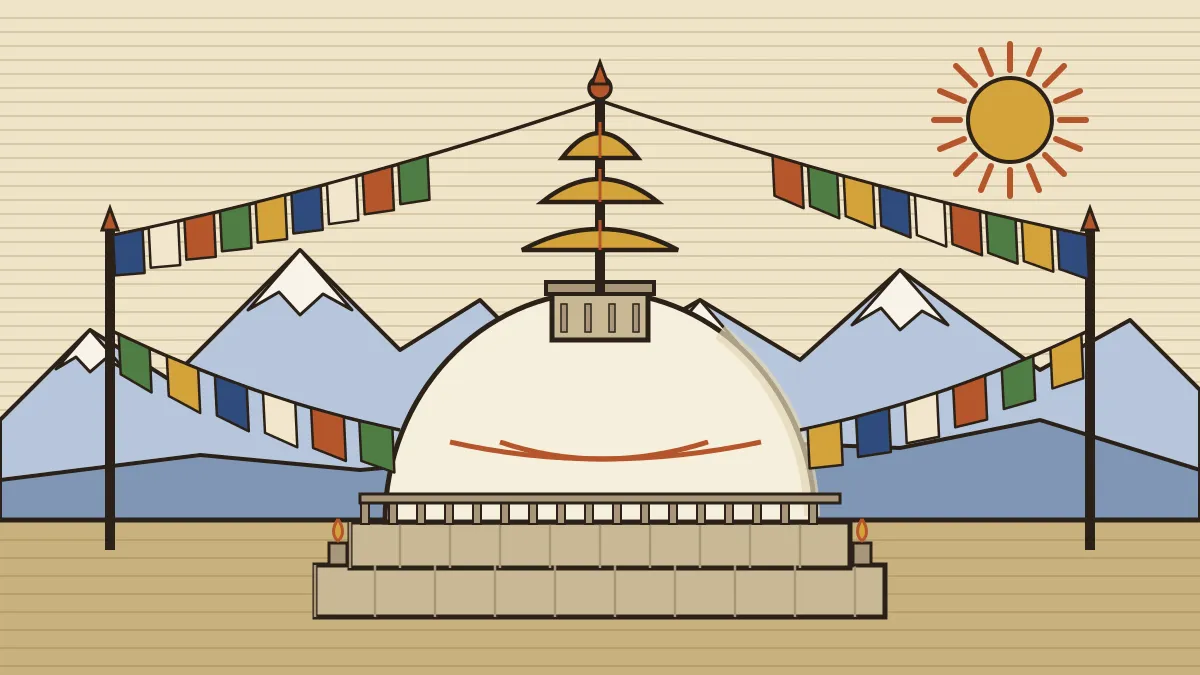
Three monument types carry Buddhist worship.
| Monument | Purpose | Key points |
|---|---|---|
| Stupa | A mound or dome holding a relic of the Buddha or a monk | Solid, not entered; devotees walk round it clockwise (pradakshina). A railing (vedika), four gateways (toranas) and a chhatra on top. Sanchi's gateways are carved with Jataka scenes; tradition credits Ashoka with spreading the stupa cult |
| Chaitya | A prayer hall, often rock-cut | Long hall with a rounded end, rows of pillars and a small stupa at the apse. Examples at Karla, Bhaja, Ajanta and Ellora |
| Vihara | A residence for monks | A courtyard with cells around it, sometimes in the same cave complex as a chaitya |
NDA 2023 asked about the Sanchi discovery: when it was found in 1818, three of its four gateways were still standing, and the fourth lay where it had fallen. The sculpture also shows elephants, horses, monkeys and cattle. A common trap is the shalabhanjika (a woman holding a branch of a tree). It stands at Sanchi, but it is a popular fertility motif and not a Buddhist idea. The woman standing among lotuses with elephants pouring water over her is a different figure, Gajalakshmi.
Nalanda and Vikramashila: The Buddhist Universities
The monasteries of the Gupta and Pala ages were also centres of learning. Nalanda (Bihar) was founded in the fifth century, with its first brick structures dated to Gupta times, and it grew with generous royal grants. Revenue from many villages supported its monks. The Chinese pilgrim Xuanzang studied there in the seventh century. Nalanda became a UNESCO World Heritage Site in 2016, and the modern Nava Nalanda Mahavihara works under the Union Ministry of Culture. Vikramashila, near Bhagalpur in Bihar, was founded by the Pala king Dharmapala around the late eighth century and became a major centre of Vajrayana teaching. Odantapuri was another Pala-era monastery. Turkish raids around the end of the twelfth century destroyed these centres, and some monks fled to Nepal and Tibet. Buddhism almost vanished from the plains, but it lived on in the Himalayas, which is why Tibetan-tradition monasteries like Tawang are part of India's heritage today.
How UPSC Has Asked It: Past Papers Solved
UPSC rarely asks the council list directly. It prefers art symbols, texts and monuments. These are real CDS and NDA questions.
Early Buddhist sculptors did not show Buddha in human form. Through which of the following symbols was Buddha's presence shown by the early sculptors?
(a) Empty Seat and Stupa only (b) Wheel and Tree only (c) Wheel, Tree and Stupa only (d) Empty Seat, Wheel, Tree and Stupa
Answer: (d). All four were used. The tempting options each drop one symbol, so a student who remembers only the wheel and the tree falls into (b) or (c).
Which of the following statements about sculptures at Sanchi is/are correct? 1. In some sculptures there is representation of Shalabhanjika. 2. The figure of Shalabhanjika is represented by a woman surrounded by lotuses and elephants. 3. The Shalabhanjika motif was not directly inspired by Buddhist ideas.
(a) 1, 2 and 3 (b) 2 and 3 only (c) 2 only (d) 1 and 3 only
Answer: (d). Statements 1 and 3 are correct. Statement 2 describes Gajalakshmi, not the shalabhanjika, who is a woman grasping a tree branch.
Which one of the following sculptures found at Sanchi Stupa is NOT directly inspired by Buddhist ideas?
(a) Empty seat (b) Shalbhanjika (c) Tree (d) Wheel
Answer: (b). The same fact as the question above, asked again three years later. The empty seat, tree and wheel are all Buddhist symbols.
Consider the following statements regarding Sanchi and its archaeological findings: 1. When Sanchi was discovered in 1818, three of its four gateways were still standing, the fourth was lying on the spot where it had fallen. 2. Animals depicted at Sanchi include elephants, horses, monkeys and cattle.
(a) Only 1 (b) Only 2 (c) Both 1 and 2 (d) Neither 1 nor 2
Answer: (c). Both are standard details of the Sanchi reliefs.
Which one of the following is not the work of Ashvaghosha?
(a) Sariputraprakarana (b) Buddhacharita (c) Saundarananda (d) Manjushrimulakalpa
Answer: (d). Ashvaghosha, the Fourth Council's deputy president, wrote the Buddhacharita, the Saundarananda and the play Sariputraprakarana. The Manjushrimulakalpa is a later Mahayana-Vajrayana text.
Which Buddhist text contains an account of the Mauryan Emperor Ashoka?
(a) Vinaya Pitaka (b) Sutta Pitaka (c) Abhidhamma Pitaka (d) Mahavamsa
Answer: (d). The three Pitakas record the Buddha's teaching, which ended long before Ashoka's reign. The Sri Lankan chronicle Mahavamsa narrates Ashoka's patronage and the mission to the island.
The story Gandatindu Jataka was written in which language?
(a) Sanskrit (b) Telugu (c) Tamil (d) Pali
Answer: (d). The Jataka tales belong to the Pali canon (the Khuddaka Nikaya). The standard collection is Pali.
Of the seven questions above, four are about Sanchi or art symbols and three about texts. None asks for the venue of a council. Learn the council table for safety, but spend more time on monuments and texts.
Practice MCQs (with answers)
- The Third Buddhist Council was held at Pataliputra under the presidency of
- Mahakassapa
- Vasumitra
- Moggaliputta Tissa
- Sabbakami
- The monks who broke away after the dispute over discipline at Vaishali were called
- Sthaviravadins
- Mahasanghikas
- Sarvastivadins
- Vajrayanis
- Which one of the following is a work of the Pali canon and NOT a Sanskrit text?
- Gandatindu Jataka
- Buddhacharita
- Saundarananda
- Prajnaparamita Sutra
- The Gandhara school of art is best identified by
- spotted red sandstone and a shaven-head Buddha
- blue-grey schist and Greco-Roman style drapery
- white marble reliefs of the Jatakas
- rock-cut paintings of the Buddha's life
- Which monument is a rock-cut prayer hall with a rounded end?
- Vihara
- Stupa
- Torana
- Chaitya
- The "Fourth Buddhist Council" is associated with which king and place?
- Ashoka at Pataliputra
- Ajatashatru at Rajagriha
- Kalashoka at Vaishali
- Kanishka in Kashmir
- Which of these is the Mahayana ideal, as opposed to the Theravada ideal?
- The bodhisattva
- The arhat
- The bhikkhu
- The thera
- Tawang Monastery, which hosted the Sacred Relics exposition in November 2026, belongs to which school?
- Theravada
- Sarvastivada
- Gelug (Tibetan Buddhism)
- Mahasanghika
1-c, 2-b, 3-a, 4-b, 5-d, 6-d, 7-a, 8-c. Q1: Mahakassapa presided at the First Council, Sabbakami at the Second and Vasumitra at the Fourth. Q3: the Buddhacharita and Saundarananda are by Ashvaghosha in Sanskrit, and the Prajnaparamita texts are Mahayana Sanskrit works. Q4: (a) describes Mathura, (c) Amaravati, (d) Ajanta. Q8: Tawang is Gelug, a Vajrayana school descended from Tsongkhapa's reform.
Quick Revision
- Councils: 1st Rajagriha, Ajatashatru, Mahakassapa. 2nd Vaishali, Kalashoka, Sabbakami. 3rd Pataliputra, Ashoka, Moggaliputta Tissa. 4th Kundalvana (Kashmir), Kanishka, Vasumitra with Ashvaghosha.
- Second Council: ten points; split into Sthaviravada and Mahasanghika. Third Council: Abhidhamma completed; Mahinda sent to Sri Lanka.
- Tripitaka: Vinaya (rules), Sutta (discourses, Jatakas), Abhidhamma (philosophy). Oldest canon in Pali; Mahayana texts in Sanskrit.
- Schools: Theravada = arhat, Pali, Sri Lanka and South-East Asia. Mahayana = bodhisattva, images, Sanskrit, China and Japan. Vajrayana = tantric, Tibet, Bhutan, Ladakh.
- Art: Gandhara = grey schist, Greek style, Kushanas. Mathura = red sandstone, abhaya mudra. Amaravati = white marble, Satavahanas, narrative reliefs. Early symbols: empty seat, wheel, tree, stupa. Shalabhanjika is not Buddhist.
- Monuments: stupa (relics, solid), chaitya (prayer hall), vihara (monks' residence). Sanchi found in 1818.
- Nalanda: Gupta-age, Xuanzang, UNESCO 2016. Vikramashila: Dharmapala. Tawang: Gelug, founded 1680-81. Relics tour: Tawang, Bomdila (8-13 Nov), Namsai (14-20 Nov), Delhi 21 Nov 2026.
Frequently asked questions
Where were the four Buddhist councils held?
The four councils are traditionally placed at Rajagriha, Vaishali, Pataliputra and Kundalvana in Kashmir. Their patrons were Ajatashatru, Kalashoka, Ashoka and Kanishka, in that order. The presidents were Mahakassapa, Sabbakami, Moggaliputta Tissa and Vasumitra.
What is the difference between Theravada, Mahayana and Vajrayana?
Theravada follows the Pali canon, treats the Buddha as a teacher and aims at the arhat's liberation. Mahayana worships images of the Buddha and bodhisattvas and holds the bodhisattva as the ideal. Vajrayana adds tantric rituals, mantras and a guru's guidance, and flourished in Tibet and the Himalayas.
What is the Tripitaka?
The Tripitaka, or three baskets, is the Buddhist canon. The Vinaya Pitaka holds monastic rules, the Sutta Pitaka holds the Buddha's discourses including the Jataka stories, and the Abhidhamma Pitaka holds philosophy. The oldest canon is in Pali.
How do Gandhara and Mathura art differ?
Gandhara art, from the north-west, shows Greco-Roman influence, using grey schist and later stucco with wavy hair and folded drapery. Mathura art used spotted red sandstone and an Indian style, with a shaven head and the raised abhaya mudra. Both flourished under the Kushanas.
Why are the Sacred Relics of the Buddha touring Arunachal Pradesh?
The Ministry of Culture, the National Museum and the International Buddhist Confederation organised public darshan. After Tawang (to 7 November 2026), the relics are at Bomdila (8 to 13 November) and the Golden Pagoda, Namsai (14 to 20 November), and return to the National Museum on 21 November.
Related CDS / OTA History topics
Ancient History is a reliable scoring zone in CDS GS
Cavalier's CDS/OTA batches teach History with timelines, tables and weekly PYQ tests, so facts like the council list become automatic.