India observes National Milk Day on 26 November, the birth anniversary of Verghese Kurien. This year the Department of Animal Husbandry and Dairying will hold it in Patna, and the programme reads like a map of the sector. It will confer the National Gopal Ratna Awards 2026 for indigenous breed conservation, hand over milk-collection units under the National Programme for Dairy Development, dedicate a 2 lakh litre-a-day milk plant built with help from the Animal Husbandry Infrastructure Development Fund, launch a rating and grading system for dairy cooperatives and a climate-resilient roadmap for livestock to 2047, and release Basic Animal Husbandry Statistics 2026. Each of those names is an exam handle. Operation Flood itself is covered in our article on Operation Flood. This one starts where that story ends, with the animals, the breeds and the schemes that run the sector today.
Counting the Herd: Livestock Census and BAHS
By Hitendra Deswal · Economics faculty, The Cavalier
India has two official ways of counting animals, and the exam likes to mix them up.
| Livestock Census | Basic Animal Husbandry Statistics (BAHS) | |
|---|---|---|
| What it counts | Every animal, species by species and breed by breed, household by household | Output: milk, eggs, meat, wool, with per-capita availability |
| How often | Every five years. The first was held in 1919-20 | Every year, from the Integrated Sample Survey |
| Latest | 20th census (2019); the 21st began in October 2024, with data collected on a mobile app | BAHS 2025 (survey year 2024-25); BAHS 2026 is released on 26 November |
The 20th census (2019) found about 536 million animals, up nearly 5 per cent on 2012. The headline pattern matters more than any single number: the goat count grew by about 10 per cent, poultry by about 17 per cent and crossed 850 million, and the cattle count was roughly flat.
| Species | 20th census (2019), about |
|---|---|
| Cattle | 193 million |
| Buffalo | 110 million |
| Goat | 149 million |
| Sheep | 74 million |
| Poultry | 852 million |
BAHS 2025 put milk output at 247.87 million tonnes in 2024-25 (growth 3.58 per cent, 485 grams a day per person). Uttar Pradesh is the largest milk state, followed by Rajasthan, Madhya Pradesh, Gujarat and Maharashtra. Andhra Pradesh leads in eggs and Rajasthan in wool. The Economic Survey 2025-26 shows why the sector is in the news: allied sectors such as livestock and fisheries are now major growth drivers in agriculture, and horticulture output has overtaken foodgrain output (UPSC asked exactly this in CDS 2026-II, solved below). For the wider sector, see our agriculture economy page.
Breeds: Indigenous, Exotic and Crossbred
Examiners ask three kinds of breed question: which state, which use and which are exotic. A short table covers nearly all of them.
| Animal | Use | Breeds to know |
|---|---|---|
| Cattle (indigenous) | Milch | Gir (Gujarat), Sahiwal (Punjab, Haryana), Red Sindhi, Tharparkar (Rajasthan, also dual-purpose) |
| Draught | Hallikar, Amritmahal (Karnataka), Kangayam (Tamil Nadu), Nagori (Rajasthan) | |
| Dual | Hariana (Haryana), Kankrej (Gujarat), Ongole (Andhra Pradesh) | |
| Dwarf cattle | Small farms | Vechur (Kerala), Punganur (Andhra Pradesh) |
| Buffalo | Milk | Murrah (Haryana, Punjab; the leading milch buffalo), Jaffarabadi (Gujarat), Banni (Kutch), Nili-Ravi (Punjab), Surti and Mehsana (Gujarat), Bhadawari (high fat) |
| Goat | Milk, meat, fibre | Jamunapari and Barbari (Uttar Pradesh), Beetal (Punjab), Black Bengal (West Bengal), Changthangi (Ladakh; pashmina) |
| Exotic dairy | High-yield milk | Jersey, Holstein Friesian, Brown Swiss |
The strategy is to keep the hardy indigenous cow and buffalo while lifting yields by selective breeding, not to replace them. Crossbreeding with exotic bulls raises milk but lowers heat tolerance, so scientists build synthetic breeds. Karan Fries (Holstein Friesian crossed with Tharparkar) and Karan Swiss (Brown Swiss with Sahiwal) came from NDRI Karnal.
Frieswal is five-eighths Holstein Friesian and three-eighths Sahiwal. It was developed by ICAR with the Ministry of Defence, from the crossbred herds on the Military Farms. India's armed forces thus helped create a dairy breed, which is a handy fact for a defence-exam candidate.
Cooperatives sit between the breed and the market. The village society, the district union and the state federation of the Anand pattern are explained in our article on cooperative societies and Part IX-B. The science of multiplying a good animal quickly, through embryos from a high-yielding mother, is in our Badri calf article.
The Scheme Map: Gokul, NLM, NPDD, AHIDF and the Health Programme
The Department of Animal Husbandry and Dairying (DAHD) grouped its schemes in 2021, for the five years 2021-22 to 2025-26. Remember the five by what each pays for.
| Scheme | Pays for | Exam handle |
|---|---|---|
| Rashtriya Gokul Mission (December 2014) | Breed improvement and conservation of indigenous cattle and buffalo: Gokul Grams, National Kamdhenu Breeding Centres, sex-sorted semen, embryo transfer, a bovine genomic centre | Indigenous breeds. The Gopal Ratna awards sit under it. A 2025 revision raised its outlay to ₹3,400 crore for 2021-26 |
| National Livestock Mission | Entrepreneurship in poultry, sheep, goat and pig farming, fodder, risk cover through livestock insurance | Sub-missions before 2021: livestock development, pig development in the North-East, fodder and feed, skill and extension |
| National Programme for Dairy Development (NPDD) | Milk chilling, testing labs and collection units (Component A); dairying through cooperatives with JICA (Japan) assistance (Component B) | Budget ₹1,790 crore (2021), raised to ₹2,790 crore in March 2025 |
| Animal Husbandry Infrastructure Development Fund (AHIDF) | Loans for dairy, meat and feed plants. 3 per cent interest subvention, loan up to 90 per cent of project cost, repayment in 8 years with a 2-year moratorium | ₹15,000 crore fund (2020, under Atmanirbhar Bharat); continued in 2024 to 2025-26 with an outlay of ₹29,610.25 crore; ₹750 crore credit guarantee fund |
| Livestock Health and Disease Control Programme (LHDCP) | Vaccination, vet services and medicine sales centres. The core is the National Animal Disease Control Programme | FMD and brucellosis; NADCP launched in 2019 with ₹13,343 crore over five years |
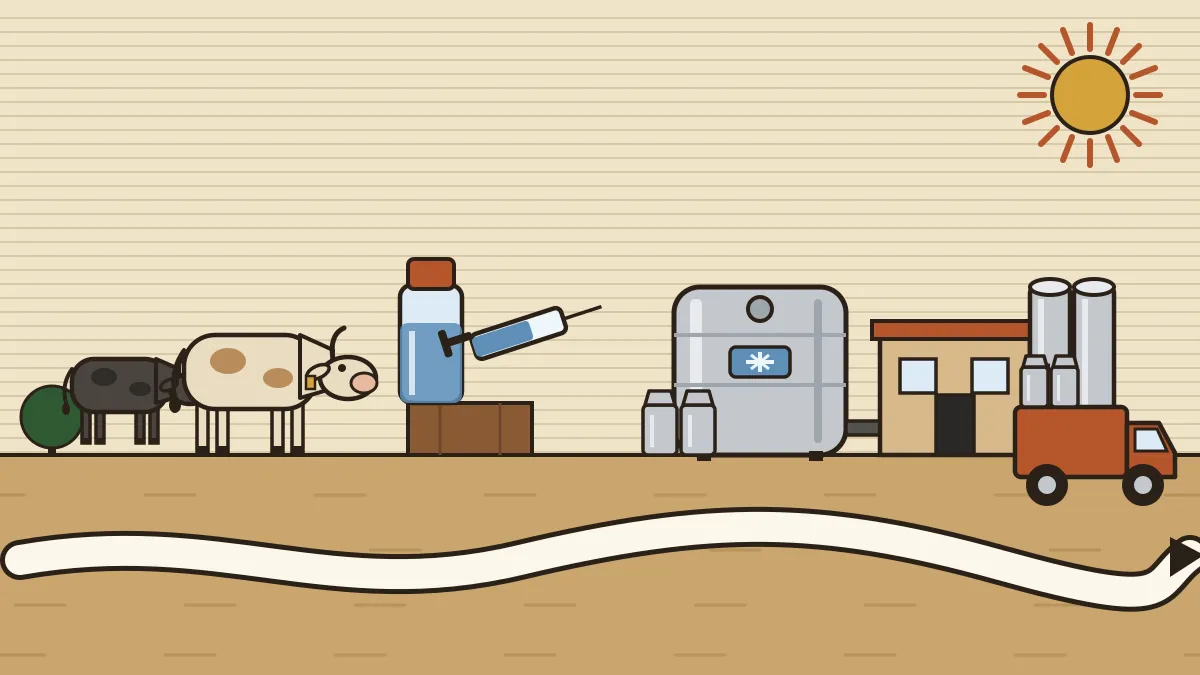
The picture above is the memory trick. Gokul and NLM work on the animal. LHDCP keeps it healthy. NPDD and AHIDF build the chilling tanks, labs and plants between the village and the consumer. The Patna programme maps onto exactly this chain: Gopal Ratna to the breeder, NPDD units to collection, and the AHIDF-assisted plant to processing.
The NLM sub-mission is for pig development in the North-East, not the north-west (NDA 2021-II, solved below). And AHIDF is a loan and interest-subsidy scheme, not a grant: the entrepreneur borrows from a bank, and the Government pays part of the interest.
Dairy also has a regulator-side story. FSSAI's September 2026 draft on analogue paneer and labelling is covered in our article on the paneer analogue rule.
Animal Health: FMD, Brucellosis and the Ruminant Stomach
Foot-and-mouth disease (FMD) is a highly contagious viral disease of cloven-hoofed animals (cattle, buffalo, sheep, goats and pigs). It cuts milk yield and the working power of bullocks and blocks exports of animal products. Brucellosis is caused by bacteria of the genus Brucella. It causes abortion in cattle and buffalo and can spread to people, which makes it a zoonosis.
The National Animal Disease Control Programme, launched in 2019 with an outlay of ₹13,343 crore over five years and fully funded by the Centre, aims at 100 per cent vaccination of cattle, buffalo, sheep, goats and pigs against FMD every six months, and of all female calves aged 4 to 8 months against brucellosis once in a lifetime. Animals are tagged with unique ear tags. The target is to control FMD by 2025 and eradicate it by 2030.
One biology point turns up in the GS paper too. Cattle, buffalo, goats and sheep are ruminants: their stomach has four chambers, the rumen, reticulum, omasum and abomasum, and they chew the cud. That is why they can live on roughage such as straw and fodder, and why fodder is a scheme line item and not an afterthought.
How UPSC Has Asked It: Past Papers Solved
Livestock questions have grown in CDS recently, with two direct National Livestock Mission questions in the 2021-2026 papers.
Which of the following statements relating to objectives of National Livestock Mission are correct? 1. Promoting risk management measures including livestock insurance for farmers. 2. Increase in production of meat, egg, goat milk, wool and fodder. 3. Employment generation through entrepreneurship development in small ruminant, poultry and piggery sector & fodder sector.
(a) 1 and 2 only (b) 2 and 3 only (c) 1 and 3 only (d) 1, 2 and 3
Answer: (d). All three are objectives of the Mission: insurance and risk cover, more meat, egg, goat milk, wool and fodder, and jobs through entrepreneurship in small ruminants, poultry and piggery. When every statement sounds like a scheme objective, check that none is a wrong sector.
Which one of the following is not a specified Sub-Mission of the National Livestock Mission?
(a) Livestock development (b) Pig development in north-western region (c) Fodder and feed development (d) Skill development, technology transfer and extension
Answer: (b). The pig sub-mission is for the North-Eastern region, so the north-western version is the invented one. The other three are real sub-missions.
Which one of the following is not a type of commercial agriculture?
(a) Dairy farming (b) Grain farming (c) Livestock ranching (d) Intensive subsistence agriculture
Answer: (d). Intensive subsistence agriculture feeds the family. Dairy farming, grain farming and livestock ranching are all run for sale.
What is the total number of chambers in the stomach of domestic animals like cattle, buffalo, goat and sheep?
(a) Four (b) Two (c) One (d) Three
Answer: (a). They are ruminants with a rumen, reticulum, omasum and abomasum. The tempting wrong answer is one, which is the human stomach.
Which one of the following major structural trends in agricultural output is highlighted in the Economic Survey 2025-26?
(a) Livestock output declined relative to crop production (b) Production of fruits exceeded production of vegetables (c) Pulses production outpaced both horticulture and food grains production (d) Horticulture production surpassed food grain production
Answer: (d). The Survey notes a shift towards high-value crops. Option (a) states the reverse of the trend: livestock and fisheries have grown faster than crops.
Scheme questions ask what a scheme covers and which sector it excludes. Learn each scheme by its single verb: Gokul = indigenous breeds, NLM = small livestock and fodder, NPDD = collection and chilling, AHIDF = loans for plants.
Practice MCQs (with answers)
- The Rashtriya Gokul Mission is mainly meant for
- setting up dairy cooperatives in cities
- conservation and improvement of indigenous cattle and buffalo breeds
- pig farming in the North-East
- export of milk products
- How often is the Livestock Census conducted in India?
- Every year
- Every two years
- Every ten years
- Every five years
- Which one of the following is a draught breed of cattle?
- Hallikar
- Gir
- Sahiwal
- Red Sindhi
- The Animal Husbandry Infrastructure Development Fund gives
- a free grant of 90 per cent
- free seed and feed to farmers
- a subsidy only on land purchase
- an interest subvention of 3 per cent on loans for processing infrastructure
- Which one of the following is a zoonotic disease that is part of the national vaccination drive for cattle and buffalo calves?
- Foot-and-mouth disease
- Rinderpest
- Brucellosis
- Lumpy skin disease
- Murrah is a breed of
- buffalo
- cattle
- goat
- sheep
- The cattle breed developed from the Military Farms, with Holstein Friesian and Sahiwal parents, is
- Karan Fries
- Karan Swiss
- Frieswal
- Jersey
- National Milk Day is observed on the birth anniversary of
- Tribhuvandas Patel
- Verghese Kurien
- M.S. Swaminathan
- Norman Borlaug
1-b, 2-d, 3-a, 4-d, 5-c, 6-a, 7-c, 8-b. Q4: AHIDF is a loan scheme with an interest subvention, not a grant. Q5: FMD is a viral disease of animals that rarely affects people; brucellosis is bacterial and also affects humans. Q7: Karan Fries and Karan Swiss were developed at NDRI Karnal.
Quick Revision
- Census: every five years, first in 1919-20; 20th (2019) about 536 million animals; goats and poultry grew fastest, cattle flat. BAHS: annual output survey; 2024-25 milk 247.87 MT, 485 g per person a day; UP, Rajasthan, MP, Gujarat, Maharashtra lead.
- Breeds: Gir (Gujarat), Sahiwal (Punjab, Haryana), Tharparkar (Rajasthan); draught Hallikar, Kangayam; dwarf Vechur; buffalo Murrah, Jaffarabadi, Banni; goat Jamunapari, Beetal, Changthangi. Frieswal = 5/8 HF + 3/8 Sahiwal (Military Farms).
- Gokul Mission (2014): indigenous breeds, Gopal Ratna. NLM: poultry, sheep, goat, pig, fodder, insurance. NPDD: chilling, labs; JICA. AHIDF: ₹15,000 crore, 3% subvention.
- NADCP (2019): FMD every six months, brucellosis once in female calves; FMD control by 2025, eradication by 2030.
- Ruminants have four stomach chambers. Economic Survey 2025-26: horticulture has overtaken foodgrains; livestock and fisheries lead growth. National Milk Day: 26 November (Kurien).
Frequently asked questions
What is the difference between the Livestock Census and BAHS?
The Livestock Census counts every animal by species and breed, once every five years. Basic Animal Husbandry Statistics comes out every year and reports output of milk, eggs, meat and wool, with state-wise figures and per-capita availability. The first Livestock Census was held in 1919-20.
What does the Rashtriya Gokul Mission do?
It conserves and improves indigenous cattle and buffalo breeds. It funds Gokul Grams, National Kamdhenu Breeding Centres, sex-sorted semen and embryo transfer, and a genomic centre. The Gopal Ratna awards, given on National Milk Day, honour farmers, breeders and cooperatives under it.
What is the Animal Husbandry Infrastructure Development Fund?
AHIDF is a ₹15,000 crore fund announced in 2020 under the Atmanirbhar Bharat package. It helps entrepreneurs, farmer producer organisations and companies build dairy, meat and feed plants, by giving a 3 per cent interest subvention on loans of up to 90 per cent of the project cost.
Why is foot-and-mouth disease a national target?
FMD is a contagious viral disease of cloven-hoofed animals that lowers milk yield and blocks exports. The National Animal Disease Control Programme aims at vaccinating all cattle, buffalo, sheep, goats and pigs every six months, with a target of controlling FMD by 2025 and eradicating it by 2030.
What is Frieswal and why is it linked to the armed forces?
Frieswal is a crossbred dairy cattle strain with five-eighths Holstein Friesian and three-eighths Sahiwal blood. ICAR developed it with the Ministry of Defence, using the crossbred herds on the Military Farms, which is why it is often cited as a defence-linked dairy breed.
Related CDS / OTA Economics topics
Livestock is now a regular CDS economy topic
Cavalier's CDS/OTA batches cover Indian agriculture and the economy with tables, current figures and weekly PYQ tests.