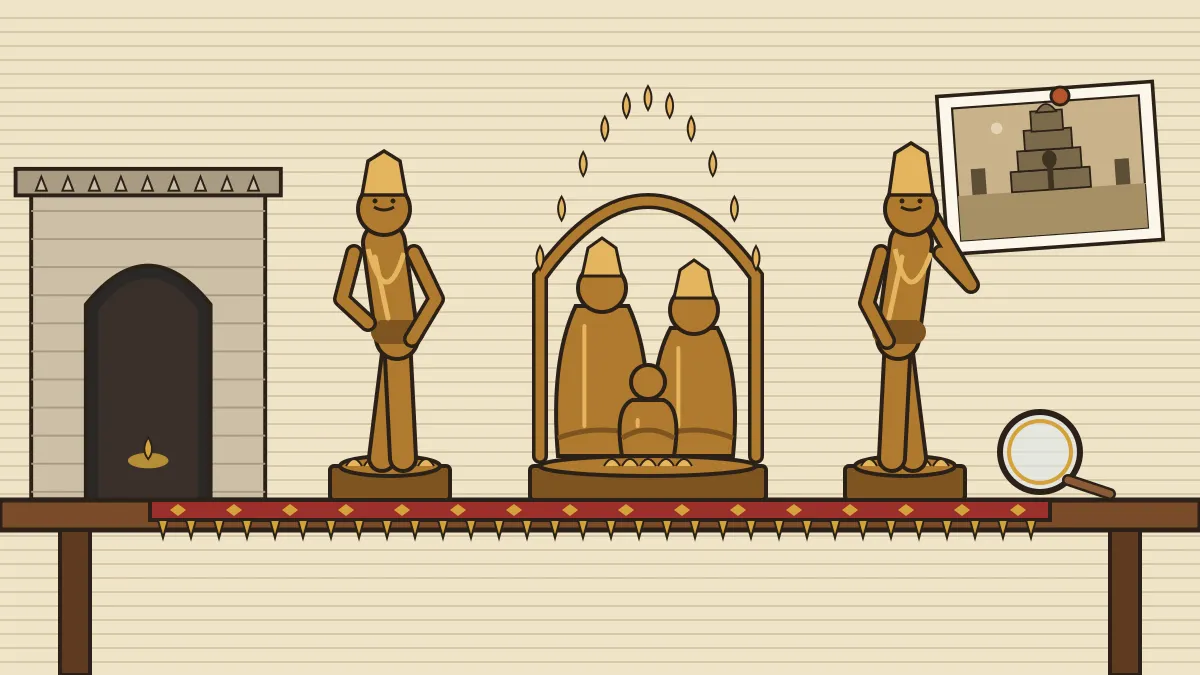
On 26 November 2026, the Archaeological Survey of India (ASI) handed over three repatriated bronze idols to the Idol Wing CID of the Tamil Nadu Police at Dharohar Bhawan, New Delhi. Two of the bronzes came back from the Smithsonian Museum in the United States and one from The Hague in the Netherlands. The handover was carried out by Shri Yadubir Singh Rawat, Director-General of the ASI, and other ASI officials.
All three are temple images from Tamil Nadu. One is a Vijayanagara-period bronze of a Shaiva saint, and two are Chola-period bronzes. None of them is just a work of art. Each was made to be worshipped and carried in procession, and each was traced back to a named temple in its home district. That is the real story of this release, and it is why the news belongs in a syllabus as much as in a newspaper: it joins art history (the Chola bronze tradition), religious history (the Nayanars), law (the Antiquities and Art Treasures Act, 1972) and international relations (the 1970 UNESCO Convention and India's agreement with the United States).
The three bronzes at a glance
The details below are from the Ministry of Culture release of 26 November 2026.
| Bronze | Period | Original temple | Returned from |
|---|---|---|---|
| Saint Sundarar with Paravai Nachiyar | 16th century, Vijayanagara period | Shiva Temple, Viracholapuram, Kallakurichi, Tamil Nadu; photographed in 1956 | Smithsonian Museum, USA |
| Saint Kannappa Nayanar | Chola period | Arulmigu Agneeswarasamy Temple, Thirupugalur, Nagapattinam district | The Hague, Netherlands |
| Somaskanda (Shiva and Uma) | 12th century, Chola period | Shiva Temple (Sri Visvanatha), Alattur, Mannargudi taluk, Thanjavur district; photographed in 1959 | Smithsonian Museum, USA |
The release describes the Kannappa Nayanar bronze as a standing figure in the tribhanga (three-bend) posture, with the right hand raised towards the eye. Tamil place names often have several transliterations (Viracholapuram is also written Veerasolapuram), so for an exam remember the district and the temple type, not the spelling.
How a bronze is traced home
An idol sitting in a foreign museum has no label saying where it was stolen from. India's cases are built on provenance research, which means proving an object's history link by link.
The ASI's method, described in the Ministry of Culture's May 2026 release on the first Smithsonian bronzes, rests on three things:
- Archival records, which are old registers and surveys.
- Field documentation at temples.
- Historical temple photographs from the 1950s and 1960s. This is the decisive step. When an idol appears in a photograph taken inside its own shrine in 1956 or 1959, and the same idol later turns up in a museum catalogue abroad, the case for its return is strong.
That is why the release gives the year of the photograph for two of the three bronzes. The 1956 and 1959 dates are not trivia. They are the evidence, because they fix the last moment at which the idols were known to be in their temples.
Once the temple is identified, the Ministry of Culture, the museum concerned and the Embassy of India negotiate the return. In the Smithsonian cases, the Minister of Culture said in May 2026 that the return was a milestone in bringing back stolen cultural treasures and in strengthening ethical museum practices worldwide.
Why a temple bronze is not a museum piece
To see why these returns matter so much to Tamil Nadu, it helps to know what a bronze idol does in a temple.
The Chola bronze tradition. NCERT's art textbooks note that bronze casting in India uses the lost-wax (cire perdue) method, which goes back to the Indus Valley. A wax model is covered in clay, the wax is melted out, and molten metal is poured into the hollow. Bronze images were made under the Pallavas in the 8th and 9th centuries, but the finest were produced under the Cholas, from the 10th to the 12th century. The craft is still practised today, notably at Kumbakonam. The Chola period also gave the world the fully developed Nataraja form. One notable royal patron in the tenth century was the widowed queen Sembiyan Maha Devi.
Processional images. The main stone image in a sanctum cannot move. A bronze can. NCERT's Themes in Indian History records that around 945 CE the Chola king Parantaka I consecrated metal images of the three great Shaiva saints, Appar, Sambandar and Sundarar, in a Shiva temple, and that these were carried in processions during the festivals of those saints. This is exactly the kind of object that is returning now: small enough to be removed, important enough to be a living part of temple ritual. It is also why a bronze stolen from a village shrine is treated as the loss of a deity, not only a piece of property.
The Nayanars. The Nayanars were the Shaiva saint-poets of the Tamil country, and the Alvars their Vaishnava counterparts. NCERT places the earliest bhakti movements at about the sixth century and notes that the poems of Appar, Sambandar and Sundarar form the Tevaram, compiled and classified in the tenth century. The tradition counts sixty-three Nayanars in all, and the 12th-century Periya Puranam is the text that tells their lives. The Chola kings, NCERT adds, used temples adorned with stone and metal sculpture to link their own power to these popular saints, and they introduced the singing of the Tamil hymns in temples under royal patronage. Two of today's three bronzes, Sundarar and Kannappa, are portraits of Nayanars. The study note on the bhakti and Sufi movements covers this background.
Who the figures are
Sundarar with Paravai Nachiyar. Sundarar (Sundaramurti) is one of the three Tevaram poets. Paravai Nachiyar is shown with him and is traditionally described as his wife. The bronze is of the 16th century, which makes it a Vijayanagara-period piece. Bronze casting continued in the south under Vijayanagara patronage. NCERT notes, for example, the life-size portrait bronzes of Krishnadevaraya and his queens cast at Tirupati in the 16th century.
Kannappa Nayanar. Tradition, as told in the Periya Puranam, makes Kannappa a hunter whose devotion to Shiva took the form of offering his own eye to a linga. The raised hand towards the eye in this bronze is the visual shorthand of that story. He is among the best-known of the sixty-three. NCERT notes that the saint-poets came from varied social backgrounds, from Brahmanas to artisans and cultivators.
Somaskanda. The Somaskanda form shows Shiva with Uma, and in classical iconography with the child Skanda seated between them. It is among the most common and most beloved subjects in Chola temple bronze. The 12th-century image from Alattur is of this type.
The law and the machinery behind a return
A handover like this is the visible end of a long chain.
At home: the legal frame.
- The Antiquities and Art Treasures Act, 1972 regulates antiquities. Under it an "antiquity" is, broadly, an object in existence for not less than 100 years (manuscripts and records: 75 years). Its Section 3 bars private export, and the ASI issues the permits when an object may go abroad temporarily.
- The Ancient Monuments and Archaeological Sites and Remains Act, 1958 protects monuments and sites. The ASI's own annual reporting says it enforces both Acts.
- The Idol Wing is a specialised unit of the Tamil Nadu Police for theft and loss of cultural artefacts. In 2022 the Vice-President described it as the first of its kind in the country. It is the natural recipient of returned idols because it deals with idol theft cases in the state.
- Whenever a theft from a protected monument is reported, an FIR is lodged and a Look Out Notice is circulated, including to customs exit channels. In a written reply in the Rajya Sabha in February 2026 the Culture Minister said six thefts had been reported from Monuments of National Importance in five years, four of them recovered, none of them moved abroad.
Abroad: the international frame.
- The 1970 UNESCO Convention on the Means of Prohibiting and Preventing the Illicit Import, Export and Transfer of Ownership of Cultural Property is the basic treaty. India and the United States are both parties.
- Its limit, as the Ministry itself notes, is timing: a large number of antiquities were smuggled out before the Convention was ratified and now sit in museums and private collections.
- India and the USA therefore signed the first-ever Cultural Property Agreement (CPA) on 26 July 2024 at Bharat Mandapam, on the sidelines of the 46th World Heritage Committee. It is made under Article 9 of the 1970 Convention. It restricts the import into the US of Indian archaeological material dating from about 1.7 million years ago to 1770 CE and of certain ethnological material (religious and ceremonial items, manuscripts) from the 2nd century BCE to 1947 CE, and helps US Customs seize such objects quickly so they can be returned to India. The United States already had similar agreements with many other countries, among them Cambodia, China, Egypt and Greece.
Memory line: The 1970 Convention is the rule; Article 9 is the door for bilateral deals; the 2024 CPA is India's key to that door; the ASI is the detective; the Idol Wing is the claimant at home.
The repatriation numbers
The Ministry of Culture's own figures show how sharply the pace has changed. All counts are antiquities repatriated to India.
| Date of statement | Total repatriated | Of which since 2014 |
|---|---|---|
| August 2021 | 54 | 41 |
| April 2023 | 251 | 238 |
| July 2024 | 358 (since 1976) | 345 |
| May 2026 | 666 | 653 |
Two readings follow. First, the base never changes: only 13 antiquities came back between 1976 and 2013 (54 minus 41, 358 minus 345 and 666 minus 653 all give 13). Second, the Ministry quotes counts over different periods (since 1976, since 2014, the last five years), so always note the period before comparing numbers. The Tamil Nadu connection is long-standing. In June 2022, ten sculptures from Australia and the USA were handed over to the Tamil Nadu government, among them a Nataraja and two figures of the child saint Sambandar, and in April 2023 a late-Chola Hanuman from a temple in Ariyalur district was handed to the Idol Wing as case property.
The Smithsonian Nataraja and the loan
The November handover is the second chapter of a story that began in May 2026. Then, the Minister of Culture announced the return of three bronzes from the Smithsonian's National Museum of Asian Art: a Chola-period Shiva Nataraja (about 990 CE, from the Bhava Aushadesvara temple in Thanjavur district, photographed in 1957), the Somaskanda and the Sundarar with Paravai. The last two reached New Delhi on 12 May 2026.
The Nataraja was a different case. As a goodwill gesture, and in support of responsible museum engagement, India agreed to a three-year loan of the Nataraja to the museum from 2025 to 2028, so that audiences could see its whole journey from origin to repatriation. The 26 November release names only two Smithsonian bronzes, the Sundarar and the Somaskanda, so the Nataraja is not part of this handover. Keep the two apart: Nataraja on loan to 2028, Somaskanda and Sundarar already back.
In the same May announcement the Minister said that 657 art objects of Indian origin had been handed over by US law enforcement agencies to the Embassy of India in Washington, with arrangements under way for transport and verification by ASI experts. That is a much larger consignment than the three bronzes of this week, and the verification work on it is likely to produce further handovers.
What to watch
- Where the bronzes go next. The release does not say when the idols will go back to their home temples. Earlier returns, such as the Hanuman bronze of 2023, were handed to the Idol Wing as case property first.
- Verification of the 657 objects from the United States, and the ASI's provenance work on them.
- The Nataraja loan to 2028, and whether it becomes a model for other museums with disputed objects.
- More Cultural Property Agreements. The US route has shown results, and other countries with large Indian collections are the obvious next targets.
For a broader look at how India is putting its heritage on display at home, see our explainer on the Yuge Yugeen Bharat Museum. For the dynasty behind the bronzes, revise the Imperial Cholas.
🔑 Revision block
The event. 26 November 2026: ASI hands over three repatriated bronzes to the Idol Wing CID, Tamil Nadu Police, at Dharohar Bhawan, New Delhi; DG ASI Yadubir Singh Rawat.
The idols. Sundarar with Paravai Nachiyar (16th c., Vijayanagara; USA). Kannappa Nayanar (Chola; Thirupugalur, Nagapattinam; Netherlands). Somaskanda (12th c., Chola; Alattur, Thanjavur; USA). Two from the Smithsonian, one from The Hague.
How traced. Archival records, field work and temple photographs of the 1950s–60s (1956 and 1959 in this case).
Art and religion. Chola bronzes (10th–12th c.) made by lost-wax casting; Parantaka I (c. 945) consecrated processional images of Appar, Sambandar, Sundarar; 63 Nayanars; Tevaram; Periya Puranam (12th c.).
Law. Antiquities and Art Treasures Act, 1972 (100 years; manuscripts 75; Section 3 bars private export); 1958 Act; 1970 UNESCO Convention; India–US CPA, 26 July 2024 (Article 9).
Numbers. 666 repatriated in all, 653 since 2014, 13 before (May 2026). Nataraja (c. 990 CE) on loan to the Smithsonian 2025–28. 657 objects handed by US agencies to the Indian Embassy, awaiting verification.
🎯 Practice MCQs
Q1. Which body carried out the provenance research that traced the repatriated bronzes to their original temples?
(a) Central Industrial Security Force
(b) Archaeological Survey of India
(c) Indian Council of Historical Research
(d) National Museum Institute
→ (b)
The ASI used archival records, field documentation and temple photographs of the 1950s and 1960s. It also enforces the Antiquities and Art Treasures Act, 1972.
Q2. The Chola bronze images of Tamil Nadu were made by which technique?
(a) Cold hammering of sheet metal
(b) Sand-mould casting
(c) Electroplating over clay
(d) Lost-wax (cire perdue) casting
→ (d)
A wax model is coated in clay, the wax is melted out and molten metal fills the cavity. The method is as old as the Indus Valley and was perfected under the Cholas.
Q3. Consider the following statements:
1. Sundarar is counted among the Nayanars, the Shaiva saint-poets of the Tamil country.
2. The Nayanars were devotees of Vishnu.
Which of the statements given above is/are correct?
(a) 1 only
(b) 2 only
(c) Both 1 and 2
(d) Neither 1 nor 2
→ (a)
The Nayanars were devotees of Shiva. The Vaishnava saint-poets were the Alvars.
Q4. The 1970 UNESCO Convention is concerned with:
(a) Protecting the underwater cultural heritage
(b) Listing sites of outstanding universal value
(c) Prohibiting and preventing the illicit import, export and transfer of ownership of cultural property
(d) Safeguarding intangible cultural heritage
→ (c)
Options (a), (b) and (d) are the subjects of the 2001 Underwater Heritage Convention, the 1972 World Heritage Convention and the 2003 Intangible Heritage Convention respectively.
Q5. Under the Antiquities and Art Treasures Act, 1972, an object is generally treated as an "antiquity" if it has been in existence for not less than:
(a) 50 years
(b) 100 years
(c) 150 years
(d) 200 years
→ (b)
The Act uses 100 years for objects, and 75 years for manuscripts, records and documents.
Q6. India and the United States signed their first Cultural Property Agreement on:
(a) 26 July 2024
(b) 15 August 2024
(c) 2 October 2024
(d) 14 November 2024
→ (a)
It was signed at Bharat Mandapam on the sidelines of the 46th World Heritage Committee, under Article 9 of the 1970 UNESCO Convention.
Q7. According to the Ministry of Culture's figures of May 2026, of the 666 antiquities repatriated to India, how many came back since 2014?
(a) 13
(b) 345
(c) 358
(d) 653
→ (d)
666 minus 653 leaves 13, the number repatriated before 2014. The figures of 345 and 358 are from July 2024.
Q8. Consider the following statements about the handover of 26 November 2026:
1. Two of the three bronzes returned from the Smithsonian Museum in the United States.
2. The bronzes were handed to the Idol Wing CID of the Tamil Nadu Police.
Which of the statements given above is/are correct?
(a) 1 only
(b) 2 only
(c) Both 1 and 2
(d) Neither 1 nor 2
→ (c)
The third bronze, of Kannappa Nayanar, came from The Hague in the Netherlands. The Smithsonian Nataraja is on loan until 2028 and was not part of this handover.
📋 How this gets asked (PYQ pattern)
Heritage and art are a steady CDS source, and this story can be asked in four ways.
The first is art history: the features of Chola bronzes, the lost-wax method, the Nataraja iconography (the dance of cosmic cycles, the demon of ignorance beneath the foot) and the difference between Chola temples in stone and Chola bronzes in metal. Expect options that swap the dynasty, Pallava or Vijayanagara in place of Chola.
The second is religion and literature: Alvars versus Nayanars, the Tevaram versus the Nalayira Divyaprabandham, and the 63 Nayanars. The examiner likes the mix-up of Vaishnava and Shaiva saints, as in Q3.
The third is law and institutions: the 1972 Act, the 1958 Act, the ASI's parent ministry, and the 1970 UNESCO Convention. Match-the-following questions pair each convention with its subject, as in Q4.
The fourth is current affairs: a recent repatriation, a recent agreement, or a headline number. Fresh hooks this cycle are the 26 July 2024 CPA, the 666 and 653 figures and the Nataraja loan to 2028.
Preparing for CDS? Make a one-line card for each Chola bronze type and each Nayanar you meet, with the district of the temple. Revise with our notes on the Imperial Cholas and the bhakti movements. Follow the daily CDS current affairs, and learn with experienced faculty in the upcoming Cavalier courses in Delhi.
Source: PIB / Ministry of Culture, "Three Antiquities Repatriated from USA and Netherlands Handed Over to Tamil Nadu Police by ASI", 26 November 2026; Ministry of Culture release of 13 May 2026 on the Smithsonian bronzes; releases of 26 July 2024 (India–US Cultural Property Agreement), 25 April 2023, 1 June 2022 and 12 February 2026 (Rajya Sabha reply). Chola bronzes, Parantaka I and the Nayanars from NCERT, "Indian Bronze Sculpture" and "Themes in Indian History, Part II". Antiquities and Art Treasures Act, 1972 as published by the Ministry of Culture; 1970 UNESCO Convention as published by UNESCO.
✍️ Written by Hitendra Deswal — Polity & current-affairs faculty at The Cavalier. Reviewed by the Cavalier Faculty Desk.