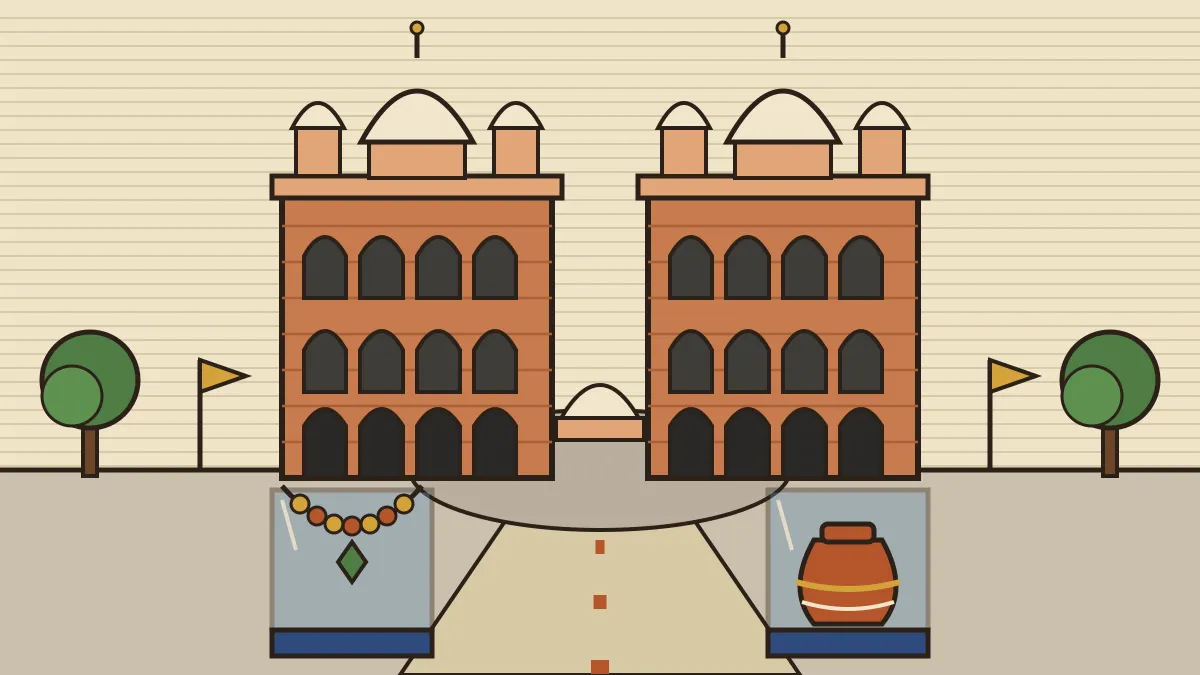
The two sandstone blocks that housed India's most powerful ministries for 95 years are to become a museum. On 11 November 2026, the Cabinet Committee on Economic Affairs (CCEA), chaired by the Prime Minister, approved the development of the Yuge Yugeen Bharat Museum (YYBM) at the North and South Block complex in New Delhi. The estimated project cost is ₹3,230 crore.
The approval comes nine months after the government vacated the buildings. On 13 February 2026 the Prime Minister's Office moved into a new building called Seva Teerth, and the Union Cabinet held its last meeting in the South Block chamber. At that same meeting (announced in a release of 14 February) the Cabinet resolved that the blocks would be part of the "Yuge Yugeen Bharat National Museum". The new approval turns that resolution into a funded, scheduled project.
For exam purposes the story has three layers: the buildings (who built them and why they matter), the project (numbers, phases, partners), and the idea (how a museum of civilisation differs from a conventional museum). This article takes them in that order.
The project at a glance
All figures below are from the Cabinet release of 11 November 2026 unless stated.
| Item | Detail |
|---|---|
| Approving body | Cabinet Committee on Economic Affairs, chaired by the Prime Minister |
| Estimated cost | ₹3,230 crore |
| Appraised by | Public Investment Board, on 27 July 2026 |
| Built-up area | About 1,78,509 sq m |
| Method | Adaptive reuse of the North and South Block complex |
| Phasing | FY 2026-27 to FY 2030-31 |
| First gallery | "Adornment", in North Block, later in 2027 |
| Objects identified | About 1.8 million |
| Visitor capacity planned | 1 crore a year |
| Announced | 18 May 2023 |
Two numbers deserve a closer look. A Ministry of Culture release of December 2024 gave the planned area as about 1,55,000 sq m. The approved figure is about 23,500 sq m larger, an increase of roughly 15%. And if the ₹3,230 crore is divided by the built-up area, the cost works out to roughly ₹1.8 lakh per square metre. Both are calculations by The Cavalier, not figures printed in the releases.
The release also claims that, benchmarked against major international museums, the YYBM will have the largest display area of any museum in the world. That is the government's claim; treat it as "claimed" if an exam option says so.
Careful with "PIB". In this story, PIB in the Cabinet note is the Public Investment Board, a body in the Ministry of Finance that appraises large central projects before the Cabinet decides. The Press Information Bureau, which published the release, is a different organisation with the same short name.
Two buildings with a long story
The North Block and South Block stand on Raisina Hill, flanking the avenue that leads to Rashtrapati Bhavan. They were designed by Herbert Baker, who worked alongside Edwin Lutyens, the architect of the Viceroy's House (today's Rashtrapati Bhavan). The question of the capital goes back to the Delhi Durbar of December 1911, where the British Crown announced that the capital would move from Calcutta to Delhi. Construction began around 1912, and the buildings were completed and brought into use around 1931, when the new capital was inaugurated. The February 2026 Cabinet release itself speaks of "nearly 95 years" since the South Block was inaugurated.
Baker's design mixed a classical frame with Indian touches such as domed pavilions (chhatris) and carved stone screens (jaalis), and the two blocks mirror each other across the central axis. They were built as the Secretariat, the administrative engine of the Raj.
After 1947 they stayed in use. Historically the South Block housed the Prime Minister's Office, the Ministry of Defence and the Ministry of External Affairs; the North Block housed the Ministries of Finance and Home Affairs. The Union Budget was prepared there for decades, and its famous pre-Budget photograph of the Finance Minister's team outside the North Block became an annual ritual. The Cabinet release of February 2026 says the complex witnessed decisions by Cabinets under 16 Prime Ministers, from Jawaharlal Nehru to Narendra Modi.
The same release describes the blocks as buildings "constructed by the British", and presents the move to Seva Teerth as a shift "from the culture of power to the culture of service". That framing explains why the museum is not just a reuse of empty space. It is a deliberate decision to turn the symbol of colonial administration into an exhibition of India's own civilisational story.
From Central Vista to museum: the timeline
The museum is part of the wider Central Vista Redevelopment, which has already produced the renamed Kartavya Path (formerly Rajpath, renamed on 8 September 2022) and the new Parliament building (inaugurated on 28 May 2023). The key dates for the museum are these.
| Date | Event |
|---|---|
| 18 May 2023 | Prime Minister announces the museum (the day is International Museum Day) |
| 19 December 2024 | National Museum signs a technical cooperation agreement with France Museums Développement |
| 13 February 2026 | Government vacates the blocks; Seva Teerth dedicated; Cabinet resolves the blocks will form the museum |
| 27 July 2026 | Public Investment Board appraises the project |
| 11 November 2026 | CCEA approves ₹3,230 crore |
The French partnership deserves a note. The agreement of 19 December 2024 was signed between the National Museum and France Museums Développement (FMD), a French partner for museum planning. It covered a feasibility study, interpretive planning and building programming. It built on an earlier Letter of Intent of 2020 and another signed during the Prime Minister's visit to Paris in 2023. A Lok Sabha reply of March 2025 said the project's timeline and budget depended on the feasibility study. The Cabinet approval, almost two years after the agreement, is the outcome of that process.
France is a natural partner because of what the Ministry of Culture calls its "Grands Projets" tradition, in which government buildings were converted into cultural institutions. The Ministry of Culture's own release cites the Louvre as the precedent, where a government ministry vacated a landmark building so that it could become a museum.
What visitors will see
The museum is meant to tell one connected story of Bharat's civilisational continuity, diversity and richness, covering both tangible heritage (monuments, sculpture, textiles, manuscripts, objects) and intangible heritage (performing arts, oral traditions, knowledge systems). That distinction is a regular exam topic, and our explainer on intangible cultural heritage and UNESCO covers the 2003 UNESCO Convention behind it.
The release names these themes:
- Adornment, the opening gallery, in the North Block, expected to open to the public in the later part of 2027.
- Architecture and Cityscapes.
- Mathematics and Astronomy.
- Languages and Scripts.
- Faith and Spirituality.
- Bharat Connects: Trade and Ideas.
The list ends with "among others", so more galleries will follow in a modular approach. Content analysis has identified around 1.8 million objects from the National Museum, other Ministry of Culture museums, 52 ASI site museums, various state museums and private collections.
The scale is worth setting beside what exists. The National Museum began as an exhibition at Rashtrapati Bhavan in 1949, and its present building on Janpath had its foundation laid in 1955 and opened from 1960. The YYBM is planned as a far larger, modern successor, drawing on that museum's collection and a network of site museums such as the ones at ASI-protected sites.
The project covers more than galleries. It includes collection storage and conservation facilities, visitor amenities, immersive technologies, landscaping and "intelligent building systems". For a heritage building this is demanding work: the new services must fit inside the old fabric without damaging it. That is the meaning of adaptive reuse.
Memory line: Adaptive reuse = a new use for an old building, with its character kept. Repurposing is not demolition.
How it was cleared: the approval route
A big central project does not go straight to the Cabinet. In this case the route was:
- The Ministry of Culture prepared the proposal.
- The Public Investment Board appraised it (27 July 2026).
- The Ministry of Culture concurred with the Board's recommendations.
- The CCEA approved it (11 November 2026).
The CCEA is a Cabinet committee chaired by the Prime Minister that decides on major economic and infrastructure proposals. Do not confuse it with the Cabinet Committee on Political Affairs, or the Cabinet Committee on Security, which handles defence and security appointments and matters.
What the government expects
The release lists several outcomes: heritage preservation, a public use for the buildings, cultural tourism, education and research, employment for artisans, craftspeople, museologists and designers, and "Make in India" vendor development for museum materials. The museum is expected to earn recurring revenue from tickets, food outlets, events, venue hire, digital experiences, tours and retail, and it is being equipped for one crore visitors a year. No beneficiary count is given, since it is a public institution.
Four things to watch:
- The 2027 opening. The Adornment gallery in the North Block is the first test of the schedule.
- Phasing to 2030-31. The five-year financial window matches the Sixteenth Finance Commission cycle, so cost control will be watched closely.
- Collection sharing. Moving 1.8 million objects from many institutions raises conservation and ownership questions that the "content and collection analysis" must settle.
- Public access. The release emphasises accessible, visitor-centric design; how ticketing is structured will decide who actually comes. Community voice in museums is a live theme; see our note on the Mysuru conclave on tribal languages and museums.
🔑 Revision block
The decision. CCEA, chaired by the Prime Minister, approved the Yuge Yugeen Bharat Museum on 11 November 2026; cost ₹3,230 crore.
Site and method. North and South Block, New Delhi (Raisina Hill); adaptive reuse; about 1,78,509 sq m (December 2024 plan: about 1,55,000 sq m).
Timeline. Announced 18 May 2023 (International Museum Day); France Museums Développement agreement 19 December 2024; blocks vacated and Seva Teerth dedicated 13 February 2026; Public Investment Board appraisal 27 July 2026; approval 11 November 2026.
Schedule. Phased over FY 2026-27 to 2030-31; first gallery Adornment (North Block), later in 2027.
Collections. About 1.8 million objects, including 52 ASI site museums; galleries on architecture, mathematics and astronomy, languages and scripts, faith, trade and ideas.
The buildings. Designed by Herbert Baker (Lutyens designed the Viceroy's House); built from about 1912, in use from about 1931; capital shift announced at the 1911 Delhi Durbar.
Traps. PIB here = Public Investment Board, not Press Information Bureau. CCEA is not CCS or CCPA.
🎯 Practice MCQs
Q1. The Yuge Yugeen Bharat Museum project of ₹3,230 crore was approved on 11 November 2026 by:
(a) Cabinet Committee on Security
(b) Cabinet Committee on Economic Affairs
(c) Cabinet Committee on Political Affairs
(d) Public Investment Board
→ (b)
The CCEA, chaired by the Prime Minister, gave the approval. The Public Investment Board only appraised the project (27 July 2026).
Q2. The body that appraised the museum project on 27 July 2026 before it went to the Cabinet was the:
(a) Public Investment Board
(b) Press Information Bureau
(c) NITI Aayog
(d) Sixteenth Finance Commission
→ (a)
The Public Investment Board appraises large central projects. The Press Information Bureau shares the short name PIB but only issues press releases.
Q3. The North Block and South Block on Raisina Hill were designed by:
(a) Edwin Lutyens
(b) Robert Tor Russell
(c) Charles Correa
(d) Herbert Baker
→ (d)
Baker designed the two Secretariat blocks. Lutyens designed the Viceroy's House, now Rashtrapati Bhavan.
Q4. Consider the following statements about the museum:
1. It will be created by adaptive reuse of the North and South Block complex.
2. The first gallery, on the theme of Adornment, is expected to open in the North Block in the later part of 2027.
Which of the statements is/are correct?
(a) 1 only
(b) 2 only
(c) Both 1 and 2
(d) Neither 1 nor 2
→ (c)
Both statements are from the Cabinet release.
Q5. The technical cooperation agreement between the National Museum and France Museums Développement for this museum was signed on:
(a) 18 May 2023
(b) 19 December 2024
(c) 13 February 2026
(d) 27 July 2026
→ (b)
It was signed on 19 December 2024. 18 May 2023 is when the museum was announced, and 13 February 2026 is when the blocks were vacated.
Q6. The museum project is to be implemented in phases over:
(a) FY 2024-25 to FY 2027-28
(b) FY 2025-26 to FY 2028-29
(c) FY 2026-27 to FY 2029-30
(d) FY 2026-27 to FY 2030-31
→ (d)
The five-year window is FY 2026-27 to FY 2030-31.
Q7. 'Seva Teerth', mentioned in the context of the North and South Block, is:
(a) The new Prime Minister's Office dedicated on 13 February 2026
(b) The new Parliament building opened in 2023
(c) The renamed Rajpath
(d) The name of the museum's first gallery
→ (a)
The new PMO was dedicated to the nation on 13 February 2026 as Seva Teerth. The renamed Rajpath is Kartavya Path; the first gallery is Adornment.
Q8. 'Adaptive reuse' of a heritage building means:
(a) Demolishing it and rebuilding an exact copy
(b) Sealing it permanently as a monument
(c) Giving it a new use while keeping its architectural character
(d) Moving its materials to a new site
→ (c)
The Cabinet release describes exactly this: preserving the blocks' character while giving them a new institutional role.
📋 How this gets asked (PYQ pattern)
Art and culture questions on museums and monuments come in three forms.
The first is institutions and who does what: the National Museum, the Archaeological Survey of India, UNESCO and the Ministry of Culture. Options are usually one step apart, so know which body protects monuments, which one displays collections and which one lists heritage.
The second is architecture and architects: who designed which building, and in what style. The Lutyens and Baker pairing for the Viceroy's House and the Secretariat blocks is the classic match-the-following item, and it is now in the news.
The third is tangible versus intangible heritage and the conventions that protect each. The fresh hook this cycle is the adaptive-reuse idea, ₹3,230 crore, 1,78,509 sq m, 1.8 million objects, the Adornment gallery and the France Museums Développement link.
Preparing for CDS? Pair this story with the colonial-era chapters of our history notes, especially the capital's move to Delhi in 1911. Follow the daily CDS current affairs, and learn with experienced faculty in the upcoming Cavalier courses in Delhi.
Source: PIB / Cabinet Committee on Economic Affairs, "Cabinet approves Development of Yuge Yugeen Bharat Museum at North and South Block Complex, New Delhi", 11 November 2026; PIB Cabinet release of 14 February 2026 on the transition to Seva Teerth; Ministry of Culture releases of 19 December 2024 and 24 March 2025. Cost per square metre and the increase over the 2024 figure were calculated by The Cavalier. Dates of the blocks' construction are approximate and vary slightly across published histories.
✍️ Written by Hitendra Deswal — Polity & current-affairs faculty at The Cavalier. Reviewed by the Cavalier Faculty Desk.