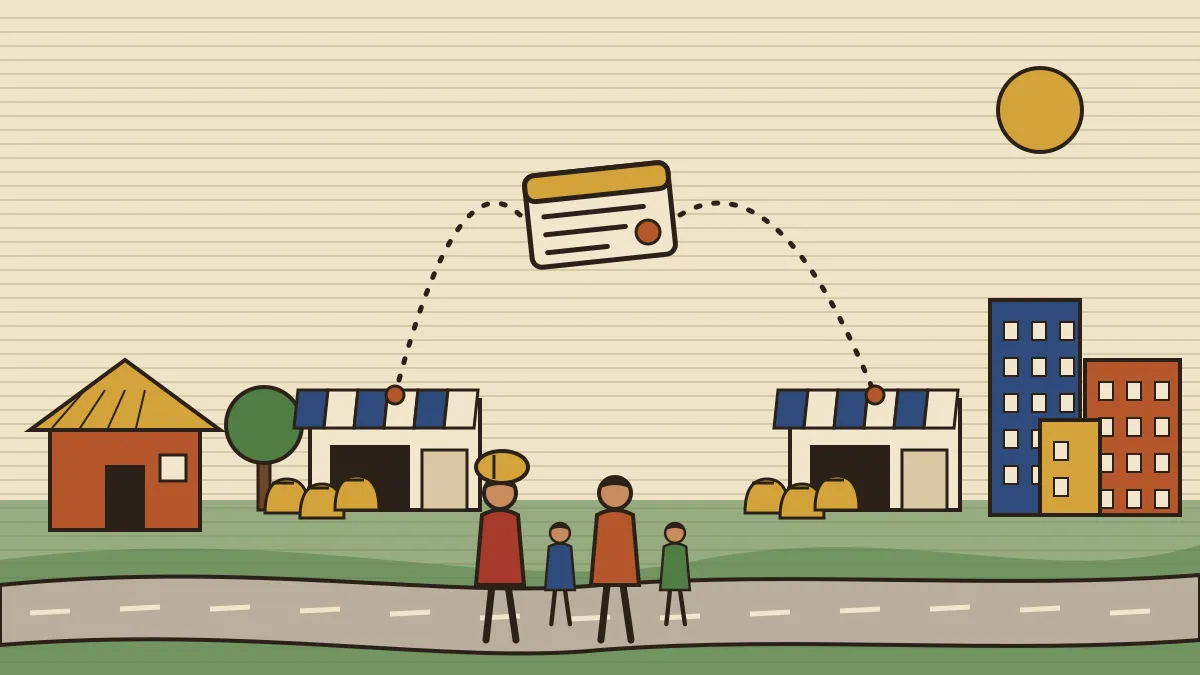
A worker from a village in one State takes a construction job in a city in another. Her family still holds a ration card, but it is registered to a fair price shop back home, hundreds of kilometres away. For decades that meant the entitlement stayed behind with the card. The scheme that fixed this, One Nation One Ration Card (ONORC), is now seven years old, and on 12 November 2026 the Press Information Bureau released a backgrounder on how far it has come.
The headline is that ONORC works in all 36 States and Union Territories, covering 100% of PMGKAY beneficiaries. About 3.27 crore portability transactions are recorded every month, and since 2019 the total has crossed 233 crore, moving more than 614 lakh metric tonnes (LMT) of foodgrains. Behind the scheme sits a much larger machine: a fully digitised database of about 78.65 crore beneficiaries, 5.51 lakh fair price shops and a mobile app in 13 languages.
This article starts from the law that creates the entitlement, then explains how portability works, what the new numbers say and where the system is still being repaired.
The law underneath: National Food Security Act, 2013
ONORC does not create a new right. It changes where an existing right can be used. The right comes from the National Food Security Act (NFSA), 2013, which turned food subsidy from a welfare scheme into a legal entitlement.
The key provisions are:
- Coverage: up to 75% of the rural and 50% of the urban population can be covered under the Targeted Public Distribution System (TPDS).
- Priority households: 5 kg of foodgrains per person per month.
- Antyodaya Anna Yojana (AAY) households, the poorest, receive 35 kg per household per month.
- Original prices: ₹3 a kilogram for rice, ₹2 for wheat and ₹1 for coarse grains. These were fixed for an initial period of three years from the Act's commencement.
The state link is the Directive Principles. Article 47 says the State must regard raising the level of nutrition and the standard of living of its people as among its primary duties. The NFSA is the statute that gives that duty teeth. Our note on the Directive Principles covers Articles 36 to 51 in full.
Since then the price has dropped to zero. On 29 November 2023 the Union Cabinet decided to provide free foodgrains to about 81.35 crore beneficiaries for five years from 1 January 2024 under the Pradhan Mantri Garib Kalyan Anna Yojana (PMGKAY), at an estimated cost of about ₹11.80 lakh crore. The same decision said these grains could be lifted from any fair price shop under ONORC, so portability and free grain now work together.
The two terms are easy to confuse, so keep them apart:
| Term | What it is | Who runs it |
|---|---|---|
| NFSA, 2013 | The law that creates the legal entitlement to subsidised foodgrains | Parliament; implemented with the States |
| TPDS | The delivery system: central grain, State distribution, fair price shops | Centre and States jointly |
| PMGKAY | The scheme under which that grain is supplied free of cost | Centre pays the subsidy |
| ONORC | The reform that makes the entitlement usable at any shop in the country | Department of Food and Public Distribution |
How portability works
Before ONORC, a ration card was tied to one shop in one place. A migrant could not use it where she lived and worked, and the family at home could not use it once she left with the card.
Under ONORC the card does not move at all. What moves is the record. The beneficiary goes to any fair price shop, where an e-PoS (electronic point-of-sale) device identifies her through Aadhaar-based biometric authentication. The system looks up her entitlement in a central database, and the shop issues the grain. The shop's stock is adjusted, and the home State is told what was drawn.
Three features make it practical:
- Part or full lifting. A beneficiary can take all or part of her entitlement at the new shop.
- Balance for the family at home. Relatives left behind can draw the remaining quantity on the same card.
- No change in entitlement. The quantity is exactly what the NFSA already fixes. ONORC moves access, not size.
The foundation is that the NFSA data of every State is linked with the others. That is why Aadhaar-seeding of cards and 100% digitised databases matter so much; without them a shop in one State cannot trust a record from another.
From four States to thirty-six
ONORC began in August 2019 (the pilot went live on 1 August) as a pilot in four States: Andhra Pradesh and Telangana formed one pair, Gujarat and Maharashtra the other. The rollout was fast, and it accelerated when the COVID-19 lockdown of 2020 stranded millions of migrant workers far from home.
| Milestone | Date | Coverage |
|---|---|---|
| Pilot launched | August 2019 | 4 States |
| Rollout wave | By December 2020 | 32 States/UTs |
| Mera Ration app launched | 12 March 2021 | 32 States/UTs; about 69 crore beneficiaries (86%) |
| Delhi and West Bengal join | August 2021 | 34 States/UTs |
| Chhattisgarh joins | 2 February 2022 | 35 States/UTs; about 96.8% of NFSA population |
| Assam joins | 21 June 2022 | All 36 States/UTs |
The Supreme Court played a part in the last stretch. On 29 June 2021, in the suo motu case on the problems of migrant labourers, a bench of Justices Ashok Bhushan and M.R. Shah directed the States that had not yet implemented ONORC to do so by 31 July 2021. It also asked the Centre to build a portal, with the National Informatics Centre, to register unorganised-sector and migrant workers. Delhi and West Bengal, two of the four remaining States, were operating the scheme by August 2021. Our explainer on five years of e-Shram covers the registration side of the same story.
Reading the numbers: what 233 crore tells us
Three figures from the new backgrounder are worth working out for yourself.
Average size of a transaction. 614 LMT is about 6.14 crore tonnes, or about 6.14 × 10¹⁰ kg. Divided by 233 crore transactions, that is roughly 26 kg per transaction. In other words a typical portable transaction is a household's monthly draw, not a token purchase.
Growth in volume. In August 2022, PIB reported more than 77.5 crore cumulative portability transactions and a monthly average of about 3.5 crore (February to July 2022). The scheme has since added about 155 crore transactions, roughly 3 crore a month on average, and today's monthly figure is 3.27 crore. So the cumulative count has tripled, but the monthly rate is no higher than it was four years ago. The scheme grew by running for longer, not by running faster.
What the monthly figure includes. The count covers both inter-State and intra-State portability. A beneficiary who moves from one district to another within her own State is counted too. Migrants crossing State borders are the heart of the story, but they are not the whole of the 3.27 crore.
The big jump in monthly volume came as the last States joined in 2021 and 2022; since then it has stayed in the range of roughly 3 to 3.5 crore.
The plumbing: digitising the Public Distribution System
ONORC only works if the PDS behind it is digital, clean and honest. The backgrounder lists what has been done, with figures for October 2026 unless stated.
- Digitisation: ration card and beneficiary databases are 100% digitised in all States/UTs, covering about 78.65 crore beneficiaries, and are public on State transparency portals.
- Aadhaar-seeding: of 20.51 crore ration cards in the central system, 98.8% (20.27 crore) are seeded. Beneficiary-level seeding stands at 76.97 crore.
- e-KYC: done for 71.52 crore beneficiaries by 30 September 2026, about 91% of the total.
- Fair price shops: 99.8% of the 5.51 lakh shops have working e-PoS devices.
- Supply chain: online allocation of foodgrains is nationwide; the supply chain itself is computerised in 31 States/UTs.
- Grievances: transparency portals, online grievance systems and toll-free helplines run in every State.
A second purpose of digitisation is cleaning the list. Using Aadhaar and PDS data analytics, the government flagged 5.95 crore suspicious records under its first "Rightful Targeting" exercise and deleted 2.58 crore duplicate or ineligible entries. That is about 43% of the flagged entries. Removing ghost and duplicate cards reduces leakage, and it also makes room for eligible families who were left out, an issue that comes up repeatedly in discussions of the NFSA.
The new umbrella: SARTHAK-PDS
The backgrounder also describes the government's current framework for PDS modernisation, the Scheme for Assistance in Ration Transport and Handling-Income with Automation in PDS (SARTHAK-PDS), which runs until 31 March 2031. It has two main limbs:
- Support for movement and margins. It funds the transport and handling of grain within States and the margins paid to fair price shop dealers.
- A unified digital backbone. Under it, SMART-PDS integrates ration cards, distribution, supply chains and grievance redressal in one central system. Two sub-initiatives, NIRMAL (data architecture and analytics) and SAKSHAM (real-time data integration, including vehicle location tracking from procurement to distribution), follow grain from the warehouse to the shop.
Dealer margins matter more than they look. A shop that earns too little has every incentive to divert grain or close. By funding margins and tracking trucks, the Centre is addressing the two weakest points in the chain: the last mile and the shopkeeper.
The Mera Ration app
The Mera Ration app was launched on 12 March 2021 by the Secretary of the Department of Food and Public Distribution. It has since been extended from Hindi and English to many more languages and is now available in 13, according to the backgrounder.
A beneficiary can use it to:
- check her monthly entitlement and past transactions;
- verify whether her Aadhaar is seeded;
- check eligibility for national portability and register voluntarily for ONORC;
- find nearby fair price shops using GPS and get map directions to the nearest one.
For a migrant who has just arrived in a strange city, the last feature may be the most useful. The system gives her a legal right, and the app tells her where the nearest shop is.
Where the gaps still are
The backgrounder is, naturally, a record of progress. A careful reader should still ask what it leaves out.
- Who is outside the list. NFSA coverage still follows population ratios fixed with reference to the 2011 Census. Any family that has formed or moved since then may not hold a card at all, and portability helps only those who do.
- Seeding is not the same as access. Aadhaar-seeded and e-KYC-completed records are high, yet biometric authentication can fail for manual labourers with worn fingerprints or for the elderly, and connectivity at a shop can drop. Fallbacks such as other authentication routes and officer-approved lifting matter in practice.
- Computerised supply chains in 31 of 36. Five States/UTs are still outside this computerisation, so tracking of grain is incomplete.
- A stable monthly count. The flat (even slightly lower) monthly numbers since 2022 could mean most migrants who need the facility are already using it, or that awareness and trust are uneven. The release does not say which.
- Dependence on free grain. The scheme has grown up alongside free grain under PMGKAY. Its fiscal cost of about ₹11.80 lakh crore over five years is the number to remember when the same debate reaches Budget time.
What to watch next
- The end of the PMGKAY five-year window, on 31 December 2028, and whether free grain continues in the same form.
- Updated beneficiary lists, which will need fresh population data once the Census exercise is complete.
- SARTHAK-PDS rollout by State, especially vehicle tracking and real-time stock data.
- Use of the Mera Ration app by migrants, which is the real test of whether portability is known as well as available.
🔑 Revision block
The release. PIB Backgrounder "One Nation, One Ration Card", 12 November 2026 (Department of Food and Public Distribution).
ONORC. Launched in August 2019, pilot in 4 States; 36 States/UTs from June 2022 (Assam last). Covers 100% of PMGKAY beneficiaries. Biometric/Aadhaar authentication at an e-PoS device in any fair price shop.
Numbers. About 3.27 crore portability transactions a month; 233 crore+ since 2019; 614 LMT foodgrains; average about 26 kg per transaction.
Digital PDS (Oct 2026). 78.65 crore beneficiaries; 20.51 crore cards, 98.8% Aadhaar-seeded; e-KYC 91%; 5.51 lakh FPS, 99.8% with e-PoS. Rightful Targeting: 5.95 crore flagged, 2.58 crore deleted.
Law. NFSA, 2013: up to 75% rural / 50% urban; 5 kg per person (priority); 35 kg per household (AAY); original prices ₹3/₹2/₹1. Article 47 (Directive Principle on nutrition). PMGKAY: free grain for 5 years from 1 Jan 2024, about ₹11.80 lakh crore.
Courts and tools. Supreme Court, 29 June 2021: States to implement ONORC by 31 July 2021. Mera Ration app: launched 12 March 2021, now 13 languages. SARTHAK-PDS (SMART-PDS, NIRMAL, SAKSHAM) to 31 March 2031.
🎯 Practice MCQs
Q1. The legal entitlement to subsidised foodgrains through the Targeted Public Distribution System is created by:
(a) The Essential Commodities Act, 1955
(b) The National Food Security Act, 2013
(c) The Consumer Protection Act, 2019
(d) The Public Distribution System (Control) Order, 1960
→ (b)
The NFSA, 2013 made subsidised food a legal right. ONORC only makes that right usable at any shop; it does not create it.
Q2. Which State became the 36th State/UT to implement One Nation One Ration Card in June 2022, completing the nationwide rollout?
(a) Assam
(b) Chhattisgarh
(c) Delhi
(d) West Bengal
→ (a)
Chhattisgarh joined earlier, in February 2022, as the 35th. Delhi and West Bengal joined in August 2021.
Q3. Under the National Food Security Act, an Antyodaya Anna Yojana household is entitled to how much foodgrain per month?
(a) 5 kg per household
(b) 15 kg per household
(c) 25 kg per household
(d) 35 kg per household
→ (d)
AAY households get 35 kg per household. Priority households get 5 kg per person, and that figure is the one the options try to confuse.
Q4. A migrant beneficiary draws foodgrains from a fair price shop in a new State under ONORC. She is identified at the shop through:
(a) Voter ID card
(b) Aadhaar-based biometric authentication on an e-PoS device
(c) PAN card
(d) Her original shopkeeper's written approval
→ (b)
The e-PoS device authenticates the beneficiary and checks the central record. No paper permission from the home shop is needed.
Q5. Consider the following statements about One Nation One Ration Card:
1. A beneficiary can lift all or part of her entitlement from any fair price shop in the country.
2. It raises the quantity of foodgrains a migrant family is entitled to under the NFSA.
Which of the statements given above is/are correct?
(a) 1 only
(b) 2 only
(c) Both 1 and 2
(d) Neither 1 nor 2
→ (a)
ONORC changes where grain can be drawn, not how much. The quantity stays what the NFSA fixes.
Q6. In June 2021 the Supreme Court directed all States and UTs to implement One Nation One Ration Card by 31 July 2021 while hearing a case on:
(a) Leakages in the public distribution system
(b) The adequacy of buffer stocks of foodgrains
(c) Problems of migrant labourers during the pandemic
(d) Aadhaar-seeding of ration cards
→ (c)
The order came in the suo motu proceedings on the problems and miseries of migrant labourers. The same order asked the Centre to build a portal to register unorganised workers.
Q7. Which Article of the Constitution makes it a primary duty of the State to raise the level of nutrition and the standard of living of its people?
(a) Article 39
(b) Article 41
(c) Article 43
(d) Article 47
→ (d)
Article 47 is the Directive Principle on nutrition and public health. Article 39 deals with the principles of policy such as equitable distribution of resources, and Article 41 with the right to work and public assistance.
Q8. Consider the following statements:
1. In November 2023 the Union Cabinet approved free foodgrains under PMGKAY for five years from 1 January 2024.
2. Since 2019, ONORC has recorded more than 233 crore portability transactions.
Which of the statements given above is/are correct?
(a) 1 only
(b) 2 only
(c) Both 1 and 2
(d) Neither 1 nor 2
→ (c)
The Cabinet decision of 29 November 2023 covers about 81.35 crore beneficiaries at about ₹11.80 lakh crore, and the 12 November 2026 backgrounder gives the 233 crore transaction count.
📋 How this gets asked (PYQ pattern)
Food security and the PDS reach the CDS paper in three recurring ways.
The first is acts and articles: which law created a right, and which Directive Principle it traces back to. Options tend to include look-alike laws, as in Q1 and Q7 above.
The second is scheme mechanics: what a named scheme does, who runs it and what technology it uses. Expect options that reverse the logic (ONORC "increases the quantity", ONORC "issues a new card") to test whether you understand that portability moves access, not entitlement.
The third is numbers and dates: the launch year, the number of States covered, the entitlement in kilograms. This cycle's fresh hooks are August 2019, 36 States/UTs, 35 kg for AAY, 5 kg per person and the five-year free-grain decision from 1 January 2024.
Preparing for CDS? Practise tying every scheme to its parent law and its constitutional article; that single habit answers most "scheme" questions. Revise the economics side with our notes on food security and buffer stocks, and the polity side in the CDS/OTA study material. Follow the daily CDS current affairs, and learn with experienced faculty in the upcoming Cavalier courses in Delhi.
Source: PIB (Research Unit) backgrounder "One Nation, One Ration Card", 12 November 2026; Cabinet decision on PMGKAY, 29 November 2023; Department of Food and Public Distribution releases of 12 March 2021, 28 August 2021, 2 February 2022, 21 June 2022 and 31 August 2022. NFSA, 2013 provisions from the Act as published on the National Food Security Portal (nfsa.gov.in). Supreme Court order of 29 June 2021 as reported by SCC Online, LiveLaw and Down To Earth. Averages and ratios calculated by The Cavalier from the published figures.
✍️ Written by Hitendra Deswal — Polity & current-affairs faculty at The Cavalier. Reviewed by the Cavalier Faculty Desk.