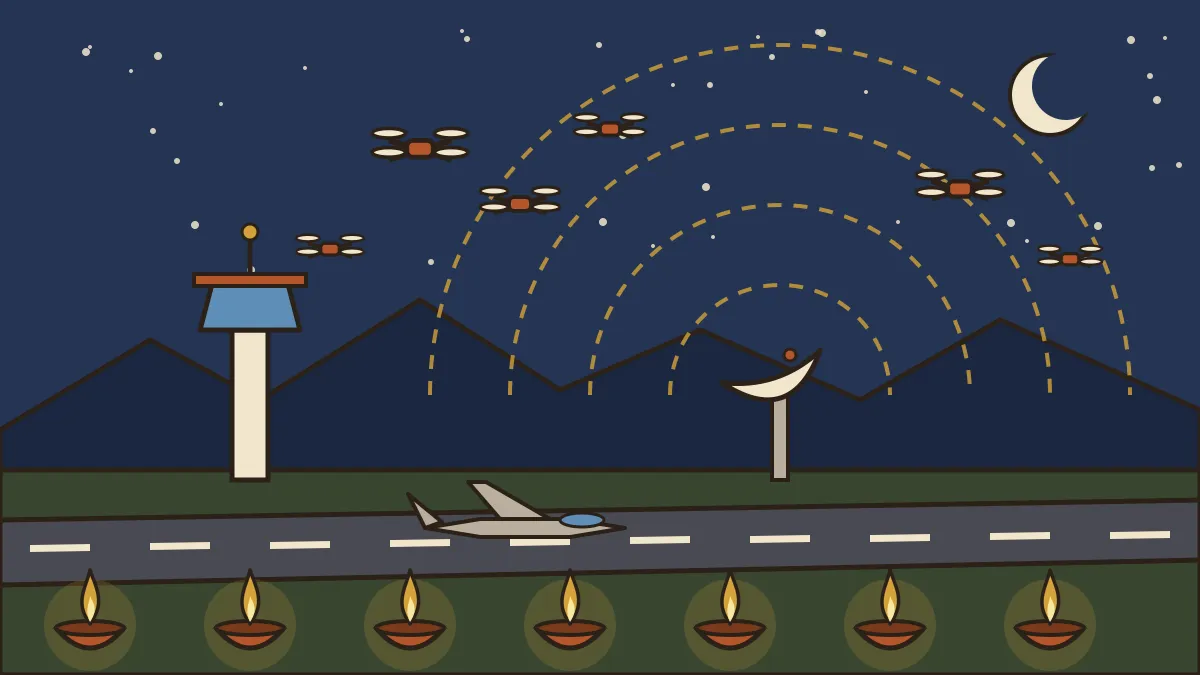
On 7 November 2026, on the eve of Diwali, Defence Minister Rajnath Singh interacted with airmen at Air Force Station Bagdogra in West Bengal. His message, as the Ministry of Defence recorded it, was short: the Defence Forces must keep the highest level of operational readiness, with special attention to domain awareness, cyber resilience and information integrity, to counter threats that are changing faster than the equipment used against them.
Each of those three terms is a technical idea with its own institutions and its own exam questions. This article takes them one by one, then looks at why the speech was made at Bagdogra and what it says about the soldier's role in a war of narratives.
What the Raksha Mantri said
The release attributes the following points to the address:
- The security landscape is more complex. Warfare, he said, now extends beyond conventional engagements on the border to asymmetric warfare, proxy wars, cyber-attacks, drone swarms, information operations and narrative management.
- The adversary avoids a direct fight. Instead it looks for weak points, and "through social media" may try to sow doubt in the minds of local people and of soldiers with misleading information. "Your role," he told the airmen, "extends beyond that of an ordinary soldier."
- Bagdogra is a strategic link. He called the region a crucial link in India's security framework, particularly for the North-East, and the Air Warriors there a "robust shield" for the eastern sector.
- Conduct matters as much as kit. Discipline and courage stay indispensable whatever the technology; the conduct, bearing, language and restraint of personnel shape the image of the military among local communities. He urged closer engagement with the population: "The more you engage with the local community, the weaker the adversary's conspiracies will become."
- Indigenous technology. He praised the growing role of Indian start-ups and industry in drones, anti-drone systems and military equipment, and the forces' readiness to learn drone operations and cyber security.
Present were the Chief of the Air Staff, Air Chief Marshal Ashutosh Dixit, and the Air Officer Commanding of the station, Air Commodore Manish Sharma.
From a line on the map to a contest in every domain
For most of history a war was a contest over territory, and the question was where the front line ran. Modern defence thinking splits the contest into domains: land, sea, air, space and cyberspace, with the information (or cognitive) domain now treated as a sixth layer that runs through all the others. Each term in the speech sits in one of these.
| Term used in the speech | What it means | Example |
|---|---|---|
| Asymmetric warfare | A weaker side avoids the stronger side's strengths and attacks its weak points | Ambushes, improvised explosive devices, attacks on soft targets |
| Proxy war | A state fights through armed groups it trains, funds or shelters, to keep deniability | Cross-border terrorism |
| Cyber-attack | Hostile action against computers, networks, power grids, banks or military communications | Ransomware on a port, malware on a command network |
| Drone swarm | Many small, cheap unmanned aircraft launched together to overwhelm radars and guns | Mass launches against airfields and radars |
| Information operation | Planned use of information to shape the beliefs and behaviour of an audience | Rumours that a posting is unsafe, forged videos, fake orders |
| Narrative management | Deliberately shaping the story told about an event, before the other side tells it | A prompt, factual official account of an incident |
Not one of these needs a declaration of war, and many of them stay below the threshold at which a government would respond with force. Analysts call this space the grey zone, and the speech is, in essence, about fighting in it without losing the habits of a disciplined force.
Domain awareness: knowing what is in your space
Domain awareness means having a continuous, accurate picture of everything that moves, transmits or happens in a domain you are responsible for. You cannot defend what you cannot see. The idea has a different practical form in each domain:
- Maritime domain awareness (MDA). The Navy runs the Information Fusion Centre – Indian Ocean Region (IFC-IOR), inaugurated on 22 December 2018 at the Information Management and Analysis Centre (IMAC) in Gurugram. It collects information on commercial shipping from partner countries, so that suspicious vessels stand out. The Navy's lease of MQ-9B Sea Guardian drones is a recent example of MDA hardware.
- Air domain awareness. Radars, ground-based sensors and airborne early warning and control (AEW&C) aircraft such as the IAF's Netra give the air force a picture of the sky. Our explainer on Netra AEW&C describes how that picture is built.
- Space domain awareness. Satellites, debris and hostile space objects must be tracked. India's Defence Space Agency, a tri-service body, was set up for this, and held its first exercise, Antariksha Abhyas, in November 2024.
- Cyber situational awareness. Knowing which networks are exposed, which software is vulnerable and what traffic is abnormal. This is the cyber counterpart of a radar screen.
The phrase in the speech, "domain awareness", is therefore not a slogan. It is the first step of any defence: sense, then decide, then act. The drone-swarm threat shows why. A swarm of small low-flying objects is hard to see on a radar built to find large fast jets, so the sensor has to change before the weapon can.
Cyber resilience: expecting to be hit, and recovering
A distinction the examiner enjoys is cyber security versus cyber resilience.
- Cyber security is about keeping attackers out.
- Cyber resilience accepts that some attacks will get through and asks how quickly a system can absorb the blow, keep its essential functions running and recover.
India's civilian and military architecture for this has several layers:
| Body | Role | Key facts |
|---|---|---|
| CERT-In (Indian Computer Emergency Response Team) | National agency for responding to cyber incidents | Set up in 2004; designated national agency under Section 70B of the IT Act, 2000 (as amended in 2008) |
| NCIIPC (National Critical Information Infrastructure Protection Centre) | Protects power, telecom, banking and other critical systems | Notified in 2014 under Section 70A; works under the NTRO |
| Defence Cyber Agency (DCyA) | The armed forces' tri-service cyber body | Under HQ Integrated Defence Staff; approved in 2018, raised from 2019 and fully operational by 2021 |
| Service cyber groups | Army, Navy and Air Force each have one | Run service networks and support the DCyA |
The DCyA has held its own exercises, among them Cyber Suraksha in May 2024 and again in June 2025, and the Territorial Army runs its own cyber hackathon, Terrier Cyber Quest. A resilient cyber posture is tested by exercises of this kind, in which a "red team" attacks a system and a "blue team" tries to defend and restore it.
Information integrity: when the target is belief
Information integrity is the least familiar of the three terms, and the one the Raksha Mantri illustrated with the example of misleading social-media posts. It means that the information a soldier, a citizen or a commander receives is accurate, from a verifiable source and not tampered with. Three kinds of bad information are worth separating:
- Misinformation is false but shared without intent to harm, by someone who believes it.
- Disinformation is false and created or shared deliberately to deceive.
- Malinformation is true information used out of context to cause harm.
The adversary's objective in an information operation is not to capture a hill but to change what people believe about the hill: that the forces are unwelcome, that a local community has been wronged, that an order is fake or a leader is lying. Modern tools make this cheaper. Social media spreads a rumour in hours, and AI-generated "deepfake" audio and video can imitate a commander's voice. Our explainer on deepfakes and AI regulation covers the legal response.
The defences are partly technical (authentication, verified channels, fact-checking) and partly human. That is where the Raksha Mantri's remark about conduct fits. If the people living around a base trust the forces, they are less likely to believe a rumour against them. The Army's Operation Sadbhavana in Jammu and Kashmir, which began in the late 1990s and runs schools, health camps and skill programmes for local communities, is the long-standing model of this approach.
Why Bagdogra
Air Force Station Bagdogra sits near Siliguri in northern West Bengal. The civil Bagdogra airport runs as a civil enclave inside the air force station, so a military base and the region's main civil airport operate from the same airfield. The station falls within the footprint of the IAF's Eastern Air Command, headquartered in Shillong; the wider command structure is set out in our Indian Air Force notes.
The location is what makes it strategic. Siliguri lies in the Siliguri Corridor, the "Chicken's Neck", a narrow land link of roughly 20-22 km at its thinnest, which joins the North-East to the rest of India and is bordered by Nepal, Bhutan and Bangladesh, with Tibet's Chumbi Valley not far to the north. Our explainer on the Siliguri Corridor sets out its geography and history. Air power based there can reach the whole eastern sector, and an air force that can see and communicate across the corridor protects the road, rail and pipeline links that run through it.
A speech on information integrity is also a logical choice for the area: the people living around such a base come from several communities and cross-border ties, and rumours spread easily. Hence the call to "engage with the local population".
Aatmanirbhar kit: drones, counter-drone systems and trust
The Raksha Mantri linked readiness to indigenous capability. The relevant ideas are:
- Drones change the cost of aerial reconnaissance and attack, so a country needs both its own drones and counter-drone systems: radars that detect small objects, jammers, and guns or lasers that destroy them.
- Start-ups and industry supply much of the innovation. Defence Ministry innovation challenges such as iDEX let young firms test products with the forces.
- Skills: the minister said that personnel have taken up drone operations and cyber security as new trades, which is a reminder that a modern force needs technicians as well as combat soldiers.
An earlier address in the same series, at Eastern Air Command in June, made a similar case for technological agility against hybrid, cyber and drone threats.
What to take from the speech
Strip away the occasion and the speech says three things.
- See first. Readiness now begins with sensors and networks that give a picture of every domain.
- Expect disruption. Resilience, not only protection, is the measure of a cyber defence.
- Hold the trust. Wars of narrative are won, in part, by the quiet conduct of ordinary soldiers.
🔑 Revision block
The event. 7 November 2026, eve of Diwali, Air Force Station Bagdogra (West Bengal): Raksha Mantri Rajnath Singh calls for the highest operational readiness, with focus on domain awareness, cyber resilience and information integrity. Present: CAS ACM Ashutosh Dixit, AOC Air Cmde Manish Sharma.
Threat list in the speech. Asymmetric warfare, proxy wars, cyber-attacks, drone swarms, information operations, narrative management.
Domain awareness. Maritime: IFC-IOR, Gurugram, 22 Dec 2018; air: radars, AEW&C (Netra); space: Defence Space Agency, first exercise Antariksha Abhyas, Nov 2024; cyber: situational awareness.
Cyber bodies. CERT-In 2004, Section 70B; NCIIPC 2014, Section 70A, under NTRO; Defence Cyber Agency under HQ IDS, approved 2018, fully operational 2021. Resilience = absorb and recover; security = keep out.
Information. Misinformation (unintended) / disinformation (deliberate) / malinformation (true, misused). Counter: verified channels plus community trust (Operation Sadbhavana model).
Place. Bagdogra: air force station with a civil enclave; near the Siliguri Corridor (~20-22 km); Eastern Air Command, Shillong.
🎯 Practice MCQs
Q1. "Domain awareness" in a defence context refers to:
(a) Registration of internet domain names by the armed forces
(b) Training soldiers in more than one language
(c) Declaring a region a defence zone
(d) A continuous and accurate picture of activity in a domain such as sea, air, space or cyberspace
→ (d)
Domain awareness is the sensing and tracking of everything relevant in a domain, the first step before decision and action.
Q2. The Information Fusion Centre – Indian Ocean Region (IFC-IOR), which supports maritime domain awareness, is located at:
(a) Visakhapatnam
(b) Gurugram
(c) Kochi
(d) Port Blair
→ (b)
It was inaugurated on 22 December 2018 at the Navy's Information Management and Analysis Centre in Gurugram.
Q3. Which of the following best describes "cyber resilience"?
(a) Preventing every cyber-attack from reaching a network
(b) The ability to absorb a cyber-attack, keep essential functions going and recover quickly
(c) Using only imported software
(d) Switching off all networks during an attack
→ (b)
Cyber security aims to keep attackers out; resilience assumes some attacks will succeed and measures how well the system survives and recovers.
Q4. Consider the following statements:
1. CERT-In is the national agency for responding to cyber security incidents.
2. The Defence Cyber Agency is a civilian body under the Ministry of Electronics and Information Technology.
Which of the statements given above is/are correct?
(a) 1 only
(b) 2 only
(c) Both 1 and 2
(d) Neither 1 nor 2
→ (a)
CERT-In is the national incident-response agency. The Defence Cyber Agency is a tri-service military body under HQ Integrated Defence Staff.
Q5. "Information that is false and deliberately created or spread to deceive" is called:
(a) Misinformation
(b) Malinformation
(c) Metadata
(d) Disinformation
→ (d)
Misinformation is false but shared innocently; malinformation is true information used harmfully out of context.
Q6. The National Critical Information Infrastructure Protection Centre (NCIIPC) functions under which organisation?
(a) National Technical Research Organisation
(b) Indian Space Research Organisation
(c) Defence Research and Development Organisation
(d) Reserve Bank of India
→ (a)
NCIIPC was notified in 2014 under Section 70A of the IT Act and works under the NTRO.
Q7. The Siliguri Corridor, near which Air Force Station Bagdogra is located, is also known as:
(a) The Kangra Gap
(b) The Palghat Gap
(c) The Chicken's Neck
(d) The Rann Link
→ (c)
The narrow strip, about 20-22 km at its thinnest, links the North-East with the rest of India.
Q8. A swarm of small drones is hard to counter mainly because:
1. Radars built for large, fast aircraft may not detect small, low-flying objects.
2. Many cheap targets can overwhelm a defence that engages one target at a time.
Which of the statements given above is/are correct?
(a) 1 only
(b) 2 only
(c) Both 1 and 2
(d) Neither 1 nor 2
→ (c)
Both reasons apply: small signatures challenge radar, and saturation exhausts guns and missiles. That is why counter-drone systems pair new sensors with cheaper effectors.
📋 How this gets asked (PYQ pattern)
Security-and-defence questions in NDA general knowledge tend to ask for the body behind a function: which agency handles cyber incidents, which agency is tri-service, which centre fuses maritime data. The safest preparation is a one-page list of agency, year, parent body, as in the table above. The examiner likes options that are each one step away from the right answer, such as a civilian body offered in place of a military one.
A second pattern is terminology: asymmetric versus conventional, proxy war, hybrid or grey-zone warfare, misinformation versus disinformation. The question is usually a definition with three plausible but wrong paraphrases. The third is place and geography: the location of an air base, the Siliguri Corridor and its neighbours, or the command headquarters of an air force command.
For this cycle the fresh hooks are the three terms in the speech (domain awareness, cyber resilience, information integrity), the drone-swarm threat, and the Bagdogra location.
Preparing for NDA? Make a one-page table of defence agencies with their year, parent body and role, and add one new line each time one appears in the news. Read our Indian Air Force notes alongside the tri-services overview. Follow the daily NDA current affairs, and learn with experienced faculty in the upcoming Cavalier courses in Delhi.
Source: PIB / Ministry of Defence, "Defence Forces must maintain highest level of operational readiness, with focus on domain awareness, cyber resilience & information integrity to counter emerging threats: Raksha Mantri at Air Force Station, Bagdogra", 7 November 2026. Background on the Defence Cyber Agency, Defence Space Agency, IFC-IOR, CERT-In and NCIIPC from PIB / Ministry of Defence releases of 2021-2025 and the Information Technology Act, 2000.
✍️ Written by Col Vijayant Thakur — Veteran, Indian Army; SSB & defence-studies faculty at The Cavalier. Reviewed by the Cavalier Faculty Desk.