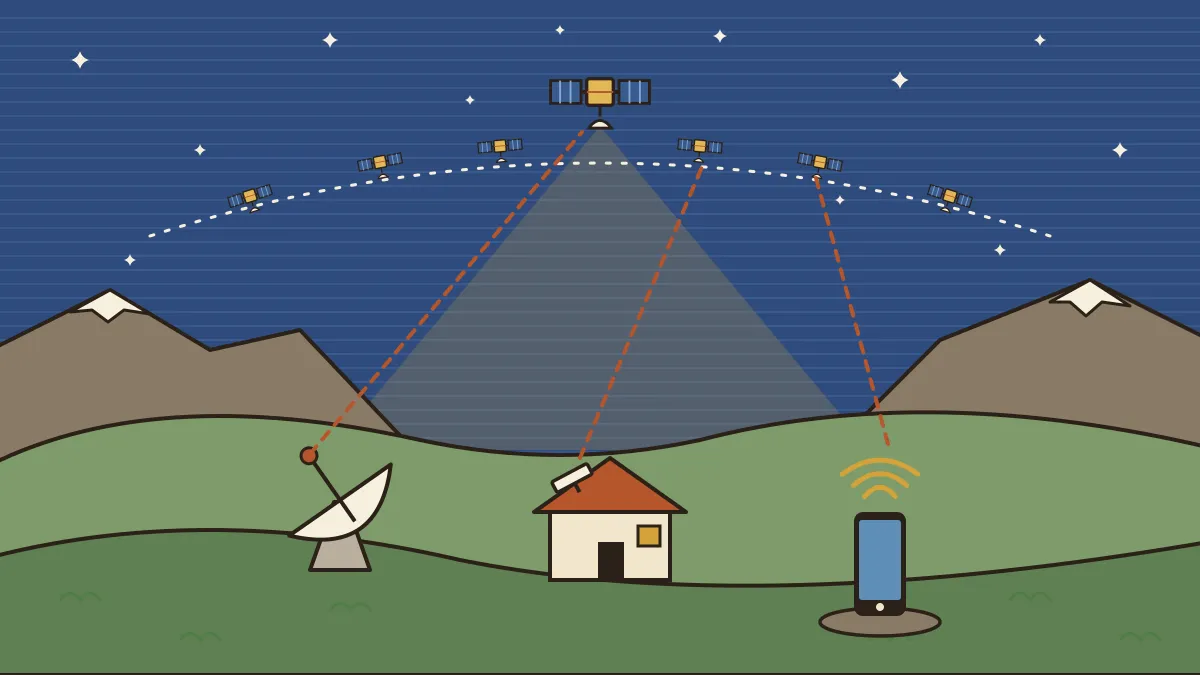
Most of us think of a satellite as something in the sky that sends television or navigation signals. The harder question is who is allowed to run the networks that connect satellites to people, and on what terms. On 5 November 2026, the Telecom Regulatory Authority of India (TRAI) answered a large part of that question when it released its recommendations on "the Framework for Satellite Communication Network Provider Authorisation, and Assignment of Spectrum to Satellite Communication Network Providers".
TRAI's recommendations are advice to the government, not law. The final decision belongs to the Department of Telecommunications (DoT) and the Union government. But the paper sketches the shape of India's satellite-communication market in detail: who may build and run the networks, what they pay, which frequencies they get, and whether an ordinary mobile phone can one day talk straight to a satellite.
This article explains the physics first, because the policy only makes sense once you know why orbits and frequency bands matter, and then walks through the recommendations.
The path to this paper
The PIB release sets out the timeline.
- 3 July 2025. The DoT told TRAI that the government proposed a new Satellite Communication Network (SCN) authorisation under Section 3(1)(b) of the Telecommunications Act, 2023, and asked for terms and conditions, including spectrum for both feeder and user links.
- 8 April 2026. TRAI issued a consultation paper.
- 2 July 2026. An open-house discussion was held, online. In all, 31 stakeholders sent comments and 12 sent counter-comments.
- 5 November 2026. The final recommendations were released.
This sits on top of earlier steps. In May 2025 TRAI recommended how satellite spectrum should be priced and assigned, including a five-year assignment extendable by two. By January 2026 the DoT had issued Unified Licences for satellite services (the GMPCS authorisation, for Global Mobile Personal Communication by Satellite) to three companies: OneWeb India, Jio Satellite Communications and Starlink Satellite Communications. At that time one more application, from Amazon Kuiper, was still under examination. The new paper adds a layer that was missing: a licence for the people who build and run the satellite network itself.
Physics first: where the satellites are
A satellite stays up because it is falling around the Earth, never reaching it. Gravity supplies the centripetal force, and the higher the orbit, the slower the satellite moves and the longer one lap takes. This is Kepler's third law: the square of the orbital period is proportional to the cube of the orbit's radius. We covered the basic idea in our note on gravitation.
| Orbit | Rough altitude | Orbital speed | One lap |
|---|---|---|---|
| Low Earth Orbit (LEO) | about 160 to 2,000 km | about 7.6 km/s at 550 km | about 95 minutes at 550 km |
| Medium Earth Orbit (MEO) | 2,000 km up to 35,786 km | in between | a few hours |
| Geostationary (GEO) | 35,786 km, above the equator | about 3.1 km/s | 23 h 56 min |
The speeds and lap times at 550 km and at 35,786 km are calculated by The Cavalier from the formula v = √(GM/r).
A geostationary satellite is the only one that matches the Earth's own rotation, because its lap takes one sidereal day and it orbits in the equatorial plane. From the ground it appears to hang at one spot, so a fixed dish can point at it for ever. Three such satellites, spaced a third of the way round, can cover almost all of the globe except the polar regions. The cost is distance.
Distance means delay. Radio waves travel at about 3 lakh km per second. A signal that goes up to a GEO satellite and down again covers at least 2 × 35,786 = 71,572 km, which takes about 0.24 seconds one way. A question and its answer therefore need about half a second at the least. For a call that feels like an awkward pause. A LEO satellite at 550 km makes the up-and-down path about 1,100 km, or under 4 milliseconds one way. That is why internet services from big constellations of hundreds or thousands of low satellites feel almost like a fibre connection.
The price of staying low is coverage. A LEO satellite crosses the sky in minutes and sees only a small patch of ground, so many satellites are needed, and each ground station must hand over from one to the next. In the TRAI paper these are the NGSO (non-geostationary orbit) systems; GSO means geostationary.
Two kinds of link, two kinds of service
A satellite network has two radio hops, and the paper treats them separately.
- The feeder link joins the satellite to a gateway earth station, a large dish connected to the ground network.
- The user link joins the satellite to the user's terminal: a small dish on a roof, a terminal on a ship or aircraft, or a handset.
The service types are named by what the user's equipment does:
- Fixed Satellite Service (FSS): between fixed points on the ground. Think of a home dish.
- Mobile Satellite Service (MSS): the user's terminal moves, as on a ship, aircraft or handheld set.
Frequency bands: why the choice matters
The paper lists which bands may be assigned. Roughly, in order of rising frequency:
| Band | Rough range | Typical use |
|---|---|---|
| L | 1–2 GHz | Mobile satellite service, handheld sets |
| S | 2–4 GHz | Mobile satellite service |
| C | 4–8 GHz | Fixed satellite, broadcasting |
| Ku | 12–18 GHz | Fixed satellite, broadband |
| Ka | about 26–40 GHz | High-capacity broadband |
| Q/V | roughly 33–75 GHz | Next-generation high capacity |
The trade-off is simple. Lower frequencies travel well through rain and can be received with small, non-pointing antennas, which makes them suitable for phones. Higher frequencies carry far more data but are weakened by heavy rain ("rain fade") and need narrow, pointed beams. TRAI recommends:
- For FSS: C, Ku, Ka and Q/V bands for geostationary satellites, and Ku, Ka and Q/V for non-geostationary ones.
- For MSS: L and S bands for the user link, with feeder links in the higher bands.
What TRAI recommends
A new licence category. A Satellite Communication Network Provider Authorisation under Section 3(1)(b) of the Telecommunications Act, 2023. Section 3(1) covers both providing telecom services and establishing or running a telecom network, and (b) is the network limb.
A wholesale model. The holder may offer Satellite Communication Network as a Service (SCNaaS) to eligible service providers, but may not serve users directly. The comparison with a mobile-tower company is fair: the tower company builds the infrastructure, and the telecom operator sells the service. Any entity already licensed to offer satellite-based services is eligible to buy SCNaaS, and holders of certain existing telecom authorisations may also provide it.
Term and area. National area, up to 20 years, with renewal for up to another 20 years.
Services allowed. FSS, MSS, direct-to-device (D2D) through MSS, and D2D through mobile (IMT) spectrum.
Spectrum.
- Feeder-link FSS spectrum is assigned administratively, not by auction.
- For user links, the entity must show that the service its partner will offer falls within the First Schedule of the Telecommunications Act, 2023.
- FSS and MSS spectrum is assigned for up to five years, which the government may extend by up to two more.
- Alternatively, the network provider may use spectrum already held by its partner, while the right to use stays with the partner.
Money. TRAI followed the principle of regulatory parity between a vertically integrated company and a split, shared-network model.
| Item | Recommendation |
|---|---|
| Authorisation fee | 8% of Adjusted Gross Revenue (AGR), no minimum fee |
| Minimum spectrum charge | ₹3,500 per MHz a year, where the Centre assigns FSS/MSS spectrum |
| Entry fee | ₹37.5 lakh |
| Initial guarantee | ₹45 lakh |
| Minimum equity | ₹60 lakh |
| Minimum net worth | ₹60 lakh |
| Application processing fee | ₹10,000 |
AGR is the base on which Indian telecom fees are calculated: the revenue from licensed activity, after allowed deductions. TRAI would let the money an operator pays to a network provider be deducted from the operator's own AGR, so that the same revenue is not taxed twice in the chain.
Direct-to-device: your phone and a satellite
The most eye-catching part is D2D, in which an ordinary smartphone connects to a satellite without any dish. The paper separates two routes.
1. MSS-based D2D. Uses the L and S bands already set aside for mobile satellite service. TRAI says it should be permitted. Phones that work in these bands need the right radio modules, so it recommends that the government encourage handset makers to include them in future phones sold in India.
2. IMT-based D2D. Uses the same mobile (IMT) spectrum as 4G and 5G networks, which belongs to the telecom operators. TRAI says it should be allowed without waiting for WRC-27, on a non-interference, non-protection basis under Article 4.4 of the ITU Radio Regulations. That means the satellite service may not cause harmful interference to anyone else, and cannot demand protection if it receives interference itself. Further conditions apply:
- The operators holding the relevant channel across all 22 licensed service areas must agree to let the satellite network use it.
- The permitted bands are the paired (FDD) bands at 600, 700, 800, 900, 1800 and 2100 MHz.
- The government should add MSS as a secondary service in these bands in the National Frequency Allocation Plan, with limits on the aggregate signal strength to protect existing services.
WRC-27 is the World Radiocommunication Conference of 2027, held by the International Telecommunication Union (ITU), the United Nations agency that coordinates global radio spectrum and satellite orbits. Its decisions shape how mobile spectrum can be shared with satellites. By recommending that India move first, TRAI is betting that early adoption will matter more than waiting for the global rules, while promising to apply any later decision.
The law and the institutions
The Telecommunications Act, 2023 replaced the old Indian Telegraph Act of 1885 and the Wireless Telegraphy Act of 1933. Section 4 sets auction as the default way to assign spectrum, except for uses listed in the First Schedule, which are assigned administratively. Satellite services are among those uses. That is why the paper can say that feeder spectrum will be assigned administratively, not auctioned.
Four bodies appear in the story, and the exam likes to test who does what:
- TRAI (set up under the TRAI Act, 1997): the independent regulator that gives recommendations.
- DoT: the ministry's department that decides policy and issues licences.
- IN-SPACe (the Indian National Space Promotion and Authorisation Centre): authorises and supervises space activities by private companies, as the interface between ISRO and industry.
- ITU: the UN body that coordinates spectrum and orbits globally.
Why it matters
Reach. The government's own reply in Parliament in January 2026 said satellite services can reach rural, remote, coastal, border and mountainous areas that fibre and microwave links struggle to cover. Direct-to-phone service would extend that to places where even a village terminal is not available.
Security. For the armed forces, communication satellites are not a luxury. India already operates dedicated military communication satellites, and we looked at the latest of them, the GSAT-7C project, recently. A strong civil satellite network gives resilience, but it also brings a security question: who controls the gateways, and where the data goes. That is why licensing is tied to security conditions.
Industry. A licence that lets companies build shared satellite networks should lower entry barriers for new firms, which fits the story told in our piece on India's space economy heading to 45 billion dollars. It also links to the wider telecom future described when India signed the 6G Call to Action, in which satellites are expected to work alongside ground networks.
What to watch next
- The DoT's decision. The government may accept, change or reject any recommendation. The final rules decide whether this is only advice or a working market.
- Handsets. D2D needs phones that can talk to satellites. Watch for announcements from handset makers.
- WRC-27. The 2027 conference decides how mobile spectrum may be shared with satellites worldwide.
- Spectrum charges. The ₹3,500 per MHz minimum and the AGR-based charge are likely to be argued over by operators.
🔑 Revision block
The news. TRAI released recommendations on 5 November 2026 on a Satellite Communication Network (SCN) Provider Authorisation and spectrum assignment. DoT asked on 3 July 2025; consultation paper 8 April 2026; open house 2 July 2026; 31 comments, 12 counter-comments.
The licence. New authorisation under Section 3(1)(b), Telecommunications Act 2023. National area, up to 20 years (+20). Offers SCNaaS to eligible providers; no direct service to users.
Spectrum. Administrative assignment (First Schedule). FSS and MSS for up to 5 years (+2). Bands: FSS GSO C, Ku, Ka, Q/V; FSS NGSO Ku, Ka, Q/V; MSS L and S. Feeder link = satellite to gateway; user link = satellite to terminal.
Money. Authorisation fee 8% of AGR; minimum spectrum charge ₹3,500 per MHz a year; entry fee ₹37.5 lakh; net worth ₹60 lakh.
D2D. MSS-based (L/S bands): permitted. IMT-based: permitted without waiting for WRC-27, non-interference, non-protection, Article 4.4, ITU Radio Regulations; needs channel holders across all 22 service areas; bands 600, 700, 800, 900, 1800, 2100 MHz.
Orbits. GEO: 35,786 km, equatorial, 23 h 56 min, about 0.24 s one-way delay. LEO: about 550 km example, 7.6 km/s, 95 min, under 4 ms. Existing GMPCS licences (Jan 2026): OneWeb India, Jio Satellite, Starlink.
🎯 Practice MCQs
Q1. Under TRAI's recommendations, an entity holding the new Satellite Communication Network Provider Authorisation would NOT be allowed to:
(a) Offer satellite network capacity as a service to eligible providers
(b) Provide telecommunication services directly to end users
(c) Seek feeder-link spectrum for fixed satellite service
(d) Hold the authorisation for a period of up to 20 years
→ (b)
The model is wholesale: the network provider sells SCNaaS to service providers, who serve users. The other three options are allowed.
Q2. A geostationary satellite orbits at an altitude of about:
(a) 550 km
(b) 2,000 km
(c) 20,200 km
(d) 35,786 km
→ (d)
At 35,786 km above the equator the orbital period equals one sidereal day, so the satellite appears fixed over one spot.
Q3. Consider the following statements:
1. A satellite in low Earth orbit gives a much shorter signal delay than one in geostationary orbit.
2. A geostationary satellite can be placed in a polar orbit.
Which of the statements given above is/are correct?
(a) 1 only
(b) 2 only
(c) Both 1 and 2
(d) Neither 1 nor 2
→ (a)
LEO is hundreds of kilometres up rather than tens of thousands, so delay is a few milliseconds. A geostationary satellite must orbit over the equator, so statement 2 is wrong.
Q4. The maximum duration of the recommended SCN provider authorisation, before renewal, is:
(a) 5 years
(b) 10 years
(c) 20 years
(d) 25 years
→ (c)
TRAI recommends up to 20 years, with renewal for up to another 20 years.
Q5. The authorisation fee recommended for SCN provider authorised entities is:
(a) 4% of AGR
(b) 6% of AGR
(c) 8% of AGR
(d) 10% of AGR
→ (c)
TRAI recommends 8% of Adjusted Gross Revenue with no minimum fee. Do not confuse it with the 4% spectrum charge TRAI proposed in May 2025.
Q6. In the TRAI paper, mobile satellite service for the user link is assigned in which bands?
(a) L and S bands
(b) C and Ku bands
(c) Ka and Q/V bands
(d) X and Ku bands
→ (a)
L and S are low-frequency bands suited to handheld terminals. The higher bands are used for fixed-satellite broadband and for feeder links.
Q7. TRAI recommends allowing IMT-based direct-to-device services on a non-interference, non-protection basis under:
(a) Section 4 of the Telecommunications Act, 2023
(b) The TRAI Act, 1997
(c) The Outer Space Treaty, 1967
(d) Article 4.4 of the ITU Radio Regulations
→ (d)
Article 4.4 lets a service use frequencies on condition that it causes no harmful interference and claims no protection.
Q8. Under the Telecommunications Act, 2023, the default method of assigning spectrum is auction, except for:
(a) Uses decided by Parliament each year
(b) Entries listed in the First Schedule, which are assigned administratively
(c) Uses by foreign companies
(d) Uses of less than one year
→ (b)
Satellite services are among the First Schedule uses, which is why TRAI recommends administrative assignment of feeder-link spectrum.
📋 How this gets asked (PYQ pattern)
Space and communication technology is a steady source of NDA science questions, usually in three forms.
The first is orbits and satellites: what a geostationary satellite is, why it has to be above the equator, how its altitude compares with low-Earth orbit, and which satellite does what. Q2 and Q3 above follow the pattern, and the trap is mixing up the altitudes.
The second is the electromagnetic spectrum and communication: which bands are used for what, and how frequency relates to range and data capacity. Options often swap neighbouring bands, as in Q6.
The third is institutions and legal terms: which body regulates, which licenses, which authorises space activity, and the difference between a recommendation and a decision. TRAI recommends; the DoT decides. Expect the question to place the ITU, TRAI, DoT and IN-SPACe in one option set, as in Q7 and Q8.
Preparing for NDA? Learn the three orbit classes with their altitudes in one table and practise one delay calculation with distance divided by the speed of light. Revise with our notes on gravitation, then browse the full NDA study material, follow the daily NDA current affairs, and learn with experienced faculty in the upcoming Cavalier courses in Delhi.
Source: PIB / Ministry of Communications, "TRAI releases Recommendations on 'The Framework for Satellite Communication Network Provider Authorisation, and Assignment of Spectrum to Satellite Communication Network Providers'", 5 November 2026. Licences issued to date: Ministry of Communications reply in the Rajya Sabha, 29 January 2026; May 2025 spectrum recommendations from the PIB Backgrounder "Satellite Internet in India" (23 September 2025). Orbit figures, band ranges and the Telecommunications Act background are standard reference facts; the speeds, lap times and delays are calculated by The Cavalier.
✍️ Written by Col D.N. Sharma — Science & general-studies faculty at The Cavalier. Reviewed by the Cavalier Faculty Desk.