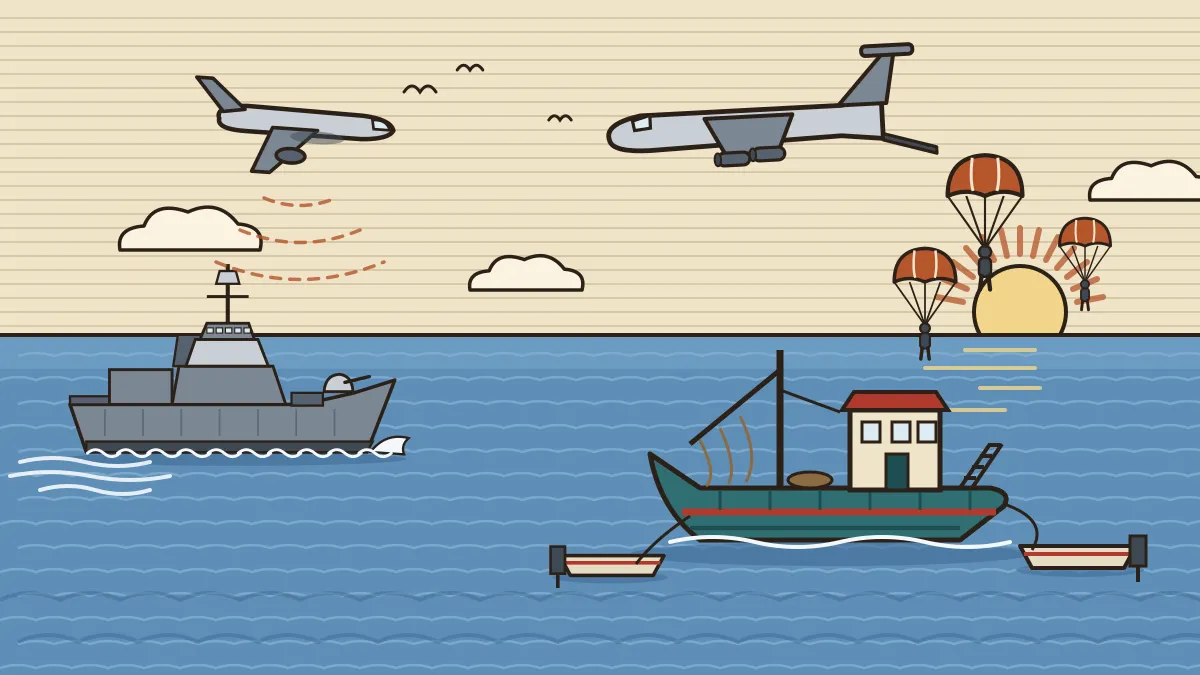
On 3 November 2026, the Ministry of Defence announced that the Indian Navy had freed the fishing vessel Azini from armed pirates. The ship had been hijacked earlier in October off the north-eastern coast of Somalia. The operation lasted over 48 hours and ended with the rescue of all 20 crew members, with no casualties or injuries.
Three details make this more than a routine rescue. The pirates were holding a fishing vessel that, in the Navy's words, could have been used as a "mother ship" to launch attacks on merchant shipping. The Navy used non-kinetic measures first, and only then a boarding. And the boarding team was reinforced by a precision airdrop from an Indian Air Force C-17, a combination of Navy and Air Force that India has used before and that now looks like a pattern. This article takes those three ideas one at a time, then looks at the law that decides who may seize a pirate ship, and at the record that led PIB to call India the "First Responder" and "Preferred Security Partner" in the Indian Ocean Region.
What the release says, and what it leaves out
The facts given by PIB (Release ID 2331872) are few and clear:
- Who: the Indian Navy, with the Indian Air Force in support.
- What: liberation of the fishing vessel Azini from an armed pirate group; all 20 crew rescued unhurt.
- Where: off the north-eastern coast of Somalia, the part of the Horn of Africa that juts into the Gulf of Aden and the Arabian Sea.
- How long: over 48 hours of operations.
- Forces: one mission-deployed warship, one maritime reconnaissance aircraft, Marine Commandos, and an IAF C-17 for the airdrop.
Equally useful is what the release does not say: the name of the Navy warship, the flag and owner of Azini, the nationality of the crew, the number of pirates, the exact date and position of the hijacking, and what became of the pirates after the vessel was secured. In a current-affairs question, an option that supplies any of these details is almost certainly invented. The rule is simple: if PIB did not print it, do not memorise it.
Why a fishing vessel can be a weapon
A pirate skiff is a small, open boat with an outboard engine. It is fast, but it carries little fuel and cannot stay long in open water. To attack a merchant ship hundreds of miles from the coast, pirates need a floating base. That base is the mother ship: a larger vessel, often a fishing boat or a dhow, that carries fuel, ladders, weapons and one or more skiffs, and releases the skiffs when a target appears.
A fishing vessel is ideal for the purpose. It is slow and ordinary-looking, it is allowed to loiter in the sea lanes, and its own crew can be held hostage and put to work. That is why the Navy did not treat Azini as a simple hostage case. A captured mother ship extends the reach of a pirate group across the whole of the western Arabian Sea, so freeing it removes a threat to every merchant ship in the area, not only the 20 people on board.
The timing fits a known pattern. The south-west monsoon (roughly June to September) makes the sea too rough for small skiffs, and attacks have traditionally fallen off in those months and picked up again once the weather calms. An October hijacking falls just after that season ends. This is an inference from the seasonal pattern, not something the release states.
Somali piracy: the short history
- 2008 to 2012. Piracy off Somalia surged from 2008 and peaked around 2010 and 2011, in the Gulf of Aden and far out in the Indian Ocean. The Indian Navy began anti-piracy patrols in the Gulf of Aden in late 2008, when the frigate INS Tabar was sent there.
- The response. An international effort followed: the EU's Operation Atalanta (from December 2008), a UN-backed Contact Group on piracy (2009), national navies on patrol, armed guards on merchant ships, and shipping-industry "best management practices" such as the citadel, a secure compartment where a crew shelters. Attacks fell sharply after 2012.
- March 2017. The tanker Aris 13 was seized, the first major hijacking in years. Its crew was freed and it did not start a trend.
- December 2023. Pirates took the Maltese-flagged bulk carrier MV Ruen. Reports described it as the first hijacking of a merchant vessel by Somali pirates since 2017, and it came while navies were focused on attacks in the Red Sea.
- January and February 2024. The Navy freed Iranian-flagged fishing vessels, among them Al Naeemi, with 19 Pakistani crew and 11 pirates, and Omari. These were cases of fishing vessels being seized, which is the Azini pattern.
Analysts doubt that the peak years will return, because armed guards are now routine on merchant ships. But two points are clear: fishing vessels are the pirates' preferred prize, and Indian warships are the force most often on the spot.
The operation, platform by platform
The release describes a layered operation rather than a single dramatic assault.
| Stage | What the release says | What it tells you |
|---|---|---|
| Find | A mission-deployed warship, supported by a maritime reconnaissance aircraft, located the vessel after persistent surveillance | Long-range sensors first; the aircraft covers far more sea than a ship can |
| Contain | The platforms tracked its movements and used calibrated non-kinetic measures to stop it escaping | Force is graduated; the hostages' safety sets the limit |
| Reinforce | Marine Commandos were augmented by a precision airdrop from an IAF C-17 | Speed over distance: a ship cannot carry every specialist |
| Secure | A swift tactical intervention overcame the pirates; all 20 crew released | The test is a clean recovery with no casualties |
Three of these platforms deserve a short profile.
The maritime reconnaissance aircraft. The release does not name the type. The Navy's long-range maritime patrol aircraft is the P-8I Poseidon, which can search wide stretches of sea with radar and sensors well beyond a ship's horizon, and our piece on the Navy's MQ-9B Sea Guardian lease explains how drones add to the same picture.
The Marine Commandos. The Navy's special force, known by its short name MARCOS, was raised in February 1987 as the Indian Marine Special Force and given its present name a few years later. It is trained to operate from the sea, and boarding a hijacked ship is a core task.
The C-17 Globemaster III. The IAF's heavy strategic transport, flown by No. 81 Squadron "Skylords" from Hindan near Delhi. The first aircraft arrived in India in June 2013, was formally inducted in September 2013, and the fleet now numbers 11. An airdrop lets a small team reach a ship far beyond helicopter range from the coast, then be recovered by the Navy.
The Ruen precedent
The Azini operation closely follows an earlier Indian case, and the comparison is the best way to remember both.
| MV Ruen (March 2024) | Azini (October to November 2026) | |
|---|---|---|
| Vessel | Maltese-flagged bulk carrier, hijacked 14 December 2023 | Fishing vessel, hijacked in October 2026 |
| Navy lead | Destroyer INS Kolkata, with other ships, drones and aircraft | A mission-deployed warship with a reconnaissance aircraft |
| Duration | About 40 hours of operations | Over 48 hours |
| Airdrop | Marine Commandos dropped by an IAF C-17 | Marine Commandos augmented by an IAF C-17 airdrop |
| Outcome | 17 crew rescued; 35 pirates surrendered | 20 crew rescued; the release is silent on the pirates |
| After | Pirates brought to Mumbai and handed to the police | Not stated |
In both cases the Navy preferred pressure to firepower: in the Ruen case, INS Kolkata disabled the vessel's steering and navigation aids after the pirates had fired at it. The Azini release speaks only of "calibrated non-kinetic measures" and does not say what they were.
The law: who may seize a pirate ship
Piracy is one of the oldest crimes under international law, because it takes place where no single state is in charge.
- UNCLOS, 1982. The UN Convention on the Law of the Sea entered into force in 1994 and India ratified it in 1995. Article 101 defines piracy as illegal acts of violence, detention or depredation, committed for private ends by the crew or passengers of one private ship, directed against another ship, on the high seas or in a place outside any state's jurisdiction. Two features matter: there must be two vessels (a mutiny on one ship is not piracy), and the motive must be private, not political.
- Duty and power. Article 100 obliges every state to cooperate in repressing piracy. Article 105 lets any state seize a pirate ship on the high seas, arrest the pirates and have its courts decide the penalties.
- The zones matter. The territorial sea extends 12 nautical miles from the coast, the contiguous zone 24, and the exclusive economic zone (EEZ) 200. In UNCLOS terms the "high seas" begin beyond the EEZ (India's 2022 Act defines the term more widely, as set out below). Inside a coastal state's own waters, a similar act is called armed robbery at sea, and the coastal state has the lead. The release says only "off the north-eastern coast of Somalia", so it does not tell us which legal category applied here.
- The Maritime Anti-Piracy Act, 2022. Parliament passed the law in December 2022 and it received the President's assent on 31 January 2023. It gives UNCLOS effect in Indian law and applies to the high seas, which the Act defines to include the EEZ (India's own and other states') and all waters beyond the jurisdiction of any other state. Piracy is punishable with imprisonment up to life (or a fine), and with death or life imprisonment where the act causes or attempts death. Taking part in, organising or directing piracy carries up to 14 years, and attempting or aiding it up to 10. Warships and military aircraft of the Navy, ships and aircraft of the Coast Guard, and other authorised government vessels may seize pirate ships, and the Centre can designate Sessions Courts to try the cases.
Before this Act, India had no dedicated piracy statute. That mattered in practice, because a state that rescues a ship but cannot prosecute the pirates is often forced to release them.
India's record, and a trap to avoid
India's anti-piracy role has three layers:
- Mission-deployed warships. The Navy keeps ships on station in key areas so that they can respond within hours. Our report on INS Trikand foiling a piracy attempt in the Gulf of Aden explains the model, and the IFC-IOR at Gurugram (set up in 2018) feeds it shipping information.
- Special forces and airlift. The Ruen and Azini operations show the Navy's commandos and the IAF's heavy transports working as one force.
- Capacity. New hulls such as the eight Next Generation Corvettes signed on 2 November 2026 are what keep that presence sustainable for years.
The trap: Operation Sankalp is a different mission. It began on 19 June 2019 to protect Indian-flagged merchant ships in the Gulf of Oman and the Persian Gulf after attacks on tankers. It is not the anti-piracy mission off Somalia, and the two are often mixed up in options.
What to watch next
Three questions remain open. Will the pirates be brought to India and tried, as in the Ruen case? Will attacks rise as the post-monsoon season advances? And will the Navy's mission deployments in the Arabian Sea be extended? Each is a likely follow-up headline.
🔑 Revision block
The event. Announced 3 November 2026 (PIB, Ministry of Defence): Indian Navy freed fishing vessel Azini, hijacked in October off the north-eastern coast of Somalia; operation of over 48 hours; 20 crew rescued, no casualties.
The platforms. Mission-deployed warship + maritime reconnaissance aircraft (surveillance, tracking, non-kinetic containment) + Marine Commandos (MARCOS, raised 1987) + IAF C-17 precision airdrop (No. 81 Squadron, Hindan; 11 aircraft; arrived 2013).
The concept. Mother ship = a larger hijacked vessel used as a floating base to launch skiffs against merchant ships far from the coast.
The precedent. MV Ruen, March 2024, INS Kolkata: about 40 hours, 17 crew rescued, 35 pirates surrendered, C-17 airdrop of Marine Commandos.
The law. UNCLOS (1982; in force 1994; India 1995): Art. 101 defines piracy (two ships, private ends, high seas), Art. 100 duty to cooperate, Art. 105 seizure. Maritime Anti-Piracy Act, 2022 (assent 31 January 2023): applies to the high seas, defined to include the EEZ; up to life imprisonment, or death or life if death is caused.
The trap. Operation Sankalp (19 June 2019) is the Gulf of Oman and Persian Gulf mission, not Somalia anti-piracy.
🎯 Practice MCQs
Q1. How many crew members were rescued from the fishing vessel Azini?
(a) 12
(b) 17
(c) 20
(d) 35
→ (c)
The release says all 20 crew were rescued without casualties. The figures 17 and 35 belong to the MV Ruen case of March 2024 (crew rescued and pirates surrendered).
Q2. Which IAF aircraft carried out the precision airdrop of Marine Commandos in the Azini operation?
(a) C-17 Globemaster III
(b) An-32
(c) Dornier 228
(d) Mi-17V5
→ (a)
The C-17 is the IAF's heavy strategic airlifter, flown by No. 81 Squadron. The other options are a medium transport, a light utility aircraft and a helicopter.
Q3. In the context of piracy, a "mother ship" is:
(a) a warship that escorts convoys of merchant vessels
(b) a merchant ship that carries armed guards
(c) a hospital ship that treats freed hostages
(d) a hijacked larger vessel used as a floating base to launch attack boats
→ (d)
A mother ship carries fuel, weapons and skiffs, which lets pirates attack far from the coast. This is why the Navy treated Azini as a threat to shipping, not only a hostage case.
Q4. Which article of UNCLOS defines piracy?
(a) Article 55
(b) Article 101
(c) Article 121
(d) Article 301
→ (b)
Article 101 gives the definition. Article 55 deals with the EEZ regime, Article 121 with islands and Article 301 with peaceful uses of the seas.
Q5. The Maritime Anti-Piracy Act, 2022 applies to:
(a) only the territorial sea of India
(b) only Indian-flagged ships anywhere
(c) only the contiguous zone
(d) the high seas, which the Act defines to include the exclusive economic zone
→ (d)
The Act gives effect to UNCLOS for the high seas, which it defines to include the EEZ and all waters beyond the jurisdiction of any other state, so it does not reach India's own territorial waters. It empowers the Navy and Coast Guard to seize pirate ships and lets the Centre designate courts.
Q6. The Indian Navy's special force known by the short name MARCOS is the:
(a) Garud
(b) Marine Commandos
(c) Para (Special Forces)
(d) Ghatak
→ (b)
MARCOS was raised in 1987 as the Indian Marine Special Force. Garud is the IAF's special force, Para (SF) belongs to the Army and Ghatak platoons are infantry commandos.
Q7. Consider the following statements about the Azini operation announced on 3 November 2026:
1. A mission-deployed warship, supported by a maritime reconnaissance aircraft, located and tracked the vessel.
2. The release states that the pirates were tried in India under the Maritime Anti-Piracy Act.
Which of the statements given above is/are correct?
(a) 1 only
(b) 2 only
(c) Both 1 and 2
(d) Neither 1 nor 2
→ (a)
Statement 1 is in the release. The release says nothing about the pirates' fate, so statement 2 is unsupported.
Q8. The Indian Navy began anti-piracy patrols in the Gulf of Aden in:
(a) 1998
(b) 2003
(c) 2008
(d) 2019
→ (c)
Deployments began in late 2008, with INS Tabar among the first ships. 2019 is the year of Operation Sankalp in the Gulf of Oman.
📋 How this gets asked (PYQ pattern)
Maritime security reaches the NDA general-ability paper in four familiar ways. The first is the news fact: the name of the vessel, the number of crew, the aircraft used. The second is vocabulary: mother ship, citadel, non-kinetic, EEZ, high seas. The third is geography: where the Gulf of Aden, the Horn of Africa and the Arabian Sea sit, and which strait joins the Gulf of Aden to the Red Sea. The fourth is the legal anchor: UNCLOS, its article numbers and the 200-nautical-mile limit.
Expect options to blur neighbours: a Navy special force swapped with an Army or Air Force one, or Operation Sankalp swapped with the Somalia anti-piracy mission. The fresh hooks this cycle are Azini, 20 crew, 48 hours, the C-17 airdrop and the Ruen comparison (17 crew, 35 pirates).
Preparing for NDA? Keep a one-page chart of India's recent naval operations with ship, aircraft, place and outcome, and add each new one as it breaks. Our NDA study material builds the geography behind these stories, the daily NDA current affairs keeps the list current, and the upcoming Cavalier courses in Delhi prepare you for the written paper and the SSB.
Source: PIB (Ministry of Defence), "Indian Navy successfully rescues hijacked fishing vessel 'Azini' off the coast of Somalia", 3 November 2026 (Release ID 2331872). Background cross-checked with Indian and international news reporting on MV Ruen (March 2024) and the 2024 fishing-vessel rescues, the Indian Navy's published account of Operation Sankalp, open sources on the C-17 induction and MARCOS history, the text of UNCLOS and summaries of the Maritime Anti-Piracy Act, 2022. Statements on the seasonal pattern and on the legal category of the Azini hijacking are The Cavalier's reading, not part of the release.
✍️ Written by Maj Sunil Chopra — Veteran, Indian Army; defence-studies & current-affairs faculty at The Cavalier. Reviewed by the Cavalier Faculty Desk.